



Dewatering Approval Sets Selkirk Copper's Path to a Mid-2027 Restart Decision


Selkirk Copper targets a mid-2027 Feasibility Study and investment decision for the Minto copper restart as dewatering approval sets the underground timeline.
- Selkirk Copper is building its Feasibility Study (FS) for the Minto copper-gold-silver restart in central Yukon to deliver a full execution plan, targeting completion in mid-2027 with a final investment decision (FID) ready at the same point.
- Under the 2026 preliminary economic assessment (PEA), initial capital is estimated at C$186 million, below the C$200 million to C$225 million range the company had guided, with an after-tax net present value (NPV7%) of C$494 million at planning prices.
- Pre-capital spending of C$20 million to C$25 million before a restart decision covers underground dewatering and rehabilitation, ongoing water treatment and generator refurbishment.
- A fully costed, roughly 5-month dewatering program is waiting on government authorization, and the company is targeting a start before the end of 2026 with crews in the underground by spring 2027.
- Phase 2 drilling reached 54,711 meters in 223 holes by October 14, 2026, and feeds an updated mineral resource estimate (MRE) planned for the first quarter of 2027.
Minto's Restart Path Moves From Geology to Execution
Selkirk Copper Mines (TSXV: SCMI | OTCQX: SKRKF) is advancing the restart of the former Minto copper-gold-silver mine in central Yukon, about 250 kilometers by road from Whitehorse. The resource base has grown quickly. The Mineral Resource Estimate (MRE) effective June 10, 2026, reports Measured and Indicated resources of 47.8 million tonnes at 0.89% copper containing 940 million pounds of copper, a 182% increase in contained copper over the 2025 estimate.
With a larger resource base established, the main workstreams ahead of a restart decision are now engineering, permitting and water management. In the 2026 Preliminary Economic Assessment (PEA), Selkirk Copper plans to mine underground first and add open pit material second, over a 13-year mine life at 1.5 million tonnes per year. The company is targeting production by mid-2028.
The schedule to that target depends on 3 workstreams: a Feasibility Study (FS) designed to finish with an execution plan, a dewatering program waiting on government authorization, and water management and partnership work with the Selkirk First Nation (SFN). Each has its own approval or delivery date, and the company states it has already budgeted the pre-capital work alongside the study.
A C$186 Million Restart Budget Backed by C$330 Million of Existing Infrastructure
Under the PEA, initial capital is estimated at C$186 million, below the C$200 million to C$225 million range the company guided before the study. Selkirk Copper attributes the lower figure to vendor quotes and optimizations to both the mine and the mill. At planning prices of US$5.00 per pound copper, US$3,600 per ounce gold and US$50 per ounce silver, Selkirk Copper reports an after-tax net present value (NPV7%) of C$494 million, an internal rate of return (IRR) of 48% and a 1.9-year payback. At spot prices of US$6.50 per pound copper, US$4,300 per ounce gold and US$65 per ounce silver, the NPV7% rises to C$1.0 billion and the IRR to 78%.
The restart capital estimate benefits from about C$330 million of infrastructure investment made by previous operators. The site retains a processing plant with 4,100 tonnes per day of throughput, existing underground workings, an on-site airstrip and an 8.5 megawatt (MW) connection to the Yukon grid. The company reports the mill buildings as intact and structurally sound. Life-of-mine (LOM) C1 cash costs are US$1.53 per pound of copper net of by-product credits, and the flowsheet is designed to produce a concentrate grading about 38% copper, 16 grams per tonne gold and 133 grams per tonne silver, trucked seasonally to the Port of Skagway, Alaska.
The asset also came out of bankruptcy without its previous concentrate offtake and gold-silver stream. The only royalty is a 1.5% net smelter return (NSR) royalty payable to the SFN, and the company identifies the uncommitted offtake as a potential source of non-dilutive capital and the removed stream as a source of improved cash flow. The PEA mine plan covers 18.4 million tonnes, about 80% Indicated and 20% Inferred, and excludes the 2026 Phase 2 drilling.
Feasibility Study Built to Deliver an Execution Plan
Selkirk Copper has bid out the FS and is targeting completion in mid-2027. The company is designing the study to deliver a final investment decision (FID) and an execution plan together.
President and Chief Executive Officer of Selkirk Copper, Colin Joudrie, described how the study departs from that sequence:
"Actually, it will be not just FID, it will be FID with an execution plan in hand, and so often what you would see with traditional sort of studies that have to do a lot more work than we need to do, they'll do the FS, they'll get support for the investment decision and then they'll do an execution plan or operations readiness plan. We're doing the execution plan as part of the Feasibility Study."
Vice President Engineering Scott Fulton, formerly Vice President Engineering and Construction at Skeena Resources, has brought early contractor involvement (ECI) into the study. Under ECI, the contractors who will do the physical work contribute to the FS bid documents on safety systems, crew rotations, staffing and the hours needed to assemble equipment. The company tested the approach on site when a contracting group removed redundant heavy equipment from one of the buildings, working on rotation; the crew slipped 1 week during the job, caught up, and finished on time and on budget.
Selkirk Copper has also set specific FS targets. The company is aiming to raise both the mining rate and mill throughput from 4,100 tonnes per day to 4,500 to 4,900 tonnes per day, lift copper recovery by 3% to 4% through metallurgical testwork and produce about 30,000 tonnes per year of copper equivalent in concentrate. It targets C1 costs of US$1.60 per pound and restart capital of about C$200 million, while maintaining the 13-year mine life.
Dewatering Approval Sets the Underground Timeline
Before a restart decision, Selkirk Copper estimates C$20 million to C$25 million of pre-capital spending, separate from the C$186 million of restart capital. That budget covers dewatering, physical rehabilitation and re-servicing of the existing underground, ongoing water treatment, refurbishment of 2 backup diesel generators and routine site care and maintenance. Equipment deposits are included in the PEA capital estimate but may be paid before the FID. Joudrie describes the pre-capital work as outside the restart itself, since the site needs it regardless, and states that it is already budgeted. The company held cash of C$36.9 million at July 30, 2026.
The underground workings are currently flooded. Specialists have designed a fully costed dewatering program that has been presented to the government, and much of the pre-work on the pumps and pipes needed for dewatering is already done. The gating item is government authorization to start pumping.
Joudrie acknowledged that in a worst case, approval timing could affect the schedule, and described the approval process:
"I would have loved to have started this 4 months ago, but you know, we're in a process where this is an asset that went into receivership. It's new territory for everybody, including the government. They're working through it deliberately. We will get there, but it's about a 5-month program once we hit go, right, and that doesn't matter if we hit go in the winter or in the spring."
The company is targeting a start to pumping before the end of 2026, with crews in the underground by spring 2027 to begin rehabilitation. Site water management also becomes Selkirk Copper's full-time responsibility in March 2027. Because dewatering takes about 5 months regardless of season, any delay in authorization pushes back the start of underground rehabilitation, which makes government approval the immediate scheduling dependency for the restart.
Water Management & the SFN Partnership as Restart Priorities
Joudrie ranks 2 items above mine planning, geology and processing, which he regards as problems the team can solve. The first is the relationship with the SFN. The Nation acquired 100% of Minto through the bankruptcy process and vended it into Selkirk Copper through a reverse takeover. It holds about 18% of the company, has nominated 2 directors, and former Chief Kevin McGinty serves as Vice President Lands and Environment. Selkirk Copper draws on the Nation's insight and experience with the Minto project and surrounding lands, and frames the restart as a partnership with the SFN, the Yukon regulator and Yukon suppliers and service providers.
Joudrie describes the partnership as a continuing investment by both parties in learning to work together and to build trust, and he called it probably more important than anything else the company does. The Nation may have extended more trust than the company has, and the company needs to keep improving over the life of the operation.
The second item is water. Joudrie set the site's history against the company's plan:
"Water is probably the one area where I do think we can manage it and we can manage it well, but I will say I'm of the view that this site has not managed it well in the past. So a big part of our plans going forward are to put in the right sort of capital, the right sort of systems and the right sort of measurement protocols that manage this water better."
Phase 2 Drilling Feeds the First Quarter 2027 MRE
As of October 14, 2026, Phase 2 had drilled 54,711 meters in 223 holes, or 109% of the planned 50,000 meters, with drilling scheduled to finish by October 20, 2026. Assay turnaround is about 8 weeks, and results are being released through fall and winter 2026. The program combines zone extensions with infill drilling designed to move resources into the Measured category for the FS. Results released to date include a Minto North intercept of 44.7 meters grading 2.12% copper, 1.16 grams per tonne gold and 10.7 grams per tonne silver.
The updated MRE is planned for the first quarter of 2027. Selkirk Copper runs a pre-modeling exercise on known zone geometry before final assays arrive, which shortens the time between the MRE and updated mine plans. Joudrie has stated he is comfortable if the FS mine plan only matches the 18.4 million tonnes in the PEA, since that tonnage supports the 13-year life; resource growth is treated as upside to the restart case.
Restart Sequence & Catalysts
The restart schedule now depends on 3 main items: government authorization for dewatering, completion of the updated resource model and delivery of the FS.
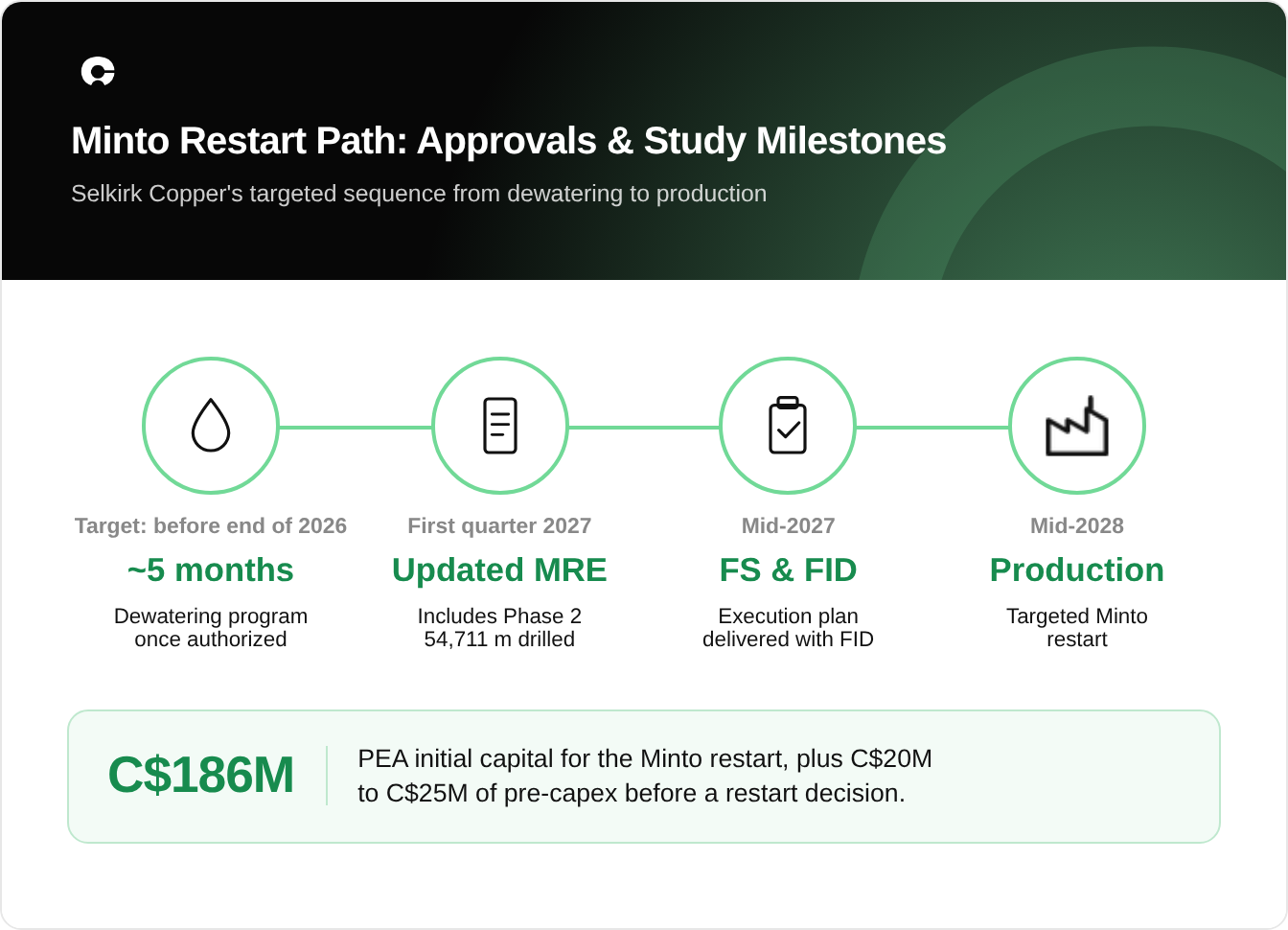
Dewatering authorization and the start of pumping are targeted before the end of 2026, alongside the remaining Phase 2 assays. Water management passes to Selkirk Copper in March 2027, the updated MRE is planned for the first quarter of 2027, and crews are targeted to reach the underground by spring 2027. The FS, with its execution plan and FID, is targeted for mid-2027, and production for mid-2028.
Beyond the restart, Phase 1 drilling delivered a 280% increase in Indicated and Inferred resource tonnage, and several targets across the central mine site are open along strike and at depth. Joudrie's stated priority is to complete the restart first.
The Investment Thesis for Selkirk Copper
- Selkirk Copper is designing its Feasibility Study to deliver an execution plan alongside the final investment decision, targeting completion in mid-2027 without a separate post-study planning phase.
- Under the 2026 Preliminary Economic Assessment, initial capital is estimated at C$186 million against roughly C$330 million of existing infrastructure, with an after-tax net present value at a 7% discount rate of C$494 million at planning prices and C$1.0 billion at spot prices.
- Government authorization to start a roughly 5-month dewatering program is the gating item for underground access, and the company is targeting a start before the end of 2026.
- Pre-capital spending of C$20 million to C$25 million covers dewatering, underground rehabilitation, water treatment and generator refurbishment, is separate from restart capital and is budgeted by the company, which reported cash of C$36.9 million at July 30, 2026.
- The Selkirk First Nation holds about 18% of the company, has nominated 2 directors and receives the only royalty on the asset, a 1.5% net smelter return royalty.
- The current mine plan of 18.4 million tonnes already supports a 13-year life without the 54,711 meters of Phase 2 drilling, which feeds an updated Mineral Resource Estimate planned for the first quarter of 2027.
Resource growth at Minto is upside to the restart case rather than a prerequisite, since the existing mine plan already supports a 13-year life. The immediate schedule risk is government authorization for dewatering, while water management and the Selkirk First Nation relationship are longer-term operating considerations that Joudrie ranks above the technical work. The FS then has to show that the PEA economics translate into a construction and restart plan the company can execute by mid-2028.
TL;DR
Selkirk Copper is targeting an FS with a built-in execution plan and an FID by mid-2027 for the Minto restart, supported by a PEA showing C$186 million of initial capital and an NPV7% of C$494 million at planning prices. The pacing item is government authorization for a 5-month dewatering program the company is targeting to start before the end of 2026, while Phase 2 drilling feeds an updated MRE in the first quarter of 2027 and production is targeted for mid-2028.
FAQs (AI-Generated)
Analyst's Notes





Subscribe to Our Channel





Stay Informed


