7 Assay Results Confirm Up to 15.4% Uranium Oxide Along IsoEnergy's South Trend


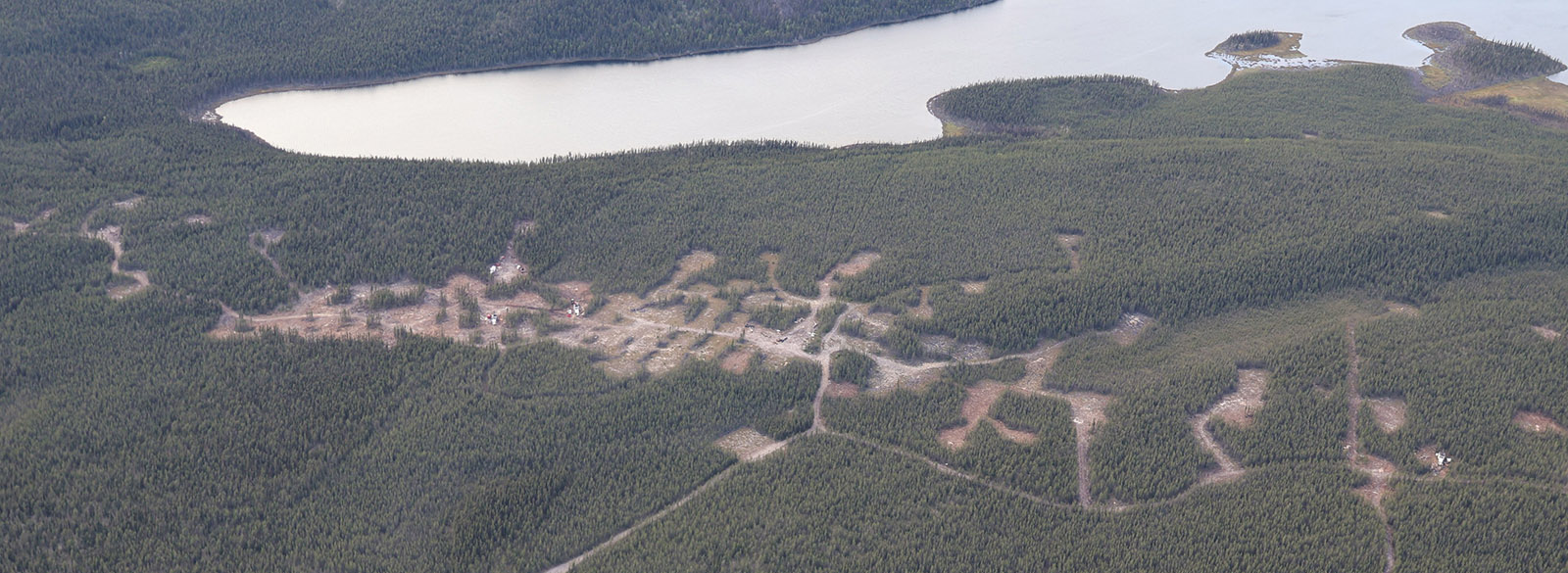
IsoEnergy's summer assays confirm uranium along 550 meters of Hurricane's South Trend, with up to 15.4% uranium oxide about 500 meters east of the deposit.
Project Overview
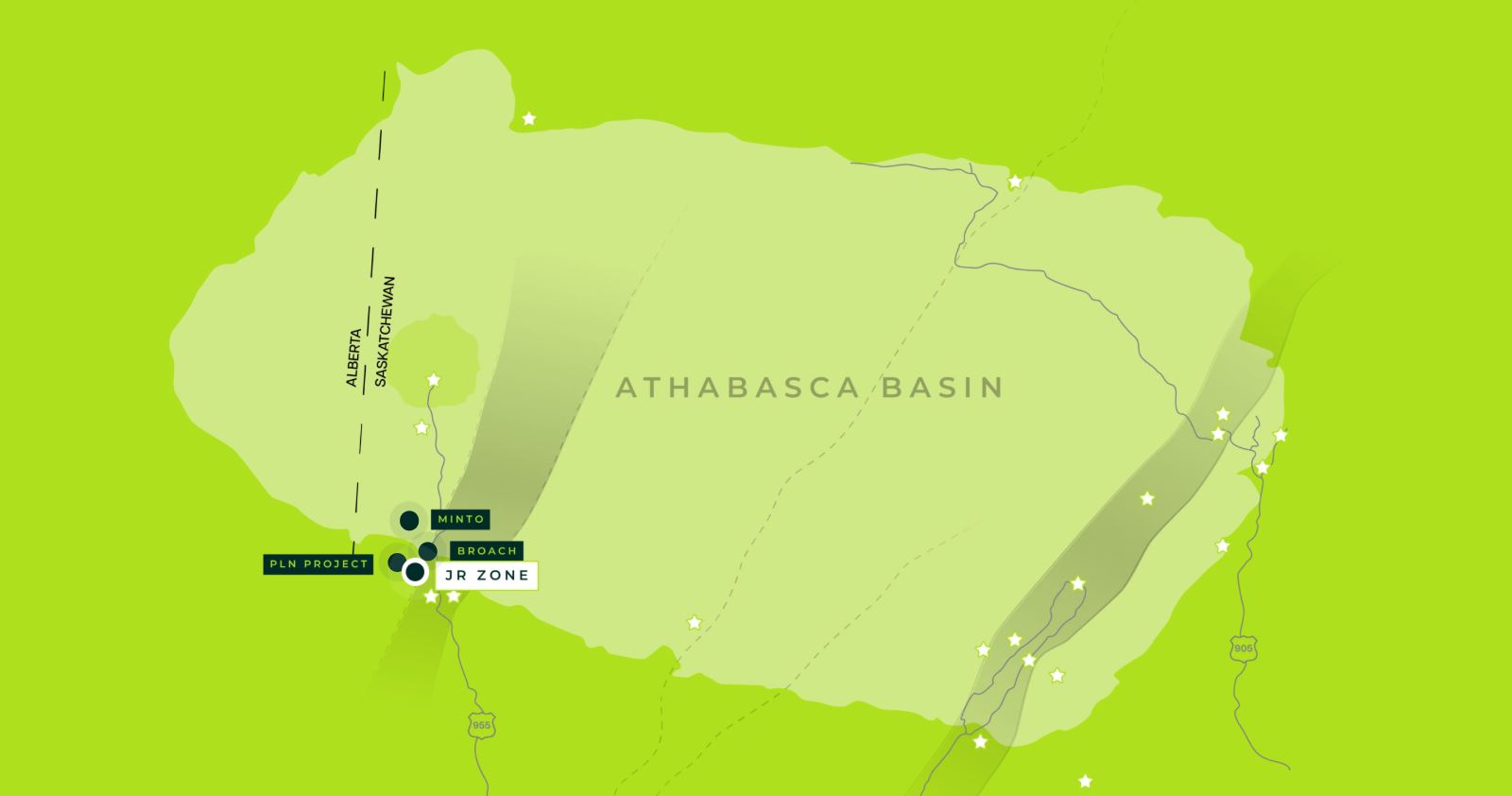
IsoEnergy (NYSE American: ISOU | TSX: ISO) has received uranium assays from its completed 2026 summer drill program at Larocque East, the eastern Athabasca Basin project that hosts the Hurricane deposit. The program completed 26 holes to target, totaling 10,159 meters (m), with 3 additional holes abandoned in sandstone. All but 1 hole tested the Hurricane South Trend, the east-striking group of structures comprising the J, K, and L faults.
Hurricane carries a current indicated resource of 48.6 million pounds of uranium oxide at 34.5% uranium oxide, and a further 2.7 million at 2.2% uranium oxide in the inferred category. The estimate has an effective date of July 8, 2022, and predates all 2026 drilling. Mineralization sits at about 325 m depth, and the project lies about 40 kilometers northwest of the McClean Lake mill.
1. Assays Match the Radiometric Readings
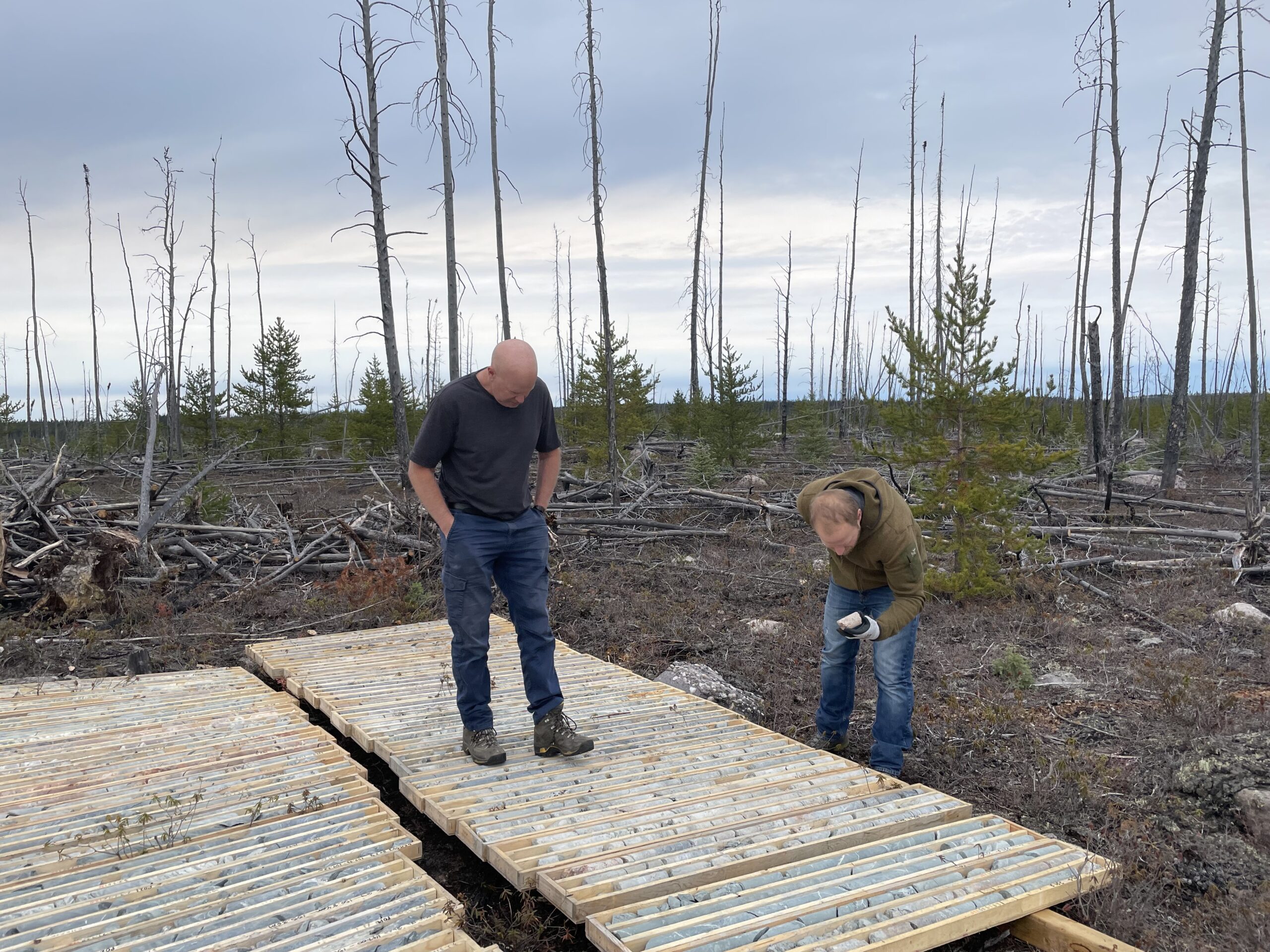
Laboratory results now attach assayed uranium grades to every summer hole that showed elevated radioactivity. The summer readings came from a handheld spectrometer measuring gamma radiation in drill core samples, a method that indicates uranium content but may not correlate with chemical assays. Uranium assays received for all 18 radioactive holes show that their radioactive intervals correspond to elevated uranium values. Mineralized intervals confirmed in 18 of 26 summer holes span 550 m of strike, the length measured along the South Trend. The summer grades are chemical assays based on results received to date.
Chief Executive Officer and Director of IsoEnergy, Philip Williams, places the trend against its drilling record:
"The interesting thing about the South Trend, and just to step back for a second, is it's an area that hadn't seen a lot of historic drilling."
The summer program concentrated on that ground: 6 holes tested the J and K faults, and 18 tested the L fault east of the existing deposit footprint.
2. Grades Up to 15.4% About 500 m East of the Deposit
Grades up to 15.4% uranium oxide came from near the eastern end of the drill-defined L fault zone, about 500 m east of Hurricane. There, a hole returned 4.17% uranium oxide over 2.0 m from a depth of 331.5 m, or 5.44% over 1.5 m, including 15.4% over 0.5 m. Visible pitchblende, a uranium oxide mineral, is present in that 0.5 m interval, where the hole's radioactivity is strongest. The mineralization is in basement rock immediately below the unconformity, the contact between the Athabasca sandstone and the older rock beneath it. The hole is interpreted to have tested the optimal target position, and the sandstone above it is strongly altered, with bleaching and clay alteration centered on fault zones.
This intercept lies 29 m west along-strike of a winter hole that returned 1.00% uranium oxide over 1.5 m, including 2.75% over 0.5 m. A hole drilled between the 2 returned 0.170% over 5.0 m, including 0.51% over 1.0 m, achieving its objective of intersecting elevated radioactivity at the unconformity. A hole 30 m east of the winter hole, interpreted to have reached the unconformity 8 m north of the optimal target, returned 0.137% over 0.5 m within a clay-altered zone. Another, drilled to test higher up a basement structure, is interpreted to have reached the unconformity 12 m south of the optimal target. Its lowest sandstone contains secondary hematite, an iron oxide mineral, centered on a fault and characterized by strong clay replacement.
3. A West L Fault Step-Out Lands Past the Footprint
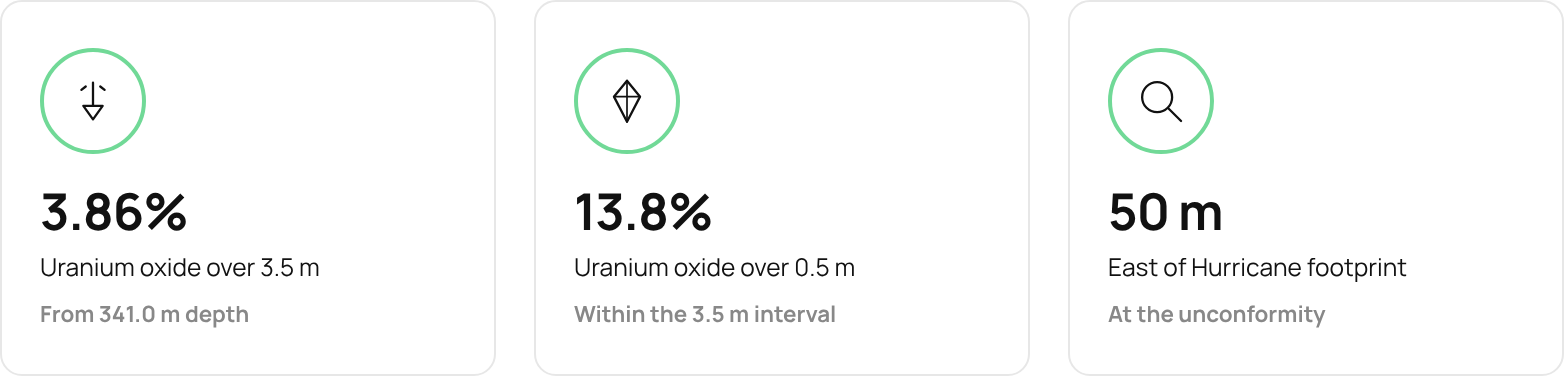
On the western L fault, a step-out hole returned 3.86% uranium oxide over 3.5 m from 341.0 m, including 5.24% over 2.5 m and 13.8% over 0.5 m. It was drilled 75 m east of a winter hole, and it reached the unconformity 50 m east of the currently defined Hurricane deposit footprint. Holes drilled to test continuity between the winter hole and the step-out returned lower grades. Their intervals averaged 0.218% over 1.0 m, 0.089% over 3.0 m, and 0.049% over 1.0 m, and 1 hole was not sampled because it showed no significant elevation in radioactivity.
In the western target, the holes that tested the optimal target position correlate with strongly elevated radioactivity. Apart from the step-out and an intercept inside the deposit, 2 of those holes returned 0.163% over 3.0 m and 0.186% over 1.0 m. A hole on strike of the southernmost hole in the existing footprint returned 0.247% over 0.5 m. The structure is interpreted as a fault zone rather than a single fault strand, and the 2026 holes in the western target were designed to test across its width.
4. Higher Grades Inside the Modeled Low-Grade Shell
In the southern portion of the deposit, a hole on the L fault zone returned 3.53% uranium oxide over 3.0 m from 328.0 m, including 5.02% over 2.0 m and 10.8% over 0.5 m. That ground was previously interpreted as part of the low-grade shell, the outer, lower-grade envelope of the resource model.
The intercept lies 11 m west of a winter hole that returned 4.21% uranium oxide over 3.5 m, including 11.6% over 1.0 m. Both intercepts improve on the uranium grades modeled for the southernmost portion of the deposit in the 2022 resource estimate.
5. Mineralization Reaches the K Fault East of the Deposit
The South Trend's mineralization reaches the K fault, 45 m east of the deposit. A hole drilled for the J fault is interpreted to have overshot it and intersected the K fault close to the optimum target. It returned 0.56% uranium oxide over 4.5 m from 330.0 m, including 1.03% over 2.0 m and 1.88% over 0.5 m.
On the J fault, a hole that reached the unconformity 6 m north of its optimal target returned 0.319% over 3.0 m from 331.0 m, with a best 0.5 m sample of 0.805%. Other J and K fault holes intersected strong alteration and graphite-bearing faults, with no significant elevation in radioactivity. One is interpreted to lie 5 m north of the optimal target, and another north of it.
6. A 140 m Trend on the Central L Fault
On the central L fault, 6 holes now define a 140 m trend over which each hole intersected more than 1.0% uranium oxide over at least 0.5 m. Four of those holes were reported between February 2022 and May 2026, and 2 come from the summer program. One summer hole, drilled to test ground between 2 earlier mineralized holes, returned 0.246% uranium oxide over 4.5 m, with a best result of 1.36% over 0.5 m. A second, interpreted as testing the ideal target at the unconformity, returned 0.91% over 1.0 m, including 1.06% over 0.5 m.
Another summer hole on the central L fault returned 0.149% over 2.0 m in the lowest sandstone. About 25 m above the unconformity, it intersected a 16 m zone of broken core with moderate alteration, including strong hydrothermal hematite, an iron oxide deposited by hot fluids, over a 2 m interval. Its basement core also cut a cataclastic fault, a zone of crushed rock, which the ideal-target hole then tested at the unconformity.
7. What Is Still Open Before 2027
The project team is proposing 2027 drilling on the sparsely tested eastward projection of the L fault, beyond the 15.4% intercept. A summer hole drilled on that projection, 140 m east of another summer hole, intersected no significantly elevated radioactivity. It did cut a fault zone at the center of an 80 m interval of strongly bleached and altered sandstone. Its unconformity intercept is 20 m south of the interpreted optimal target, and potential along the projected extension remains open.
Speaking before the summer program was complete, Williams described how much strike is left to explore:
"Again, there's a long distance of strike. That 500 m is 2 or 3 times longer than the ore body itself. And lots of room to explore there."
On the Hurricane Main Trend, a single hole 40 m east of the deposit footprint returned 0.056% uranium oxide over 0.5 m. That single test does not close off a possible eastward extension of Main Trend mineralization. Multi-element geochemical results, which measure other elements in the rock, are pending. All reported intervals are drillhole lengths, and true thickness has yet to be determined. IsoEnergy is integrating data from the 43 holes drilled in 2026 into an updated geological interpretation of the Hurricane area, which will form the basis for developing its 2027 drill targets.
Key Takeaways for Investors
- Uranium assays matched the radioactivity in all 18 radioactive summer holes, across 550 meters of South Trend strike.
- Grades up to 15.4% uranium oxide over 0.5 meters came from about 500 meters east of the Hurricane deposit on the L fault zone.
- Ground previously interpreted as low-grade shell in the southern deposit returned 3.53% uranium oxide over 3.0 meters.
- A hole on the K fault 45 meters east of the deposit returned 0.56% uranium oxide over 4.5 meters.
- The sparsely tested eastward projection of the L fault, beyond the 15.4% uranium oxide intercept, is where the project team is proposing 2027 drilling.
Bottom Line
IsoEnergy's summer assays provide assayed grades along 550 m of strike for the Hurricane South Trend, where the program first recorded radioactivity. About 500 m east of the deposit, the L fault returned up to 15.4% uranium oxide, and inside the deposit, ground modeled as low-grade shell returned 3.53% uranium oxide over 3.0 m. On the K fault, 0.56% uranium oxide over 4.5 m came from just east of the deposit. The central L fault now holds a 140 m trend of holes, each above 1.0% over at least 0.5 m. The 2022 estimate is still the current resource. IsoEnergy's next measurable steps are the updated interpretation of its 43 holes from 2026 and the 2027 drilling the project team is proposing on the eastward projection of the L fault.
Analyst's Notes





Subscribe to Our Channel



Stay Informed