




ASEAN Shields Critical Minerals Export Curbs, Rewarding Local Processors



ASEAN's new critical minerals declaration recognizes national control of exports, making funded domestic processing a key factor in project valuations.
- The Association of Southeast Asian Nations (ASEAN) leaders adopted a critical minerals declaration in Manila on November 15, 2026 that recognizes each member's sovereign rights over its natural resources, leaving national raw ore export curbs intact.
- Indonesia's nickel and bauxite ore export bans and Malaysia's and Vietnam's raw rare earth export restrictions favor domestic processing, while ASEAN's declaration leaves these policies under national control.
- Indonesia's nickel ore export ban encouraged domestic processing, helping mined cobalt output reach an estimated 44,000 tonnes in 2025.
- ASEAN's declaration sets no deadline for its regional strategy, leaving project timelines dependent on national permits and domestic processing requirements.
- Malaysia agreed on November 17 to allow some raw rare earth exports to France alongside processing cooperation, opening a sales route for projects supporting domestic refining despite its moratorium through 2027.
ASEAN Mineral Declaration Leaves Ore Curbs Intact Favoring Local Refiners
ASEAN leaders adopted the Declaration on ASEAN Critical Minerals for Regional Resilience and Sustainable Growth in Manila on November 15, 2026, calling for a shared mineral list and regional strategy without an implementation deadline. The declaration also calls for public and private financing across mineral development, processing, and refining, making domestic capacity part of ASEAN's investment priorities. London Metal Exchange (LME) cash tin fell from $48,295 to $46,895 per tonne between November 13 and November 16, while nickel declined from $16,025 to $15,805.
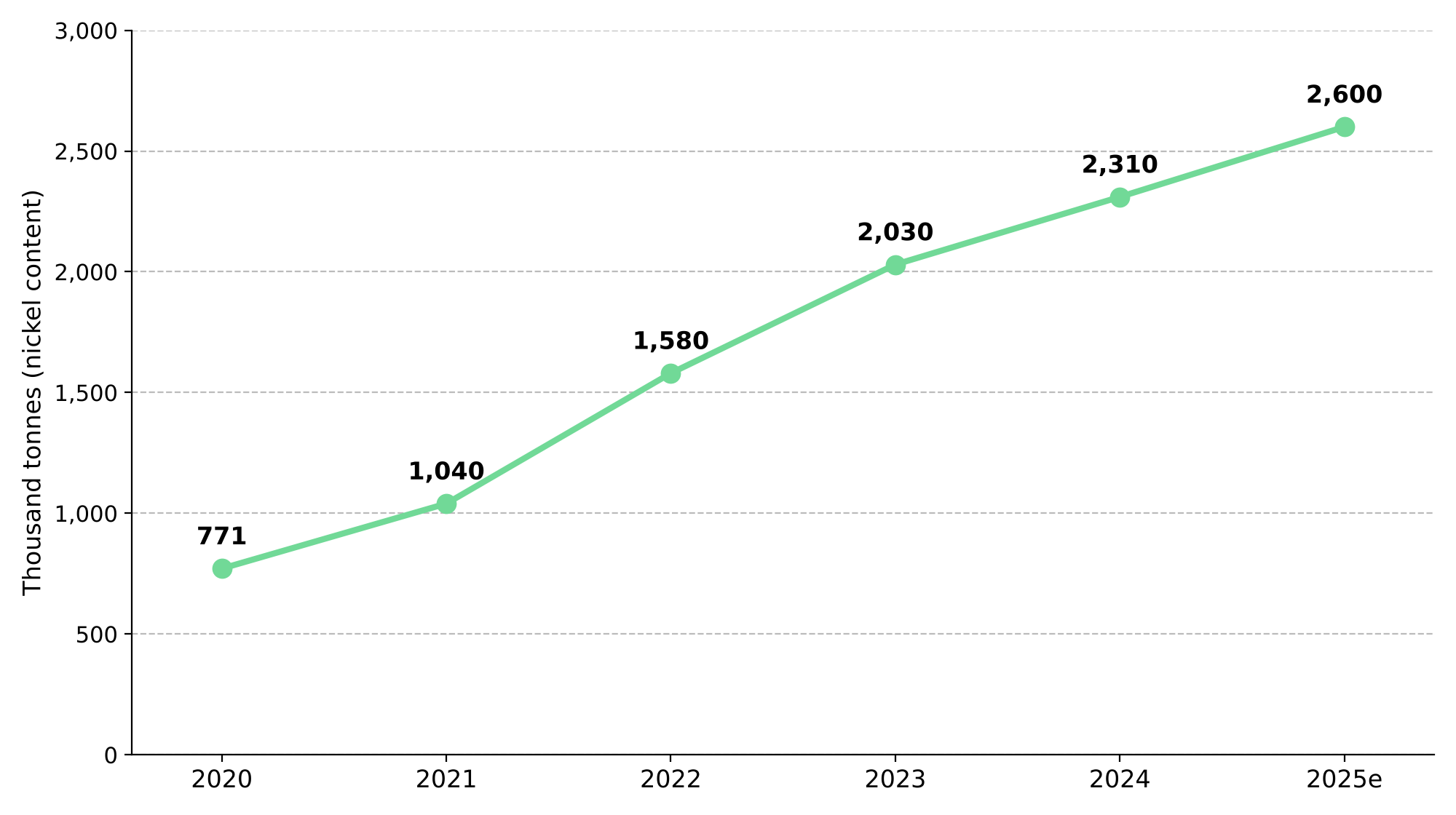
Despite lower metal prices, ASEAN members retain control over mineral exports, preserving restrictions that can direct more ore toward domestic processing. Indonesia mined an estimated 2.6 million tonnes of the world's 3.9 million tonnes of nickel and 61,000 tonnes of its 290,000 tonnes of tin in 2025. Restrictions on these major sources of supply can limit raw ore available to overseas refiners without necessarily reducing refined metal production.
Nickel Ban Helps Indonesia Reach 14% of Global Cobalt
Indonesia's January 2020 nickel ore export ban encouraged domestic high-pressure acid leach (HPAL) processing, which recovers cobalt alongside nickel. Its mined cobalt output rose from 1,100 tonnes in 2020 to an estimated 44,000 tonnes in 2025, accounting for 14% of global mine production. By contrast, Indonesia's bauxite output fell sharply after its June 2023 export ban as refining capacity lagged, with all 9.9 million tonnes mined in 2024 consumed domestically.
Malaysia's raw rare earth export restrictions, introduced in 2024 and extended through 2027, now permit conditional shipments linked to processing partnerships. Vietnam's 2026 law reaffirmed its ban on raw rare earth exports, while Indonesia prohibits rare earth exports as a primary product but allows them as byproducts.
Processing Partnerships Open Conditional Export Routes
Indonesia's 1-million-tonne-per-year Mempawah refinery began alumina shipments in April 2025, nearly two years after its bauxite export ban. Malaysia can approve raw rare earth shipments before the associated domestic processing facilities begin operating. Tengku Zafrul Aziz, then Minister of Investment, Trade and Industry, told parliament that Malaysia's policy was not intended to block trade indefinitely.
Deputy Minister of Natural Resources and Environmental Sustainability Syed Ibrahim Syed Noh cited pressure from Malaysian states and potential project funders to allow conditional raw rare earth exports. Malaysia has now agreed to supply France under a processing partnership, opening a route to market before its moratorium expires. Indonesia's pending 2027 nickel and tin mining quotas will determine permitted output, making approvals a key measure of ore available to domestic processors.
Rare Earth Rule Clarification Releases $124M in Shipments
Indonesia resumed nearly 400,000 tonnes of mineral shipments worth about $124 million after resolving disputed rules on rare earth content. Presidential Chief of Staff Dudung Abdurachman clarified that the export ban applies to rare earths sold as a primary product but not automatically to minerals containing rare earth byproducts. The decision reopened export routes for qualifying processed minerals, although domestic processing alone does not guarantee clearance.
Raw-ore export restrictions can raise costs for refiners outside ASEAN that depend on regional supply. In the refined market, Indonesia's tin exports fell 18% year over year to 3,970 tonnes in September, reducing shipments to overseas buyers. Mining projects dependent on raw-ore sales face similar restrictions, increasing the importance of domestic processing plans.
Indonesia's simplified industrial tin licensing reduced export paperwork, making overseas sales easier for eligible producers. Concentrating a portfolio in one mining company still developing its project increases exposure to permitting delays, financing needs, and share dilution. Position sizing helps preserve potential upside without depending on a single approval.
Which Projects Merit Capital
ASEAN's declaration recognizes national control over mineral exports, allowing Indonesia, Malaysia, and Vietnam to maintain restrictions on raw mineral shipments. These policies favor projects with domestic processing capacity or approved processing partnerships, creating routes to market despite export restrictions.
Mining projects in ASEAN countries with raw-ore export restrictions cannot assume they can sell unprocessed minerals overseas. Their valuations must account for the cost and timing of domestic processing or the conditions attached to approved exports.
Indonesia's nickel ore export ban supported domestic processing plants that also recover cobalt, helping the country reach an estimated 14% of global mined cobalt supply in 2025. Developers with funded local processing, secured export approvals, and contracted buyers offer a clearer path from production to revenue despite raw-ore restrictions.
Analyst's Notes





Subscribe to Our Channel





Stay Informed


