




Lifezone Lines Up US-Linked Capital as Tanzania's Terms Gate Kabanga FID


Lifezone's Kabanga nickel project advances Orion CMC equity talks, but Tanzania's Framework Agreement gates financing and a first-quarter 2027 FID.
- Lifezone Metals is in advanced negotiations with the Orion Critical Mineral Consortium, a vehicle created by Orion Resource Partners with the US International Development Finance Corporation and Abu Dhabi's L'IMAD, over a significant strategic equity investment in the Kabanga Nickel Project in Tanzania; no terms have been disclosed.
- An amended Framework Agreement and Joint Financial Model with the Government of Tanzania are conditions for financing Kabanga, and the final $18.3 million of a $60 million bridge loan can be drawn only on signing, and only until November 29, 2026.
- A Societe Generale-led project finance process has selected its development finance and export credit pathfinders, and the board is targeting a final investment decision (FID) in the first quarter of 2027.
- An independent finding that Kabanga's resettlement plan is aligned with International Finance Corporation Performance Standard 5 objectives lowered the cap on consideration payable to BHP by $8 million.
- Lifezone is applying the same government-and-partner approach in Burundi, where it holds a 14-month exclusivity over the Musongati Nickel Project, and in a US-based platinum group metals recycling project with Glencore.
Orion CMC Brings US-Linked Equity to Kabanga's Negotiating Table
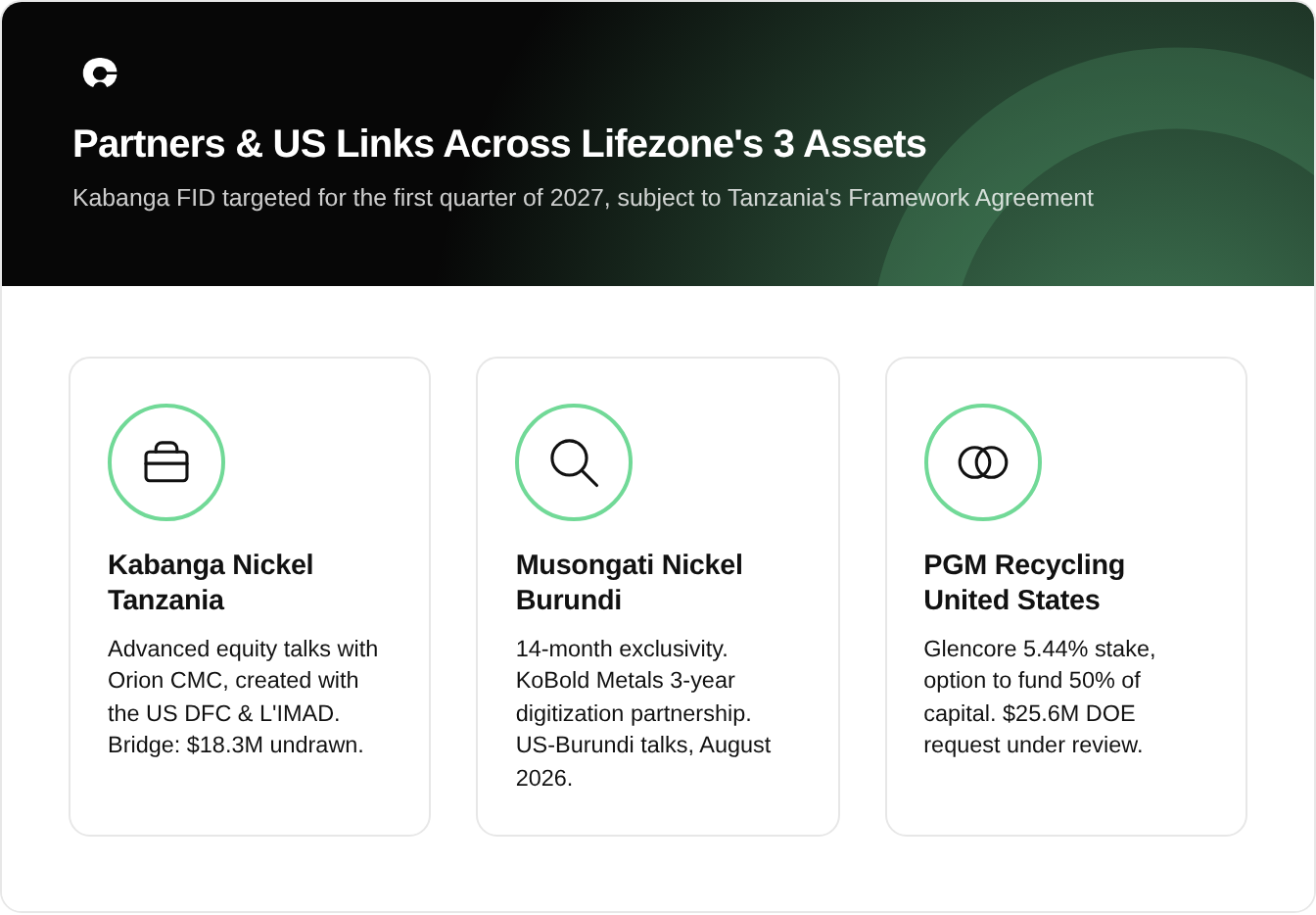
Lifezone Metals (NYSE: LZM) has reached an advanced stage of negotiations with the Orion Critical Mineral Consortium (Orion CMC) over a significant strategic equity investment in the Kabanga Nickel Project in Tanzania. The talks, confirmed on October 23, 2026, came through the strategic investment process led by Standard Chartered Bank. No definitive agreement, investment size or valuation has been disclosed.
The counterparty makeup separates this process from a conventional mining equity raise. Chief Executive Officer of Lifezone Metals, Chris Showalter, described the consortium's origins and mandate:
"Orion CMC was created by Orion Resource Partners, alongside the U.S. International Development Finance Corporation and L'IMAD (Abu Dhabi's sovereign investment platform), to invest in strategic critical minerals projects that can deliver near-term supply to the United States and its allies."
The US International Development Finance Corporation (DFC) connects to Kabanga through its role in creating Orion CMC. Lifezone has not disclosed a direct DFC investment in the project, and the size and terms of any Orion CMC stake remain under negotiation.
A signed agreement with Tanzania also carries an immediate cash consequence. Lifezone has drawn $41.7 million of a $60 million senior secured bridge loan from Taurus Mining Finance, and can draw the remaining $18.3 million only once the Framework Agreement amendment is signed, and only until November 29, 2026, after Taurus agreed to a 3-month extension.
Kabanga's Financing Tracks Are at Different Stages
Kabanga’s funding plan has 3 tracks, and only the bridge loan has reached a signed and drawn agreement. The bridge loan with Taurus Mining Finance is executed, with $41.7 million drawn and $18.3 million conditional on the Framework Agreement amendment. The strategic equity track is at an advanced stage of negotiations with Orion CMC, with no terms disclosed. On project finance, a process led by Societe Generale has selected its development finance institution and export credit agency pathfinders, and lender due diligence is one of the factors the board cites for the timing of a final investment decision (FID).
Around those tracks sits a wider policy base. Lifezone lists US government support for Kabanga, including through the DFC, and describes the project as being considered a Tanzanian, US-linked project of national importance. That support establishes strategic relevance; it is not committed funding for Kabanga.
Management took the case to 3 Tanzania-linked forums during the period, in Arusha, Helsinki and London. At the inaugural Tanzania Investment Forum in London on October 8, 2026, Chief Financial Officer Ingo Hofmaier shared a panel with Tanzania’s Minister of Minerals, Anthony Mavunde. In Arusha, Lifezone appeared on a panel alongside Prof. Sifuni Mchome, Chairperson of the Government Negotiation Team.
Tanzania's Framework Terms Set the FID Timetable
The amendment of the Framework Agreement, including agreement on a Joint Financial Model that defines how economic benefits are shared between investors and the Government of Tanzania, is a condition for project financing. The board is targeting FID in the first quarter of 2027.
Cash stood at $22.2 million on September 30, 2026. Total liquidity of approximately $40 million at that date includes the $18.3 million undrawn bridge tranche, which depends on the Framework Agreement being signed and expires on November 29, 2026.
Pre-FID spending has continued on Lifezone's own balance sheet. The company invested $24.8 million in Kabanga over the first 9 months of 2026, released 34 contract packages to market and received 24 tenders, including engineering, procurement and construction management, mining and bulk earthworks; the mining tender closed in September and evaluation is underway. Equity talks, the debt process and procurement are all advancing, but project financing cannot close until Tanzania agrees how Kabanga's economic benefits are shared.
Lender Standards Are Being Met Before the Capital Arrives
An independent Resettlement Action Plan (RAP) expert's Determination Report on September 18, 2026 confirmed the RAP's alignment with the objectives of International Finance Corporation Performance Standard 5. All cash compensation payments were made by the end of 2025, and 97% of affected households have signed agreements and received payment, with the balance held in escrow. For lenders whose due diligence feeds into the FID date, the report gives an independent reference point on resettlement.
The finding also triggered an $8 million reduction in the cap on consideration payable to BHP, announced on October 7, 2026. The change lowers the maximum amount Lifezone may owe BHP; it is not a cash inflow. Deferred consideration to BHP was carried at $20,247,269 on September 30, 2026.
Showalter linked the resettlement outcome directly to the financing process:
"This reflects our commitment to developing Kabanga to international standards, which is fundamental to securing project financing and to our partnerships with lenders and investors."
The Special Mining License and all material permits for current activities are in place, and the project has passed 3 million hours worked without a lost-time injury, with zero material health, safety, environmental or security incidents reported.
A Nickel Surplus Tests the Strategic-Supply Case
The nickel price offers Kabanga no immediate tailwind. As of October 29, 2026, the London Metal Exchange nickel price was $16,040 per tonne, up from a 2026 low of $15,019 per tonne on October 15 but down from $19,454 per tonne in May. The International Nickel Study Group now forecasts a 19,000-tonne surplus for 2026, revised from a 32,000-tonne deficit.
Supply-side pressure in Indonesia is a partial offset. Lifezone's market review notes that Indonesian high-pressure acid leach plants appear to be loss-making, with shutdowns expected, while the Indonesian Government has shortened mining quota validity from 3 years to 1 and introduced tiered royalty rates.
Orion CMC's stated mandate is to fund near-term supply to the US and its allies, which gives Kabanga a route to equity that is not set by the spot price alone. The surplus still bears on project economics and on the terms of any equity or debt Kabanga secures.
Musongati Repeats the Partner Model in Burundi
Lifezone signed a 14-month exclusivity agreement with the Government of Burundi over the Musongati Nickel Project on March 10, 2026. KoBold Metals committed to a 3-year exploration and digitization partnership with the Burundian government, signed alongside that exclusivity, and digitization of historical Musongati geological records began in Bujumbura in August 2026. US-Burundi critical minerals meetings held in Burundi the same month included the President of Burundi.
Musongati has no current resource. The 2011 estimate is historical: it was prepared under JORC (2004) guidelines, does not comply with S-K 1300 and has not been verified by a Qualified Person. Lifezone must verify the historical data and is assessing a laterite infill drilling program at the Buhinda and Rubara deposits before a current resource can be established, which leaves Musongati as an exclusivity-period option on a second nickel asset, built on the same type of government and partner relationships as Kabanga.
PGM Recycling Brings the Model Onshore in the US
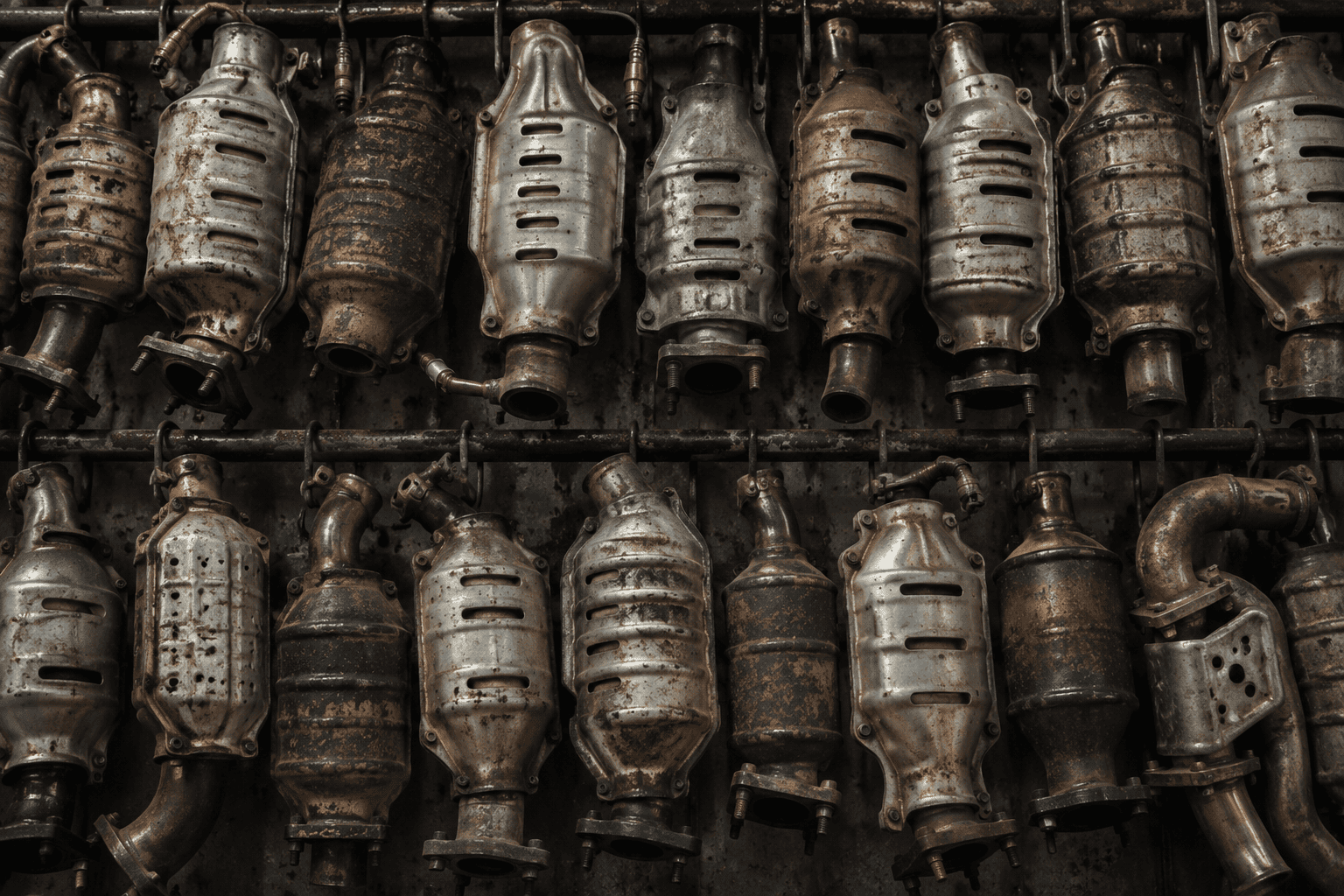
The platinum group metals (PGM) recycling project takes Lifezone's Hydromet Technology into a US supply chain. A pilot campaign on 1 ton of US-sourced spent autocatalyst material achieved more than 99% recovery of platinum and palladium, with a target of more than 95% for rhodium. Glencore invested $1.5 million for a 5.44% equity stake in the project and holds an option to fund 50% of total project capital, and a preferred US brownfield site is under negotiation.
Commercial-scale execution is still ahead, with the feasibility study and the PGM project's FID both targeted for the first quarter of 2027. Lifezone filed 2 US Department of Energy (DOE) applications totaling $41.5 million; it received no award under the second program, announced in August 2026, and the remaining $25.6 million request is under review. That request relates to the PGM project only, not to Kabanga.
The Investment Thesis for Lifezone Metals
- Advanced negotiations with the Orion Critical Mineral Consortium give Kabanga an identified strategic equity counterparty whose stated mandate is near-term supply to the US and its allies, although no terms have been disclosed and the US International Development Finance Corporation's role is as a founding partner of the consortium.
- The amended Framework Agreement and Joint Financial Model with the Government of Tanzania are conditions for project financing, which makes the Tanzanian negotiation the gating item for Kabanga's project financing and its final investment decision.
- The same signature releases the final $18.3 million of the bridge loan, available only until November 29, 2026, so the timing of Tanzania's agreement also governs near-term pre-construction funding.
- Independent confirmation that the resettlement plan is aligned with International Finance Corporation Performance Standard 5 objectives gives lenders a documented reference point for due diligence and lowered the maximum consideration payable to BHP by $8 million.
- A forecast 2026 nickel surplus and a price below its May level remain a risk to project economics and financing terms, even with a strategic-supply investor in negotiation.
Lifezone has identified the counterparties for Kabanga's equity and debt. The board's target of a final investment decision in the first quarter of 2027 depends on converting those processes into signed agreements, and the first step is Tanzania's agreement on how the project's economic benefits are shared.
TL;DR
Lifezone is negotiating a strategic equity investment in Kabanga with Orion CMC, a consortium created with the DFC and L'IMAD, while a Societe Generale-led debt process advances, but neither has reached a signed agreement. Tanzania's amended Framework Agreement is a condition for project financing and for the final $18.3 million of bridge funding, available until November 29, 2026, ahead of an FID targeted for the first quarter of 2027.
FAQs (AI-Generated)
Analyst's Notes





Subscribe to Our Channel







Stay Informed


