ATHA Energy Mobilizes for Its Largest-Ever Drill Program at Angilak: Three Rigs, CAD $63 Million, & Results Still to Come



ATHA Energy deploys 3 drills at Angilak with CAD $63M funded. One high-grade hole demands follow-up. 2026 results will make or break the thesis.
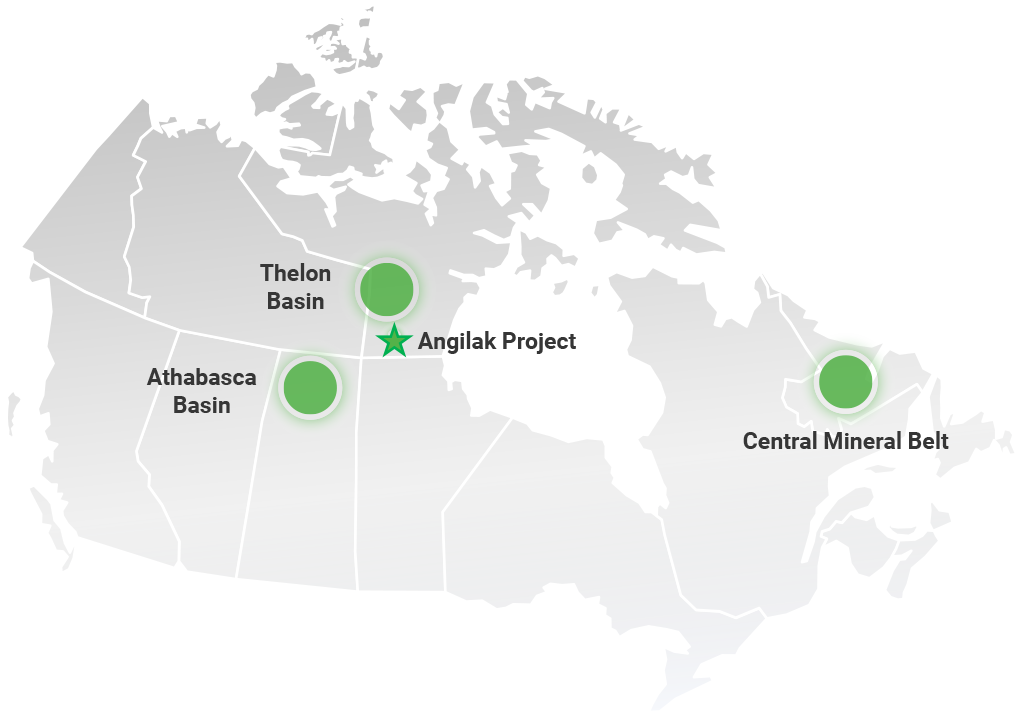
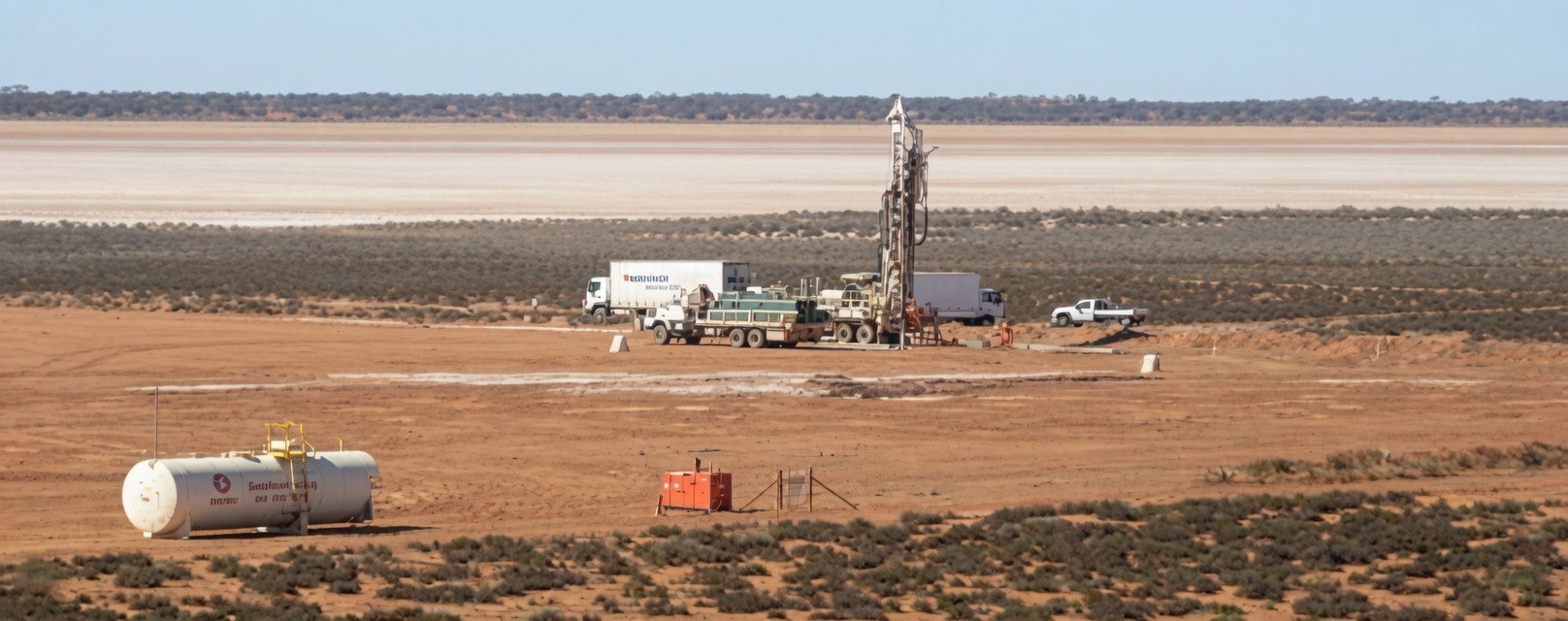
- ATHA Energy has commenced mobilisation for its largest-ever drill program at the 100%-owned Angilak Uranium Project in southern Nunavut, deploying 3 simultaneous diamond drill rigs with exploration activities targeting a late April 2026 start - funded by a CAD $63 million treasury closed in February 2026, with no additional financing required for the current program.
- The 2026 program is built on a single high-priority result: the 2025 RIB North maiden hole, which returned 34.7 metres of composite uranium mineralisation grading up to 8.16% uranium oxide over 0.5 metres - more than 8 times ATHA's own high-grade threshold of 1% uranium oxide - but which has not yet been confirmed by follow-up drilling, leaving the geometry, continuity, and tonnage of the system undefined.
- Angilak carries no NI 43-101 (National Instrument 43-101) compliant Mineral Resource Estimate (MRE); the existing Lac 50 Exploration Target is an internal estimate with no regulatory standing, meaning the project remains at the exploration stage and cannot yet support formal economic analysis - a formal MRE is the single most important de-risking milestone the project has yet to achieve.
- The uranium spot price stands at approximately US$84/lb as of early April 2026, with the long-term contract price reaching a 14-year high of US$86.50/lb in December 2025; the World Nuclear Association (WNA) projects global nuclear capacity to grow from 398 gigawatts electric (GWe) in mid-2025 to 746 GWe by 2040 - a demand outlook that supports the case for new uranium supply sources, including early-stage Canadian exploration assets.
- The critical data points to monitor in 2026 are, in order of priority: follow-up drill results at RIB North confirming or refuting continuity of the high-grade system; first-pass results from untested basin corridors; and any company guidance on the timeline and data requirements for a first NI 43-101 compliant MRE at Angilak.
Opening Briefing
ATHA Energy (TSXV:SASK | Frankfurt: X5U | OTCQB: SASKF) confirmed on March 31, 2026 that site mobilisation is underway at its Angilak Uranium Project in southern Nunavut, with diamond drilling targeting a late April 2026 start. Fuel, supplies, equipment, and a third diamond drill - supplied by Base Diamond Drilling Ltd. - are being transported via chartered ATR (Air Transport Command) aircraft from Yellowknife, Northwest Territories (NWT), and Baker Lake and Rankin Inlet, Nunavut, to the project's winter airstrip. The 2026 program is the largest in Angilak's history by drill rig count, following a 2025 campaign that identified 5 new uranium showings across the Angikuni Basin - including RIB North, where the maiden hole returned 34.7 metres of composite uranium mineralisation grading up to 8.16% uranium oxide (U3O8) over 0.5 metres. The program is fully funded from the CAD $63 million financing closed in February 2026. No formal Mineral Resource Estimate (MRE) exists at Angilak under National Instrument 43-101 (NI 43-101).
Three Rigs: What the Operational Decision Signals
Running 3 simultaneous diamond drill rigs at a remote Nunavut site increases daily operational cost relative to a 1 or 2-rig program, but allows the company to test multiple geological targets concurrently rather than sequentially. For a basin the size of the Angikuni - where ATHA has identified targets across at least 2 separate corridors outside the Lac 50 Deposit zone, in addition to the deposit zone itself - sequential drilling would extend the time to a basin-wide result by at least 1 to 2 field seasons. The 3-rig configuration is therefore a decision to accept higher near-term cost in exchange for a faster read on whether the 2025 multi-corridor discovery pattern is repeatable across the basin.
The winter airstrip at Angilak, capable of receiving heavily loaded ATR aircraft, reduces per-tonne freight cost relative to helicopter-only access and allows heavier equipment - including the third drill - to be staged before spring breakup. This infrastructure, built over successive field seasons, lowers the logistical cost of scaling up and is relevant to any future assessment of development feasibility, though the project remains at the exploration stage.
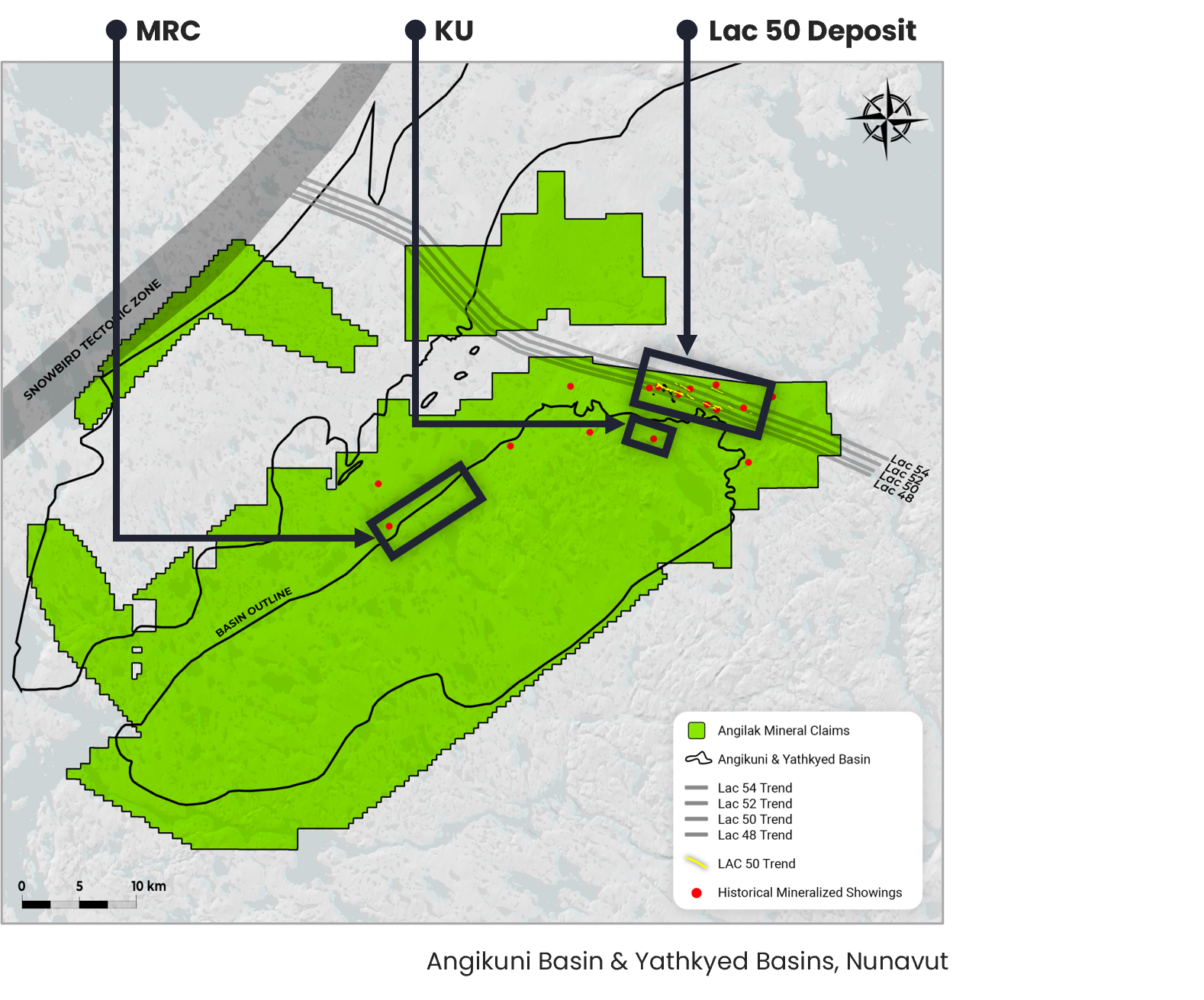
What the 2024 & 2025 Campaigns Established & What They Did Not
The 2024 campaign produced Angilak's first formal Exploration Target for the Lac 50 Deposit Corridor. An Exploration Target under NI 43-101 is not a resource estimate - it is a range of tonnage and grade that the company believes could be present based on available data, and it carries no regulatory certainty. It does, however, establish a data baseline against which 2026 drilling can be measured, and any revision upward following additional infill or step-out drilling would be a material disclosure.
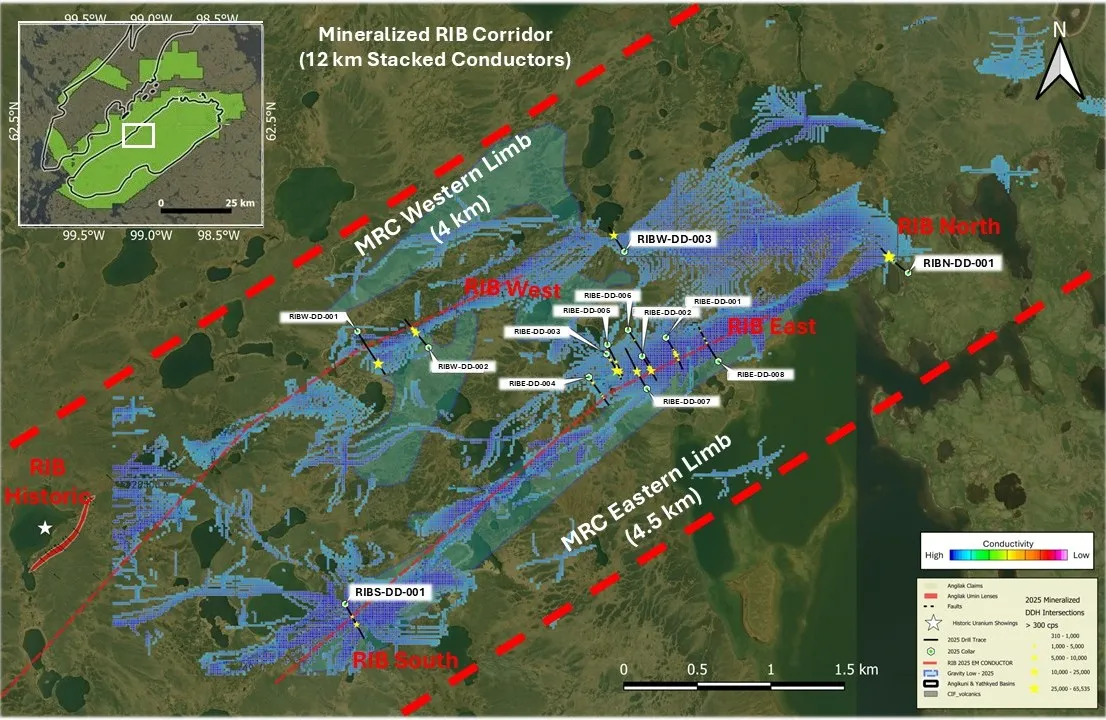
The 2025 campaign produced results with more immediate market implications. By moving away from Lac 50 and drilling the Mineralized RIB (Radioactive Iron Body) Corridor and KU-Nine Iron Corridor for the first time, ATHA's exploration team demonstrated that uranium mineralisation at Angilak is not confined to the known deposit zone. The RIB North maiden hole - 34.7 metres of composite mineralisation at up to 8.16% uranium oxide over 0.5 metres - is significant because the company's own definition of high-grade is any interval above 1% uranium oxide, making this result more than 8 times that threshold in its peak interval. That said, 1 drill hole establishes the presence of mineralisation at a point in space, not the geometry, continuity, or tonnage of a system. The 2026 program must demonstrate that this result is reproducible across multiple holes before it can be incorporated into any resource framework.
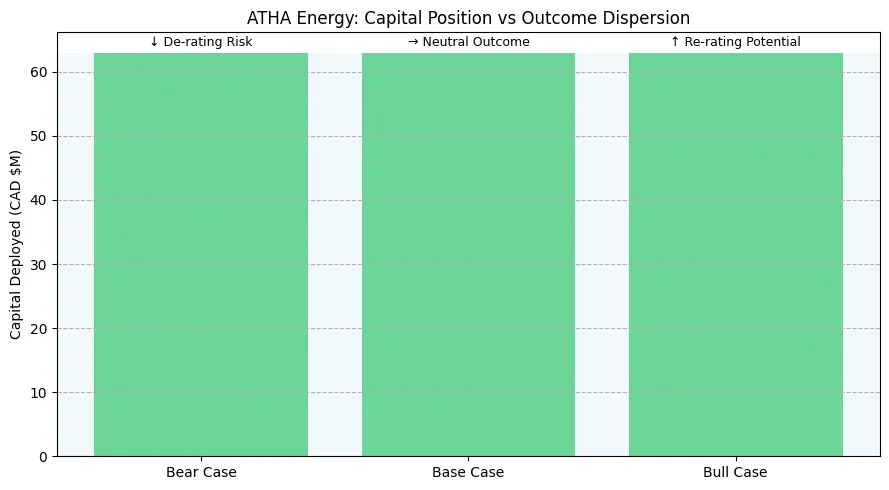
Capital Position Relative to Program Scale
The CAD $63 million raised in February 2026 funds the 2026 Angilak program and, by ATHA's account, exploration beyond it. For a junior uranium explorer operating a 3-rig program in a remote jurisdiction, that treasury removes the financing risk that would otherwise force a program curtailment if early-season results were ambiguous. The practical implication is that ATHA can complete the full planned 2026 drill campaign regardless of whether interim results are positive, negative, or mixed - a meaningful operational advantage over peers that must manage capital allocation dynamically through a season.
The risk profile of this position is symmetric. A fully funded 3-rig program that produces strong follow-up results at RIB North and additional corridor discoveries would validate the capital deployment and likely trigger a re-rating of the asset. The same program that fails to reproduce 2025 results would represent a proportionally larger capital expenditure against a diminished geological thesis, with no near-term catalyst to recover the ground. Investors should weigh both outcomes as live possibilities.
The Uranium Market: Specific Conditions Relevant to Angilak
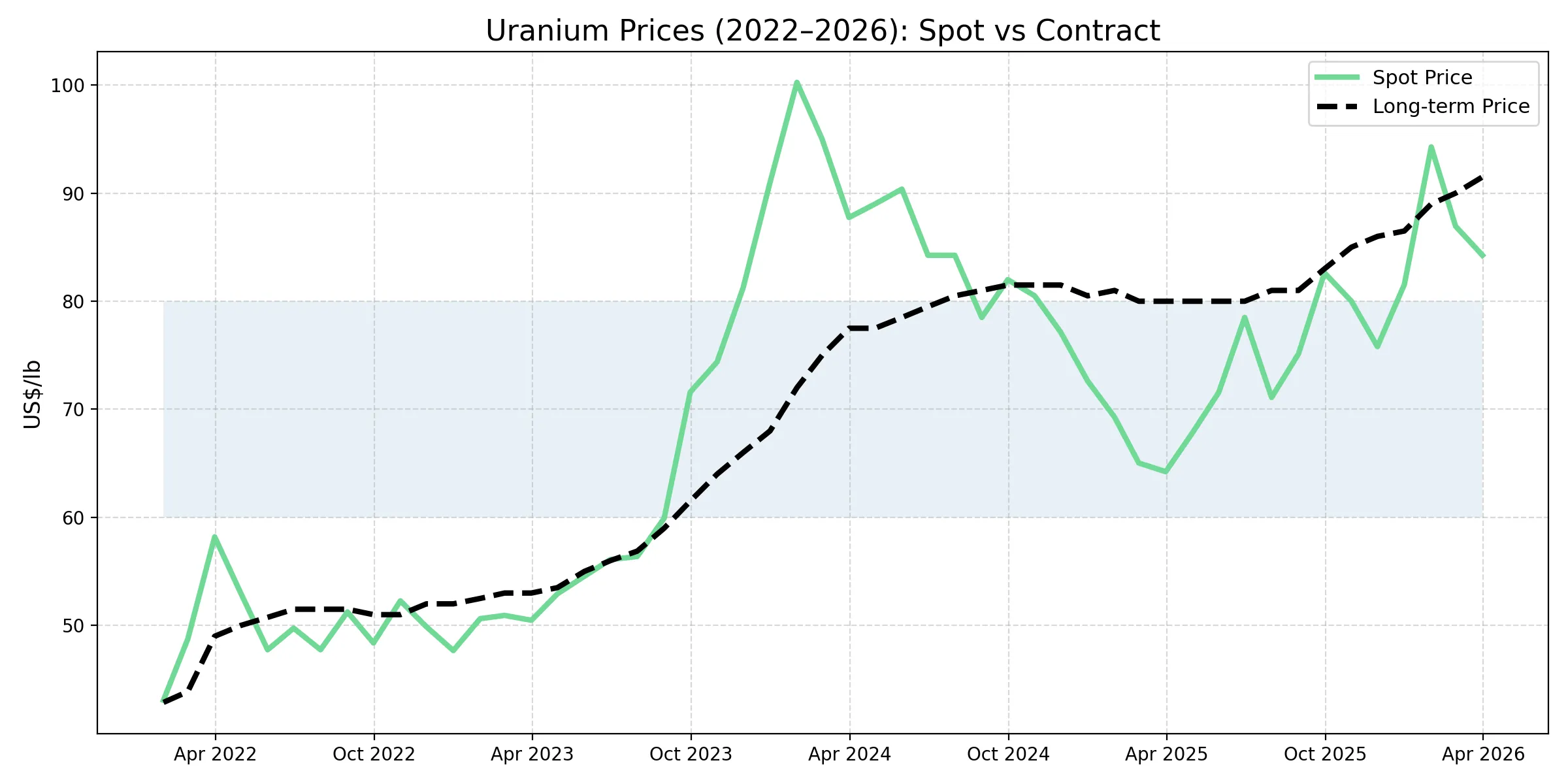
After the 2011 Fukushima disaster, uranium spot prices fell from above US$70/lb to a low of below US$18/lb in 2016 - the lowest level since the early 2000s - and remained below US$25/lb for approximately 3 years. That price depression reduced global uranium exploration expenditure materially and left a supply pipeline that has been slow to recover. The meaningful price recovery began in Q3-Q4 2023, driven by 2 traceable mechanisms. Russia's invasion of Ukraine in February 2022 led Western utilities - which had historically sourced a significant share of uranium conversion and enrichment services from Russia - to seek alternative supply, tightening the available pool of non-Russian material. Separately, Kazatomprom, the Kazakh state producer that supplies approximately 43% of global uranium production, missed production targets in both 2023 and 2024 due to sulfuric acid supply shortages and development delays, reducing spot market availability. By January 2024, the uranium spot price reached US$106/lb - its highest point in 17 years.
The spot price has since retreated and stabilised. The full-year 2025 uranium spot price averaged US$73.54/lb, with the annual trading range between US$63/lb and US$83/lb (Cameco Supply & Demand Report, 2025). The long-term contract price - the price at which utilities sign multi-year supply agreements and the more relevant indicator of structural demand - reached US$86.50/lb in December 2025, its highest level in 14 years (Cameco Supply & Demand Report, 2025). Into 2026, volatility has persisted: the spot price reached US$101.41/lb in January 2026 before falling 15.91% in 7 days to US$85.50/lb by February 5, 2026, driven by geopolitical instability and investor de-risking (Investing News Network, Q1 2026 Uranium Price Review). As of early April 2026, the spot price stands at approximately US$84/lb (CarbonCredits.com, April 6, 2026).
On the demand side, the World Nuclear Association (WNA) projects global installed nuclear capacity to grow from 398 gigawatts electric (GWe) in mid-2025 to 746 GWe by 2040 under its reference scenario, and to 966 GWe under an accelerated buildout - representing a near-doubling to more than doubling of current capacity (WNA Nuclear Fuel Report, 2025). In 2025, utilities placed approximately 116 million pounds of uranium under long-term contracts globally, a volume that fell below replacement rate and widened the cumulative gap between contracted supply and projected forward requirements (Cameco Supply & Demand Report, 2025). Canada is the world's second-largest uranium producer after Kazakhstan, and Western utilities have increased their weighting toward Canadian supply as they reduce exposure to Russian-linked and politically higher-risk supply chains - a dynamic that supports the investment case for Canadian uranium exploration assets at all development stages.
Material Risks at the Current Project Stage
Angilak carries the risks common to exploration-stage assets, several of which are material enough to warrant specific identification. The project has no NI 43-101 compliant MRE. The Lac 50 Exploration Target is an internal estimate with no regulatory standing and cannot be used to calculate project economics. The 5 uranium showings identified in 2025 have each been tested by limited drilling - in the case of RIB North, by a single hole. Until multiple holes define the geometry of these systems, the grade and width of any single intercept cannot be extrapolated into a resource framework.
Operationally, the Angikuni Basin's remoteness means that all winter supply is air-dependent, increasing per-tonne freight cost relative to road-accessible projects. Summer ground access adds its own logistical complexity. These factors affect both the cost of the 2026 exploration program and the longer-term development economics of any deposit that may be delineated. A CAD $63 million treasury is sufficient to fund current exploration plans but does not address the capital requirement of a future development scenario, which would be substantially larger and subject to separate financing.
Key Takeaway for Investors
The 2026 Angilak program is ATHA Energy's largest exploration investment to date - 3 simultaneous drill rigs, a CAD $63 million funded treasury, and targets across multiple corridors of a basin the company controls exclusively. The geological basis for the program is the 2025 RIB North maiden hole result of 34.7 metres grading up to 8.16% uranium oxide over 0.5 metres - more than 8 times the company's own high-grade threshold in its peak interval - but that result comes from a single hole and has not yet been confirmed by follow-up drilling. The uranium market provides a supportive backdrop: the spot price at approximately US$84/lb as of early April 2026, long-term contract prices at a 14-year high of US$86.50/lb (Cameco, December 2025), and WNA projections of nuclear capacity growth from 398 GWe to 746 GWe by 2040 all point to sustained demand for new uranium supply sources. Against that backdrop, the investment risk at Angilak is geological and stage-specific: no MRE exists, no single corridor has been drilled sufficiently to define a resource, and the 3-rig program increases the financial cost of a season that does not deliver confirmatory results. The 2026 drill data - beginning with RIB North follow-up holes - will determine whether Angilak's discovery narrative advances or stalls.
What to Watch Next
RIB North follow-up assay results. The maiden hole returned 34.7 metres of composite mineralisation grading up to 8.16% uranium oxide over 0.5 metres. Follow-up holes targeting lateral and down-dip continuity will establish whether the system has the geometry required to support a resource calculation. A minimum of 3 to 5 consistently mineralised holes across at least 100 metres of strike would begin to define a system; results falling short of that would limit RIB North's near-term contribution to any MRE.
First-pass results from untested corridors. The 2026 program is targeting structural corridors in the Angikuni Basin that have not previously been drilled. A maiden intersection above 1% uranium oxide - ATHA's own high-grade threshold - at any new target would expand the basin's mineralised footprint and add a new variable to the project's scale assessment.
Any NI 43-101 Mineral Resource Estimate guidance. A compliant MRE is the next major de-risking milestone for Angilak. It is the point at which the project moves from exploration-stage to resource-stage, enabling peer comparison, scoping economics, and a wider investor base. Any company disclosure on the data requirements or timeline for an MRE would be a material development.
Lac 50 Exploration Target revision. The current Lac 50 Exploration Target was released following the 2024 campaign and has not been updated. New drilling data from 2026 infill and step-out holes at Lac 50 may support a revised range. An upward revision, or conversion to a compliant resource, would represent a specific, quantifiable change in the project's stated scale.
Assay release schedule. The Angilak camp uses Saskatchewan Research Council (SRC) Geoanalytical Laboratories in Saskatoon for sample analysis - an ISO/IEC 17025:2005 accredited facility. Turnaround time between sample submission and result release will determine the pace of news flow through the 2026 season and affects how the market can track program progress in real time.
Analyst's Notes





Subscribe to Our Channel






Stay Informed