




Atlas Salt Targets Free Cash Flow for Mine Life Extension at Great Atlantic


Atlas Salt targets remaining free cash flow for mine life extension at Great Atlantic, with 868 million tonnes of inferred salt resource outside the plan.
- Atlas Salt is targeting the remaining free cash flow (FCF) for mine life extension initiatives at the Great Atlantic Salt Project in Newfoundland, including edge-of-mine horizontal drilling, which the company expects will require only a relatively small portion of FCF.
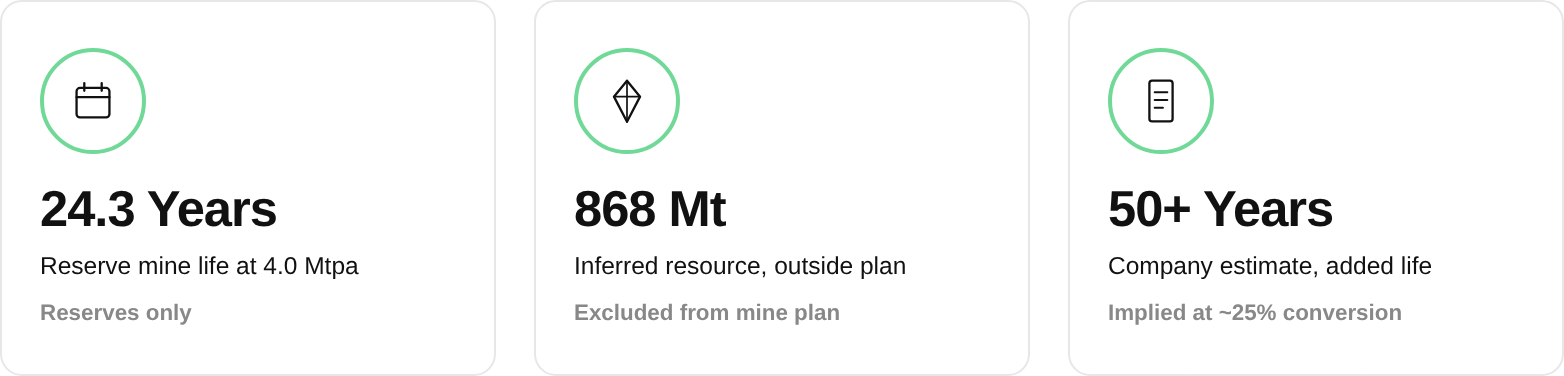
- Probable reserves of 95.0 million tonnes at 95.9% sodium chloride support 24.3 years at 4.0 million tonnes per annum, and a further 868 million tonnes of inferred resource at 95.2% sodium chloride is excluded from the mine plan.
- At the roughly 25% ratio of reserves to indicated resource, the company estimates the inferred resource implies about 200 million tonnes of reserves and more than 50 more years of potential production capacity.
- Average unlevered FCF is about C$161 million a year in years 1 to 8 and about C$203 million a year in years 9 to 24.
- The company's net asset value model reaches C$2.8 billion in year 10 and C$3.9 billion in year 24, against an after-tax net present value at an 8% discount rate of C$920 million in the feasibility study.
What Has Happened
Atlas Salt Inc. (TSXV: SALT | OTCQX: SALQF | FSE: 9D00) is developing the Great Atlantic Salt Project in Newfoundland as an underground salt mine with a nameplate production capacity of 4.0 million tonnes per annum (Mtpa) and production estimated by 2030. The 2025 Updated Feasibility Study supports an after-tax net present value at an 8% discount rate (NPV8%) of C$920 million over a 24.3-year mine life.
The plan to lengthen that life has 2 parts. Edge-of-mine horizontal drilling would assess the deposit's continuity beyond the current mine plan, and the company targets the remaining free cash flow (FCF) for mine-life extension initiatives.
The 24.3 years are based on reserves alone. The 868 million tonnes (Mt) of inferred resource are outside the plan, and the company estimates that they imply more than 50 more years of potential production capacity.
Reserves Support 24.3 Years While the Inferred Resource Stays Outside the Plan
Probable reserves total 95.0 Mt at 95.9% sodium chloride, equal to 91.1 Mt of contained sodium chloride. They include significant concentrations of high-grade salt above 98% sodium chloride.
The inferred resource totals 868 Mt at 95.2% sodium chloride, or 827 Mt of contained sodium chloride, and the deposit remains open in all directions. The salt body averages 200 meters thick, with a range of 68 to 340 meters, and lies about 180 meters below the surface, a depth reached by declines instead of shafts.
How Horizontal Drilling Would Extend the Mine
Extension depends on moving inferred resource into reserves. The mine plan excludes the inferred resource, which the company says could increase annual production and mine life.
Edge-of-mine horizontal drilling would test deposit continuity at the margins of the mined body. The company's current numbers imply a conversion ratio of about 25%, from 368 Mt of contained sodium chloride in the indicated resource to 91.1 Mt in reserves. Applied to the 827 Mt of contained sodium chloride in the inferred resource, that ratio gives about 200 Mt of reserves, which the company says implies more than 50 more years of potential production capacity. The company expects the drilling to require a relatively small portion of FCF, and it describes the work as activity that could take place during production years.
FCF Allocation Leaves Room for Extension Work
In years 1 to 8, average unlevered FCF is about C$161 million a year. The company targets 50% for debt repayment and 50% for shareholder returns, about C$80 million each. In years 9 to 24, average unlevered FCF is about C$203 million a year, and the company targets more than 90% for shareholder returns. The company targets the remaining FCF for mine life extension initiatives.
Across the life of mine, pre-tax operating cash flow averages C$325 million a year, and post-tax cash flow averages C$188 million a year. The study shows a 21.3% after-tax internal rate of return (IRR) and a 4.2-year after-tax payback on C$589 million of initial capital expenditure, using a base salt price of C$81.67 per tonne. At C$73.50 per tonne, after-tax NPV8% is C$0.5 billion with an IRR of 16.9%, and at C$89.84 per tonne it is C$1.5 billion with an IRR of 25.0%.
Chief Executive Officer of Atlas Salt, Nolan Peterson, said the company's modeling is based on last year's numbers, so a return to normal market conditions would leave its cost position intact:
"The market could go back to normal tomorrow, and again, we would still be the lowest cost producer."
The company's net asset value (NAV) model equals the NPV8% of future FCF plus accumulated net cash, assuming all FCF is retained, and reaches C$2.8 billion in year 10 and C$3.9 billion in year 24. The company states that mine life extensions would further preserve value.
Broader Context & What to Watch Next
Great Atlantic's 24.3 years on reserves alone compare with median mine lives of 7.0 years for silver, 9.0 years for gold and 18.0 years for copper in a FactSet screen run on February 11, 2026.
Securing the financing package remains a priority milestone for the C$589 million in initial capital. Atlas Salt has secured up to C$225 million in financing letters of interest (LOIs) for senior debt, including C$150 million from Export Development Canada and C$75 million from an export credit agency wholly owned by its national government. A separate LOI from Sandvik covers mining equipment worth C$79 million, including C$45 million for capital equipment, and Endeavour Financial is engaged for project finance.
Strategic partnerships, potential offtakes and equity participation, remaining permits and finishing mine construction are the other milestone priorities. A memorandum of understanding with Scotwood Industries targets volumes of 1.25 to 1.5 Mtpa.
FAQs (AI-Generated)
Analyst's Notes





Subscribe to Our Channel




Stay Informed


