




Axo Metals Secures Key Permit Early, Clearing Major Hurdle for Mexico Gold Project


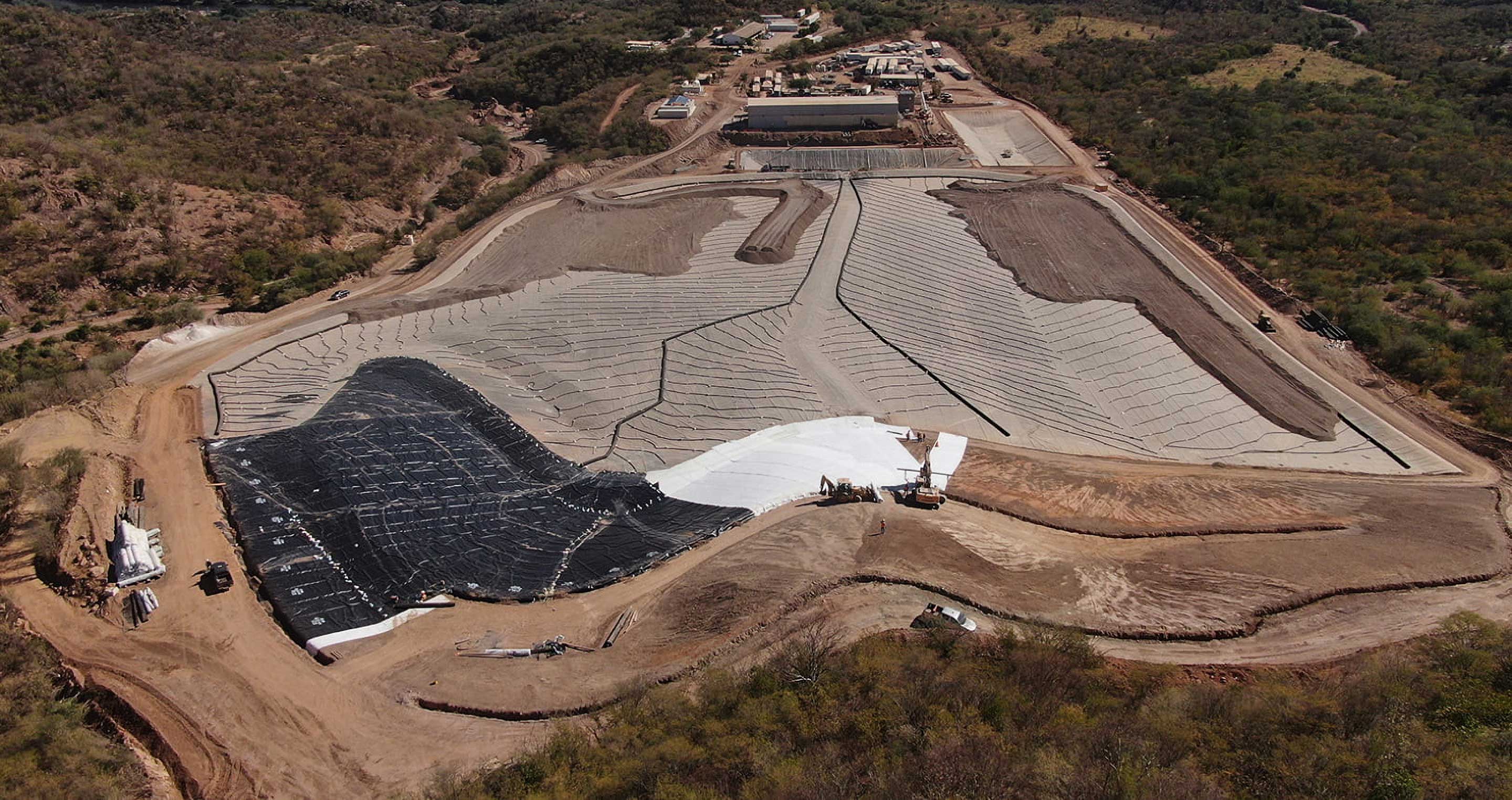
Axo Metals (TSXV:AXO) secures its main environmental permit at San Antonio months early, shifts drilling to expansion, and delays its PEA to capture the upside.
- Axo Metals has secured SEMARNAT's approval of the MIA, the primary environmental permit for its San Antonio gold project in Sonora, Mexico, arriving roughly 6 months after filing versus a one-year timeline originally guided to the market.
- The approval covers all deposits and existing infrastructure at San Antonio, and management is now assessing options to restart stockpile processing ahead of the main Sapuchi starter-pit build.
- Three rigs are drilling roughly 3,000 metres a month, with two-thirds of that capacity now directed at resource expansion beyond the current pit boundary rather than infill.
- Management is pushing its Preliminary Economic Assessment back by roughly two months to incorporate an updated resource that captures the expansion drilling, rather than releasing a study based on the existing 2021 block model.
- Capital is being concentrated on San Antonio over the company's La Huerta copper project in Jalisco, reflecting a deliberate prioritisation of the nearer-term gold production pathway following the January permit application's swift approval.
Axo Metals Corp. (TSXV:AXO) has cleared what its President and CEO calls the single biggest variable outside a developer's control: the permit. On 27 July, Mexico's federal environmental regulator, SEMARNAT, approved the Environmental Impact Statement (the "MIA") for the company's San Antonio gold project in Sonora - arriving roughly six months after Axo filed the application, well ahead of the one-year timeline the company had originally guided the market to expect. For a junior developer racing toward a brownfield restart, the approval removes the largest source of binary risk on the project's critical path, and management is now recalibrating both its drilling programme and its economic study timeline in response.
Permit Approval Clears the Path for Growth
The newly issued MIA covers all existing infrastructure and every deposit at San Antonio - Sapuchi, Golfo de Oro and California - meaning Axo does not need to revisit the environmental approval as it advances any of the three. A single administrative step remains before mining can begin at those pits: the Change of Use of Soils ("CUS"), an ancillary tree-clearing authorisation that management submitted earlier this year and expects to have in hand before year-end. Critically, the CUS does not apply to the company's existing infrastructure - the carbon-in-column plant, crusher, stockpiles and camp are already fully permitted - which means Axo can move on stockpile reprocessing without waiting on the CUS at all.
CEO Jonathan Egilo framed the significance of the approval bluntly:
"It derisks us massively... the one biggest thing that's outside of your own control, quite frankly, is the permit. This is a third permit that the group's got in about 10 months... it massively de-risks the project."
That "group" reference points to Axo's shared lineage with sister companies Silver Tiger and GoGold, which share overlapping founding shareholders and in-country expertise in Mexico - a track record management is now leaning on as a proof point for its own permitting execution.
Interview with Jonathan Egilo, CEO, Axo Metals
Drilling Ramps Toward Resource Expansion
Axo currently has three drill rigs active at San Antonio, running at a combined pace of roughly 3,000 metres a month. Where the programme was previously weighted toward infill at the Sapuchi starter pit, two of the three rigs are now testing ground roughly 500 metres outside the existing resource boundary - meaning two-thirds of current drilling capacity is directed at expansion rather than infill, a reallocation management says reflects growing confidence in the step-out targets rather than a scattershot approach.
The infill work at Sapuchi is also producing what the company frames as incremental model upgrades: several holes have intersected mineralisation above cut-off grade in blocks the 2021 resource model had classified as waste. Hole SOSAP-26-013, for example, intercepted 27.9 metres at 0.43 g/t gold roughly 100 metres north of the nearest previously modelled ore domain - one of several intercepts the company says point to a larger, better-connected deposit than the existing block model shows. A 26 May news release also reported the first batch of assays from the programme, including 23.6 metres at 2.13 g/t gold from surface and 27.1 metres at 1.31 g/t gold from 29 metres downhole - both within the Sapuchi footprint.
Metallurgical work is running in parallel and, according to Egilo, beyond what a Preliminary Economic Assessment (PEA) alone would require: bottle-roll tests and multiple column tests are underway across Sapuchi at what management describes as feasibility-study level of rigour for the heap leach component specifically.
PEA Pushed Back to Capture Upside
Axo had previously guided the market to a September PEA built on the existing, pre-acquisition resource. That timeline has now shifted: management intends to fold an updated resource estimate - incorporating drilling from December 2025 through October 2026 - into the study before its release, pushing the PEA out by roughly two months. The trade-off is deliberate: rather than publish a study anchored to a resource that predates the current drill programme, Axo is opting for a study that reflects the expansion results it expects to have in hand by the autumn.
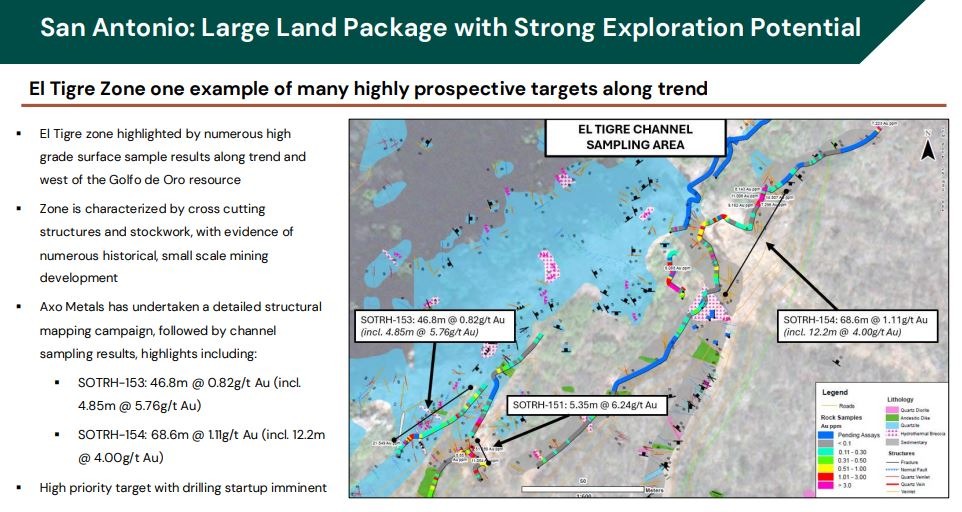
Ahead of that, the company plans a dedicated drilling update in September covering the step-out and expansion results, separate from the ongoing Sapuchi infill releases. Exploration at the El Tigre target - roughly 1,500 metres long by 500 metres wide, with a history of high-grade grab samples - has also progressed from structural mapping into channel sampling, returning results including 68.6 metres at 1.11 g/t gold (including 12.2 metres at 4.00 g/t) and 46.8 metres at 0.82 g/t gold (including 4.9 metres at 5.76 g/t). Drilling at El Tigre is slated to begin imminently as part of a 5,000-metre resource-expansion budget.
Capital Discipline: San Antonio Over La Huerta
Axo's $40 million bought-deal financing, closed in February, was earmarked specifically for San Antonio - and with the permit now in hand, management is using it as the basis for formally deprioritising near-term spending at La Huerta, the company's copper discovery in Jalisco. Egilo was direct about the trade-off:
"It's very difficult to advance two projects full gas at the same time... we can spend our resources on developing San Antonio to push it to production, to growing the resource at San Antonio, which is going to be our first mine into production... it's hard to stretch that to a third key priority of spending a lot of money at La Huerta as well."
Management characterised the La Huerta programme as essentially unchanged rather than cancelled, but the capital allocation signal is clear: San Antonio is the near-term production priority, with La Huerta held at a lower-intensity exploration pace until San Antonio reaches a construction decision.
Investment Thesis for Axo Metals
- Permit de-risking, ahead of schedule: SEMARNAT's MIA approval arrived roughly six months after filing, versus the one-year timeline management had guided the market to expect, removing the largest binary risk on San Antonio's development path.
- Brownfield restart economics: San Antonio's existing carbon-in-column plant, crusher, stockpiles, ponds and camp are already fully permitted and require no further soil-use authorisation, and management estimates finishing the build could cost in the region of $50 million versus an estimated $100 million to replicate the site from scratch.
- Drilling capacity shifting to growth: Two of three active rigs are now testing ground outside the resource boundary, with management targeting a dedicated expansion drilling update in September.
- Resource upgrade ahead of the PEA: Management is deliberately delaying its PEA by roughly two months to incorporate an updated resource built on a full year of new drilling, rather than publishing a study anchored to the pre-acquisition 2021 block model.
- Capital concentrated on the nearer-term asset: The $40 million raised in February was earmarked for San Antonio, and management is now explicitly deprioritising near-term spend at the La Huerta copper project in favour of pushing San Antonio to production.
- Watch item - CUS approval: The Change of Use of Soils authorisation, expected by year-end, is the remaining administrative step before mining can begin at Sapuchi, Golfo de Oro and California, though it does not block near-term stockpile reprocessing.
- Watch item - September drilling and PEA updates: Both the step-out drilling results and the revised PEA timeline are near-term catalysts worth monitoring for signs of the resource growth management is guiding toward.
Macro Thematic Analysis
Junior gold developers with brownfield infrastructure occupy a narrower and increasingly valuable lane in the current market: assets that can reach production without a multi-hundred-million-dollar capital build, in a jurisdiction with a demonstrated permitting pathway. San Antonio's history as a former copper oxide and, more recently, gold-producing operation means Axo inherits a plant, crusher capacity and camp rather than building from a greenfield footprint - a distinction that matters more in a financing environment where equity for large-scale construction remains harder to source than for step-out drilling.
Management's own framing of the gold price backdrop underscores how directly that plays into the investment case. Asked how a sideways-to-softer metals market affects the company's thinking, Egilo pointed to the project's cost position rather than short-term price direction:
"Producing at even $4,000 is an absolute dream case... $4,000 gold is an unbelievable price to be producing gold at."
The comment reflects a broader dynamic across the sector: with San Antonio's oxide resource sitting at bottom-quartile costs on management's own estimate, a heap leach operation of this grade profile has historically generated strong margins across a wide range of gold price environments - meaning the company's near-term catalysts (permitting, drilling, the PEA) matter more to the investment case than where gold trades on any given week.
TL;DR
Axo Metals has received SEMARNAT approval of its main environmental permit for San Antonio roughly six months after filing - well inside its one-year guidance. With that de-risked, the company is shifting two of three rigs to resource expansion outside the current pit, pushing its PEA back about two months to include an updated resource, and concentrating its $40 million treasury on San Antonio over its La Huerta copper project. A September drilling update and the revised PEA are the next catalysts to watch.
FAQ (AI-generated)
Analyst's Notes





Subscribe to Our Channel


Stay Informed






















