




Canada Nickel Targets US$2.5B Crawford 2027 Financing as Indonesia Readies Nickel Quota


Mark Selby on Indonesia's 2027 nickel quota, Crawford's first-quartile costs and Canada Nickel's US$2.5B funding plan targeted for the first quarter of 2027.
- Canada Nickel holds federal approval for Crawford and is targeting its US$2.5 billion funding package in the first quarter of 2027, with a final investment decision targeted for the third quarter of 2027.
- Selby expects Indonesia's 2027 nickel quota, due before the end of December 2026, to lift prices toward US$19,000 to US$20,000 per tonne from just under US$16,000.
- Crawford's life-of-mine net C1 cash cost of US$0.39 per pound is in the first quartile of the global cost curve, the company's answer to a nickel price range managed by Indonesia.
- Canada's new accelerator fund and First and Last Mile Fund are expected to deploy capital in 2027, and an investment tax credit facility of up to US$600 million goes to market in early January 2027.
- The Auramet loan of over US$27M matures on February 2027, in the same quarter as the targeted financing close, and 9 published resources stand behind Crawford in the Timmins Nickel District.
Canada Nickel (TSXV:CNC) is heading into 2027 with federal approval for its Crawford Nickel-Cobalt Sulphide Project near Timmins, Ontario, and a US$2.5 billion funding plan it is targeting to complete in the first quarter of 2027. The company targets a final investment decision (FID) in the third quarter of 2027 and first production in the fourth quarter of 2029.
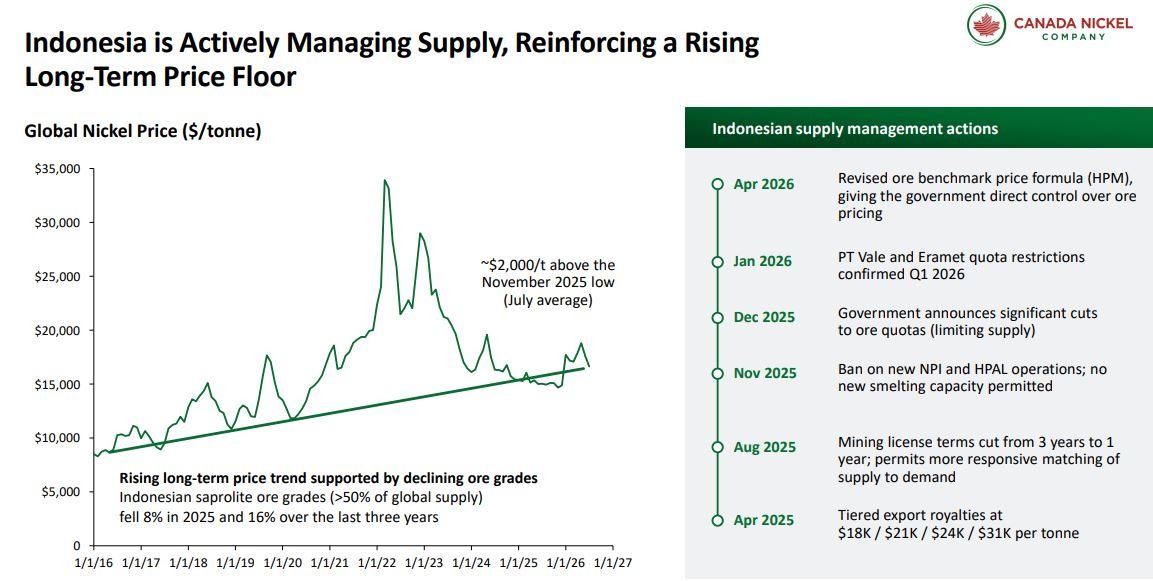
The price Crawford will be financed against is now set largely by Indonesia, which holds 67% of global nickel supply on the company's figures and has moved its mining quotas to an annual cycle. Nickel traded just under US$16,000 per tonne, below the lowest of Indonesia's export royalty thresholds.
Floor Under Nickel Prices: Indonesia's Annual Quotas
Indonesia tightened its policy in stages through 2025, cutting mining license terms from 3 years to 1 in August, banning new nickel pig iron and high-pressure acid leach capacity in November and announcing ore quota cuts in December. The 2026 quotas were set close to 2025 production, and the government raised them by 10% to 15% in mid-2026 based on market conditions.
Chief Executive Officer of Canada Nickel, Mark Selby, said the policy redirects value inside Indonesia's supply chain:
"Right now, all the measures that they took are basically a way to transfer value from largely Chinese-controlled processors to largely Indonesian-owned mining companies and in the form of more government."
Selby said nickel prices rose 30% after the quota announcement at the end of 2025, while Indonesia's government reported revenue from nickel activities up 100% over the first 8 months of 2026. Citing the analysts he follows, he said Indonesian finished nickel output will fall 4% to 5% in 2026, although muddled government communication left most of the market believing supply had risen.
Indonesia announces its 2027 quota before the end of December 2026. Selby said official messaging has become much more direct over the past 6 weeks, and he expects a clear commitment to quotas that lifts prices back to the US$19,000/t to US$20,000/t range seen a year earlier.
A Price Window for a Short List of Western Projects
Indonesia has set export royalty thresholds at US$18,000/t, US$21,000/t, US$24,000/t and US$31,000/t. Selby expects the government to weigh revenue against lost market share, accepting US$20,000/t to US$21,000/t while holding prices below US$22,000/t for a period, the level he said many restarts of shut production would need.
At that range, Selby said, a handful of advanced projects globally could proceed. He put the market's growth requirement at 6% to 7% a year, or about 250,000 t of nickel annually, equal to the entire pool of late-stage projects.
Crawford's cost profile is the company's answer to that price range. The 2023 Bankable Feasibility Study puts life-of-mine net C1 cash cost at US$0.39 per pound (lb) and all-in sustaining cost at US$1.54/lb, which the company places in the first quartile of the global cost curve on Wood Mackenzie data, driven by scale and by-product credits from iron, chromium and cobalt. Front-end engineering and design (FEED) in 2025 raised the after-tax net present value (NPV8%) to US$2.8 billion, with initial capital up about 5% to approximately US$2.0 billion. Selby said projects this well placed on the cost curve can move quickly once prices recover.
Canadian Funds & Agency Letters Build the Financing Stack
The US$2.5 billion plan is split 40% equity and 60% debt. Equity sources include approximately US$600 million of Clean Technology Manufacturing and carbon capture investment tax credits (ITCs) and a US$100 million Samsung SDI option tied to offtake. On the debt side, Export Development Canada (EDC) issued a US$500 million letter of intent as Mandated Lead Arranger, refreshed in 2026, and a second Canadian agency provided a C$500 million support letter.
Selby said federal programmes that took most of 2026 to set up are now operating. A new accelerator fund, run through EDC, is set to provide non-dilutive capital, and a First and Last Mile Fund has replaced the earlier infrastructure fund with a broader mandate. He expects both to deploy capital in 2027, with government checks written for a number of Canadian critical minerals projects.
SB1 Markets was mandated in June 2026 to arrange an ITC facility of up to US$600 million, and Selby said it goes to market in early January 2027. He said equity raises would be limited to bridging and to giving large funds a starter position. With most of his own net worth in the company, he said he would accept extra time to secure a decent chunk of non-dilutive capital.
Interview with Mark Selby, CEO, Canada Nickel
Offtake & Strategic Partners Open US, European & Korean Capital
Selby described the US as Crawford's natural market. The US imports 100% of the nickel it needs, nickel enters without tariffs, and Canada Nickel's US government funding applications are progressing. Nickel and tungsten were in the first-round call of the Defense Industrial Base Consortium, the vehicle the US government plans to use to deploy capital.
In Europe, steelmakers now pay for carbon, a cost Selby expects to ramp up over the next decade, and he cited that as a founding reason for the agreement with Swiss Steel Group. Shareholder Samsung SDI wants low-carbon nickel outside Indonesian and Chinese control for its high-end car customers in Europe and the US. Its US$100 million option for a 10% direct interest values Crawford at US$1 billion and brings 10% of life-of-mine nickel offtake plus a further 20% for 15 years.
These relationships also widen the pool of lenders. Selby said the links with Swiss Steel Group and RWE open doors to European funds, and that Korea's mineral agency, which carried out due diligence on Canada Nickel for Korean battery companies, is regaining a balance sheet to deploy capital.
Federal Approval Is Behind Crawford, Construction Permits Are Next
Crawford received its federal Decision Statement in July 2026, the first mining approval under Canada's amended Impact Assessment Act since 2019. Selby said the company went from its fifth drill hole to a feasibility study in 4 years, and to the federal permit in 7. He said it sets aggressive deadlines deliberately, because counterparties given an extra year would take it without moving faster.
Crawford holds Ontario's One Project, One Process designation and is 1 of 5 mining projects referred to the federal Major Projects Office. The company targets construction permits in the third quarter of 2027, followed by a 27-month build. Selby described the goal as having the financing package in place and being in a position to make the FID by the end of 2027.
Nine Resources Make Timmins a District Pipeline
Crawford is the one of 9 published resources in the Timmins Nickel District. Agnico Eagle funded an exploration programme several years ago to test the district's scale, and Selby said its final 2 resources came out in September 2026.
Across the 9 deposits, measured and indicated resources contain 10.3 million tonnes (Mt) of nickel at 0.24%, and inferred resources 13.2 Mt at 0.23%, against an estimated 19 Mt endowment for the Sudbury district. Crawford's own reserves contain 3.8 Mt. Reid, the largest deposit after Crawford, has an initial resource covering only 55% of its target footprint.
Selby said nickel is one of only a handful of minerals large enough to draw the major miners. Once investors see Indonesia as a disciplined supplier, he expects the district, with its infrastructure and supportive First Nations, to give Canada Nickel a multiplier effect beyond Crawford.
The Investment Thesis for Canada Nickel
- Crawford's proven and probable reserves contain 3.8 million tonnes of nickel, second only to Norilsk on the company's chart, and front-end engineering and design set the after-tax net present value at an 8% discount rate at US$2.8 billion.
- A life-of-mine net C1 cash cost of US$0.39 per pound places Crawford in the first quartile of the global cost curve, while Selby expects Indonesia to accept prices of US$20,000 to US$21,000 per tonne.
- Indonesia's 2027 quota announcement, due before the end of December 2026, is the next price catalyst for nickel.
- Monitor the investment tax credit facility going to market in early January 2027 and the full financing package targeted for the first quarter of 2027.
- Canada's accelerator fund and First and Last Mile Fund are expected to deploy capital in 2027, which Canada Nickel is targeting as non-dilutive funding.
With the federal approval received, the equity case for 2027 depends on the price Indonesia allows and on how much of the US$2.5 billion plan arrives as non-dilutive capital.
Western Nickel Supply & Indonesia's Pricing Power
Indonesia's 67% share of global nickel supply is 13 percentage points above OPEC's peak share of oil, and nickel's dominant share of Indonesian exports gives the government a revenue reason to manage supply. Selby described the country as effectively an OPEC of one.
Demand has grown about 6-7% a year since 2019, and the company, citing International Nickel Study Group data, forecasts it doubling to about 5 Mt by 2030. Supply outside Indonesia, the Philippines and China has seen little investment, which Selby called short-term pain and a long-term benefit for the few Western developers still advancing:
"Once the market goes, 'Oh, we need nickel projects from outside Indonesia again,' the list is very, very short. So there'll be all of a sudden a lot of capital choosing a handful of good projects."
Institutional capital is starting to look at that list. Selby said Prime Minister Mark Carney's investment summit in Toronto brought the world's largest hedge funds and sovereign funds to Canada, and that a US-based fund managing $3.5 trillion is now looking at critical minerals companies with market capitalisations of a couple of hundred million dollars. A Canadian sulphide project with US, European and Korean links can draw on that capital while Selby expects Indonesia to hold prices below the levels most restarts need.
TL;DR
Canada Nickel holds federal approval for Crawford and is targeting a US$2.5 billion financing package in the first quarter of 2027, with a final investment decision targeted for the third quarter of 2027. Chief Executive Officer Mark Selby expects Indonesia's 2027 nickel quota, due before the end of December 2026, to lift prices toward US$19,000 to US$20,000 per tonne, with Indonesia holding them below the US$22,000 level most restarts need. Crawford's life-of-mine net C1 cash cost of US$0.39 per pound is in the first quartile. An investment tax credit facility of up to US$600 million goes to market in January 2027, and Canadian government funds are expected to deploy capital in 2027.
FAQs (AI-Generated)
Analyst's Notes





Subscribe to Our Channel





Stay Informed


