Purepoint Uranium Advances Dorado with Partner-Backed 7,700-metre Drilling in 2027


Purepoint Uranium and IsoEnergy plan 7,700 meters of 2027 drilling at Dorado to follow up Q24, while partners and fees cover much of the cost.
- The Purepoint and IsoEnergy joint venture has approved 7,700 meters of drilling in 14 holes at Dorado for 2027.
- The first hole at the new Q24 target intersected 7.4 meters of elevated radioactivity at the unconformity, and 9 follow-up holes are planned from January through March 2027.
- Five summer holes will test new structures around the high-grade Nova discovery, guided by a 2026 MobileMT survey.
- Management fees from operating partner-funded projects cover about 75% of Purepoint's overhead, according to the Chief Executive Officer.
- Purepoint has cash and chose not to raise into falling markets in late 2026, after Cameco advised against it.
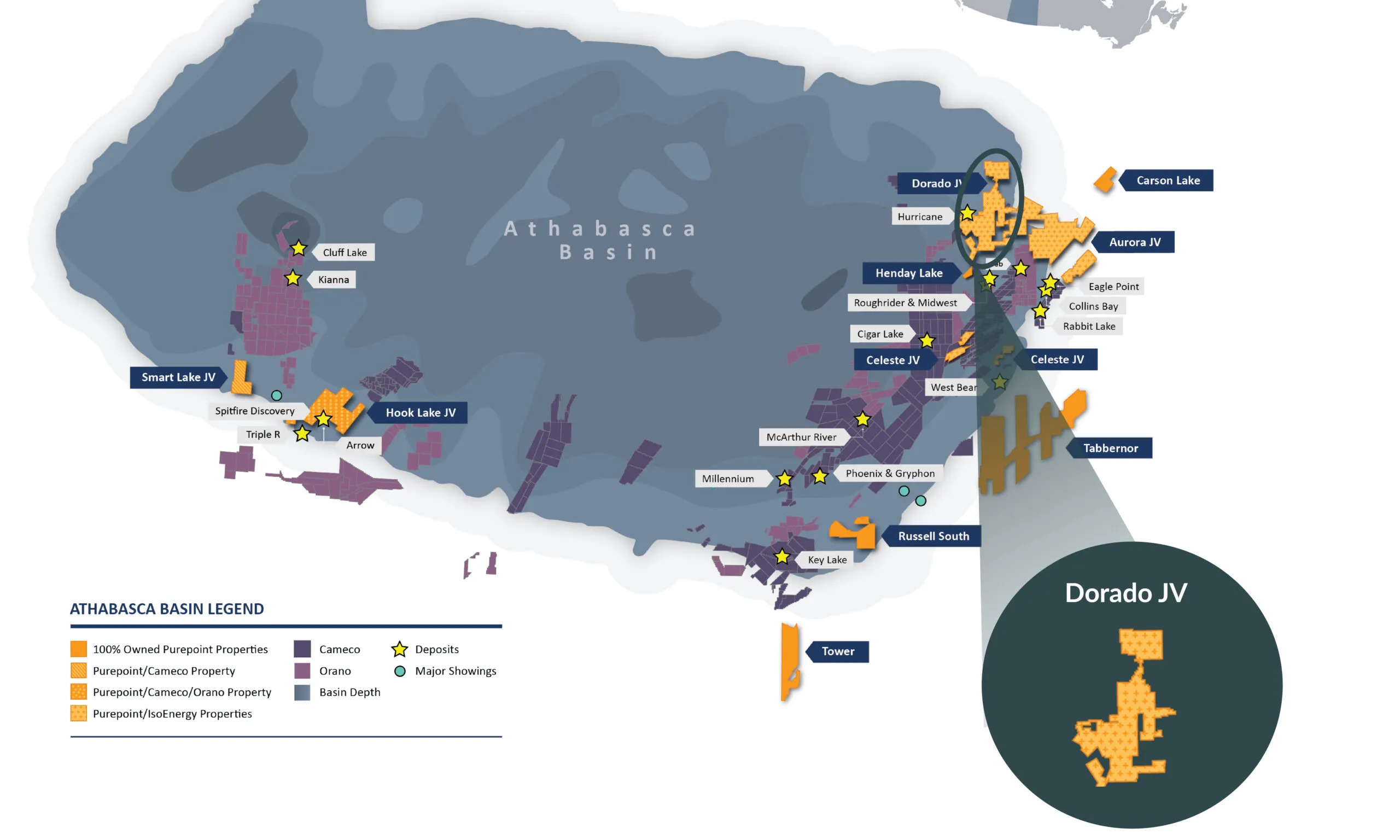
Uranium explorers spent much of 2026 conserving cash as equity markets fell and investor attention moved to other sectors. Purepoint Uranium Group Inc. (TSXV:PTU) is heading the other way. Its 50/50 joint venture (JV) with IsoEnergy has approved 14 diamond drill holes totaling 7,700 meters (m) at the Dorado Project in Saskatchewan's eastern Athabasca Basin, with drilling targeted to begin in January 2027.
The programme follows up a new target called Q24, where the first hole drilled in summer 2026 intersected 7.4 m of elevated radioactivity at the unconformity. Purepoint can keep drilling through a weak financing market because partners fund a large share of its exploration and management fees cover most of its overhead. In an interview at Mines and Money in London, management explained how that structure works and why the company will not slow its pace in 2027.
Opens a Second Front at Dorado
The 2027 plan starts at Q24, a target on a previously untested conductive structure. The first hole there intersected 7.4 m of elevated radioactivity from 284.1 m to 291.5 m downhole, averaging 8,760 counts per second (cps) with a maximum reading of 50,110 cps. The interval spans the unconformity directly above a graphitic basement conductor. That is the classic geological setting for uranium mineralization in the Athabasca Basin.
The same hole cut further zones of elevated radioactivity below the main interval, plus a nearby chalcopyrite vein. The company reads both as evidence of the hydrothermal processes commonly associated with uranium mineralization. The intervals are downhole gamma probe readings, and true widths are unknown.
The winter programme assigns 9 holes totaling about 4,950 m to Q24. The holes will step out northwest and southeast of the first hole to test the continuity, orientation, and extent of the system. Winter access preparation is planned for December 2026, with drilling targeted from January through March 2027. Management said Q24 will be the focus when crews return in January.
Nova Gets New Targets From 2026 Geophysics
Nova, inside the Q48 grid, is the JV's high-grade discovery. Drilling in 2025 returned 1.62% U₃O₈ over 2.1 m, including 8.13% over 0.4 m. Follow-up holes have confirmed uranium mineralization at several points along the Nova conductive corridor. The company reports that the mineralized corridor now extends to 1 kilometer (km). Winter 2026 drilling added 1.65% U₃O₈ over 0.3 m at the unconformity.
The 2027 summer programme calls for 5 helicopter-supported holes totaling about 2,750 m in July and August. They will test conductive, structurally complex features southwest and northeast of the discovery. A MobileMT survey of 2,390 line km flown across Dorado in 2026 identified those features. The same summer window covers airborne magnetotelluric surveys on the Aurora Main, Celeste North, and Celeste South properties.
The 2027 plan follows a 2026 season in which the JV completed 8,879 m of diamond drilling in 16 holes, plus 5 restart holes. Dorado lies on the Larocque Trend, which also hosts IsoEnergy's high-grade Hurricane deposit.
Interview with Chris Frostad, President & CEO of Purepoint Uranium
A Partner-Funded Operator Model
Purepoint operates 10 projects in Canada, and most are joint ventured with larger companies. Cameco and Orano are partners at Hook Lake, Cameco at Smart Lake, and IsoEnergy across Dorado, Aurora, and the Celeste Block. Eldorado Gold is earning into the Denare West project. Purepoint earned a 21% interest at Hook Lake and a 27% interest at Smart Lake by spending the first money on those projects, and it still operates both on behalf of the partnerships.
The IsoEnergy arrangement started differently. Each company contributed properties in the eastern Athabasca Basin to form a single 50/50 JV, established in December 2024, which now covers about 101,453 hectares. The partners split exploration costs, and Purepoint is paid to run the programmes.
President and Chief Executive Officer of Purepoint, Chris Frostad, explained how the fee offsets the company's share of spending:
"We operate the projects, we get paid to do so and we do all the exploration, but we split the costs going in. We have less money we need to raise, less dilutive to our shareholders, and we don't get cornered in markets like today where we have to do a raise because we have money available to us and and partners who are picking up a lot of the freight."
Frostad put net overheads over the last 12 months at around $300,000. Fees have covered all overhead in some years, though in most years they cover the bulk of it. Lower cash needs mean smaller raises and less dilution for shareholders.
Governance Puts Partner Geologists on Every Programme
Purepoint stays the operator for as long as the projects remain in the exploration phase. It drafts the programmes and budgets, then presents them to a technical committee where partner geologists challenge them until both sides agree. The JV agreements set a minimum level of exploration and a spending ceiling. Neither 50/50 partner can stall a project or force excessive spending on the other.
At Hook Lake, no partner holds a majority. Frostad said Cameco and Orano generally side with each other and can outvote Purepoint, and that the majors pace the work more often than they push it. Partner review applies at the Cameco and Orano projects as well, and Frostad said few juniors face that level of outside technical scrutiny.
Financing on the Timetable
Purepoint has cash in the bank and chose not to raise in late 2026. Frostad said a raise made little sense with markets falling sharply, and that Cameco was the first partner to advise against raising at that point. The company typically raises what it needs for the next budget year. It is waiting for tax-loss selling pressure to ease in the new year before deciding on timing.
Canada's flow-through system lets explorers pass exploration deductions to investors and extends to a charitable donation structure. Under that structure, shares can end up with investors outside Canada, usually through a slightly discounted, possibly warrant-bearing private placement. Frostad said this has drawn more interest from European investors during meetings in London and Zurich.
The Investment Thesis for Purepoint Uranium
- Purepoint and IsoEnergy have approved 7,700 meters of diamond drilling in 14 holes at Dorado for 2027, so the company keeps drilling while many uranium explorers have cut back.
- The first hole at the new Q24 target intersected 7.4 meters of elevated radioactivity at the unconformity above a graphitic conductor, and 9 winter holes will test its extent from January through March 2027.
- The Nova discovery has returned up to 8.13% U₃O₈ over 0.4 meters, and 5 summer holes will test new structures southwest and northeast of it in July and August 2027.
- Management fees cover about 75% of overhead by the Chief Executive Officer's estimate, which reduces how often and how much the company needs to raise.
- Cameco, Orano, and IsoEnergy fund exploration alongside Purepoint and review each programme through joint technical committees.
- Monitor Q24 assays and winter step-out results as the next catalysts, while recognizing that the company has no defined resource and relies on partner spending decisions.
Purepoint gives shareholders exposure to partner-funded drilling across a district-scale land package in the Athabasca Basin. The winter results at Q24 will show whether Dorado holds a second mineralized system beside Nova.
Macro Thematic Analysis
Uranium equities had a quieter 2026 as technology and energy-crisis themes competed for investor capital. For explorers, a weak tape forces a choice between drilling and preserving cash, and many juniors chose cash. That choice has a cost, because discovery in the Athabasca Basin requires sustained spending over several programmes.
Frostad tied the company's pace to the money needed to find a deposit:
"You've got to put money in the ground. I think in the last 20 years there have been six new deposits defined. And every one of those, if you go back, those companies spent between $10 and $20 million before they hit their first discovery hole."
Frostad said a junior spending $500,000 a year on uranium exploration has little realistic chance of a discovery. Partnerships change the math. A 50/50 JV lets Purepoint put a full programme in the ground while paying half, and at its Cameco and Orano projects the majors hold the larger interests. Purepoint's earlier work at Hook Lake produced the Spitfire discovery, with results including 10.3% U₃O₈ over 10.0 m, although no resource has been defined there.
The western side of the basin shows the scale of spending that discovery work draws. Hook Lake lies in the Patterson Uranium District, near NexGen Energy's Arrow deposit and Paladin Energy's Triple R deposit. NexGen had a 42,000 m drill programme underway in 2026 east of Arrow. Juniors that must raise into a falling market accept heavy dilution or stop work. Purepoint's partners carry much of its programme cost, and its management fees cover most of its overhead.
TL;DR:
Purepoint Uranium's 50/50 joint venture with IsoEnergy will drill 14 holes totaling 7,700 meters (m) at Dorado in 2027. The 9 winter holes, from January through March, will follow up a first hole at the Q24 target that intersected 7.4 m of elevated radioactivity at the unconformity. The 5 summer holes will test new structures around the Nova discovery, which has returned up to 8.13% U₃O₈ over 0.4 m. Partners fund a large share of exploration, and management fees cover about 75% of overhead, so Purepoint can keep drilling without raising into a weak market. The company has no defined resource and depends on partner spending decisions.
FAQs (AI-Generated)
Analyst's Notes





Subscribe to Our Channel



Stay Informed