




Canada Nickel: Positioning for Long-Term Value as Nickel Market Fundamentals Reset



Canada Nickel's Crawford Project advances toward construction amid tempered nickel forecasts, offering investors exposure to critical mineral supply outside Indonesia's dominance.
- Canada Nickel advances its Crawford Nickel Sulphide Project toward year-end 2026 construction decision amid a cooling nickel market, positioning for long-term fundamentals over short-term speculation.
- Crawford holds the world's second-largest nickel reserve with 3.789 million tonnes of contained nickel and robust feasibility economics (US$2.8 billion after-tax NPV₈% and 17.6% IRR) making it a first-quartile cost producer.
- The project has been designated a national priority by Canada's federal government and Province of Ontario, backed by strategic shareholders including a major Canadian gold producer (10.0%), a leading battery manufacturer (7.2%), and a global diversified mining company (6.3%).
- The Timmins Nickel District contains 10.13 million tonnes of measured and indicated nickel across eight published resources, positioning Canada Nickel to become a major non-Indonesian nickel supplier.
- Three separate carbon storage pathways, including IPT Carbonation technology with potential to store 1.5 million tonnes of CO₂ annually, qualify the project for US$600 million in Canadian tax credits while addressing supply chain decarbonization demands.
Canada Nickel Advances Amid Market Recalibration
As base metals analysts temper their 2026 forecasts following January's speculative rally, Canada Nickel Company (TSX-V: CNC) finds itself in a strategically advantageous position. While research indicates that nickel is expected to post modest 4 to 5% price gains with reduced battery demand signaling lower enthusiasm, the company's Crawford Nickel Sulphide Project continues advancing toward a year-end 2026 construction decision, targeting first production by late 2028. The timing reflects a disciplined approach to project development. Rather than chasing speculative price spikes, Canada Nickel has focused on building a low-cost, large-scale operation capable of generating returns across price cycles.
This approach gains relevance as market analysts note that industry demand fundamentals are expected to reassert themselves following the unsustainable rally that pushed copper to record levels. For nickel, where Indonesia's output growth has dampened near-term price enthusiasm, the investment case increasingly centers on supply chain security, carbon credentials, and jurisdictional stability—areas where Canada Nickel holds structural advantages. The company's January 2026 investor presentation outlines a comprehensive financing strategy targeting US$2.5 billion in project capital, supported by US$600 million in expected investment tax credits and strategic offtake arrangements.
Company Overview: Building North America's Next Major Nickel Operation
Canada Nickel Company, headquartered in Toronto, has assembled a district-scale land position in the Timmins region of Ontario containing over 42 km² of ultramafic rock targets (the geological host for nickel mineralization). The company's flagship Crawford Project anchors this portfolio with proven and probable reserves totaling 1,715 million tonnes grading 0.22% nickel, containing 3.789 million tonnes of nickel metal alongside significant cobalt, platinum group metals, iron, and chromium byproducts. According to third-party industry analysis cited in the company's feasibility study, Crawford holds the world's second-largest nickel reserve after Russia's Norilsk operation.
Beyond Crawford, Canada Nickel has published resources at seven additional properties in the Timmins Nickel District. As detailed in the company's investor deck, these eight resources collectively contain 10.13 million tonnes of measured and indicated nickel (4.30 billion tonnes at 0.24% nickel) and 12.46 million tonnes of inferred nickel (5.41 billion tonnes at 0.23% nickel). The project's bankable feasibility study, completed in October 2023 and updated through Front End Engineering Design (FEED) work in March 2025, demonstrates life-of-mine average net cash costs of US$0.39 per pound and all-in sustaining costs of US$1.54 per pound after byproduct credits, positioning Crawford in the first quartile of the global nickel cost curve.
Key Development: Crawford Achieves National Priority Status
In a significant validation of the project's strategic importance, Canada Nickel's Crawford Project was referred to Canada's Major Projects Office by the federal government and named to Ontario's new "One Project, One Process" (1P1P) framework. Prime Minister Mark Carney stated:
"Canada Nickel's Crawford Project will anchor Canada's global leadership in clean industrial materials... Crawford will set the global standard for the future of responsible mining. In 2026, our government is going full-tilt to unlock one of the world's largest nickel deposits that will supercharge our economy and help end China's critical mineral dominance."
This political support translates into tangible benefits: streamlined permitting processes, coordinated federal-provincial regulatory reviews, and access to government financing programs designed to accelerate critical mineral development. The company filed its Environmental Impact Statement in November 2024 and is advancing toward receipt of final federal permits in 2026, with construction targeted to begin by year-end. Financing progress includes a US$500 million Letter of Interest from a Canadian export credit agency to serve as Mandated Lead Arranger for the debt facility, a C$500 million support letter from a leading Canadian financial institution, and active discussions with global export credit agencies and government funding programs spanning Canada, France, Germany, Japan, and Korea.
Strategic Significance: Non-Indonesian Supply in a Concentrated Market
Market analysis highlighting Indonesia's output growth as a factor dampening near-term nickel enthusiasm underscores a critical aspect of Canada Nickel's investment thesis: supply concentration risk. The company's investor presentation draws a direct parallel between nickel supply concentration in 2024 and OPEC's control of oil markets at its 1973 peak, noting that Indonesia now controls 61% of global nickel production (exceeding OPEC's 54% share of oil at that time) with the Philippines adding another 11% to bring Southeast Asian dominance to 72%. This concentration creates multiple strategic vulnerabilities as Indonesia has already demonstrated willingness to manage supply through reducing mining licenses from three years to one year, banning new nickel pig iron smelters and HPAL operations except for downstream processing, and implementing significant fines for forestry violations.
Canada Nickel CEO Mark Selby, who brings extensive nickel market expertise from previous roles in the Canadian mining industry, noted that nickel has become Indonesia's largest export product at approximately 12% of total exports. The company expects Indonesia will attempt to push ore and nickel prices higher during the Philippine rainy season (January to March) when alternative ore supply is seasonally constrained, creating price volatility that favors disciplined, long-life operations in stable jurisdictions. For end-users seeking supply chain security (particularly automotive and battery manufacturers facing geopolitical and ESG pressures) Crawford offers Class 1 nickel from a Tier 1 jurisdiction with established rule of law, transparent permitting, and labor standards.
Carbon Sequestration: Differentiating Through Decarbonization
While market research notes that reduced battery demand has tempered nickel enthusiasm, the energy transition's underlying trajectory continues to drive structural demand for low-carbon materials. Canada Nickel has developed a unique competitive advantage through three separate pathways for carbon sequestration that could enable net-zero or even net-negative nickel production (a distinction increasingly valued in supply chains facing Scope 3 emissions scrutiny). The company's proprietary IPT Carbonation process utilizes tailings directly from the mineral processing circuit, conditioning them with CO₂ for a brief period to permanently store carbon as solid carbonate minerals with latest testwork demonstrating potential to store 1.5 million tonnes of CO₂ annually at Crawford.
Beyond IPT Carbonation, Canada Nickel is working with an Australian technology partner to commercialize enhanced weathering technology that could increase CO₂ storage capacity by an order of magnitude to 10 to 15 million tonnes annually, potentially reaching more than 500 million tonnes of lifetime sequestration capacity at Crawford alone. A third pathway involves partnership with the University of Texas at Austin and the U.S. Department of Energy's ARPA-E program to pilot direct CO₂ injection and mineralization techniques where injected CO₂ turns to solid rock within six months. This approach qualifies for Canada's Carbon Capture, Utilization, and Storage (CCUS) investment tax credit (50% of eligible capital expenditures for projects commissioned between 2022 to 2030) contributing an estimated US$300 million to project economics and improving after-tax IRR from 17.6% to 18.9% when CCUS credits are included.
Current Activities: District Exploration & Downstream Development
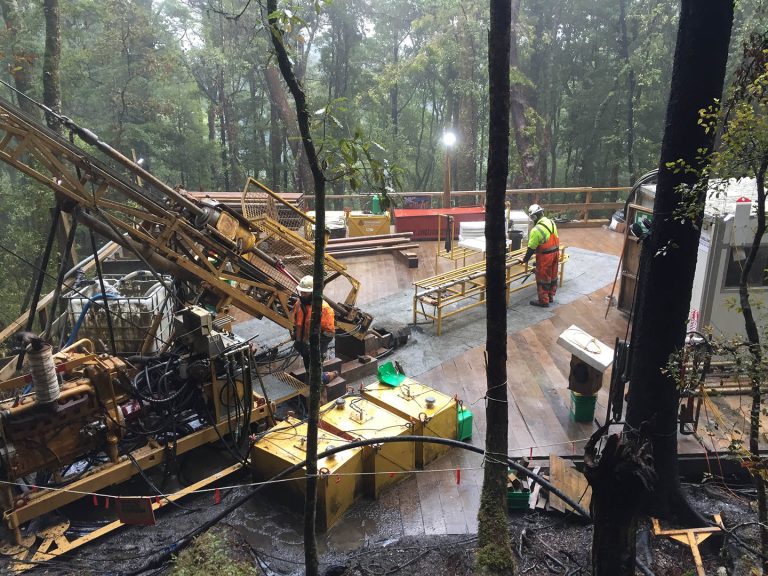
While advancing Crawford toward construction, Canada Nickel continues systematic exploration across the Timmins Nickel District to demonstrate the region's potential as what the company describes as potentially "the world's largest nickel sulphide district." The company's 2024 drilling program announced successful results from thirteen different properties, maintaining a 98% success rate in intersecting target mineralization across 20+ consolidated ultramafic targets with 25 times the geophysical footprint of Crawford. Notable results from the company's "Three Giants" (Reid, Mann West, and Midlothian) illustrate the district's scale. At Reid, where the initial resource was published in January 2026 covering only 55% of the 3.9 km² target footprint (more than twice Crawford's size), infill drilling intersected 0.48% nickel over 12.0 metres and 0.41% nickel over 37.5 metres within 73.5 metres of 0.34% nickel.
Perhaps most significantly, drilling at Bannockburn intersected the first massive sulphide discovery in the Timmins Nickel District: 3.95% nickel, 0.40% copper, 0.15% cobalt, and 1.08 g/t palladium and platinum over 4.0 metres within 12 metres grading 1.61% nickel. Concurrently, the company's NetZero Metals subsidiary, led by an executive with 35 years of nickel processing experience in senior leadership positions at major global refineries, is advancing engineering studies with international engineering firms for downstream processing facilities that would create what is expected to be North America's largest nickel processing operation and Canada's only large-scale stainless steel and alloy production facility.
Market Context: Fundamentals Over Speculation
Market reports that January 2026's price rally was "speculative and not fully sustainable" with "industry demand fundamentals expected to reassert themselves" provides important context for evaluating Canada Nickel's investment timing. While copper reached record levels around $14,500 per tonne and tin hit unprecedented highs near $59,000 per tonne during this rally, nickel's more modest gains reflect the structural factors that analysts expect will limit near-term price appreciation: Indonesia's continued capacity additions and battery demand growth below previous expectations. However, these near-term headwinds obscure longer-term supply-demand dynamics that favor new, large-scale, low-cost projects in stable jurisdictions.
Industry data cited in Canada Nickel's feasibility study identifies Crawford as the world's second-largest nickel resource, positioned behind only Russia's Norilsk operation in contained metal with 3.789 million tonnes of nickel in proven and probable reserves. The company's all-in sustaining cost of US$1.54 per pound (approximately $3,395 per tonne) provides substantial margin even at conservative long-term price assumptions. Chief Financial Officer Wendy Kaufman, with over 25 years leading mining companies in project finance and capital markets including completion of a $4 billion finance for a major copper project, has structured a capital cost funding package that targets 40% equity and 60% debt for the project's US$2.0 billion initial capital requirement (reflecting a 5% increase from the original US$1.943 billion feasibility study estimate), minimizing equity dilution while the company advances a world-class asset toward production.
Investor Takeaway: Positioning for the Next Cycle
For investors evaluating Canada Nickel at this stage of project and market development, the disconnect between near-term price pessimism (as captured in analyst reports projecting only 4 to 5% nickel gains for 2026) and long-term supply requirements creates entry point opportunities in development-stage projects that will produce into a different market environment. Crawford's targeted late-2028 first production timing positions it to enter production as Indonesian supply growth plateaus and energy transition demand continues its multi-decade trajectory. The project's scale and cost position provide downside protection in modest price environments while preserving substantial upside leverage if supply tightness emerges, with byproduct credits from cobalt (215,000 tonnes life-of-mine), platinum group metals (777,000 ounces), iron (110 million tonnes), and chromium (9.787 million tonnes) providing natural hedging against nickel price volatility.
The carbon sequestration capability differentiates Crawford in an increasingly ESG-conscious market as automotive OEMs and battery manufacturers face mounting pressure to decarbonize supply chains. Canada Nickel's vision for a "Zero-Carbon Industrial Cluster" in Timmins (integrating mining, carbon storage, and downstream processing) positions the company to capture this value through both direct carbon credit monetization and premium offtake pricing. The district-scale resource base provides option value beyond the initial Crawford development with 10.13 million tonnes of measured and indicated nickel already outlined across eight published resources, plus 12.46 million tonnes of inferred nickel and substantial exploration upside across 20+ targets creating potential for Crawford to serve as the anchor for multiple decades of production growth.
The Investment Thesis for Canada Nickel Company
- Non-Indonesian Class 1 nickel production in a Tier 1 jurisdiction becomes increasingly valuable as concentration risks materialize in Southeast Asian supply.
- First-quartile all-in sustaining costs of US$1.54/lb provide margin resilience across price cycles while preserving leverage to supply tightness.
- Unique carbon sequestration capabilities enable net-zero or net-negative production, capturing ESG premiums and US$600 million in Canadian tax credits.
- National priority designation, strategic shareholder base, and advancing financing package de-risk permitting and funding pathways toward year-end 2026 construction decision.
- 22.59 million tonnes of total nickel resources across eight published estimates plus exploration upside create multi-decade production potential beyond initial Crawford development.
- Advancing toward production during period of price consolidation positions project to enter market as Indonesian supply growth moderates and structural demand strengthens.
Long-Term Value Creation in a Resetting Market
As market analysis makes clear, the base metals market is entering a phase where "bullish sentiment remains, but tempered" and "price spikes likely to be reined in by physical demand realities." For investors, this environment favors projects with robust fundamentals over speculative near-term plays. Canada Nickel's Crawford Project exemplifies these characteristics: world-class scale with 3.789 million tonnes of nickel reserves, first-quartile costs at US$1.54/lb AISC, strong political and strategic support, and unique decarbonization capabilities that align with long-term supply chain evolution. The company's systematic approach to district-scale consolidation, methodical project advancement, and integrated downstream vision reflects management's deep industry experience and long-term perspective.
The participation of strategic investors including a major Canadian gold producer (10.0%), a leading Asian battery manufacturer (7.2%), a global diversified mining company (6.3%), and an Indigenous nation partner (7.1% on conversion) validates this approach while providing technical expertise, offtake commitment, and social license that enhance project execution prospects. For investors with appropriate time horizons and risk tolerance for development-stage mining assets, Canada Nickel offers exposure to critical mineral supply outside the Indonesia-China nexus, carbon sequestration as a new value driver in mining, and optionality on a potentially world-class mining district (all in a jurisdiction with established infrastructure, skilled labor, and transparent regulation). As structural supply-demand trends reassert themselves following the current period of market recalibration, Crawford's path toward late-2028 production positions it to emerge as a significant participant in the next phase of the global nickel market.
TL;DR
Canada Nickel advances Crawford (world's 2nd largest nickel reserve with 3.789Mt contained nickel) toward year-end 2026 construction decision with US$2.8B after-tax NPV₈%, 17.6% IRR, and first-quartile US$1.54/lb AISC. National priority designation, strategic backing from major mining and battery companies, and unique carbon sequestration enabling zero-carbon production (qualifying for US$600M tax credits) differentiate the project as Indonesian supply concentration increases. District-scale 22.59Mt total nickel resource base across eight properties positions company to become major non-Indonesian supplier entering production late-2028 as near-term price pessimism creates entry opportunity before structural demand strengthens.
FAQs (AI-Generated)
The project's first-quartile costs (US$1.54/lb AISC), 41-year mine life with 1.558 million tonnes nickel production over life-of-mine, and late-2028 production timeline position it for long-term economics independent of near-term price volatility.
Three carbon storage pathways enable net-zero production qualifying for US$600 million in Canadian CCUS and Clean Technology Manufacturing tax credits while commanding ESG premiums from battery supply chains facing Scope 3 pressure.
Indonesia now controls 61% of global nickel supply and is actively managing output through license reductions and forestry enforcement, creating supply security premium for non-Indonesian Class 1 producers in stable jurisdictions.
National priority designation streamlines permitting, US$500M export credit agency financing commitment anchors debt package, US$600M in expected tax credits reduces equity needs, and strategic offtake provides demand certainty.
Eight published resources totaling 22.59Mt nickel across 42km² of targets (including Reid with 3.6Mt total resource potentially larger than Crawford's 9.8Mt, and massive sulphide discovery at Bannockburn) create multi-decade district development potential.
Analyst's Notes





Subscribe to Our Channel




Stay Informed


