




Canada's Steel Counter-Tariffs Lift North American Mine Input Costs



Canada’s steel counter-tariffs raise North American mine project costs as hot-rolled coil reaches $1,205, favoring developers with secured pricing.
- Canada’s counter-tariffs take effect on September 8, 2026, covering 874 tariff lines and C$27.6 billion in US imports.
- On September 3, 2026, steel was the largest target, covering C$10.17 billion in 2025 imports: C$4.57 billion in basic and semi-finished steel at the 50% rate and C$5.59 billion in downstream products.
- Steel Market Update’s (SMU) US hot-rolled coil (HRC) average rose from $930 per short ton on January 6, 2026, to $1,205 on September 3, 2026, while plate averaged $1,395 per short ton.
- Iron ore fines containing 62% iron traded at $97.72 per metric ton on September 2, 2026, within their $93 to $100 range since June, leaving producers without a revenue offset to higher steel costs.
- US-Canada talks resuming before the threatened 50% tariff on Canadian steel takes effect on January 1, 2027, could lower tariff-related steel costs.
50% Counter-Tariffs Raise Canadian Steel Costs as HRC Reaches $1,205
Canada’s counter-tariffs take effect on September 8, applying rates of 15%, 25%, and 50% to 874 tariff items covering an estimated C$27.6 billion in US imports. Based on 2025 trade data, the listed goods were worth C$31.15 billion, including C$13.59 billion, or 43.6%, in steel, aluminum, and other base-metal products.
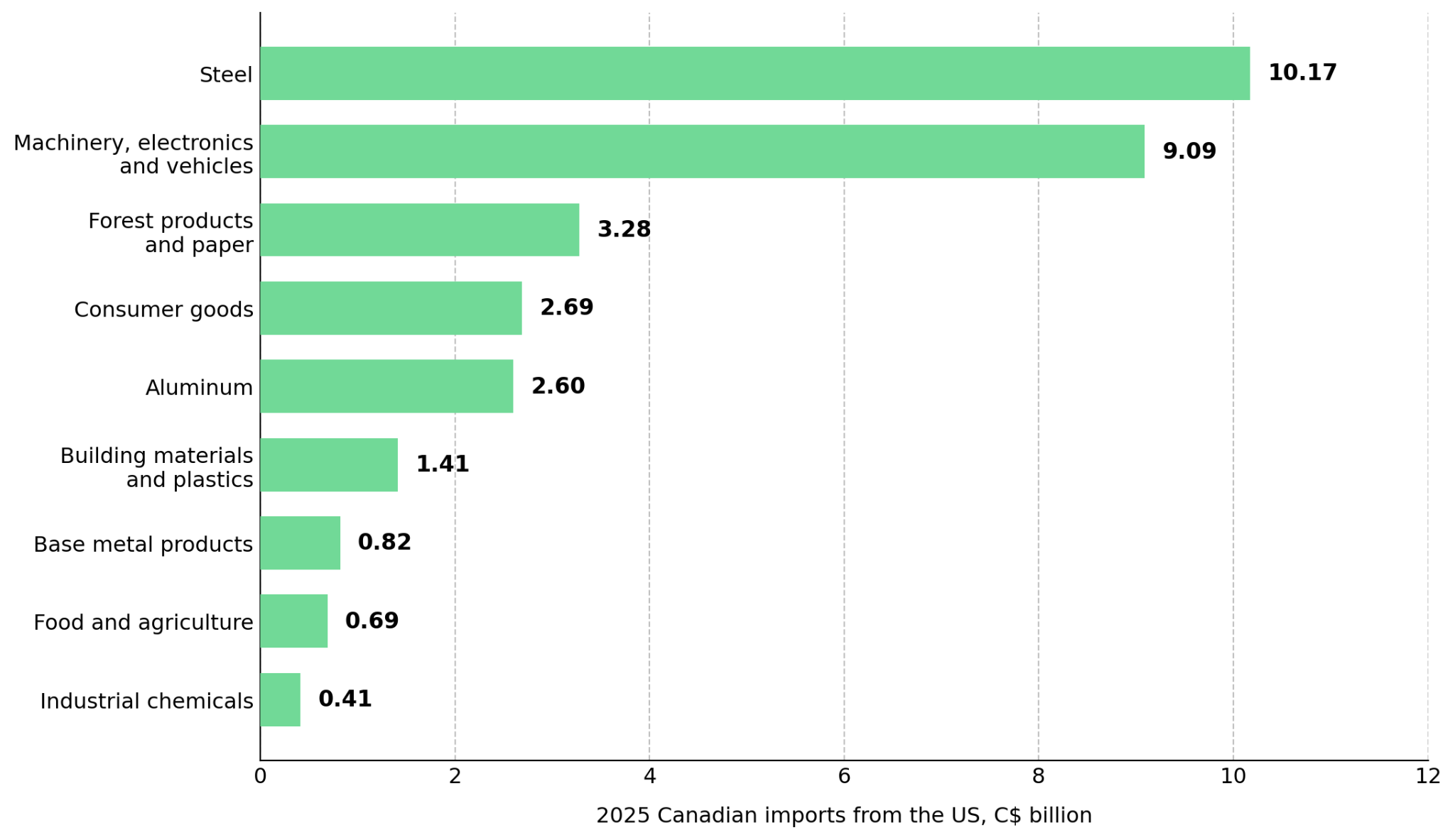
SMU’s HRC assessment averaged $1,205 per short ton and plate averaged $1,395, while Nucor’s consumer spot price reached $1,185 and mill negotiability fell to a nearly five-year low, raising costs and reducing bargaining power for mine builders.
42.9% US Steel Import Share Raises Procurement Exposure for Canadian Mines
Tariffs raise mining capital costs through procurement because projects buy steel plate, structural sections, piping, grinding media, and ground support. Canada sourced 42.9% of its steel and iron imports from the US, worth $3.86 billion in the first half of 2026, and the surtax on affected goods doubles from 25% to 50% on September 8, increasing costs for Canadian projects that buy US steel.
US steel imports fell 26% by volume from January through May 2026 compared with the same period in 2025. Dennis Darby, President and CEO of Canadian Manufacturers & Exporters, explains that changing suppliers requires capital investment, new equipment, additional workers, customer commitments, and time to qualify production. Jamieson Greer, US Trade Representative, confirms that no talks are underway, giving developers with qualified non-US suppliers or steel orders secured before September 8 a procurement advantage.
Fixed Construction Schedules Turn Tariffs Into Immediate Capital Pressure
Projects under construction must absorb higher steel costs or delay completion because procurement is tied to build schedules. Pierre Gratton, President of the Mining Association of Canada, identifies higher mine input costs as the sector’s primary concern. Lithium Americas estimated Thacker Pass Phase 1’s tariff exposure at $80-100 million against a $2.93 billion capital estimate that excluded tariffs and cited limited US fabrication capacity. Jonathan Evans, Chief Executive Officer of Lithium Americas, confirms that mechanical completion remains targeted for late 2027, preserving the schedule despite higher procurement costs.
Stalled US-Canada Talks Favor Developers With Clear Cost Disclosures
Pre-production developers face greater cost exposure than producers because steel packages repriced after September 8 raise project capital costs and reduce internal rates of return. Developers with fixed-price steel contracts or completed procurement are better positioned to protect project economics. Producers absorb higher steel costs later through sustaining purchases of mill liners, grinding media, and ground support. Iron ore has traded between $93 and $100 per metric ton since June, leaving iron ore producers without a higher selling price to offset those costs.
Operational flexibility can be assessed through quantified tariff exposure, schedule stability, and access to fabrication capacity. Projects that disclose a defined tariff estimate, maintain completion targets, and identify fabrication constraints provide clearer visibility into capital costs and funding needs.
With no negotiations underway and neither government’s position disclosed, the September 8 deadline is an unreliable trading signal. Positioning should instead rely on third-quarter technical reports and revised capital estimates, which can quantify tariff exposure more reliably than political headlines.
$1,100 HRC Threshold Signals Lower Mine Costs
US steel supply remains constrained, with mill lead times at or near multi-year highs, price negotiability at a nearly five-year low, and imports down 26% by volume from January through May 2026 compared with the same period in 2025. An SMU HRC price above $1,150 per short ton supports pricing power for integrated steelmakers and electric arc furnace producers while raising capital costs for mine developers.
If US-Canada talks resume before January 1, 2027, and the 50% Section 232 tariff on Canadian steel is reduced, the tariff premium in US HRC could narrow. An SMU HRC assessment below $1,000 per short ton would reverse roughly $200 per short ton of the 2026 increase and reduce capital cost pressure on North American mining projects.
Steel producers retain pricing power, while mine developers with quantified tariff exposure or secured steel pricing hold an advantage over projects without those protections. Lower HRC prices or suspension of the Canadian surtax would reduce capital cost pressure on mine projects. SMU price assessments and Canadian government orders provide the key reversal signals.
Analyst's Notes





Subscribe to Our Channel
.png)

.png)

.png)
Stay Informed


