




China's Rare Earth Exports Swing With Trade Diplomacy; Kasiya's By-Product Isn't Waiting on Beijing



As Washington and Beijing negotiate rare earth flows ahead of the Trump-Xi summit, Sovereign Metals' Kasiya by-product offers supply independent of that outcome.
- China's rare earth magnet exports to the US fell 21% in August 2026 to 512 tons, days before Presidents Trump and Xi meet in Washington on September 24, 2026, to negotiate a trade truce that expires November 10, 2026.
- US Treasury Secretary Scott Bessent and Trade Representative Jamieson Greer met China's Vice Premier He Lifeng in New York the weekend before the summit to discuss artificial intelligence, trade and rare earth flows, with a senior US official saying China's critical mineral performance "has not been up to par."
- Sovereign Metals' Scoping Study for its Kasiya Critical Minerals Project in Malawi confirms a monazite rare earth concentrate by-product containing 5 of the 7 rare earths placed under Chinese export control since April 2025.
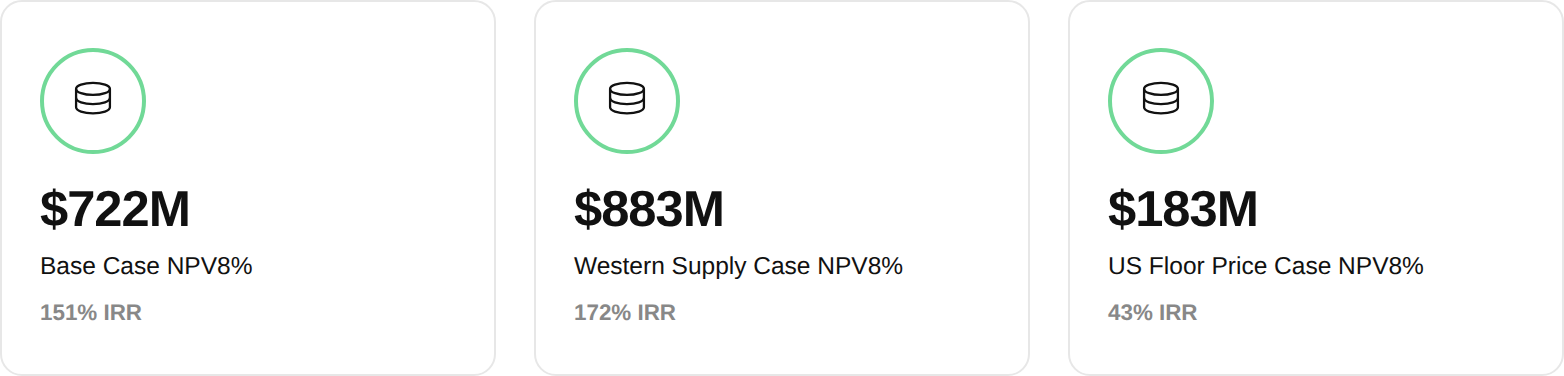
- The by-product carries a potential incremental pre-tax net present value at an 8% discount rate (NPV8%) of approximately US$722 million at a 151% internal rate of return, requiring no additional mining beyond Kasiya's existing definitive feasibility study.
- Even under a downside scenario applying US government floor prices instead of market rates, the by-product still generates approximately US$183 million of incremental NPV8%, supply that does not depend on Beijing's export licensing decisions.
China's rare earth magnet exports to the US fell 21% in August 2026, dropping to 512 tons from the month before, according to Chinese customs data. The dip lands days ahead of a September 24, 2026 meeting between Presidents Trump and Xi in Washington, called to work through everything from artificial intelligence (AI) to critical mineral flows. Rare earths and the magnets built from them became Beijing's clearest leverage point in trade talks last year, and the pattern is now familiar: restrictions tighten, negotiations produce partial relief, then the cycle repeats as the next deadline approaches.
That deadline is close. The US-China tariff truce, which caps duties at approximately 20%, expires November 10, 2026, and includes Beijing's commitment to keep critical minerals moving through expanded export licenses. US Treasury Secretary Scott Bessent and US Trade Representative Jamieson Greer met He Lifeng in New York on September 20, 2026, specifically to discuss rare earths alongside trade and AI, and a senior US official said China's performance on restoring mineral flows "has not been up to par." Bloomberg Economics has pointed to the trade-off built into that dynamic: Washington needs enough stability with Beijing to keep rare earth inputs moving, yet the same periods of calm that restore access to lower-cost Chinese material reduce the pressure on the US to build supply that doesn't depend on China at all.
That tension defines the industry problem this piece addresses: a rare earth supply chain still substantially routed through one country's export licensing office, where a single diplomatic outcome can loosen or tighten flows on short notice.
Industry Context
China introduced export controls on 7 medium and heavy rare earths in April 2025, including dysprosium, terbium, yttrium, samarium and gadolinium, citing dual-use applications. It added 5 more elements, including holmium and europium, in October 2025. China controls the large majority of global mined production of these elements and effectively all commercial separation capacity, leaving the US 100% import-reliant on yttrium and without any commercial-scale domestic supply of dysprosium, terbium or yttrium at its only fully integrated rare earth producer.
Rare earth magnet shipments to the US averaged roughly 504 tons a month in 2026, still below the 621 tons a month recorded in 2024 before the curbs began. The August dip and the timing of the Bessent-He Lifeng talks illustrate how closely rare earth flows now track the diplomatic calendar rather than underlying industrial demand. For downstream buyers and the investors backing them, that correlation is itself the risk: supply availability shifts with negotiating positions, not with mine output.
Emerging Practices & Industry Progress
The industry's response has concentrated on 2 tracks: government-backed price floors for the separation and magnet-making stage, and by-product recovery at the mining stage. Since July 2025, guaranteed minimum prices have become a standard feature of US rare earth supply arrangements, including a US$110 per kilogram floor for neodymium-praseodymium established with MP Materials Corp. and repeated with Lynas Rare Earths Limited, plus the first Western floor prices for heavy rare earths at US$575 per kilogram for dysprosium and US$2,050 per kilogram for terbium.
Those floors de-risk the separation and refining stage, but they still require a qualified, scalable feed of heavy rare earth concentrate. New separation capacity is being financed specifically to fill that gap: MP Materials with funding from the Department of War, Iluka Resources Limited with funding from Export Finance Australia, Tronox Holdings plc with funding from the Export-Import Bank of the United States, and Lynas with funding from the Department of War. The by-product model addresses the upstream half of that equation by recovering rare earths from mineral streams that an already-approved mine plan is generating anyway, rather than justifying a standalone rare earth mine on its own economics.
Remaining Challenges
By-product recovery still carries execution risk that a headline NPV figure does not capture. A monazite concentrate contains naturally occurring thorium and uranium, which typically requires Class 7 radioactive-material handling, specialized packaging, and cross-border transport approvals, none of which are simplified by a project's underlying mine plan already being approved.
A monazite concentrate also faces a commercial gate that recovery economics alone don't clear: product specifications, impurity limits, and radionuclide acceptance must be agreed customer by customer, regardless of how favorable a scoping study's numbers look. The gap between the resource-and-economics work, and a signed customer buying the concentrate is the last unresolved step before a by-product becomes bankable.
Company or Project Examples
Sovereign Metals (ASX: SVM | AIM: SVML | OTCQX: SVMLF) illustrates how the by-product model plays out against an existing project. Its Kasiya Critical Minerals Project in Malawi already carries a pre-tax net present value at an 8% discount rate (NPV8%) of US$2.204 billion from its April 2026 definitive feasibility study (DFS) for natural rutile and natural flake graphite, a 25-year mine life at 24 million tons per annum of throughput. The company's Scoping Study, released September 9, 2026, adds a monazite rare earth concentrate (REC) recovered entirely from the non-conductor tailings stream the DFS mineral separation plant already generates, requiring no additional mining and no new front-end processing.
At steady state, the Study forecasts 2,626 tons per annum of REC containing 1,485 tons per annum of total rare earth oxides over a 23-year initial life of mine, carrying 5 of the 7 rare earths under Chinese export control: dysprosium, terbium, yttrium, samarium and gadolinium. The Base Case shows an incremental NPV8% of approximately US$722 million at a 151% internal rate of return (IRR) on approximately US$29 million of incremental capital, with a Western Supply Case (reflecting higher payability for ex-China concentrate) lifting that to US$883 million at 172% IRR. A US Floor Price Case, applying the neodymium-praseodymium and heavy rare earth floors described above instead of Argus market forecasts, still generates approximately US$183 million of incremental NPV8% at a 43% IRR.
Kasiya's own commercial progress reflects that same gap between the resource-and-economics work and a signed customer: product qualification and offtake discussions are only beginning, and the Scoping Study itself carries an accuracy range of plus or minus 30%, short of the reserve-level certainty needed for project financing.
Managing Director and Chief Executive Officer of Sovereign Metals, Frank Eagar, tied the by-product's insulation from price cycles directly to Kasiya's cost base:
"Kasiya can potentially provide the supply this effort requires: 5 of the 7 rare earths under Chinese export controls, for at least 23 years, from a project already at the definitive feasibility stage. And because rutile and graphite carry the cost base, our rare earths do not need high rare earth prices or floor prices to be viable."
Regional & Jurisdictional Perspective
Kasiya's base-case export route runs by road to the Port of Dar es Salaam in Tanzania, then by sea to the US, with the company costing delivery specifically to CIF Houston, Texas at approximately US$3.68 per kilogram of REC. That routing places Kasiya's concentrate directly into the Western separation buildout described above, where MP Materials, Iluka, Tronox and Lynas are adding capacity across the US, Australia and Malaysia. Western primary production skews toward light rare earths, with only trace quantities of dysprosium, terbium and yttrium, so none of those facilities can rely on domestic mining alone for a qualified, scalable heavy rare earth feed, and Malawi's position outside China's supply chain, alongside Kasiya's status as a project already at the DFS stage rather than an early-stage discovery, shortens the distance between a financeable feed source and that new separation capacity.
Industry Outlook
The truce expiring November 10, 2026 sets a near-term marker for whether this month's export data and this week's summit produce a durable arrangement or another temporary reprieve. Sovereign has stated it will progress REC marketing and offtake discussions immediately, targeting completion of a pre-feasibility study in 2027. Whether or not the Trump-Xi summit produces lasting relief on rare earth flows, projects whose by-product economics hold under floor-price, no-cooperation assumptions represent the category of supply that Western buyers can plan around independent of the next round of diplomacy.
FAQs (AI-Generated)
Analyst's Notes





Subscribe to Our Channel











Stay Informed


