




C$186M Capex Makes Selkirk Copper's Minto a Leveraged Copper Call



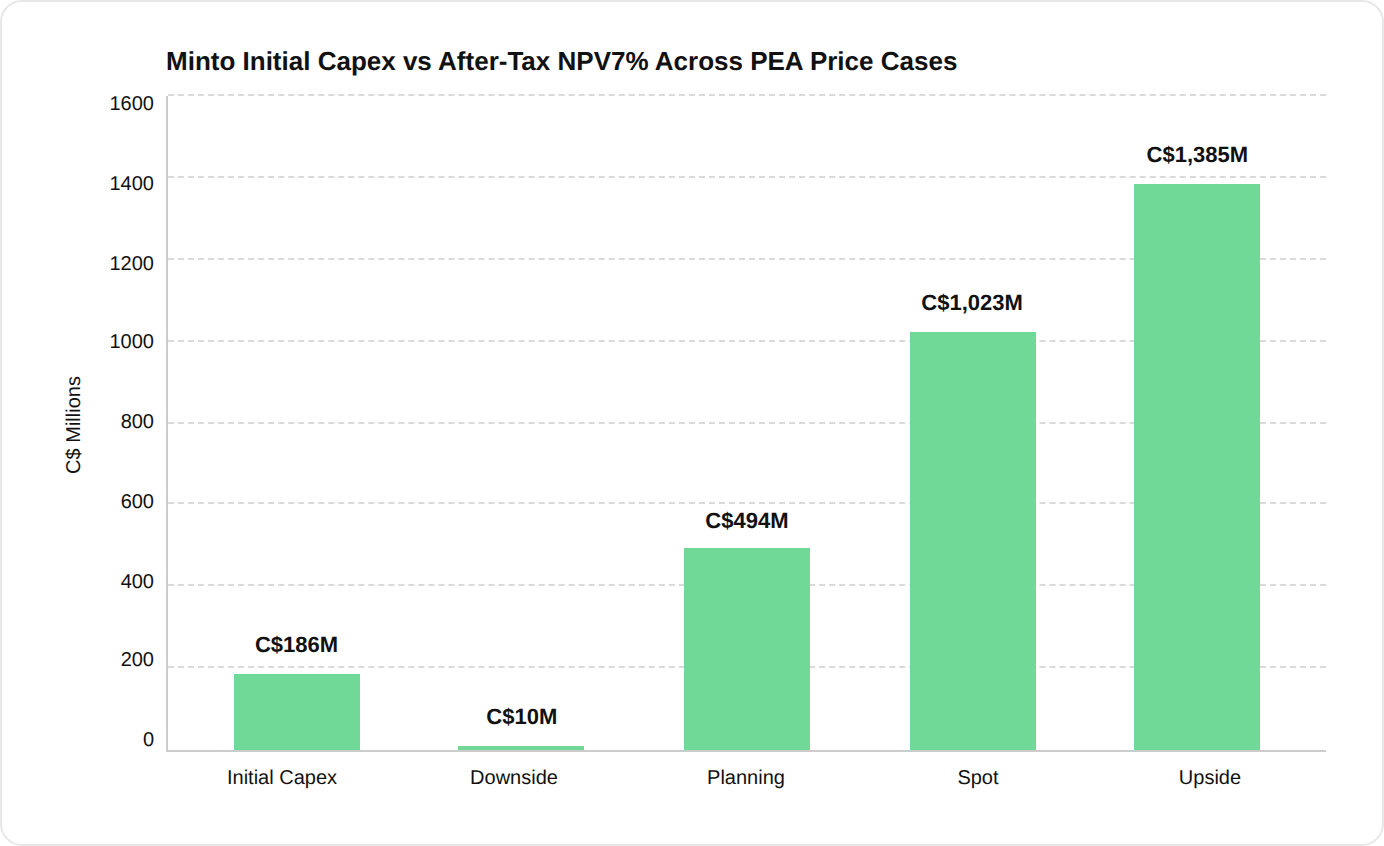
Selkirk Copper's Minto PEA pairs a C$186M initial capex with a 1.9-year payback, and NPV7% swings from C$10M to C$1,385M across the study's copper price cases.
- Selkirk Copper's preliminary economic assessment (PEA) for the Minto copper-gold-silver project in Yukon pairs initial capital of C$185.9 million with a 13-year mine life and a 1.9-year after-tax payback from first production.
- The PEA reports an after-tax net present value at a 7% discount rate (NPV7%) of C$494 million and a 47.8% after-tax internal rate of return at Planning Prices of US$5.00/lb copper, US$3,600/oz gold, and US$50.00/oz silver.
- Minto's Capital Efficiency Ratio, defined as after-tax NPV7% divided by initial capital cost, is 2.7:1 at Planning Prices and 5.5:1 at Spot Prices.
- NPV7% reaches C$1,023 million at Spot Prices and falls to C$10 million in the study's Downside case of US$3.50/lb copper, where payback extends to 6.5 years.
- Initial capital covers restart work at a site that already holds a 4,100 tonne per day mill, a 400-person camp, grid power, and water treatment, which the company values at more than C$330 million.
What Has Happened
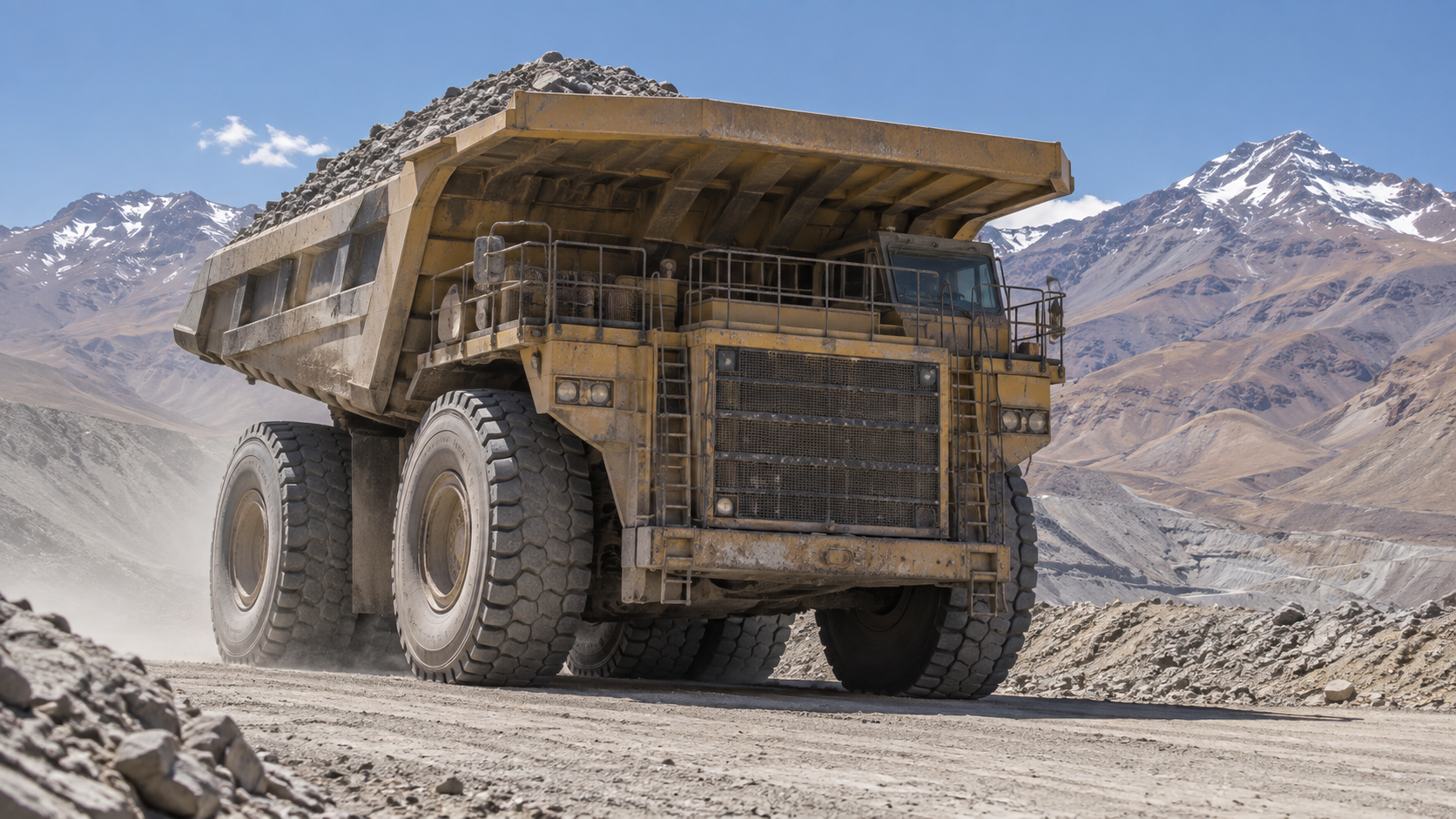
Selkirk Copper Mines Inc. (TSX-V: SCMI | OTCQX: SKRKF | FRA: IO20) published a preliminary economic assessment (PEA) for the Minto copper-gold-silver project in central Yukon on September 22, 2026. The study models a restart of open-pit and underground mining feeding an existing mill at 4,100 tonnes per day, producing a single copper-gold-silver concentrate over an initial 13-year mine life.
Initial capital is estimated at C$185.9 million. Against that outlay, the PEA reports an after-tax net present value at a 7% discount rate (NPV7%) of C$494 million, an after-tax internal rate of return (IRR) of 47.8%, and a payback of 1.9 years from first production, using Planning Prices of US$5.00/lb copper, US$3,600/oz gold, and US$50.00/oz silver. Sustaining capital across the 13 years, including a scoping-level closure and rehabilitation estimate, adds C$409.3 million.
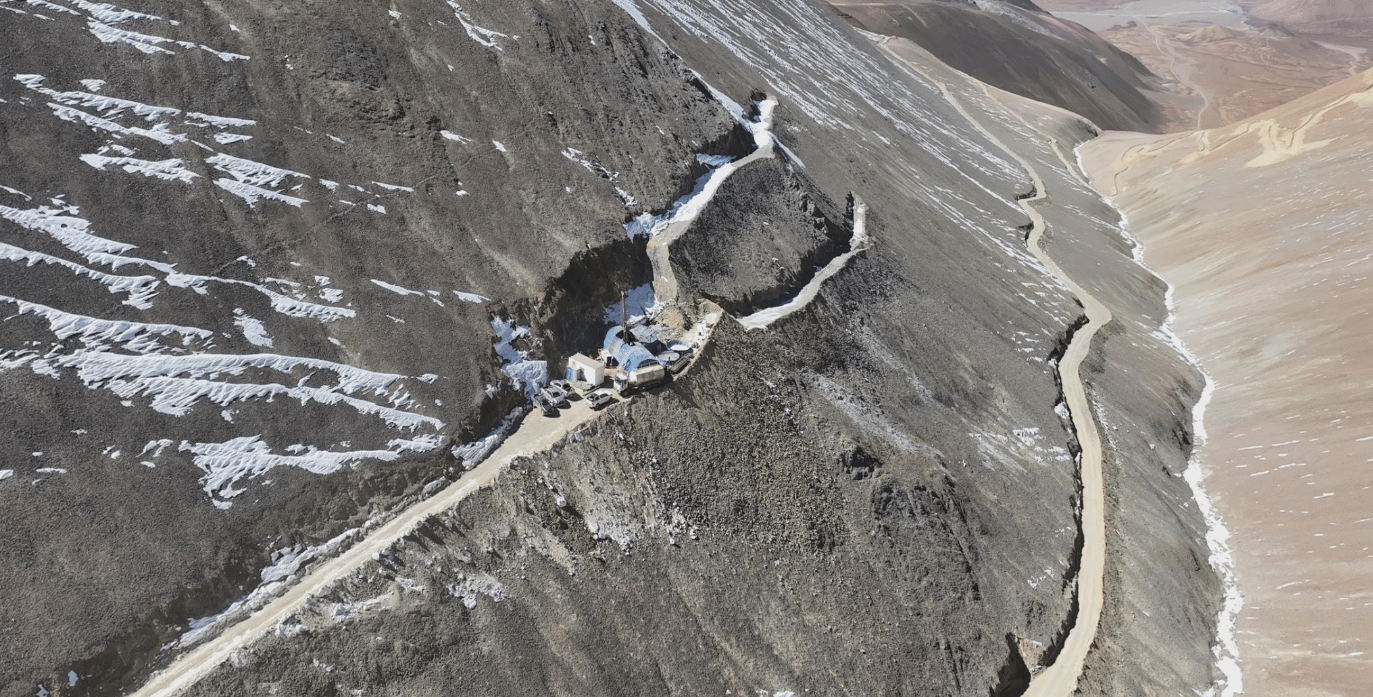
The initial figure is small because the plant is already standing. Minto produced high-grade copper concentrate as recently as May 2023, and the site retains a semi-autogenous grinding mill and 2 ball mills, a flotation circuit, a water treatment plant, a 400-person camp, an airstrip, a 27 km access road, grid power, and a substation. Selkirk Copper values the installed infrastructure at more than C$330 million.
What the Capital Efficiency Ratio Measures
The PEA reports a Capital Efficiency Ratio of 2.7:1 at Planning Prices, rising to 5.5:1 at Spot Prices. The company defines the ratio as after-tax NPV7% divided by initial capital cost and identifies it as a non-IFRS measure with no standardized meaning under accounting rules. Read plainly, it counts how many dollars of modeled project value each dollar of restart capital buys, before the sustaining bill arrives.
A second ratio in the study, Mine Life-to-Payback, comes to 6.8:1 at Planning Prices: planned mine life divided by the after-tax payback period from first production. The two ratios together describe an asset that returns its build cost early within a 13-year plan. Capital goes into rehabilitating underground workings, 2 open pits, a new three-stage crushing circuit, 2 gravity concentrators, and a concentrate dryer, not into a mill, a camp, a road, or a power line.
The starting point moves with the capital number. The estimate targets an Association for the Advancement of Cost Engineering Class 5 accuracy range of -50% to +100%, costs are stated in second quarter 2026 Canadian dollars with no escalation applied, and spending incurred before July 1, 2027, is excluded from the economics as sunk. A C$22.6 million contingency is included in the C$185.9 million.
Where the Price Leverage Comes From
A small capital base makes the result move hard with metal prices, and the PEA runs 4 price cases to show it. At Downside Prices of US$3.50/lb copper, US$2,500/oz gold, and US$35.00/oz silver, NPV7% is C$10 million, the IRR is 9%, and payback runs 6.5 years. At Planning Prices, the figures are C$494 million, 47.8%, and 1.9 years. At Spot Prices of US$6.50/lb copper, US$4,300/oz gold, and US$65.00/oz silver, NPV7% reaches C$1,023 million, a 78.2% IRR, and a 1.3-year payback. At Upside Prices of US$7.50/lb copper, US$5,400/oz gold, and US$75.00/oz silver, the study shows C$1,385 million, a 96.3% IRR, and a 1.0-year payback.
The PEA ranks the restart's sensitivities in order: copper price, the Canadian dollar-to-US dollar exchange rate, copper recovery, gold price, and operating costs. Gold and silver now count in full because the precious metals stream and the concentrate offtake agreement that previously encumbered the project were removed through the bankruptcy process, so the project now carries a 1.5% net smelter return royalty payable to the Selkirk First Nation. Mill feed over the plan contains approximately 434 Mlbs of copper, 271 koz of gold, and 2.36 Moz of silver.
President and Chief Executive Officer M. Colin Joudrie draws a comparison against larger copper assets when describing how Minto should be valued:
"This is not a tier 1 asset. It's a very good, highly leveraged asset to the copper price."
The Downside Column
The C$10 million Downside result is the honest end of that leverage. A 9% IRR comes with payback stretching to 6.5 years, compared with a 13-year plan, which leaves little room for the schedule slippage the study itself flags: returns are sensitive to mine construction execution timelines and permitting timelines.
Smelter terms swing with the case as well. The Downside and Planning cases apply treatment and refining charges of US$35/t and 3.5 US cents/lb payable copper, while the Spot and Upside cases apply negative charges of US$(186)/t and US$(0.186)/lb, the point at which smelters pay a premium to receive concentrate instead of charging to process it.
Joudrie treated that condition as without precedent:
"That is a first in the industry. Never happened before. It's just a very strong signal about the lack of supply of concentrate."
Operating costs give some cushion. Total on-site operating cost averages C$95.77 per tonne milled over the plan, with underground mining the largest unit component at C$34.47 per tonne milled. Copper C1 cash cost net of by-product credits comes to US$1.53/lb, and the copper-equivalent cash operating cost to US$2.63/lb, on modeled recoveries of 88.7% copper, 84.6% gold, and 77.3% silver. Those recovery figures are historical assumptions: preliminary test work by Blue Coast Research in the fourth quarter of 2025 and the first quarter of 2026 indicated improvement through blending, and a geo-metallurgical program is planned for the Feasibility Study (FS).
Broader Context: Concentrate Quality & Market Terms
The product gives the price case its weight. Minto targets a concentrate grading 38.0% copper, with 12-18 g/t gold, 100-150 g/t silver, and negligible deleterious elements, at up to 49,000 tonnes per year. Calgacus AG, which advised on concentrate marketing, assessed it as one of the few high-grade copper concentrates above 35% likely to reach the market before 2030 and expects premium pricing and offtake terms.
Market terms have already moved in that direction. Benchmark treatment and refining charges averaged US$78/dmt and 7.8 US cents/lb for payable copper between 2016 and 2023, compared with US$33.8/dmt and 3.38 US cents/lb for annual contracts from 2024 to 2026. Calgacus recommends a long-term planning assumption of US$35/dmt, a copper refining charge of 3.5 US cents/lb, US$5.00/oz for gold, and US$0.50/oz for silver for the 13-year life, which the study applies in its base case.
Ownership shapes the permitting path alongside the economics. The Selkirk First Nation is the largest shareholder at approximately 18%, with 2 board representatives, and holds the 1.5% royalty. The restart has been designed to stay within the existing Quartz Mining License boundary, with no significant changes to water discharge criteria. Basic market capitalization was C$273 million at a C$1.72 share price on September 18, 2026, against C$36.9 million of cash.
What to Watch Next
Three items decide how firm the 2.7:1 starting point turns out to be. Selkirk Copper is targeting an FS commencing in the fourth quarter of 2026, permit amendment applications in the fourth quarter of 2026, and an updated mineral resource estimate in the first quarter of 2027 that will carry results from the 50,000 m Phase 2 drill program, which was 98% complete and is excluded from the PEA mine plan.
The production sequence follows from those. Selkirk Copper is targeting a restart decision on completion of the FS and receipt of permit amendments in the second half of 2027, first concentrate production in the second half of 2028, and full ramp-up in mining, milling, and concentrate production by the first half of 2029. The complete Technical Report is to be filed on the company website and on SEDAR+ within 45 days of the September 22, 2026, release.
Beyond the timeline, 2 numbers deserve to be tracked. The first is capital at FS accuracy, rather than Class 5. The second is conversion: the mine plan draws an approximately 18.4 Mt mineable inventory from a resource base of 47.8 Mt Measured and Indicated at 0.89% copper, 0.34 g/t gold and 3.2 g/t silver, plus 16.9 Mt Inferred, so how much of that base enters the next mine plan sets how far the 13 years, and the ratios built on them, can extend.
FAQs (AI-Generated)
Analyst's Notes





Subscribe to Our Channel






Stay Informed


