




Crawford's First-Quartile Cost Curve Cushions It From Nickel's Price Slide


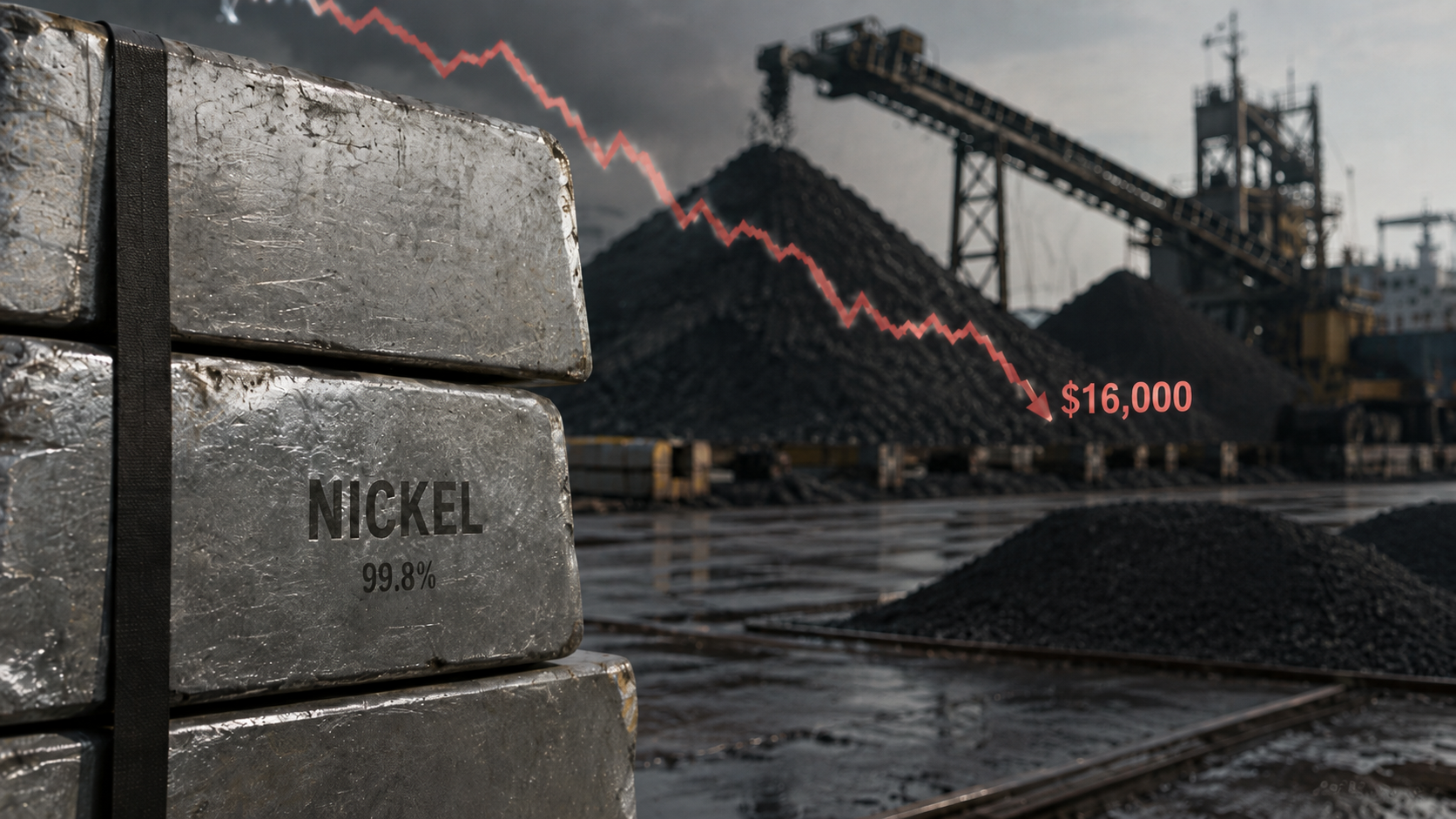
Crawford's cash costs of US$0.39 per pound keep Canada Nickel's economics intact as nickel slides to $16,000 a ton.
- Crawford's life-of-mine net C1 cash cost of US$0.39 per pound and all-in sustaining cost of US$1.54 per pound place it in the first quartile of the global nickel cost curve.
- By-product credits from iron, chromium and cobalt cut net cost well below the project's gross mining and milling cost.
- Front-End Engineering and Design work completed in 2025 lifted after-tax net present value at an 8% discount rate to US$2.8 billion and internal rate of return to 17.6%, on only a 5% increase in initial capital cost versus the 2023 feasibility study.
- Nickel on the London Metal Exchange has slid to $16,000 to $17,000 a ton, the bottom of a 6-month range, on uncertainty over Indonesian ore export quotas rather than a change in underlying demand.
- Canada Nickel's own disclosures show the project generating positive free cash flow at nickel prices well below current spot levels.
Canada Nickel Company Inc. (TSXV: CNC | OTCQX: CNIKF) is advancing its Crawford Nickel-Cobalt Sulphide Project in Timmins, Ontario, toward a construction decision, and the project's appeal rests on more than scale. Crawford holds Proven and Probable reserves of 1,715 million tons at 0.22% nickel, the world's second-largest nickel reserve by contained metal. That head grade sits well below what a high-grade sulfide operation would carry: a large low-grade deposit only works as an investment case if its unit economics hold up, and Crawford's do, at a moment when nickel prices are testing the low end of their trading range.
The Cost Curve Position
Crawford's Front-End Engineering and Design (FEED) results, completed in 2025, calculate a life-of-mine average net C1 cash cost of US$0.39 per pound and a net all-in sustaining cost of US$1.54 per pound, both of which rank the project in the first quartile of global nickel producers. Those figures are net of by-product credits: Crawford produces iron, chromium, and cobalt alongside nickel, and revenue from those streams is applied against mining and milling costs to arrive at the net figure. The gross cost of moving and processing ore at a 0.22% head grade is materially higher; the by-product credits pull the net number into first-quartile territory.
During its 27-year peak production period, Crawford is designed to produce 48,000 tons per annum of nickel, 800 tons per annum of cobalt, 13,000 ounces per annum of platinum group metals, 1.6 million tons per annum of iron and 76,000 tons per annum of chromium, the by-product volumes behind those cost credits.
The FEED work also refined the project's mine plan, cutting pre-stripping by 30% and re-sequencing delivery of higher-value ore from the East Zone. That optimization, combined with the by-product structure, produced an after-tax net present value at an 8% discount rate (NPV8%) of US$2.8 billion and an internal rate of return (IRR) of 17.6%, up from US$2.5 billion and 17.1% in the 2023 feasibility study (FS), while holding the increase in initial capital cost to roughly 5%, to US$2.0 billion. Including anticipated carbon capture and storage tax credits, the company's disclosures put NPV8% closer to US$2.9 billion and IRR at 18.9%.
Where the Price Sits Now
That cost position is being tested against a real market backdrop. Nickel has pulled back to the $16,000 to $17,000 a ton range, the bottom of where it has traded for 6 months, after briefly moving above $17,000. Canada Nickel Chief Executive Officer and Director Mark Selby attributes the move to positioning around Indonesian export quota decisions rather than any deterioration in demand, pointing to Indonesian ore production running below last year's pace and a government quota decision still pending.
Selby laid out his own price expectation from here:
"We're trading around $16,000 to $17,000. We should go back up to the $19,000 to $20,000 range by year end, and maybe a little bit higher than that come January, February."
Whether that recovery materializes on Selby's timeline, Crawford's own economics are built to hold up on either side of it: the company's disclosures state the project generates positive free cash flow at nickel prices well below current spot levels, a distinction from higher-cost sulfide and laterite developments that need a sustained price recovery to clear their break-even.
Management also points to seasonal Philippine ore supply as a factor independent of Indonesian quota politics: production runs at roughly two-thirds to three-quarters of capacity through the 6 months to September, then drops to a quarter to a third of that level from October through March, a pattern he expects to physically tighten nickel supply regardless of how the quota decision lands.
Why the Distinction Matters for a Development-Stage Project
Crawford has not yet produced a pound of nickel, so its cost-curve position is a modeled outcome, not an operating track record, and the gap between the 2023 FS and the 2025 FEED work shows the underlying numbers move as engineering advances. The 5% capital cost increase between those two studies is a reasonable proxy for the execution risk remaining between a first-quartile FEED study and a first-quartile operation.
Against that caveat, the structural case still holds: Crawford's by-product mix is fixed by the deposit's mineralogy, not by a commodity-price assumption, which means the cost advantage does not depend on cobalt, chromium, or platinum group metal prices moving in the company's favor. For investors weighing a large-tonnage, low-grade nickel sulfide project against a nickel price near the bottom of its recent range, the relevant question is not whether nickel recovers to $20,000 a ton, but what the project's economics look like if it does not.

FAQs (AI-Generated)
Analyst's Notes





Subscribe to Our Channel






Stay Informed


