




China’s Shipment Refusals Raise the Value of Allied Critical Mineral Supply



China’s rare earth shipment refusals show why allied critical mineral projects with integrated processing offer greater supply security.
- Some Chinese suppliers are refusing to ship rare earth elements to US customers despite holding export licenses, showing that regulatory approval no longer guarantees physical delivery.
- China’s sanctions on a US-linked supply-chain auditor have added supplier willingness and end-user eligibility to the risks created by export licensing.
- International Energy Agency (IEA) reports that the largest refined supplier’s average market share reached 70% in 2025, leaving manufacturers exposed to decisions within one jurisdiction.
- Producers controlling multiple processing stages face fewer third-party delivery risks, while developers with qualified buyers have a clearer path from project output to contracted sales.
- Graphite, rutile, rare earth elements (REEs) and platinum group metals (PGMs) projects outside dominant producing regions can broaden future supply, but recovery rates, costs, permits and financing determine whether their resources reach commercial production.
Rare Earth Supplier Refusals Show Export Licenses Cannot Guarantee Delivery
Some Chinese suppliers have refused to ship REEs to US customers despite holding export licenses, showing that regulatory approval no longer guarantees physical delivery. The refusals began after China sanctioned the Responsible Business Alliance (RBA), a US-based supply-chain auditing group, in August 2026. Additional suppliers reportedly declined orders because they feared that the material could be resold to prohibited end users. The affected volume remains unconfirmed, but the cases show that supplier willingness remains a separate condition from government approval.
Before delivery, each shipment must receive Chinese export approval, be accepted by a supplier willing to serve the destination, and go to a customer eligible under both Chinese and US rules. Failure at any stage can interrupt supply without closing a mine or imposing a nationwide embargo. Aggregate export figures therefore cannot confirm availability to specific customers because they do not show product form, destination, approval delays or whether licensed shipments completed delivery.
Yttrium shows how delivery constraints can reach high-value industries because it is used in aerospace, semiconductors, energy systems and medical devices. Although Chinese yttrium exports to the US rose during 2026, volumes remained approximately 50% below 2024 levels, and some US businesses waited more than six months for licenses. Yttrium prices remained near record levels despite the broader recovery in Chinese rare earth and magnet exports, showing that restricted customer access can support prices even when aggregate shipments increase.
China’s RBA Sanctions Turn Compliance Into a Critical Mineral Supply Risk
China’s sanctions on the RBA add a compliance barrier because they also affect the Responsible Minerals Initiative (RMI), an RBA program that Western manufacturers use to verify mineral origin and supply-chain practices. Some Chinese suppliers feared penalties from Beijing for using the framework, giving them a reason to reject US orders even when shipments otherwise qualified for export.
Competing Compliance Rules Raise the Value of Traceable Mineral Supply
Western manufacturers require documentation covering sourcing, labor, ownership and end-use rules before accepting mineral shipments. Chinese authorities can independently restrict destinations, customers, technologies or auditing organizations, so an export license does not guarantee that a supplier can complete every approved sale. Unlike a published quota, these restrictions can emerge through individual commercial decisions, making customer-level supply harder to quantify before shipment.
On September 8, 2026, the US administration criticized Ford’s use of licensed technology from Chinese battery producer CATL and urged the automaker to reduce its ties to Chinese companies, even though Ford said it owns and controls the Michigan plant. The dispute shows that domestic ownership may not resolve policy concerns when production still depends on Chinese technology, extending supply-chain reviews beyond factory location to ownership, technology, and material origin. Tracing material from mine through conversion without relying on a dominant intermediary reduces approval-dependent handoffs and lowers the risk that conflicting rules block delivery after export authorization.
Record Refining Concentration Raises the Value of Processing Capacity
Across key energy minerals, the leading refiner’s average market share reached a record 70% in 2025, up from 68% in 2020. Indonesia led nickel refining, while China led most other markets and supplied 100% of the European Union’s (EU) heavy REE requirements. Between 2023 and 2025, the leading supplier in each market accounted for more than 75% of refined-supply growth, including almost all graphite growth. New mines can diversify extraction without reducing delivery risk if their concentrates still require conversion in the dominant supplier country.
Processing Gaps Leave Allied Mines Dependent on Refiners
The announced 2035 REE project pipeline outside China contains nearly 50,000 tonnes of mining capacity, while planned refining and separation capacity remains below 40,000 tonnes. Planned capacity for rare earth metals, alloys, and magnets falls further to approximately 18,000 tonnes when measured by contained REEs. The decline from nearly 50,000 tonnes of mine capacity to 18,000 tonnes of downstream capacity means new extraction will not provide an equivalent volume of customer-qualified alloy or magnet material.
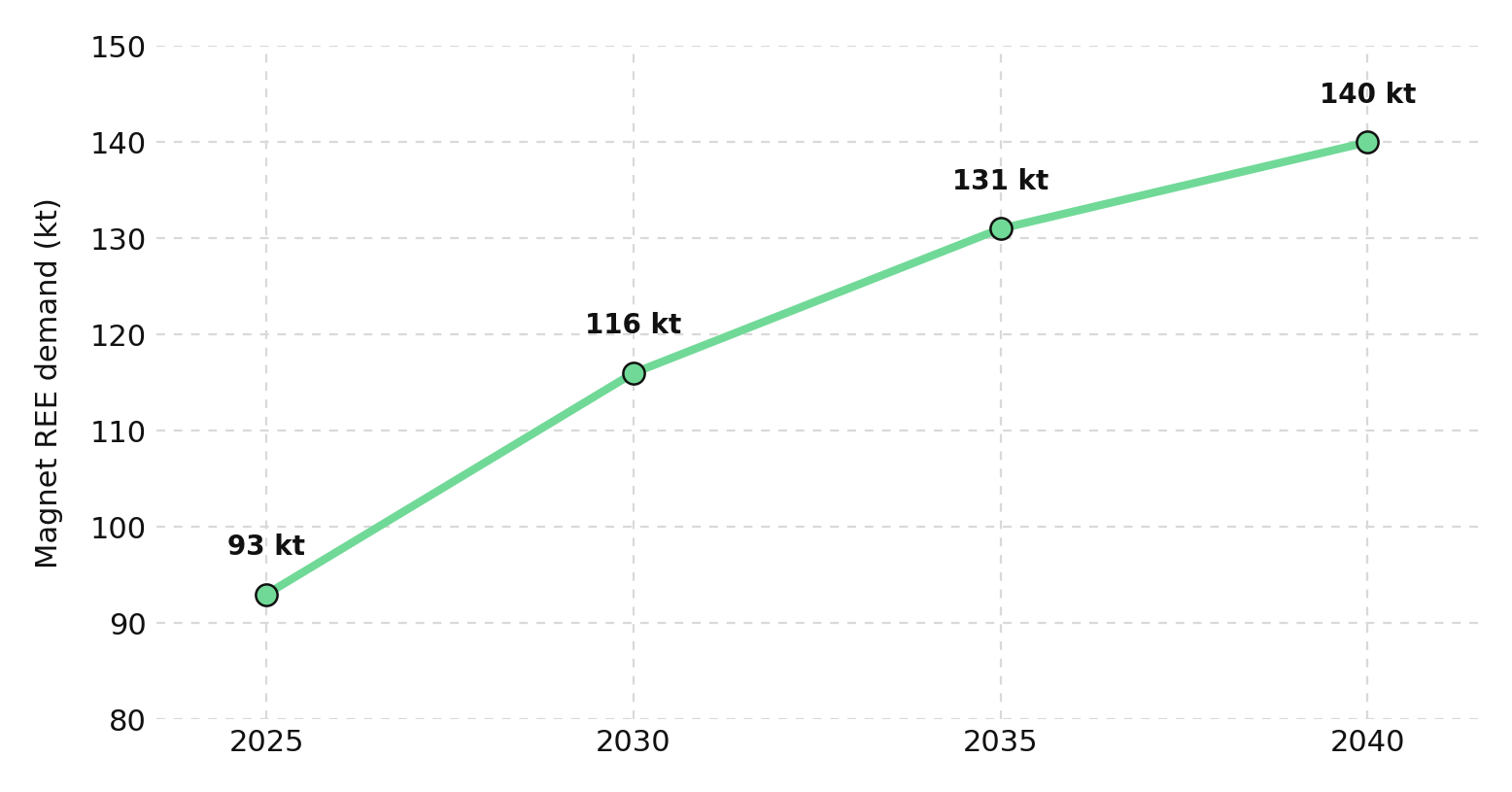
Total critical mineral demand almost doubles from 2025 levels by 2040, while demand for graphite and magnet REEs rises by 50% to 90% over the same period. Battery storage, electric vehicles, wind generation, electricity networks, electronics, and defense applications require processed materials that meet specific chemical and metallurgical standards. Supply security therefore depends on sufficient processing capacity to meet customer specifications, not simply the number of announced mines.
Integrated Capacity & Offtakes Convert Resources Into Qualified Supply
Existing processing plants have equipment, technical teams, and product qualification records, so their capacity carries less construction and commissioning risk than proposed facilities. Rare earth production involves at least seven stages between mining and magnet manufacturing, while China controls approximately 90% of global magnet capacity. Refining projects outside dominant supplier countries face capital costs 20% to more than 150% higher, while operating costs rise around 50%, so processing control must be paired with suitable technology, feedstock, and financing to produce at competitive costs.
Operating Alloy Capacity Reduces Third-Party Conversion Risk
Operating capacity that extends from rare earth oxides through alloy production gives a producer more control over whether material reaches customers. Keeping those conversion steps within one platform reduces reliance on third-party processors that can delay or reject shipments, while making the supply chain easier for magnet customers to verify.
Energy Fuels completed its acquisition of Australian Strategic Materials on August 28, 2026, adding the operating Korean Metals Plant in South Korea to its US rare earth oxide operations and extending production into metals and alloys. The plant has 1,300 tonnes per year of neodymium-iron-boron alloy capacity, with an expansion targeting 3,600 tonnes per year as early as the end of 2026, nearly three times current capacity and enough to support more than 1 million electric vehicles annually.
Feasibility Studies & Offtakes Move Development Assets Toward Supply
For a development-stage project, delivery certainty begins with a workable route from the mine to a committed customer. Competitive costs and existing transport links improve the path to financing, while binding offtake agreements give lenders clearer evidence that planned output has a market.
Sovereign Metals is advancing the Kasiya project in Malawi, where existing rail and port access and ongoing rutile and graphite offtake discussions with Mitsui, Traxys, and other counterparties provide a potential route from planned output to customers. The definitive feasibility study (DFS) outlines annual production of 222,000 tonnes of natural rutile and 275,000 tonnes of natural graphite, with a pre-tax net present value of US$2.204 billion at an 8% discount rate (NPV8), a 23% pre-tax internal rate of return (IRR), and an initial capital cost of US$727 million. The study results and customer engagement support Kasiya’s path toward project financing and future sales.
Concentrated PGM Supply & Low Stocks Raise the Value of New Regions
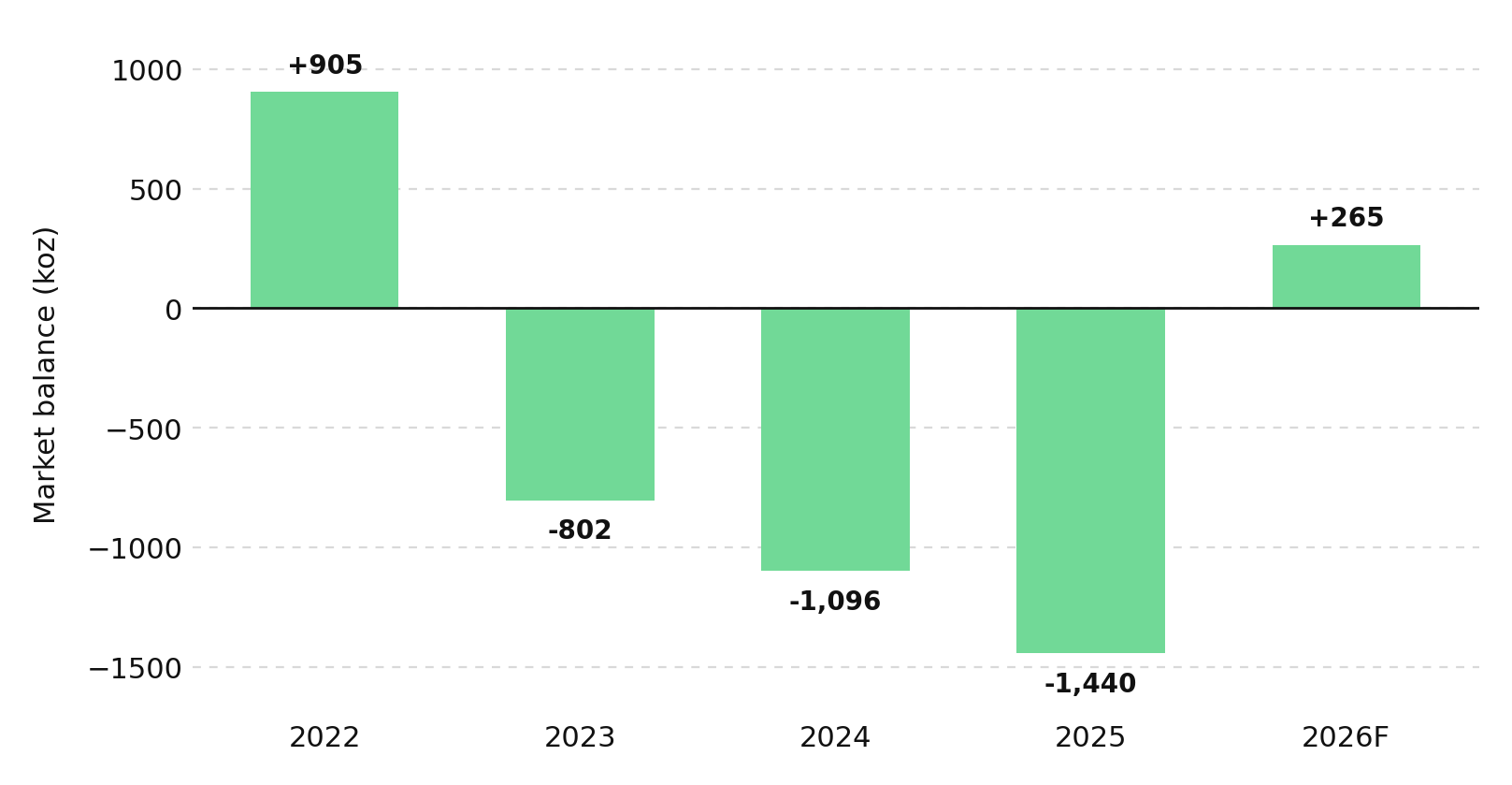
South Africa supplies 71% of the platinum required by the EU, leaving customers exposed to disruption in one producing country even though Chinese export controls do not govern PGM trade. The World Platinum Investment Council (WPIC) forecasts a 265,000-ounce platinum surplus for 2026, comprising a 548,000-ounce surplus in the first half and a 283,000-ounce deficit in the second half. Mine supply is forecast to remain flat at 5.551 million ounces, leaving recycling to provide all projected growth, while above-ground stocks of 2.010 million ounces cover approximately 3.4 months of demand. This limited stock buffer means a regional disruption could tighten availability despite the full-year surplus.
Brazilian PGM Exploration Expands Long-Term Geographic Supply Options
New PGM discoveries outside established producing regions can broaden future supply, with an inferred resource providing the first estimate of a project’s scale. Additional drilling and an initial economic study can then improve confidence by testing whether the resource and projected costs support further development.
ValOre Metals has completed more than 40,000 meters of drilling across seven near-surface resource zones at its 100%-owned Pedra Branca project in Ceará State, Brazil. Five additional zones drilled in 2023 remain outside the current estimate, providing further data for the resource update targeted for the third quarter of 2026. The current inferred resource totals 2.198 million ounces of platinum, palladium, and gold across 63.3 million tonnes grading 1.08 grams per tonne. A preliminary economic assessment (PEA) targeted for the fourth quarter of 2026 would provide initial estimates of recoveries, capital requirements, and operating costs, allowing the project’s development potential to be assessed beyond resource size alone.
Thiago Diniz, Vice President of Exploration at ValOre Metals, explains why geographic diversification matters to PGM supply:
“Palladium and platinum are produced only in certain regions of the globe. Being able to advance a project outside of that small space is actually an opportunity.”
September 24 Summit Tests Whether Trade Pledges Restore REE Deliveries
The September 24 meeting between the US and Chinese presidents will test whether negotiations can restore rare earth deliveries to US customers. The key measure is whether licensed shipments reach customers on predictable timelines, not how many licenses are announced. A political commitment that does not restore commercial deliveries would leave the central supply risk unchanged.
Clarifying the RBA sanctions could encourage affected Chinese suppliers to resume US shipments of constrained materials such as yttrium. Higher shipment volumes could reduce immediate price pressure without changing China’s dominant role in refining and magnet manufacturing. A temporary agreement can restore trade before alternative Western mines and processing plants are built, but it would leave buyers exposed to another supply restriction during a future dispute.
Rare earths account for approximately 40% of permanent-magnet costs but less than 1% of a vehicle’s value. Even a tripling of rare earth prices would raise the total cost of a car by only about 0.1%. This small cost impact gives manufacturers room to pay more for material with a verified delivery route when it reduces the risk of a production stoppage.
The Investment Thesis for Critical Minerals
- Producers that control the chain from mining through downstream processing rely on fewer third parties, reducing the number of points where shipments can be delayed or rejected.
- Developers have a clearer path to construction when feasibility studies show competitive costs and binding offtake agreements demonstrate demand for planned output, although permits and financing must still be secured.
- Explorers can create future supply alternatives by defining resources outside established producing regions, but further drilling and initial economic studies must support a financeable development plan before those resources can reach production.
- Critical mineral valuation should reflect how far an asset has progressed from a geological resource toward processed material that an eligible customer can receive, because export approval alone does not guarantee delivery.
- Production outside dominant supplier countries can remain commercially viable when critical minerals make up only a small share of the final product’s cost and reliable delivery reduces the risk of a more expensive factory shutdown.
- Trade agreements can restore shipments faster than new mines or processing plants can be built, but reducing dependence on a dominant supplier requires additional capacity across several countries.
Critical mineral markets are likely to place greater value on dependable delivery than on resource size or export approval alone as national-security rules extend beyond the mine gate. Negotiated access can restore shipments faster than new mines and conversion capacity can be built, but it cannot reduce concentration in refining. Because these minerals represent a small share of final-product costs but can halt production when unavailable, manufacturers have room to support higher-cost alternatives that protect supply continuity. Over time, value should favor assets with competitive economics and a proven route from production to a qualified customer.
TL;DR
Chinese export licenses no longer guarantee that rare earth shipments reach US customers because suppliers must also navigate sanctions, end-user restrictions, and competing compliance rules. With the leading refiner holding a 70% average market share across key energy minerals in 2025, new mines alone cannot diversify supply if output still depends on dominant refiners. Operating downstream capacity reduces third-party conversion risk, while feasibility studies and offtakes can move development projects toward qualified sales. Alternative PGM regions also gain relevance as platinum mine supply remains flat and above-ground stocks cover about 3.4 months of demand. The September 24 summit may restore near-term trade, but durable supply security requires competitive capacity across multiple jurisdictions.
FAQs (AI-Generated)
Analyst's Notes





Subscribe to Our Channel










.png)





Stay Informed



