




Fed Hawkish Pivot Tests Silver Prices, but the 46.3 Million-Ounce Deficit Remains


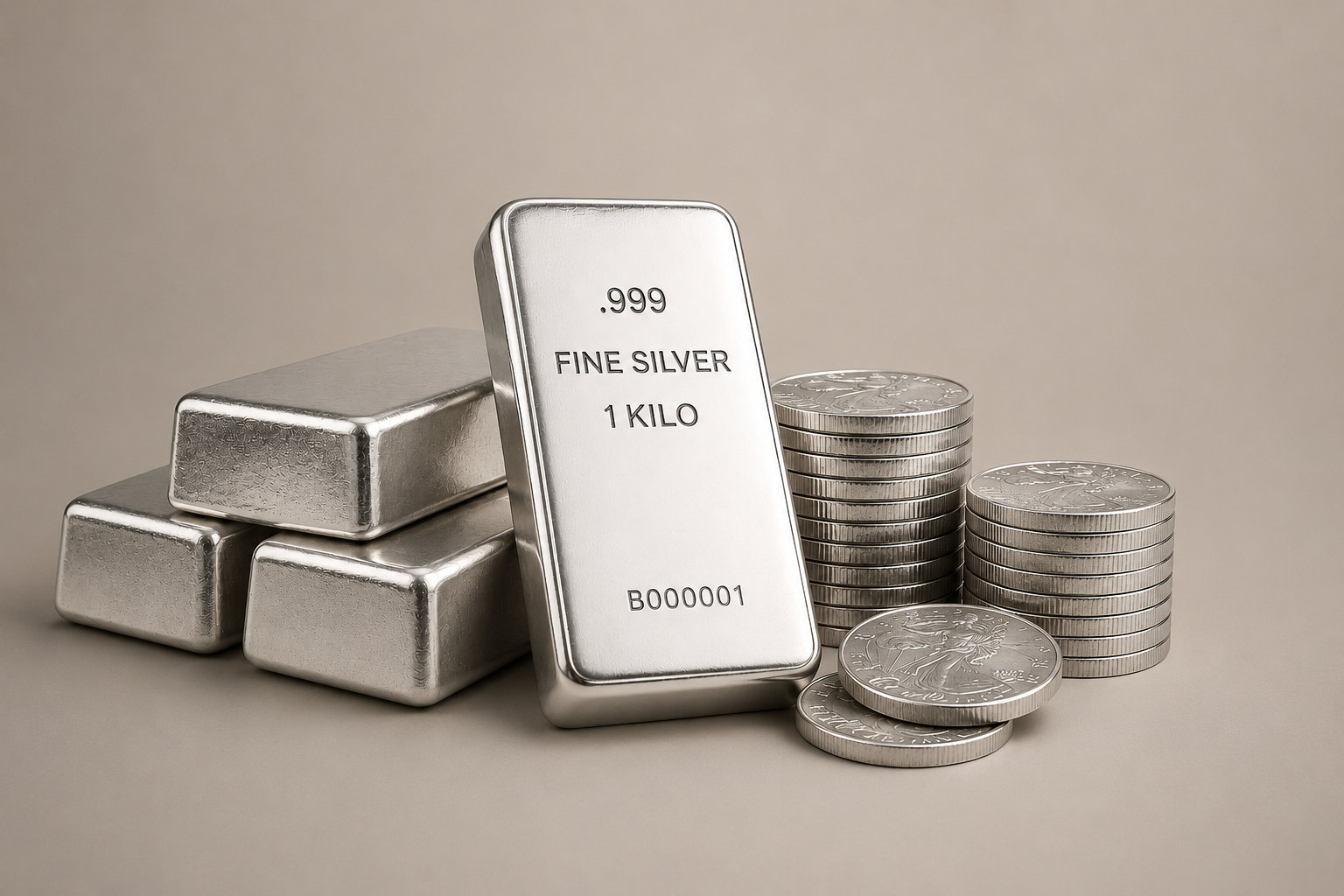
Fed policy may drive silver's near-term price, but a 46.3 million-ounce supply deficit continues to support the longer-term investment outlook
- The Federal Open Market Committee (FOMC) held rates at 3.5% to 3.75% on a 9-3 vote on July 29, 2026, with 3 regional presidents dissenting in favor of a 25-basis-point rate hike, the most hawkish dissent bloc since September 2016.
- Chair Kevin Warsh and Governor Lisa Cook have since indicated they could support a September rate hike, shifting away from the rate-cut narrative that carried silver to its January 29, 2026 record of $121.67 per ounce.
- The Silver Institute's World Silver Survey 2026 confirms a 6th consecutive annual deficit, widening to 46.3 million ounces, while mine supply remains concentrated in Mexico, Peru, and China, increasing exposure to disruptions in a small number of key producing jurisdictions.
- Production-, development-, and exploration-stage companies each benefit from the same supply deficit through different mechanisms: producers capture operating leverage, developers preserve project economics using conservative price assumptions, and explorers create value by expanding future resources.
- The July 2026 Consumer Price Index (CPI) release, due August 12, 2026, is the next major catalyst for Fed policy expectations and silver's near-term price, while the mine supply deficit continues to shape the longer-term outlook.
Fed Turns More Hawkish & Silver Faces Higher Real-Yield Pressure
The FOMC held the federal funds rate at 3.5% to 3.75% on July 29, 2026, by a 9-3 vote, with Beth Hammack, Neel Kashkari, and Lorie Logan dissenting in favor of a 25-basis-point rate hike. It was the committee's largest hawkish dissent bloc since September 2016, signaling that a meaningful minority of voting members believes current policy is not restrictive enough to return inflation to target. Subsequent comments reinforced that view. According to Financial Times reporting, Chair Kevin Warsh is prepared to support a September 2026 rate hike if inflation remains elevated, while Governor Lisa Cook said on August 5 that she sees the risk of high inflation as greater than the risk of a weakening labor market. Together, those signals challenge the rate-cut expectations that helped lift silver to its nominal record of $121.67 per ounce on January 29, 2026.
Markets have already begun repricing that outlook. CME-implied odds of a September 2026 rate hike fell from 67% to 55% within two days after Strait of Hormuz de-escalation headlines, illustrating how geopolitical events can reshape Fed expectations alongside economic data. Silver closed between $62.16 and $62.26 per ounce on August 6, 2026, about 49% below its January record, while the gold-silver ratio remained near 69:1, close to the upper end of its 50-year range. Because silver offers no yield, changes in expected interest rates affect its relative appeal through real yields and investment demand, making Fed policy the primary driver of near-term price movements before the physical supply deficit reasserts itself over the longer term.
Fed Rate Path Shifts Investment Demand While Solar & EV Demand Anchors Silver Consumption
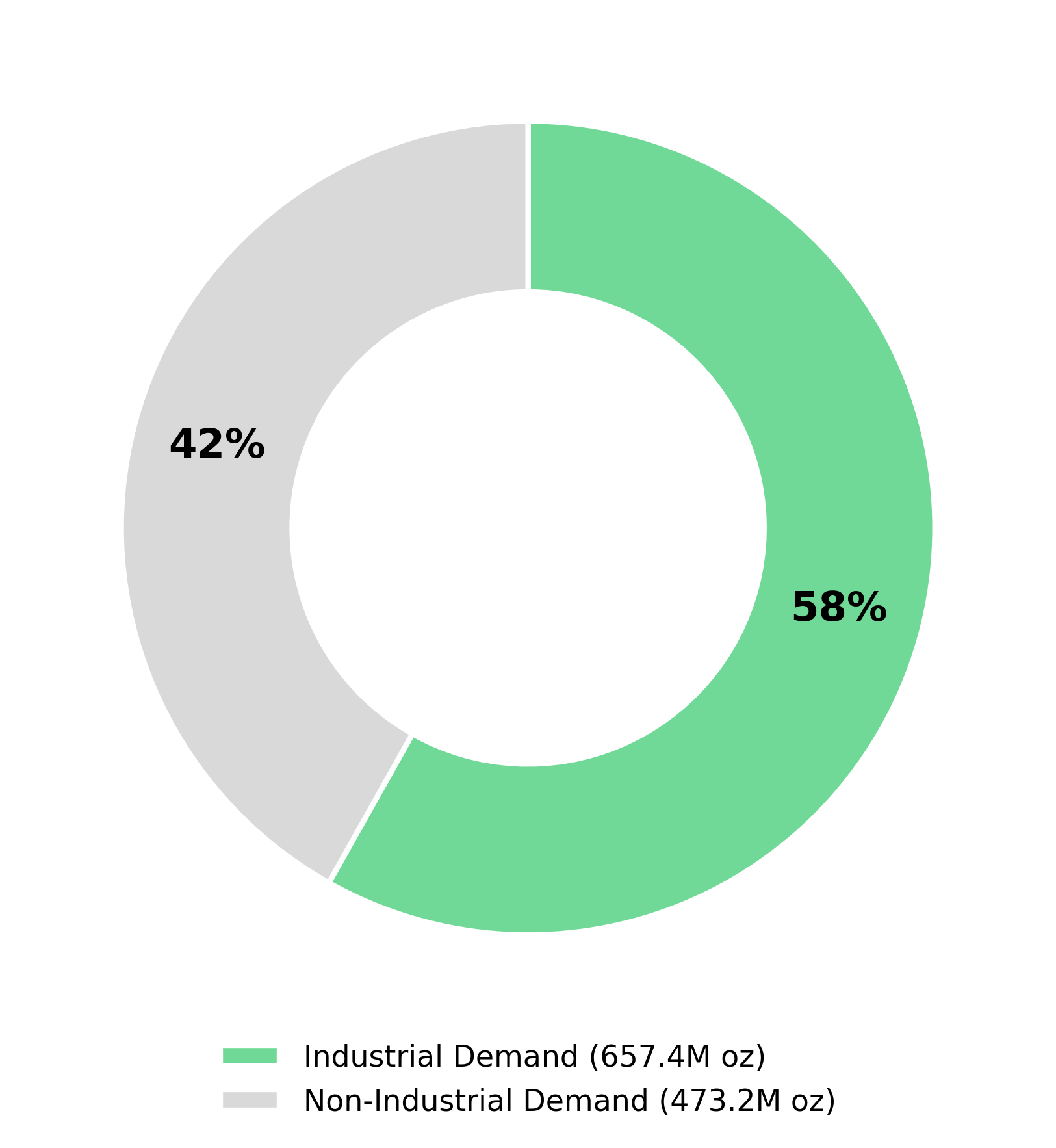
Silver pays no coupon or dividend, so its return depends primarily on price appreciation. As real interest rates rise, the opportunity cost of holding a non-yielding asset also increases. Fed policy primarily influences silver through financial demand, while physical supply and industrial consumption are driven by different factors. Industrial buyers generally base silver purchases on production schedules rather than individual FOMC decisions. According to the Silver Institute's World Silver Survey 2026, industrial demand reached 657.4 million ounces in 2025, representing approximately 58% of total global demand of 1,130.6 million ounces. Solar photovoltaic manufacturing and electric vehicle production accounted for much of that demand, reflecting manufacturing schedules rather than the cost of capital.
Oliver Turner, Executive Vice President of Corporate Development at Americas Gold & Silver, a production-stage silver and base-metals producer operating the Galena Complex in Idaho and the Cosalá Operations in Mexico, describes how this industrial pull is stacking across multiple end markets at once:
"The old adage is that copper is the highway, but silver is the glue. You need silver in all of these circuit boards and in any of this technology rollout."
Industrial silver demand is unlikely to change in response to a single FOMC decision because manufacturers purchase metal to meet production schedules. Near-term price weakness therefore reflects changes in financial demand rather than a decline in industrial consumption. A hawkish Fed repricing can reduce investment demand through weaker coin, bar, and exchange-traded fund flows while leaving industrial demand, which accounted for 58% of global silver consumption in 2025, largely unchanged.
Export Restrictions & Mine Supply Constraints Extend Silver's Supply Deficit
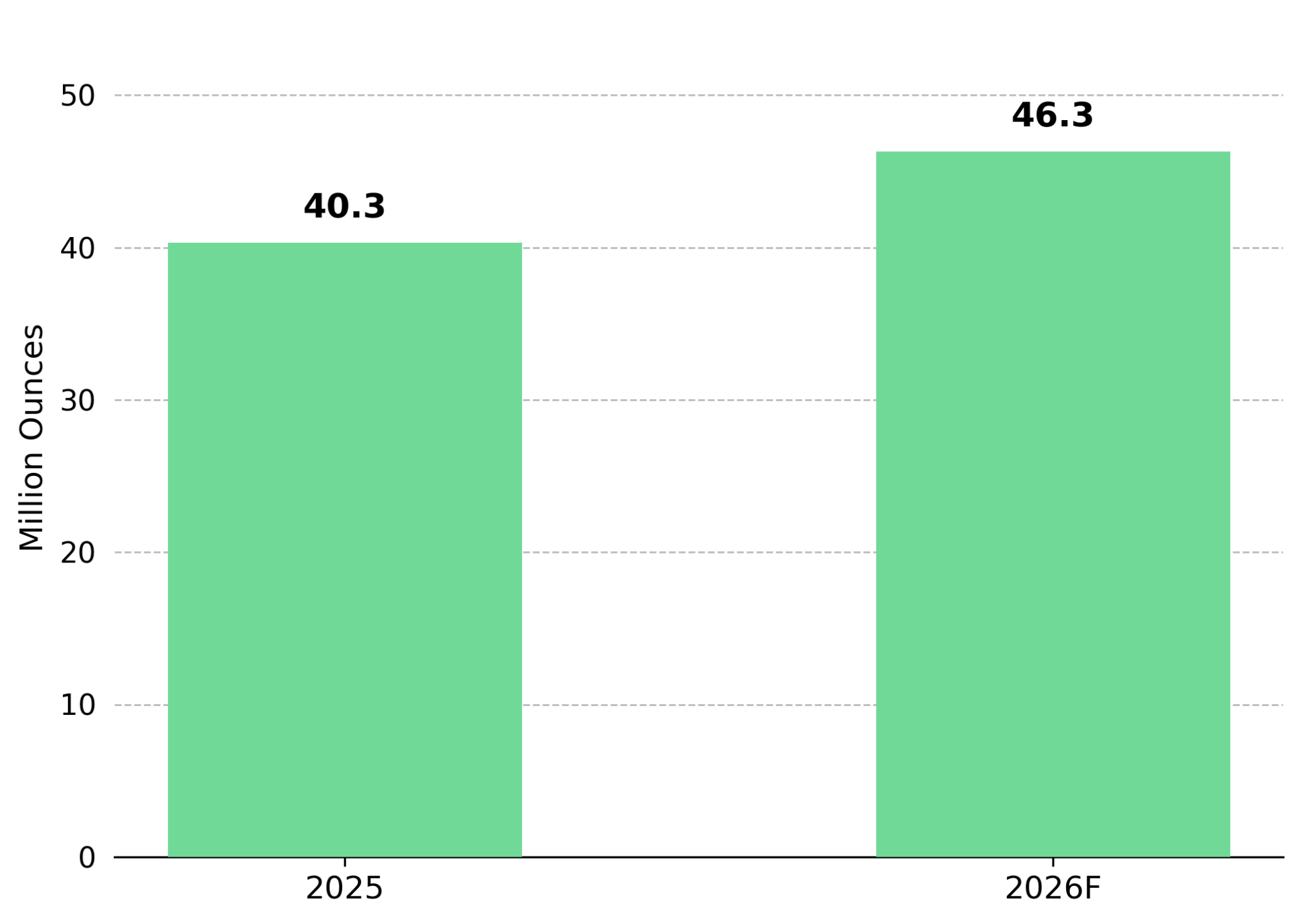
The Silver Institute's World Silver Survey 2026 forecasts a sixth consecutive annual deficit, widening to 46.3 million ounces in 2026 from 40.3 million ounces in 2025. Since 2021, the market has drawn 762 million ounces from above-ground stocks to bridge the supply-demand gap. Because roughly 70% of mined silver is produced as a byproduct of copper, lead, and zinc mining, supply cannot respond quickly to higher silver prices. Sulfuric acid shortages linked to the Strait of Hormuz disruption also constrained copper output earlier in 2026, further limiting byproduct silver production.
China's export licensing regime adds another constraint. Since January 1, 2026, export approvals have been limited to 44 licensed companies, directing more refined silver toward domestic solar and electric vehicle manufacturing. Peru adds a second supply risk as delays to the REINFO registry, Petroperú's energy crisis, and recurring road blockades continue to disrupt concentrate shipments from one of the world's largest silver producers. Meanwhile, COMEX registered inventories recovered to 99.72 million ounces by July 30, 2026, reducing near-term delivery risk but not the Silver Institute's forecast 46.3 million-ounce supply deficit, since exchange inventories are a liquidity buffer rather than a source of new mine supply.
Silver's Supply Deficit Creates Different Value Drivers Across the Mine Life Cycle
The same supply deficit creates different opportunities for production, development-, and exploration-stage companies because each deploys capital at a different point in the mine life cycle. Production-stage companies with completed infrastructure benefit most from higher silver prices because additional revenue flows through existing operations. Development-stage companies base project economics on feasibility-study price assumptions that are typically set years before first production. Exploration-stage companies create value by converting drilling expenditure into new mineral resources at an attractive discovery cost.
Completed Capital Investment Increases Output & Operating Leverage
Americas Gold & Silver, a production-stage company, produced 664,971 ounces of silver in the second quarter of 2026 and reaffirmed full-year guidance of 3.2 million to 3.6 million ounces at an all-in sustaining cost of $30 to $35 per ounce. The company's shift from underhand cut-and-fill mining to mechanized long-hole stoping increased productivity by more than 300% across completed panels and reduced mining cycle times by a factor of 12. Those operational gains convert prior capital investment into higher output, increasing operating leverage as silver prices rise.
The company also eliminated more than $85 million of legacy price-linked precious-metal delivery obligations during the quarter, allowing a larger share of future production to be sold at prevailing market prices rather than committed under legacy agreements. Because silver generates roughly 75% to 80% of the company's revenue, removing those price-linked obligations increases earnings sensitivity to future movements in the silver price.
Conservative Feasibility Assumptions Protect Development Economics Below Spot Prices
Vizsla Silver is advancing its wholly owned Panuco silver-gold project in Sinaloa, Mexico, and has not yet made a production decision. Construction remains contingent on completing detailed engineering, securing financing, and obtaining the remaining permits and approvals. The company's November 2025 Feasibility Study reports an after-tax net present value of $1.8 billion at a 5% discount rate and an internal rate of return of 111%, based on a base-case silver price assumption of $35.50 per ounce.
The feasibility study's $35.50 per ounce silver price assumption remains well below current spot prices. If a hawkish Fed repricing pushes silver prices lower before project financing is secured, that conservative assumption reduces the risk that a short-term decline changes the project's financing economics or lender underwriting. The company has since awarded equipment supply agreements covering 8 major process plant packages and continues targeting first silver production in the second half of 2027, indicating that project execution is advancing alongside financing preparations.
Michael Konnert, President and Chief Executive Officer of Vizsla Silver, described the recent hire of a new President, Mexico as evidence toward construction:
"As we transition from project development toward construction and ultimately production, his appointment adds further depth to our leadership team and strengthens our in-country capabilities."
Efficient Exploration Expands Resources & Builds Future Silver Supply
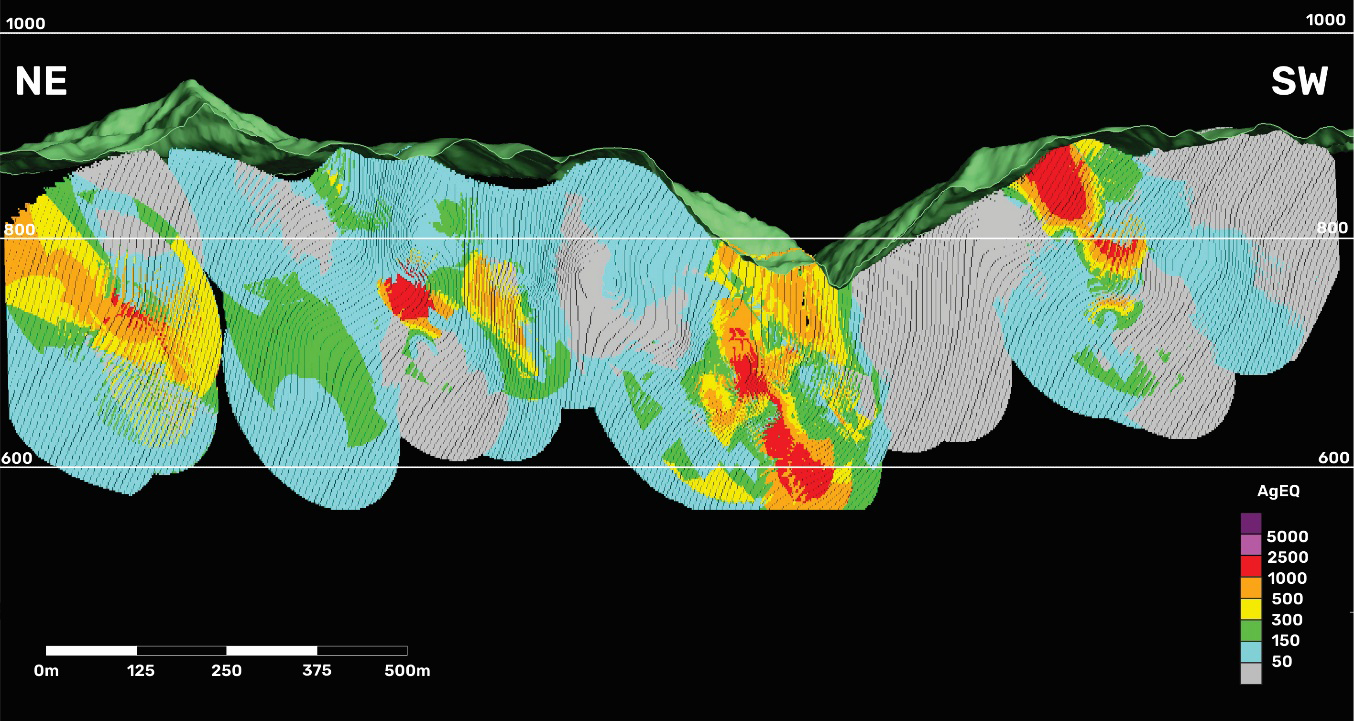
GR Silver Mining is advancing the Plomosas Project in Sinaloa, Mexico, where exploration drilling remains the primary value driver ahead of a preliminary economic assessment. Its 2023 mineral resource estimate reports 55 million ounces of silver in the Indicated category and 22 million ounces in the Inferred category. A July 2026 step-out hole intersected 21.9 meters of true width grading 168 grams per tonne silver, extending mineralization at least 150 meters beyond the current resource boundary as part of a 20,000-meter drilling program scheduled for completion before an updated resource estimate in late 2026 and a preliminary economic assessment in the first half of 2027.
The company relocated its logistics base to Durango in November 2025 after cartel-related activity along the Rosario access road disrupted project access. While the relocation reduced operational disruption, jurisdictional risk remains an important consideration alongside exploration potential.
Eric Zaunscherb, Interim President and Interim Chief Executive Officer of GR Silver Mining, put the scale of the remaining target in context:
"What we've drilled is about 20% of that perimeter all the way around that intrusive body, so there's another 80% of that perimeter to go. That's one exploration target, and that's where we see the high-grade silver."
July CPI Tests Silver's Near-Term Outlook While Supply Signals Test the Deficit Thesis
A softer-than-expected July CPI reading would revive the rate-cut narrative that helped lift silver to its January 2026 record and could move spot prices closer to the 2026 average price forecasts published by Goldman Sachs, J.P. Morgan, Citigroup, and HSBC, while leaving the underlying supply deficit unchanged. Only a few developments would alter that longer-term thesis: sustained growth in COMEX registered inventories beyond delivery requirements, an expansion of China's export licensing regime, or an earlier-than-expected resolution of Peru's REINFO registry or Petroperú's energy constraints, all of which would improve physical silver availability.
The Investment Thesis for Silver
- The Silver Institute's forecast of a 6th consecutive annual deficit of 46.3 million ounces supports the physical silver market even if Fed repricing pressures prices in the near term, because monetary policy influences financial demand while the supply deficit remains unchanged.
- China's export licensing regime and Peru's supply disruptions increase supply-chain concentration, making jurisdictional diversification more valuable for new silver production and resource growth.
- Producers with completed infrastructure convert prior capital investment into higher near-term output, increasing operating leverage as silver prices rise.
- Developers with feasibility studies based on conservative silver price assumptions remain less exposed to near-term price volatility because project economics do not depend on current spot prices to support financing.
- Explorers that expand mineral resources through efficient drilling create long-term value from the supply deficit, with progress determined by exploration results rather than near-term Fed decisions.
- A hawkish Fed repricing can pressure silver prices in the near term without changing the underlying supply deficit, leaving the long-term physical market unchanged even as financial demand weakens.
Silver's investment case now runs on two different clocks. The underlying supply deficit changes as mine supply, refining capacity, or industrial demand shifts, none of which typically move with monthly economic data releases. The Fed's rate path can change market sentiment and near-term silver prices within weeks, well before the underlying supply deficit changes. Near-term price movements will therefore depend primarily on Fed expectations, while the longer-term investment case continues to depend on whether the physical supply deficit narrows.
TL;DR
The Fed's increasingly hawkish stance has raised uncertainty over silver's near-term price by lifting expected real yields and reducing investment demand. However, the Silver Institute's forecast of a sixth consecutive annual supply deficit of 46.3 million ounces remains the stronger long-term driver because mine supply growth is constrained by byproduct production, China's export restrictions, and disruptions in Peru. Producers, developers, and explorers each benefit from this deficit through different mechanisms, making company stage as important as commodity prices. The July CPI report is the next key catalyst for Fed expectations, while changes in physical supply remain the main test of the longer-term investment thesis.
FAQs (AI-Generated)
Analyst's Notes





Subscribe to Our Channel









Stay Informed






