




China’s 5.2% Industrial Growth Raises Pressure on Limited Silver Supply



China’s high-tech manufacturing growth is increasing pressure on silver supply as deficits, inventories and slow mine development limit new metal.
- China’s industrial output rose 5.2% year over year in August 2026, while high-technology investment increased 5.2% from January through August and output of lithium-ion batteries and industrial robots climbed 57.2% and 34.6% year over year, expanding the manufacturing base for silver-bearing components.
- On September 17, 2026, President Xi Jinping called for China to expand advanced manufacturing and strengthen control over key supply chains, directing policy support toward electronics, automation, artificial intelligence systems and energy technologies that use silver-bearing components.
- Silver Institute forecasts industrial fabrication declining 3% to 640 million ounces and total supply declining 2%, widening the silver market deficit from 40.3 million ounces in 2025 to 46.3 million ounces in 2026.
- Producers with existing infrastructure and controlled all-in sustaining costs can convert higher silver prices into near-term cash flow, while funded developers provide medium-term production growth without relying entirely on new financing.
China’s Manufacturing Shift Expands Silver’s Industrial Demand Base
National Bureau of Statistics data reported by Reuters on September 15 showed China’s industrial output rose 5.2% year over year in August 2026, up from 4.5% in July and above the 4.8% consensus forecast. Beijing’s shift toward advanced manufacturing is increasing activity across sectors that use silver-bearing components.
Retail sales rose only 0.4% in August, while fixed-asset and property investment declined 7.2% and 19.9%, respectively, during the first eight months. Over the same period, high-technology investment rose 5.2%, while August output of lithium-ion batteries and industrial robots increased 57.2% and 34.6%. These figures do not translate directly into silver demand because product designs and metal content vary, but they confirm growth across silver-using industries.
President Xi Jinping called for stronger advanced manufacturing and greater control over key supply chains, while Premier Li Qiang prioritized intelligent manufacturing and domestic high-end technologies. Beijing’s reallocation of capital from property toward these industries supports spending on factories, automation and power infrastructure.
Industrial Growth Sustains Silver Demand as Thrifting Meets Tight Supply
Silver’s electrical conductivity supports compact, high-load components in electronics, photovoltaic cells, vehicle systems, charging equipment, switchgear and data centers. China’s expansion across these sectors increases the volume of silver-bearing products, although lower metal use per unit can limit demand growth.
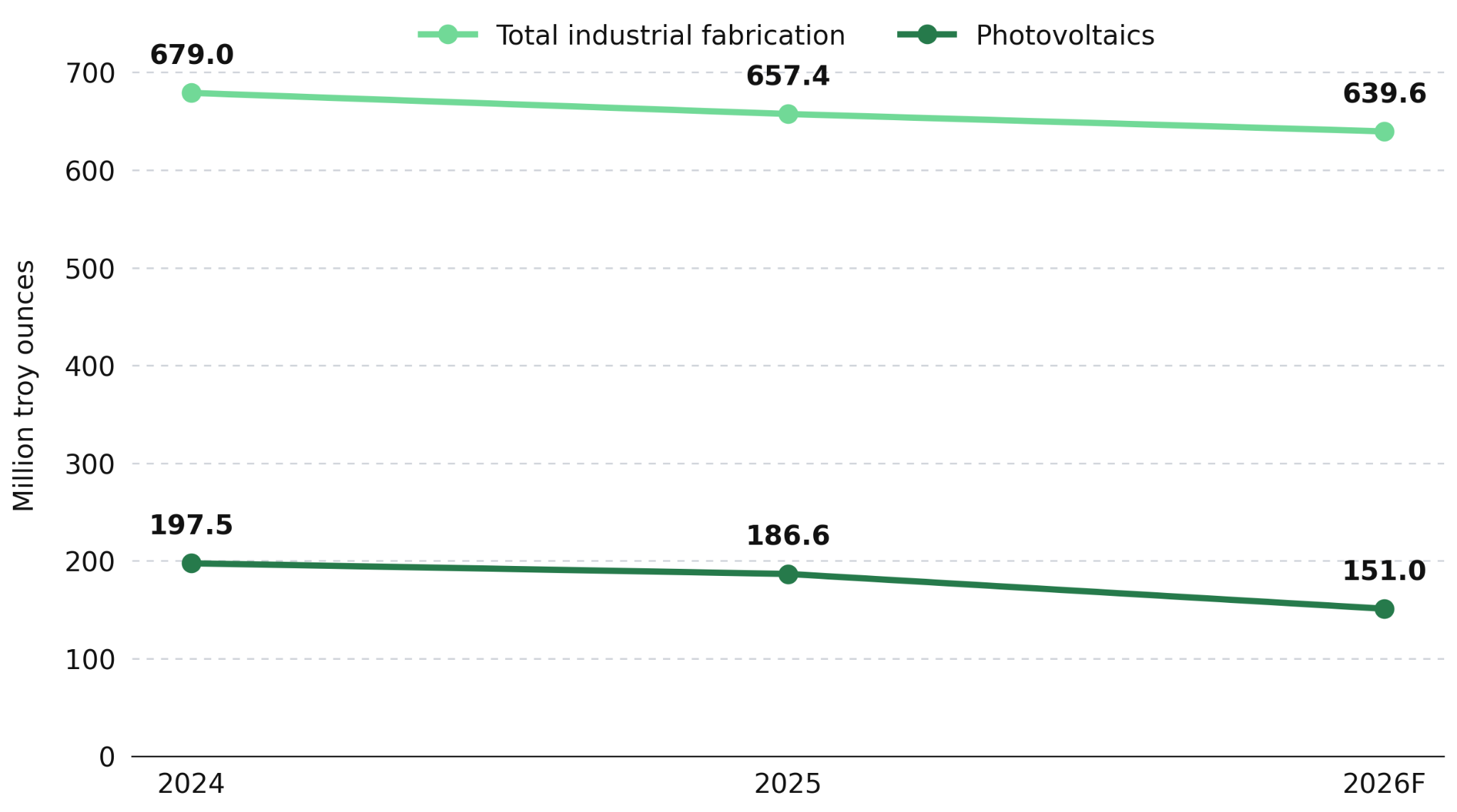
Manufacturers can reduce silver use by lowering paste loadings, redesigning components or substituting materials as prices rise. Metals Focus’s base-case forecast in the World Silver Survey 2026, published by the Silver Institute on April 15, puts industrial fabrication at 640 million ounces, down 3% to a four-year low. The Silver Institute’s February 10 preliminary outlook cited photovoltaic thrifting and substitution as drivers of lower use, but aggregate industrial demand can still rise if production growth exceeds per-unit savings.
Oliver Turner, Executive Vice President of Corporate Development, explains why rising demand meets limited silver supply:
“The answer is we need more silver because demand is continuing to increase, but even if we have this additional demand, where’s the additional silver going to come from? Seventy percent of silver is a byproduct from other mines; you don’t have a highly responsive supply of silver, and you can’t just turn on more silver supply when the world needs it.”
Americas Gold & Silver ranked 24th in the 2026 TSX30 after its share price increased 477% over the three years ended June 30, 2026, generating $2.2 billion in market-capitalization growth. The recognition follows growth in silver production, balance-sheet strengthening and continued investment in high-grade North American assets, providing a firmer operating and financial base for further production growth.
Sixth Consecutive Deficit Raises Value of New Silver Supply
Metals Focus’s base-case forecast in the World Silver Survey 2026, published by the Silver Institute on April 15, projects a sixth consecutive annual deficit, widening from 40.3 million ounces in 2025 to 46.3 million ounces in 2026 even as total demand and supply each decline approximately 2%. Reuters reported that cumulative deficits had drawn 762 million ounces from inventories since 2021, reducing the buffer against future shortfalls. If stronger Chinese industrial consumption limits the forecast demand decline, the deficit would exceed 46.3 million ounces unless supply outperforms its forecast.
Approximately 70% of mined silver is recovered as a byproduct of lead, zinc, copper and gold operations, tying supply to investment decisions for other metals. Higher silver prices increase byproduct revenue but do not alone justify mine expansion, limiting the supply response to rising demand. Prices can also encourage recycling, but scrap availability, collection rates and processing margins constrain how much recycled metal can offset mine depletion.
Silver Inventories Cushion Deficits
Metals Focus estimated that London vaults held 884 million ounces of silver at the end of March 2026, but only 28% was untied from exchange-traded products (ETPs) and potentially available, up from 17% in September 2025. Silver returning from the US, ETP outflows and weaker Indian demand helped normalize lease rates after the October squeeze. Headline inventories therefore overstate immediately available metal and could tighten if Chinese fabrication, Indian buying and ETP inflows strengthen together. Transfers can ease regional shortages but cannot expand global supply, which requires additional mine output or recycling.
2027 Production Targets Shift Investor Focus to Execution
Manufacturing can expand faster than new silver mines, allowing demand to outpace supply. Feasibility studies, financing, local capacity, project economics and permitting provide better measures of development value and risk than resource size alone.
In-Country Leadership Strengthens Construction Readiness
Vizsla Silver appointed Luis Lázaro as President, Mexico, bringing 30 years of operational leadership as Panuco advances through permitting and potential construction toward targeted first silver production in the second half of 2027. The November 2025 feasibility study outlines annual production of 17.4 million silver-equivalent ounces over 9.4 years, an after-tax net present value at a 5% discount rate (NPV5%) of US$1.8 billion, an internal rate of return (IRR) of 111% and a seven-month payback. The appointment strengthens in-country execution and stakeholder management as detailed engineering, financing arrangements and required approvals progress toward a potential production decision.
When positioning around future Chinese industrial demand, critical development indicators include permit receipt, fixed-price procurement, construction progress, workforce readiness and commissioning performance. These determine whether forecast ounces arrive while market tightness remains economically relevant.
Incentive Awards Put Near-Term Project Milestones in Focus
China’s industrial growth increases demand for replacement silver resources, but new discoveries take years to reach production. Continuous, recoverable mineralization near infrastructure provides stronger evidence of mineability than isolated high-grade intercepts.
One-Year Vesting Links Executive Compensation to Performance
GR Silver Mining granted 4,135,000 stock options to certain directors, officers, employees and consultants at an exercise price of $0.38 per share for five years. Half vest immediately, with the remainder vesting after one year. The company also awarded 1,322,566 performance share units (PSUs) to certain executives, which vest after one year if specific short-term performance targets are achieved. This structure ties part of executive compensation to near-term company performance as resource expansion continues at the wholly owned Plomosas Project.
China’s Industrial Growth Favors Credible Silver Supply Despite Volatility
China’s policy and credit shift toward electronics, automation and energy technologies expands silver-using supply chains, although varying product designs prevent output growth from translating directly into ounces of demand. Metals Focus’s April 15 base-case forecast in the *World Silver Survey 2026* places the 2026 deficit at 46.3 million ounces, marking a sixth consecutive annual shortfall. Mine financing, permitting and construction delays increase reliance on inventories, while weaker manufacturing and lower per-unit silver use can reduce consumption without expanding reserves or shortening development timelines.
Silver reached a record US$121.60 per ounce in January 2026 before falling as US metal returned to London, ETP outflows increased and Indian demand weakened. Reuters reported spot silver at US$65.44, approximately 46% below the record, showing that deficits and industrial demand do not prevent large corrections. Exposure across producers, funded developers and technically supported explorers can distribute risk, but valuation still depends on evidence that mineralization can produce saleable silver under documented cost, permitting and operating assumptions.
The Investment Thesis for Silver
- China’s policy and credit shift toward advanced manufacturing increases activity across electronics, automation, power infrastructure and energy technologies that use silver-bearing components.
- Producers that expand throughput while maintaining grade, recovery and controlled all-in sustaining cost (AISC) can convert higher silver prices into cash flow available for reinvestment.
- Funded developers with completed feasibility studies and defined permitting milestones can reduce financing and schedule risk, increasing the probability that resources reach production.
- Explorers reduce geological uncertainty when drilling confirms continuous mineralization across sufficient widths, metallurgical testing demonstrates recovery and nearby infrastructure lowers potential development costs.
- Thrifting and substitution reduce silver use per product, but aggregate industrial demand can remain stable or rise when manufacturing growth exceeds those per-unit savings.
- Measured and indicated resources support higher-confidence technical studies than inferred resources, while reserve-based production plans require at least prefeasibility work and relevant modifying factors.
- Existing infrastructure, documented permitting requirements and established mining codes can reduce schedule and cost uncertainty, while permitting, community and security conditions can still delay development.
- Capital discipline and diversification across producers, developers and explorers can distribute financing, construction and commodity-price risk across different project stages.
China’s policy and credit shift toward electronics, automation and energy technologies broadens the industrial base for silver demand, while the forecast sixth consecutive market deficit leaves less metal available to rebuild inventories. Weak consumer spending, falling property investment and substitution can slow near-term demand, so the outlook does not support uniform gains across silver assets. Producers must convert silver prices and production into operating margins, developers must turn financing and permits into commissioned capacity, and explorers must demonstrate continuous, recoverable mineralization with credible economics.
TL;DR
China’s shift toward advanced manufacturing is expanding activity across industries that use silver-bearing components. Metals Focus forecasts a sixth consecutive silver deficit in 2026, even as industrial fabrication declines because of thrifting and substitution. Supply remains slow to respond because roughly 70% of mined silver is produced as a byproduct, while new mines require years of financing, permitting and construction. Inventories can absorb temporary shortages but cannot create new supply. Producers offer exposure to current output, funded developers can add medium-term capacity, and credible explorers can support longer-term replacement supply. However, sharp price corrections remain possible, making grade, recovery, costs, infrastructure, financing and permitting central to asset quality.
FAQs (AI-Generated)
Analyst's Notes





Subscribe to Our Channel







Stay Informed






