Federal Reserve Repricing Pressures Gold While Central Bank Demand Anchors the Long-Term Outlook


Central bank gold buying offsets Fed-driven volatility, supporting long-term demand as investors favor disciplined producers over gold price leverage.
- Central banks bought gold through the first quarter of 2026 at a pace above the five-year average, even as Western gold-backed funds recorded more than $12 billion in six-month outflows, suggesting official-sector demand continues to provide support for gold despite weaker Western investment sentiment.
- The Fed's July 29 rate decision is the primary near-term catalyst for gold prices, with markets pricing a 36% probability of a rate hike this meeting and about an 80% probability for September, while central bank buying continues to anchor the longer-term demand outlook.
- A June 2026 European Central Bank report found gold had surpassed US Treasuries as the world's second-largest official reserve asset, attributing the shift to the 2022 freezing of Russian reserves and reinforcing long-term central bank demand for gold.
- Gold producers with low all-in sustaining costs and fully funded growth projects can continue advancing development even if higher interest rate expectations pressure.
Federal Reserve Policy Drives Short-Term Gold Prices While Central Bank Demand Anchors the Long-Term Outlook
Gold's price action over the past week reflects competing influence from short-term financial investors and long-term central bank buyers responding to different market signals. Short-term financial investors, primarily Western participants using gold ETFs and futures markets, are trading the metal based largely on expectations for Fed policy and interest rates. Long-term official-sector buyers, primarily central banks managing reserve portfolios, continue accumulating gold despite the current rate cycle, suggesting geopolitical and reserve-management considerations carry greater weight than near-term monetary policy. Determining which group is driving marginal price movements is the key question for gold investors ahead of this week's Fed decision.
Hawkish Federal Reserve Expectations Drive Western Gold ETF Outflows
The July 28-29 Federal Open Market Committee meeting does not include updated Summary of Economic Projections, leaving markets to focus on the policy statement and Fed Chair Kevin Warsh's guidance. Markets are pricing an unusually high probability of a rate increase this close to a decision, with CME FedWatch futures implying a 36% chance for July, up from 16% a week earlier, and roughly an 80% probability for September. The US Dollar Index has strengthened alongside those expectations, holding near a one-month high around 101.5. Investor positioning has shifted in response.

SPDR Gold Shares, the world's largest gold-backed ETF, recorded more than $1.6 billion in net outflows over the past 30 days and more than $12 billion over six months. Meanwhile, global gold funds attracted $1.668 billion during one reporting week, almost entirely offset by $1.67 billion in redemptions elsewhere, suggesting Western investment demand remains highly sensitive to changing interest-rate expectations.
Central Banks Continue Buying Gold Despite Higher Interest Rates
Official-sector demand continues to diverge from Western investment flows. Net central bank purchases reached 244 tonnes in the first quarter of 2026, exceeding both the previous quarter and the five-year average.
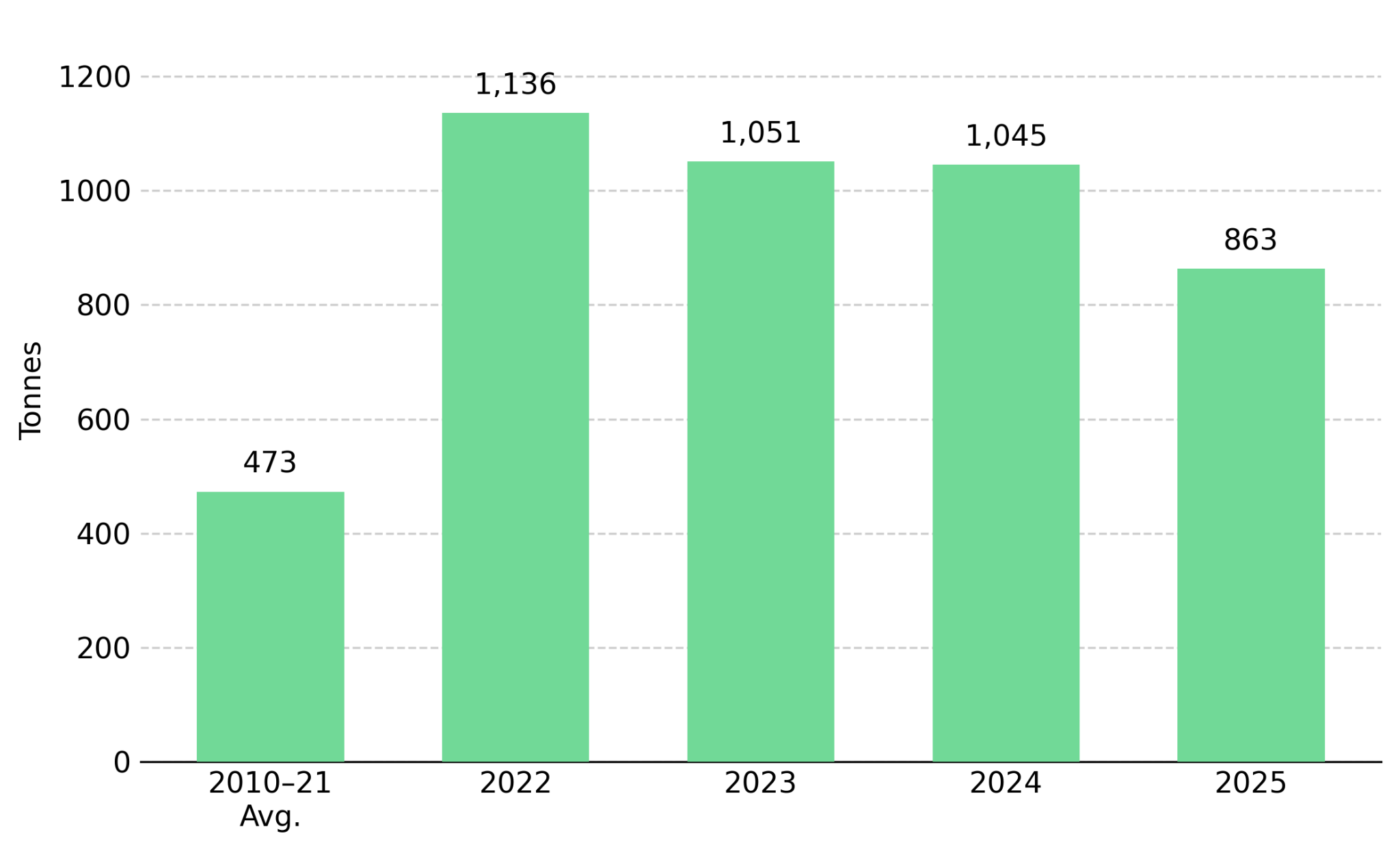
The World Gold Council's 2026 Central Bank Gold Reserves Survey found that 89% of reserve managers expect global gold holdings to increase over the next year, while a record 45% expect their own institutions to buy more gold. Because most responses were collected after the Middle East conflict began, the survey reflects current geopolitical conditions. The findings suggest a single Fed decision may influence short-term gold prices without changing the long-term reserve diversification driving official-sector demand.
Central Bank Gold Buying Continues Despite Federal Reserve Policy Shifts
The People's Bank of China extended its net gold-buying streak to a 20th consecutive month in May 2026, adding 10 tonnes, its largest monthly purchase since December 2024. The National Bank of Poland bought 18 tonnes in May, its fourth consecutive month of double-digit purchases, increasing year-to-date acquisitions to 64 tonnes and total holdings to 614 tonnes as it works toward its stated 700-tonne reserve target. Neither institution is buying in a single large tranche timed to a price decline.
Both institutions have continued accumulating gold through the metal's roughly 28% correction from its January 2026 peak. Rather than increasing purchases during the decline, they maintained a steady pace, suggesting their buying is guided by long-term reserve allocation objectives rather than short-term market timing.
European Central Bank Data Confirms a Shift in Gold Reserve Allocations
The European Central Bank's June 2026 report provides strong evidence explaining recent changes in official reserve allocations. Gold accounted for 27% of official reserve assets at the end of 2025, up from 20% a year earlier, surpassing US Treasuries at 22%, while the US dollar remained the dominant reserve currency with a 42% share of global reserves.
The ECB attributes the shift to the 2022 freezing of Russia's reserves, which highlighted the sanctions and counterparty risks of financial assets that physical gold does not carry. The findings point to a multi-year change in reserve allocation, helping explain why official-sector demand has remained resilient despite higher interest rates.
Markets Underprice Geopolitical Risk as Gold Awaits a New Catalyst
Beyond this week's Fed decision, investors are also watching the unresolved US-Iran dispute over the Strait of Hormuz, where any disruption to oil shipments could raise energy prices, reinforce inflation expectations, and complicate the Fed's policy outlook. A breakdown in the current ceasefire could therefore support gold through renewed geopolitical demand even if higher inflation strengthens expectations for tighter monetary policy.
The latest ceasefire proposal would reopen shipping through the Strait of Hormuz while negotiations continue on a longer-term transit agreement. However, an earlier memorandum of understanding collapsed this year, leaving markets uncertain that the current pause will hold.
Gold and oil have diverged despite heightened geopolitical tensions. Brent crude briefly approached $100 per barrel around July 23 before retreating on ceasefire expectations, while gold remained comparatively subdued as investors focused on the Fed. If negotiations fail, markets could quickly reprice both geopolitical and monetary policy risks, providing renewed support for gold.
Uncertain Gold Prices Shift Investor Focus to Producer Fundamentals
When gold's near-term direction is uncertain, investors tend to place greater value on operational quality than on maximum exposure to higher prices. Instead of favoring producers with the greatest leverage to a gold price rally, this environment favors companies whose operations remain profitable across a range of gold prices through disciplined costs, self-funded growth, and control over key processing infrastructure. The following four gold producers demonstrate three approaches to maintaining value through uncertain market conditions: low-cost production, internally funded growth, and operational control.
Range-Bound Gold Prices Increase the Value of Cost Discipline
Integra Resources' June 2026 feasibility study shows why one year of elevated costs does not necessarily reflect a mine's long-term economics. The study extended Florida Canyon's mine life to eight years, increased reserves by 78%, and estimated a 5% discounted net present value of $601 million alongside nearly $800 million in after-tax free cash flow. While 2026 site-level all-in sustaining costs are expected at $3,300 to $3,500 per ounce, above the life-of-mine estimate of $2,331 per ounce, management attributes the increase to temporary waste stripping and higher input costs rather than a lasting change in the mine's cost base.
President and Chief Executive Officer George Salamis has been direct about the source of that cost pressure, attributing it to input inflation common across the sector rather than an issue specific to Florida Canyon:
"Fuel prices are high, explosive prices are high, and that's being reflected in our all-in sustaining costs right now. It's a fact of life. We have to just deal with it, as every other producer does."
Self-Funded Growth Reduces Reliance on Tightening Capital Markets
Serabi Gold ended its most recent quarter debt free with $65.7 million in cash, funding exploration through operating cash flow rather than external financing. That balance sheet strength becomes more valuable when higher Fed rate expectations reduce investor appetite for mining equities and increase financing costs. Meanwhile, West Red Lake Gold Mines increased second-quarter production by 51% quarter over quarter and expects mined grades to rise to 6–8 grams per tonne as operations advance into higher-grade zones, demonstrating how operational execution can improve project economics regardless of short-term gold price movements.
Chief Executive Officer Mike Hodgson connects Serabi Gold's current financial flexibility directly to the gold price cycle, noting that the company's improved access to capital has come alongside a thinner opportunity set for acquisitions:
"Ironically, when we had no money, there were lots of opportunities. We didn't have the currency. Now we've gone up, the paper's getting better and the currency is getting better, but the opportunities mainly have gone."
Higher Gold Prices Strengthen Margins During Mine Ramp-Up
President and Chief Executive Officer Shane Williams frames West Red Lake Gold Mines' margin resilience against its own asset's mining history, comparing current economics with the higher cost base the mine's previous operator required:
"Their previous operators, Pure Gold, were mining for $2,500, $3,000 an ounce, but unfortunately gold was at $1,500 an ounce at the time. When you look at it today, even with all that, if we're mining at that rate, we're still making a good margin. So margin, gold price, helps give you some leeway as we ramp up for sure."
Owning Processing Infrastructure Protects Margins From Toll Milling Costs
i-80 Gold is investing $430 million to refurbish its Lone Tree pressure oxidation facility, increasing expected payability from 55-60% through third-party toll processing to about 92% under owner-operated infrastructure. Because refractory ore requires pressure oxidation before conventional cyanide leaching can recover the gold, internal processing allows the company to retain more of the recovered metal and improve operating margins without relying on higher gold prices.
Chief Operating Officer Paul Chawrun ties the recapitalization that funds this buildout to a broader shift in the company's operating model:
"This is what launches i-80 into the next level. We did the equity raise last year, we raised this amount of capital, and what this does for us is, first of all, to be able to put this project together."
Long-Term Gold Fundamentals Remain Intact Despite Short-Term Market Volatility
Beyond near-term price swings, the stronger long-term signal for gold comes from continued official-sector buying rather than any single Fed decision. Central banks have continued accumulating gold through its recent price correction, reinforcing reserve diversification as a multi-year investment theme.
Whatever Wednesday's outcome, the European Central Bank's reserve allocation framework is unlikely to change. A dovish hold could support a near-term rally, while a rate increase or hawkish hold could pressure gold prices. Neither outcome alters the longer-term trend in official-sector demand.
For gold equity investors, commodity price risk and producer execution risk remain separate drivers of returns. Companies with attractive jurisdictions, competitive costs, and strong balance sheets can still see their share prices react to Fed-driven changes in market sentiment rather than their underlying operations.
The Investment Thesis for Gold
- Central bank reserve diversification continues to support long-term gold demand even as the Federal Reserve's near-term rate decisions drive short-term price movements.
- Near-term gold price direction remains uncertain ahead of this week's Fed decision, with credible upside and downside scenarios. That uncertainty supports measured position sizing rather than a single directional bet.
- Producers with disciplined all-in sustaining costs and self-funded growth plans are better positioned to preserve margins and advance their projects when gold prices trade within a range rather than provide a sustained upward tailwind.
- Owning processing infrastructure rather than relying on third-party toll milling can increase payability and improve project economics, giving developers and producers greater control over operating margins.
- Jurisdictions with predictable permitting and established infrastructure can reduce execution risk by shortening development timelines and improving project certainty.
- Gold price risk and company-specific execution risk should be evaluated separately, because a well-positioned operator can still experience share price volatility following a Fed policy announcement that does not alter its underlying business.
This week's Fed decision is likely to drive gold's near-term price direction, with the potential for sharp moves in either direction as markets remain tightly positioned ahead of Wednesday's announcement. It will not, however, determine the longer-term outlook supported by European Central Bank research and World Gold Council reserve data. Together, those findings show that central banks continue to treat gold as a strategic reserve asset over a horizon that extends beyond any single Fed rate cycle. For investors, the key distinction is between the trade, driven by Fed policy over days or weeks, and the investment thesis, supported by reserve diversification over multiple years. Gold and gold mining equities can still decline from current levels if Fed policy expectations strengthen or investor sentiment weakens. Producer-specific risks, including permitting delays, cost inflation, and financing conditions, add to commodity price risk rather than replace it.
TL;DR
Gold remains caught between two powerful forces: short-term Federal Reserve policy expectations and long-term central bank reserve diversification. While hawkish Fed pricing has triggered Western ETF outflows and could pressure gold prices in the near term, official-sector purchases continue above historical averages, reinforcing long-term demand. European Central Bank research supports this shift, showing gold has become the world's second-largest official reserve asset. For investors, producer quality is becoming increasingly important as gold prices remain uncertain. Companies with disciplined costs, self-funded growth, and owned processing infrastructure are better positioned to preserve margins and advance projects regardless of short-term market volatility.
FAQs (AI-Generated)
Analyst's Notes





Subscribe to Our Channel





Stay Informed