




First Hole, First Signals: Carolina Rush Uncovers Deep Porphyry Signals at South Carolina's Historic Brewer Mine


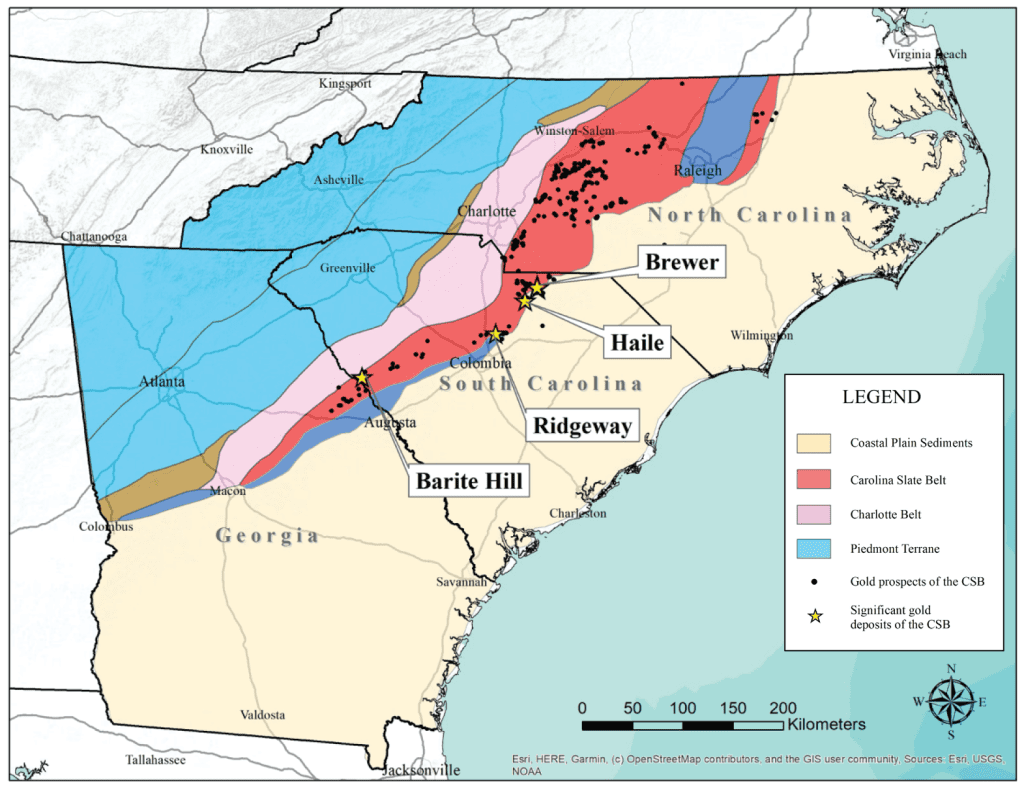
Carolina Rush's first deep hole at Brewer hit 410m of chalcopyrite-rich copper, confirming a kilometer-scale system and sharpening the hunt for a porphyry source northwest.
For more than a century, the rolling pine country of Chesterfield County, South Carolina, has been known for one thing: gold. The Brewer mine produced it intermittently from the 1820s through the 1990s, and Carolina Rush Corporation has spent the past six years proving there's still plenty left - a resource exceeding 500,000 ounces sits in the ground, verified under NI 43-101 standards. But this spring, the company's attention shifted to something deeper, and potentially much bigger.
A First-of-Its-Kind Drill Program
In early January, drill rigs operated by Timberline Drilling began turning at Brewer on a program unlike anything attempted there before. Rather than chasing more near-surface gold, the three-hole campaign was designed to test what lies beneath - a possibility geologists have floated since the 1970s, when the U.S. Geological Survey first flagged Brewer as a potential copper porphyry target. By mid-April, the rigs had logged 3,579 meters across three holes, the deepest reaching nearly 1,400 meters. It was, by any measure, the first systematic deep test in Brewer's long history.
What Hole 37 Found
The early results, released in early May, gave the company something concrete to work with. Hole 37, drilled to a final depth of 1,288 meters, intersected 410 meters of elevated copper averaging 183 parts per million - including a richer 78-meter stretch averaging 260 ppm, and a 14-meter zone running 490 ppm. For context, background copper levels at Brewer typically sit below 50 ppm, so this represents a substantial departure from anything the property has shown before.
What makes the discovery interesting isn't just the copper grade, but how it's hosted. The mineralisation in Hole 37 is dominated by chalcopyrite - the copper mineral most commonly associated with porphyry systems - and it's a different beast entirely from the high-sulfidation gold mineralisation known near the historic pit. Alongside the chalcopyrite, geologists logged banded quartz-sulfide veining (so-called "B-type" veins), multiple intrusive dikes, and a textbook alteration sequence running from advanced argillic near surface down through sericite-chlorite to chlorite-epidote at depth. Taken together, it's the kind of signature that porphyry geologists look for as evidence of a magmatic-hydrothermal system at depth.
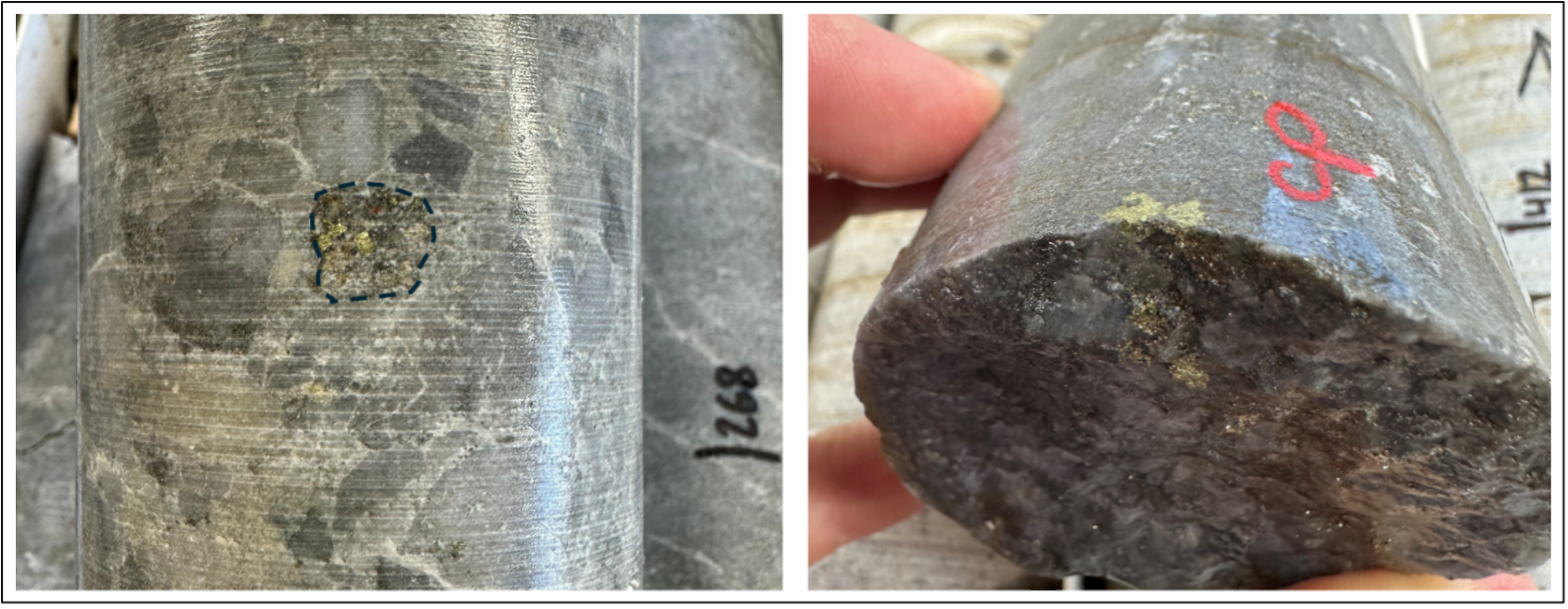
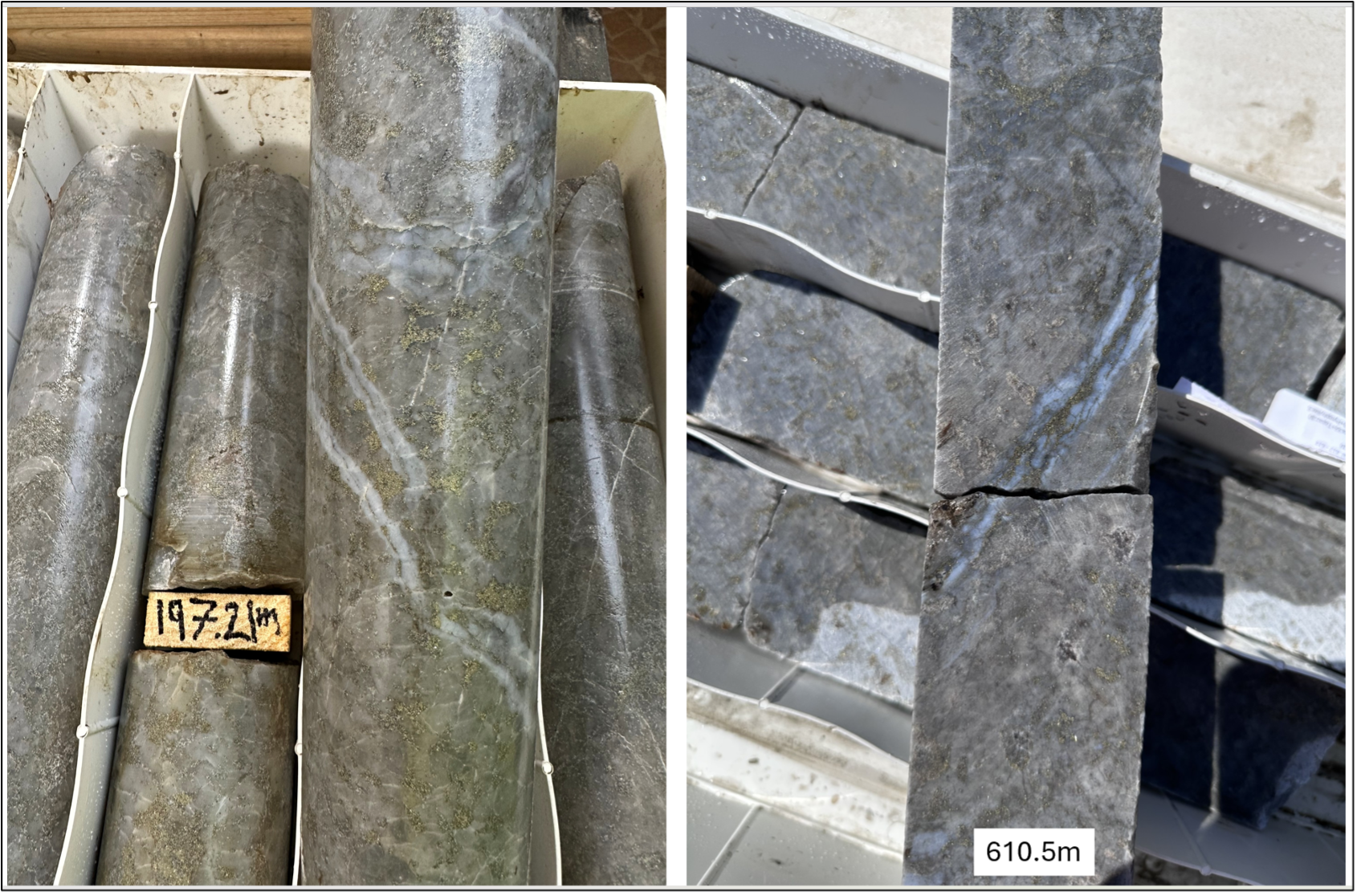
"Background copper levels at Brewer are less than 50 parts per million," said CEO Layton Croft. "Hole 37 intersected 410 meters averaging 183 ppm copper, predominantly chalcopyrite, within the top 600 meters. Together with Hole 37's B-type veining and alteration zonation, these results confirm we are clearly within a magmatic-hydrothermal system."
Croft was careful to temper expectations - no porphyry source has been identified yet, and no economic gold-copper grades were found in this hole. But he framed the result as a meaningful step rather than a dead end. "Porphyry copper deposits are typically discovered over multiple drill campaigns, and we are encouraged by our first," he said.
Redrawing the Map
Perhaps the most useful outcome of the program wasn't the copper itself, but what it revealed about where to look next. The drilling targeted a large low-resistivity anomaly identified in a 2025 geophysical survey, an anomaly the company had hoped might mark a buried intrusion. Instead, Hole 37 showed that the anomaly reflects a contrast between two types of altered rock - a peripheral signature rather than a central one. That reinterpretation may redraw the map, potentially pointing the system's likely source toward an area to the northwest, where alteration appears to thicken and strengthen.
That northwest vector already shaped where the second hole, B26C-038, was placed - roughly 750 meters northwest of Hole 37, testing the extension of the same hydrothermal system. Results from that hole, along with the third (B26C-039, which retested ground closer to the historic mine), are still pending, with the company now working through integrated geological, geochemical, and geophysical interpretation ahead of planning a second phase.
A Major Partner with Local Knowledge
None of this would be happening without Carolina Rush's partner. OceanaGold, which operates the Haile gold mine just 13 kilometers away, struck an earn-in agreement with Carolina Rush last September that could see the larger company spend up to US$20 million on exploration at Brewer in exchange for as much as an 80% interest. The just-completed drill program satisfied OceanaGold's initial US$1.5 million minimum commitment - a threshold expected to be confirmed met in the second quarter. Carolina Rush, for its part, remains free-carried through the entire US$20 million program, retaining a 20% interest without putting up additional capital. The next checkpoint comes in the second half of 2026, when OceanaGold weighs whether to continue funding toward the US$8 million, 50%-interest milestone due by the end of 2027.
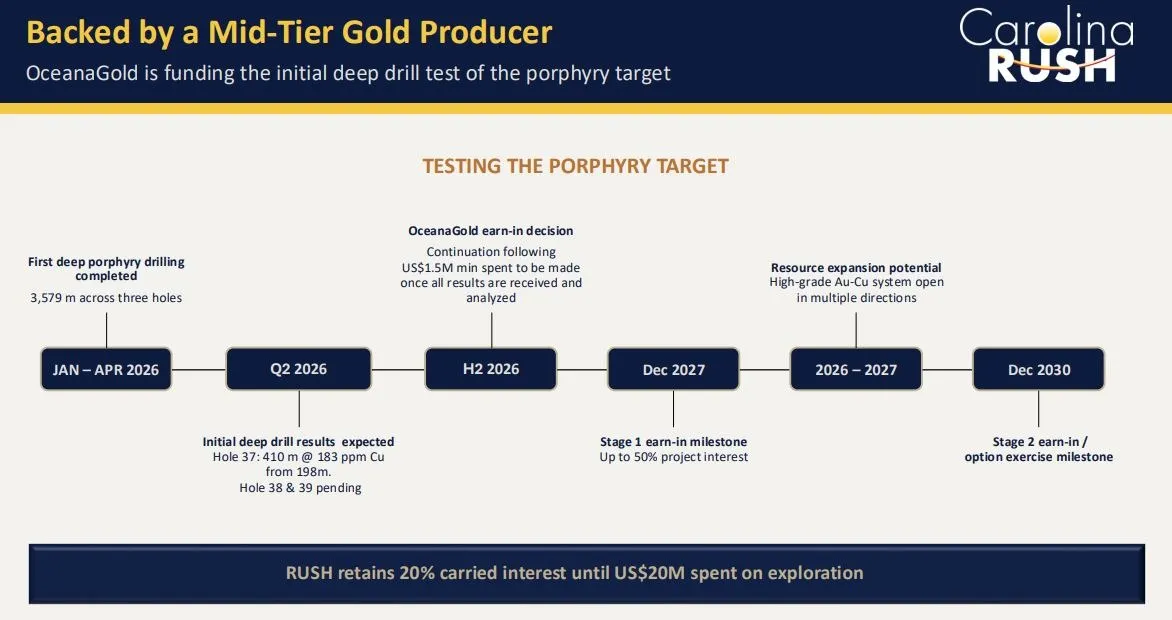
For a junior explorer, that kind of backing is no small thing. OceanaGold brings not just capital, but on-the-ground familiarity with the geology of the district - the company's Haile mine, some five million ounces and counting, shares characteristics with what Carolina Rush believes may lie beneath Brewer. The proximity is practical too: Haile's mill is roughly 15 minutes' drive from Brewer, a detail that hints at potential longer-term synergies if a discovery were ever to advance toward development.
Looking Ahead
What's clear after this first deep campaign is that Brewer's hydrothermal system is real, large, and extends well beyond the footprint of the known gold resource - confirmed now to depths exceeding a kilometer. Whether a porphyry copper-gold center exists within reach remains an open question, and the company is careful to frame its porphyry references as conceptual at this stage. But with two more sets of assays pending, a sharpened target area to chase, and a well-funded partner already committed through the next phase, Carolina Rush heads into the second half of 2026 with more data - and more direction - than it's had in Brewer's 200-year history.
Analyst's Notes





Subscribe to Our Channel





Stay Informed


