




Marimaca Puts Pampa Medina Next to Kakula's Best Copper


Marimaca Copper's July 2026 drilling at Pampa Medina has management benchmarking the stacked, high-grade system against Kamoa-Kakula's best copper.
- Marimaca Copper's July 2026 step-out drilling at Pampa Medina extended a stacked, high-grade copper-silver system and returned the deepest hole at the deposit so far.
- Management benchmarks Pampa Medina against the Kakula selective mining zone, the high-grade core of the Kamoa-Kakula complex.
- Best intercepts include 6 metres (m) at 6.11% copper and 24.0 grams per tonne (g/t) silver, with earlier holes returning 16 m at 5.7% copper and, with silver, grades reading above 6% on a copper-equivalent basis.
- Pampa Medina stacks multiple high-grade horizons and carries no overlying aquifer, unlike Kamoa-Kakula.
- A maiden resource is targeted for early 2027, with Marimaca Oxide Deposit (MOD) financing targeted before the end of 2026 and first cathode in 2029.
Marimaca Copper (TSX: MARI | ASX: MC2) has spent 2026 drilling out its Pampa Medina copper discovery in Chile's Antofagasta Region, and a step-out round released in July 2026 extended the high-grade sulphide zone and returned the deepest hole yet. In a July 2026 interview, management set those results against the Kakula selective mining zone, the high-grade core of the Kamoa-Kakula complex, arguing that Pampa Medina's stacked horizons carry widths and grades of the same order. It is an unusually direct benchmark for a deposit that has not yet published a resource.
The Latest Drilling at Pampa Medina
The step-out programme kept building the picture of a stacked, high-grade system. One hole returned 20 metres (m) at 2.65% copper and 13.9 grams per tonne (g/t) silver from 564 m depth, including 6 m at 6.11% copper and 24.0 g/t silver, then a second interval of 104 m at 1.01% copper from 664 m depth carrying 40 m at 2.04% copper and, within it, 4 m at 6.54% copper and 38.5 g/t silver. The intervals sit one above another rather than in a single band.
The same round produced the deepest drilling completed at the deposit to date. That hole reached 1,052 m and returned a 660-metre intersection at 0.41% copper from 386 m depth, cutting multiple stacked mineralised layers, or mantos. It also carried mineralisation down into the basement at 66 m of 0.70% copper from 802 m depth. True widths are estimated at about 80% of the reported downhole intervals. Six drill rigs are turning on the deposit.
Measuring Against Kakula
Kakula is the core, highest-grade portion of the Kamoa-Kakula complex, the zone that drove that project's payback and its industry-leading return on invested capital. It covers roughly 6 km by 1.5 km, about 10 square kilometres, and holds 400 million tonnes at close to 3% copper with no byproduct credits, at an average true thickness of around 12 m and a 1% copper cut-off.
About 450 m to the south of earlier holes, Pampa Medina returned 96 m at 1.19% copper, including 16 m at 5.7% copper. Silver lifts the grade further on the company's own calculation: a 12-metre interval at 2% copper and 24 g/t silver reads closer to 2.5% on a copper-equivalent basis, and an 18-metre interval at 5% copper and 53 g/t silver sits above 6%. This is a different style from the porphyry systems of the Vicuña district, where high grade extends deep but far less widely.
Chief Executive Officer of Marimaca Copper, Hayden Locke, is precise about how the intercepts stand against Kamoa-Kakula's best rock:
"If you had 16 metres at 5%, that would be considered in line with the best part of the Kamoa-Kakula deposit, the Kakula selective mining zone. We're delivering, on a regular basis, widths and grades of the same level they saw at Kamoa-Kakula."
The benchmark is Kakula's best rock, not its average grade.
Stacked Horizons & No Overlying Aquifer
Two features separate Pampa Medina from its benchmark. The first is structure: where Kamoa-Kakula is mined from a single horizon, Pampa Medina stacks several high-grade horizons on top of one another, each at economic width and grade, and its high-grade zone runs to true thicknesses in excess of 10 m. The second is water, because Kamoa-Kakula sits beneath a large aquifer whose inflows complicate mining, while Pampa Medina carries no overlying water.
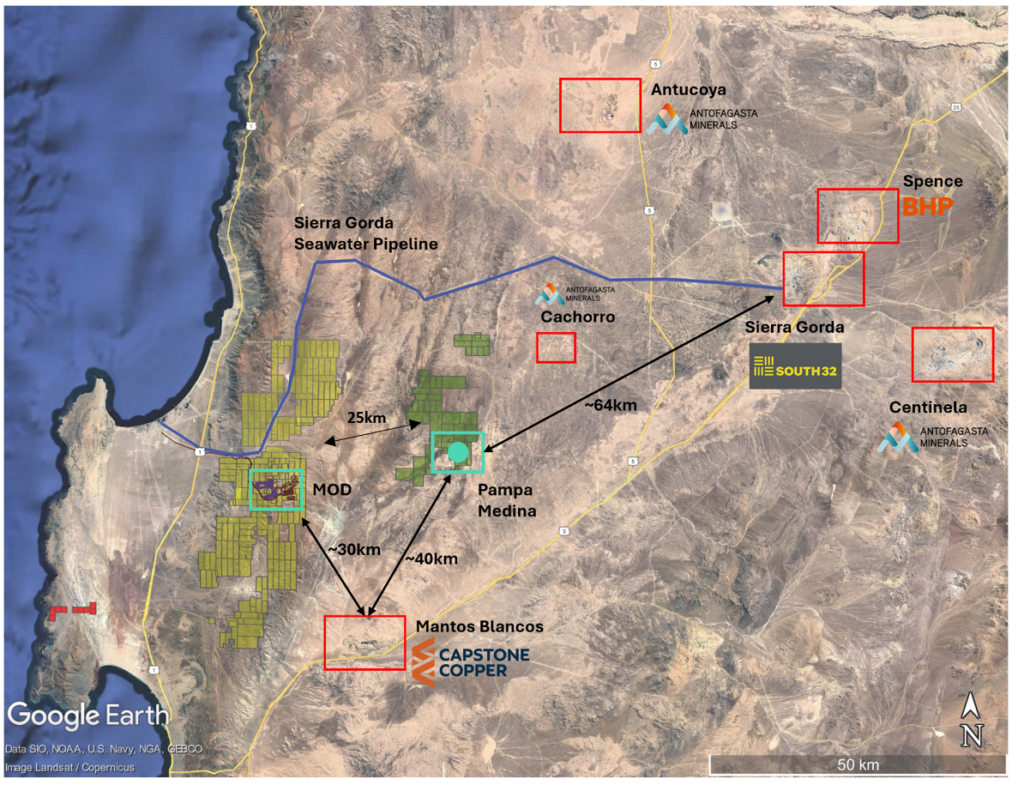
The deposit sits in Chile's low coastal range, with the Marimaca Oxide Deposit (MOD) starting near 700 m above sea level and Pampa Medina near 1,000 m, and the MOD lies 25 km from the Port of Mejillones. That puts infrastructure within reach rather than requiring a build from scratch.
Locke is direct about what sets the deposit apart:
"We are starting to delineate a potentially world-class sediment-hosted copper deposit in the low coastal range in Chile, which is 50 kilometres from a port. There's no water overlying this deposit, there are no aquifer units."
Pampa Medina Within the Broader Basin
The drilled footprint is a small part of the ground that Marimaca reads as prospective. Current drilling covers about 2 km by 1.5 km, inside a basin the company puts at roughly 10 km to 12 km north to south and about 5 km east to west. Evidence of sediment-hosted copper turns up across that ground, including at a neighbouring deposit more than 15 km to the north.
Broad geophysics over the whole package has flagged several targets that resemble Pampa Medina, and a scout drilling programme is working through gravel cover to test them, alongside a 30,000-metre step-out and delineation programme on the deposit itself.
Locke frames the scale case against the wider Kamoa deposit rather than the Kakula core:
"If we then look at our average true thickness relative to Kamoa, we're in some cases more than 10 times thicker with multiple stacked horizons of high-grade mineralisation. We don't need as large a footprint. We think this area has the potential to put us into the tier one category already, if the drilling hangs together."
Tier-one tonnage could therefore come from far less strike than the roughly 6 km of Kakula's long axis.
What Comes Next
Several dated events will test the comparison. Marimaca is targeting an announcement of the MOD project financing before the end of 2026, with a final investment decision and construction start both targeted for 2027 and a 24-month build targeting the first copper cathode in 2029, a date the company says it could pull forward. A maiden resource for Pampa Medina, covering both the oxides and the sulphides, is targeted for early 2027.
Nearer the existing plan, the company sees the Pampa Medina oxides adding 20,000 to 25,000 tonnes per year of cathode on top of the MOD's 50,000 tonnes per annum, without further exploration success. Until that first resource attaches a number to it, the benchmark against Kakula stays a claim about drill intercepts.
FAQs (AI-Generated)
Analyst's Notes





Subscribe to Our Channel






Stay Informed


