IsoEnergy Ltd. & Reducing Uranium Development Risk Through a Multi-Asset Strategy


IsoEnergy combines near-term production, high-grade uranium resources and financial strength to reduce execution risk across 3 global jurisdictions.
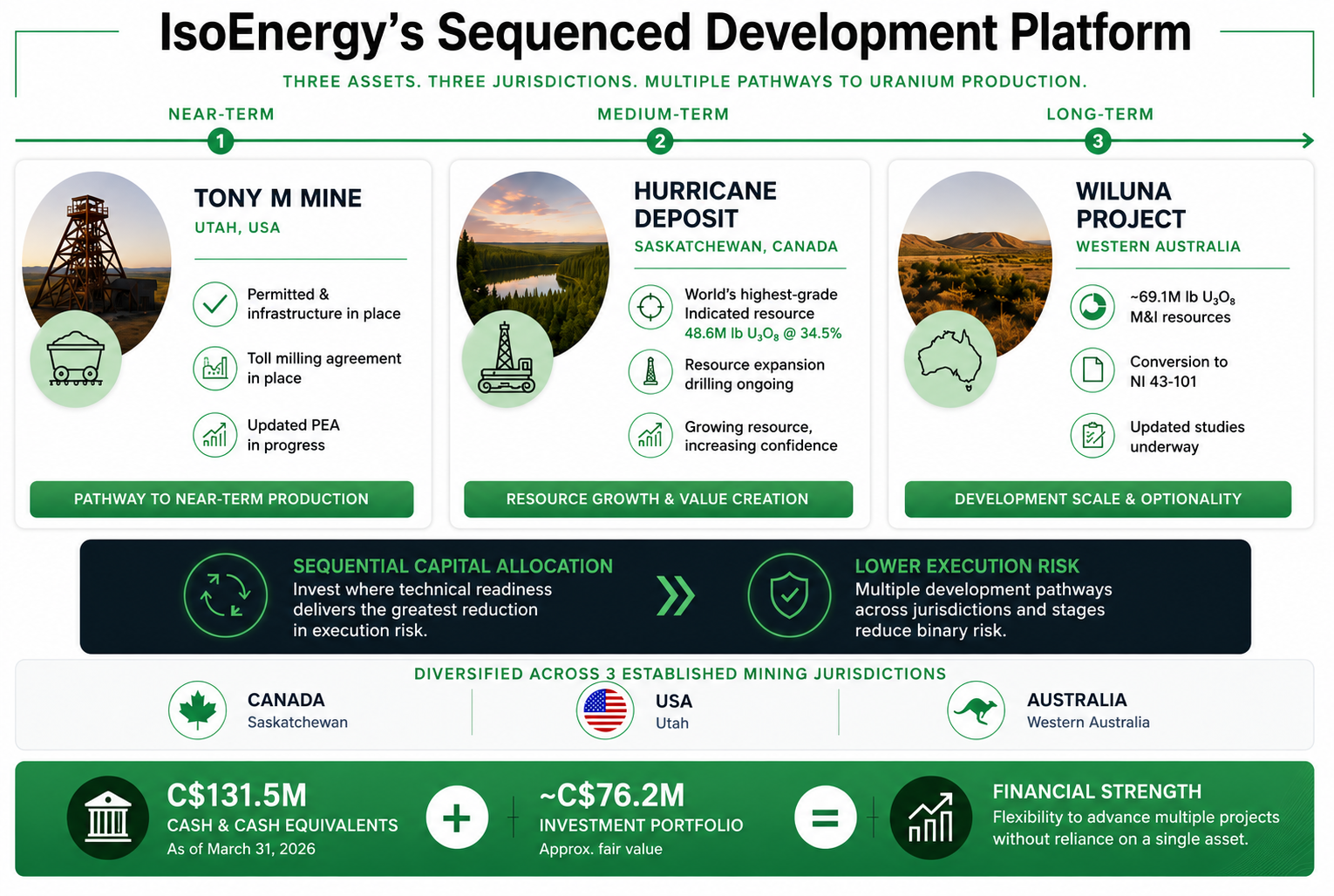
- IsoEnergy has built a diversified uranium portfolio across Canada, the US, and Australia to reduce dependence on any single project, jurisdiction, or development milestone.
- The Tony M Mine represents IsoEnergy's most advanced asset, supported by existing permits, underground infrastructure, and a toll milling agreement that could enable a faster production restart.
- The Hurricane deposit remains the company's primary long-term value driver, combining the world's highest-grade published Indicated uranium resource with ongoing resource expansion drilling.
- The acquisition of the Wiluna Uranium Project adds large-scale Australian uranium resources and expands IsoEnergy's long-term development pipeline.
- A cash balance of approximately C$76.2 million, an investment portfolio valued at approximately C$41.7 million, and a sequential development strategy support disciplined capital allocation across multiple projects.
Building a Sequenced Uranium Development Platform
IsoEnergy (TSX: ISO | NYSE American: ISOU) has evolved beyond exploration success to focus on disciplined project execution across a diversified portfolio of uranium assets. During 2025 and the first half of 2026, the company expanded its development pipeline through the acquisition of Toro Energy Limited, advanced technical work at the Tony M Mine in Utah, continued resource expansion at the Hurricane deposit in Saskatchewan, and published its inaugural Sustainability Report. Together, these developments position IsoEnergy to advance multiple assets through different stages of development while reducing reliance on any single project or jurisdiction.
Unlike many uranium developers whose valuations depend on a single permitting decision or construction milestone, IsoEnergy has assembled projects at different stages of technical maturity across three established mining jurisdictions. This portfolio allows management to allocate capital where engineering, exploration, or permitting can deliver the greatest reduction in technical uncertainty while maintaining flexibility as development priorities and uranium market conditions evolve. Rather than concentrating future value creation on a single asset, the company has created multiple pathways to future uranium production.
Management intends to advance projects according to technical readiness, allowing financial resources and operational focus to shift from one development stage to the next. This sequential approach reduces execution risk by avoiding overlapping large-scale capital commitments while preserving exposure to multiple long-term development opportunities. For investors, the strategy shifts the investment case from reliance on a single catalyst to the steady reduction of technical and execution risk across the broader portfolio.
Why Portfolio Diversification Matters
For uranium developers, project value is often determined as much by execution as by resource quality. Permitting, engineering studies, financing, and construction typically extend over several years, and delays at any stage can materially affect project economics and development schedules. By maintaining assets across Canada, the US, and Australia, IsoEnergy reduces dependence on a single regulatory process or development timeline while preserving multiple opportunities to advance toward production.
The strategy also improves capital allocation. Exploration programmes, engineering studies, and permitting activities can be prioritised based on technical readiness rather than predetermined corporate timelines, thereby directing investment toward projects that deliver the greatest reduction in execution risk. As individual assets mature, financial and technical resources can be redeployed across the broader portfolio rather than remaining tied to one development outcome.
Chief Executive Officer and Director of IsoEnergy Ltd., Philip Williams, introduced the company's long-term strategy:
"We understood from the very beginning that single-asset, single-jurisdiction companies are far more risky, particularly in the uranium space. You can be the greatest project in the world and can be delayed for all kinds of reasons you can't foresee, so taking a portfolio approach is the way to insulate yourself and insulate shareholders from being exposed to what could be a binary outcome."
Tony M Mine Offers the Clearest Pathway Toward Production
Among IsoEnergy's portfolio, the past-producing Tony M Mine in Utah represents the company's most advanced opportunity to generate future cash flow. Unlike a greenfield development that would require new permitting and processing infrastructure, Tony M already benefits from state and federal operating permits, established underground workings, and a toll milling agreement with Energy Fuels Inc.'s White Mesa Mill. These existing assets materially reduce development complexity and allow management to focus on optimising project economics rather than establishing basic project viability.
During 2025 and 2026, the company extracted approximately 2,000 tonnes of bulk sample material for beneficiation testing, following earlier work that demonstrated the potential to retain more than 90% of the contained uranium while reducing the material requiring downstream processing by approximately 75%. The results are being incorporated into an updated Preliminary Economic Assessment (PEA), which management is targeting before making a production restart decision. Because much of the supporting infrastructure already exists, the study aims to determine whether technical improvements can sufficiently enhance project economics to justify restarting operations.
Williams discussed the measured pace of project advancement:
"Rushing to fail, I don't think is the answer; I think patience is a great answer, which is why we're not rushing to turn Tony M on. We're permitted, we have a toll milling agreement, we have the infrastructure, we can move it into production very quickly, but we want to maximise the value of that asset and make as much as we can per pound."
The investment significance of Tony M extends beyond its existing infrastructure. Because permitting, underground development, and processing arrangements are already in place, the updated PEA will primarily determine whether existing assets can be converted into economically attractive uranium production rather than whether the project can be built at all.
Hurricane Combines Exceptional Resource Quality with Long-Term Value Creation
While Tony M represents IsoEnergy's earliest potential production opportunity, the Hurricane deposit remains the company's principal long-term value driver. Hurricane hosts an Indicated mineral resource of 48.6 million pounds of uranium grading 34.5%, making it the highest-grade published Indicated uranium resource globally. The project benefits from its position within one of the world's most established uranium mining districts. Rather than accelerating immediately into engineering studies, IsoEnergy continues to prioritise resource expansion, reflecting management's view that increasing the size and confidence of an already exceptional resource before committing development capital can create greater long-term value than advancing prematurely toward mine construction.
During the winter 2026 drilling programme, the company intersected uranium mineralisation substantially exceeding the existing resource model along the Hurricane South trend, demonstrating that high-grade mineralisation extends beyond previously interpreted boundaries. The follow-up summer programme is targeting approximately 8,000 metres across up to 20 drill holes to further evaluate this corridor and refine the geological model. Because higher-grade uranium deposits generally require less material movement to produce each pound of uranium, continued exploration success has the potential to improve both resource scale and future project economics while reducing geological uncertainty before development studies begin.
Williams commented on the significance of the recent drilling programme:
"In the winter, we drilled into the low-grade area at that south trend, and where we were expecting to hit 1 and a half %, we hit over 10%, so we had 11.6% in all, so upgraded that area significantly relative to what the resource model told us it would be. That was important because it showed us that high-grade mineralisation can exist on the south trend."
Wiluna Adds Development Scale & Capital Allocation Flexibility
The acquisition of Toro Energy Limited expanded IsoEnergy's development pipeline by adding the Wiluna Uranium Project in Western Australia. According to the July 2026 corporate presentation, Wiluna contributes approximately 69.1 million pounds of uranium in Measured & Indicated mineral resources across the Lake Maitland, Centipede-Millipede, and Lake Way deposits. Unlike Hurricane, whose competitive advantage lies in exceptional grade, Wiluna's value proposition is based on resource scale, shallow mineralisation, and the potential for future open-pit development.
Management believes Wiluna's primary constraint under previous ownership was financial capacity rather than technical quality. IsoEnergy plans to update historical technical work by converting Joint Ore Reserves Committee (JORC) mineral resources to National Instrument 43-101 (NI 43-101) compliant mineral resources, completing targeted drilling where required, and refreshing economic studies. By reducing technical uncertainty before committing major capital, the company can advance Wiluna alongside Tony M and Hurricane in line with project readiness and uranium market conditions, preserving capital allocation flexibility while lowering portfolio execution risk.
Sustainability & Financial Strength Support Execution
As IsoEnergy's portfolio advances from exploration toward development, governance and financial capacity become increasingly important investment considerations. The company's inaugural 2025 Sustainability Report establishes formal oversight for environmental stewardship, workforce safety, Indigenous and community engagement, ethical business conduct, and climate-related governance across its operations in Canada, the US, and Australia. Rather than serving solely as an environmental, social, and governance disclosure, the report documents Board and executive oversight, as well as policies for operational risk management and stakeholder engagement. For uranium developers, these systems extend beyond corporate reporting because permitting, community relationships, and operational discipline can directly influence project timelines and access to capital.
IsoEnergy's financial position complements this governance framework by providing the flexibility to advance projects according to technical readiness rather than funding constraints. The company reports C$131.5 million in cash and cash equivalents as of March 31, 2026, together with an equity investment portfolio valued at approximately C$40.2 million. This balance sheet allows management to continue exploration at Hurricane, complete engineering work at Tony M, and advance technical studies at Wiluna without relying on one project to finance another. The combination of financial flexibility and formal governance supports disciplined capital allocation while reducing the execution risk associated with advancing multiple uranium projects simultaneously.
Investment Thesis for IsoEnergy
- Diversification across Canada, the US, and Australia reduces dependence on a single development asset, permitting pathway, or construction schedule, allowing capital to be allocated where it can generate the greatest reduction in execution risk.
- Existing permits, underground infrastructure, and established processing arrangements at the Tony M Mine provide the clearest pathway toward potential near-term uranium production while materially reducing development complexity compared with a greenfield uranium project.
- The Hurricane deposit combines the highest-grade published Indicated uranium resource globally with continued exploration upside, creating opportunities to expand the resource and strengthen future project economics before major development capital is committed.
- The Wiluna Uranium Project broadens IsoEnergy's long-term development pipeline through a large-scale Australian resource that management is upgrading to current Canadian reporting standards before advancing future economic studies.
- A strong balance sheet, formal governance systems, and a disciplined, sequential development strategy provide the organisational capacity to advance multiple projects while preserving capital-allocation flexibility and reducing long-term execution risk.
IsoEnergy's investment case is increasingly defined by execution rather than discovery. The company has assembled assets at different stages of technical maturity and intends to advance them sequentially, allowing each milestone to reduce technical uncertainty before additional capital is committed. Progress at Tony M, continued resource growth at Hurricane, and technical advancement at Wiluna will determine whether management can convert a diversified uranium portfolio into sustainable long-term shareholder value.
TL;DR
IsoEnergy has evolved into a multi-jurisdictional uranium developer with a staged development strategy spanning Canada, the US, and Australia. A potential restart at Tony M, continued resource growth at Hurricane, the addition of Wiluna, and a strong financial position provide multiple pathways for long-term value creation while reducing reliance on any single development project.
FAQs (AI-Generated)
Analyst's Notes





Subscribe to Our Channel











Stay Informed