




Why the Zinc-Silver Halo West of B26 Points to a Copper Core


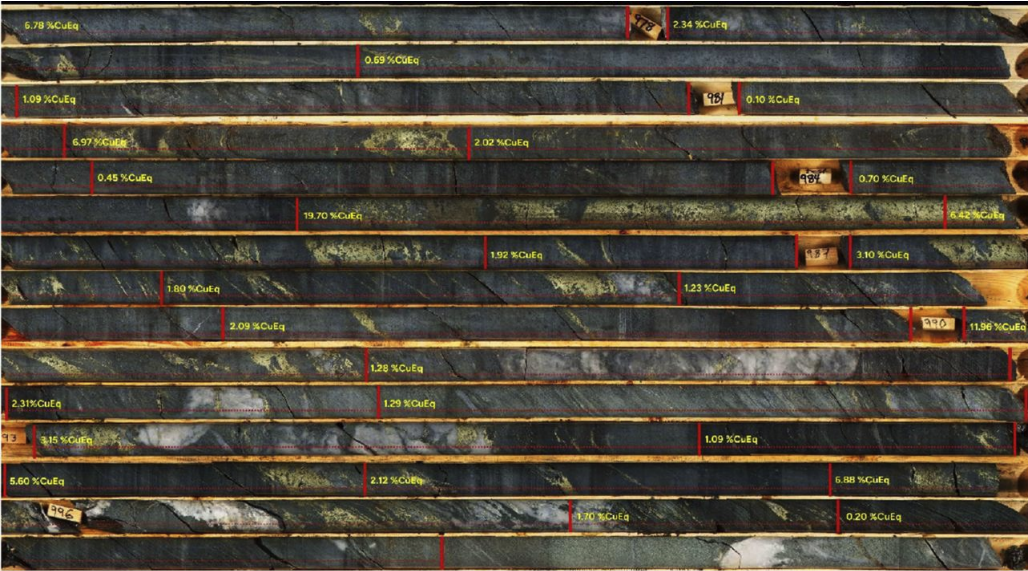
Abitibi Metals' first regional drilling at B26 intersected a new zinc-silver zone whose zonation mirrors that of the deposit, suggesting a possible copper-gold core.
- Abitibi Metals' first systematic regional drill programme at its B26 project in Québec has intersected a new potential volcanogenic massive sulphide (VMS) zone approximately 1.5 kilometres (km) west of the deposit.
- The discovery intercept ran 14.25 metres (m) at 1.13% zinc and 51.51 grams per tonne (g/t) silver, cut at approximately 400 m vertical depth.
- A narrow copper-rich interval roughly 70 m farther downhole reproduces the signature of B26's copper stringer zone, replicating the deposit's metal zonation.
- Outside the deposit itself, historical drilling was largely limited to the upper 200 m, leaving the property's depth dimension untested until this programme.
- Downhole electromagnetic surveys and a follow-up programme targeting winter 2027 will test whether the new zone carries a copper-gold core.
What Has Happened
Abitibi Metals (CSE: AMQ | OTCQB: AMQFF | FSE: FW0) has reported results from the first systematic test of the regional ground around its 100%-owned B26 polymetallic project in Québec: 3,285 metres (m) across four holes, covering three of seven priority target areas defined by reinterpreted historical drilling, legacy induced polarisation (IP) surveys and a 2025 airborne geophysical survey. The key result is a new potential volcanogenic massive sulphide (VMS) zinc-silver zone approximately 1.5 kilometres (km) west of the B26 deposit, cut at 400 m vertical depth: 14.25 m grading 1.13% zinc and 51.51 grams per tonne (g/t) silver, including 3.10 m at 2.82% zinc and 120.64 g/t silver. Drilling resumed in July 2026 following a temporary wildfire-related suspension.
The Target 1 Intercept & Its Host Rocks
The discovery sits in a corridor the company calls Target 1, which covers the western extension of the B26 stratigraphic horizon for approximately 1.5 km beyond the current deposit and shares its subdued magnetic signature. Two holes tested the corridor, approximately 500 m and 1,500 m west of the deposit. The nearer hole cut 4.30 m at 0.29% zinc and 2.78 g/t silver, including 0.50 m at 1.49% zinc, confirming that the B26 stratigraphic package continues westward; the farther hole delivered the discovery intercept, which also carried 3.50 m at 1.61% zinc and 82.49 g/t silver, with 2.00 m at 2.18% zinc, 106.10 g/t silver and 0.11 g/t gold at its base.
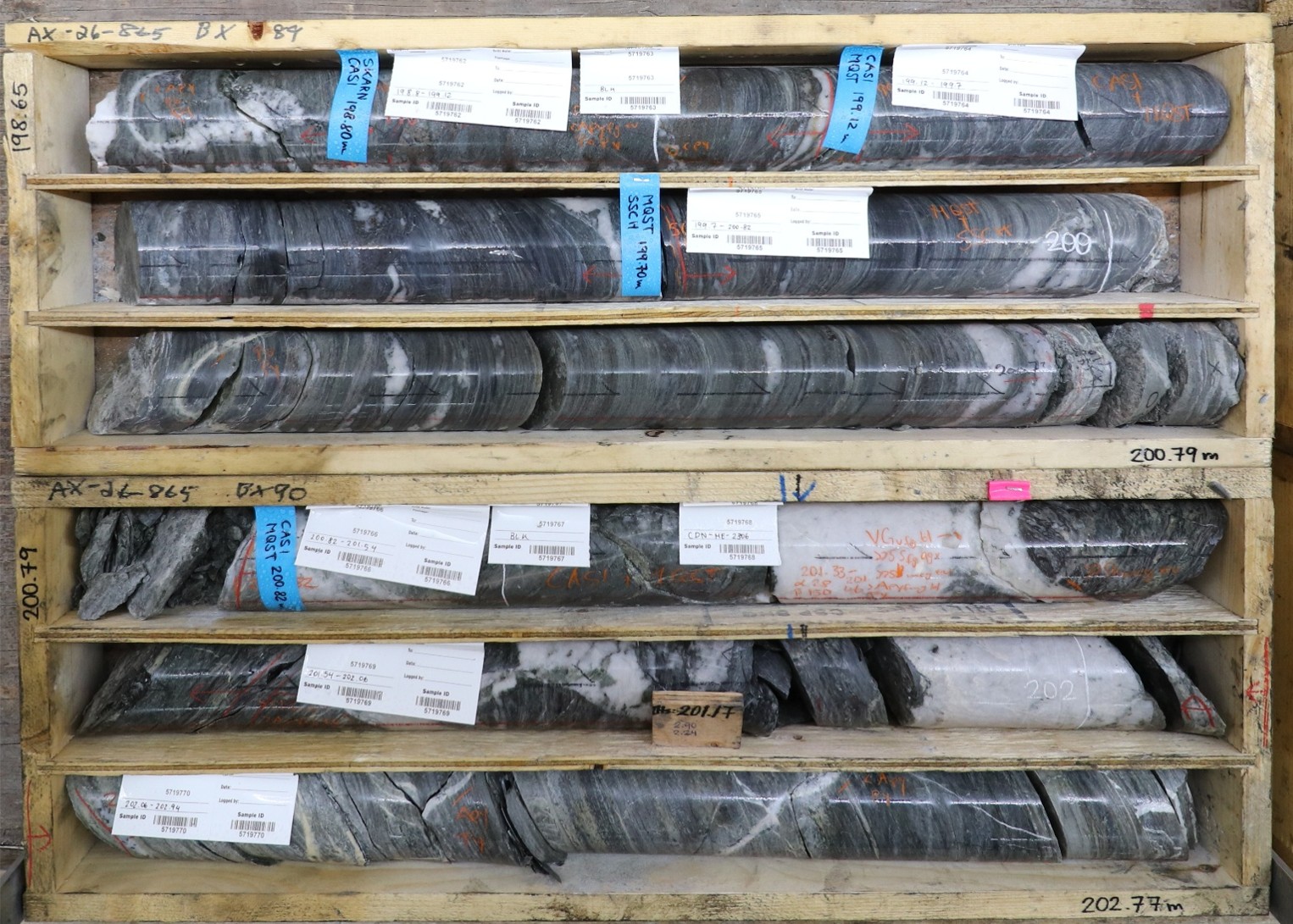
The zinc-silver mineralisation is hosted in pyritised, locally semi-massive felsic ash and lapilli tuffs carrying medium to strong sericite, silica, and iron carbonate alteration, the same host-rock package and alteration style as the B26 deposit sequence. The core is more intensely altered and moderately foliated than at B26, which distinguishes this occurrence from the deposit itself. The corridor was not empty ground: a historical hole here returned 0.33% zinc and 98.1 g/t silver over 4.7 m from 284.3 m within a B26-style alteration system, and was never followed up.
Reported intersections are core lengths rather than true widths; local interpretation puts true width at 60 to 80% of core length, which tempers the quoted intervals accordingly.
Metal Zonation & the Copper Signature
The interpretive weight of the result lies approximately 70 m farther downhole, where the same hole intersected a separate copper-rich interval grading 0.55% copper, reported in the release's intercept table as 16.80 g/t silver over 1.10 m and in its discussion text as a 0.60 m interval. The interval is narrow, but its mineral assemblage, chalcopyrite stringers within black chlorite alteration, is the signature style of B26's copper stringer zone. That pairing mirrors the metal zonation seen at B26, where the zinc-silver-rich horizon sits adjacent to the main copper-gold-rich horizon.
Founder & Chief Executive Officer of Abitibi Metals, Jonathon Deluce, is precise about how the deposit's metal is arranged:
"85% of the deposit is hosted in this copper-gold stringer zone, with the balance in this parallel massive sulphide zinc-silver. This is a large deposit: 1.6 km strike length, down to about 1,100 m vertical."
Read through that template, the July 2026 release interprets the new zinc-silver zone as the possible peripheral expression of a new B26-like VMS lens, one that could lead to a massive sulphide body with an associated copper stringer zone, and states that the reproduced architecture strengthens the case that Target 1 hosts a fertile VMS system analogous to, but distinct from, B26. The lens remains open in all directions, and whether it carries an economic copper-gold core is untested; follow-up drilling is planned to define the controls on mineralisation and to drill toward the copper-gold-enriched centre of the interpreted lens.
Historical Drilling Limits & the 400-Metre Tests
The property's drilling history explains how a 3,285-m campaign produced a new zone. Outside the immediate footprint of the B26 deposit, historical drilling remains largely limited to the upper 200 m, with no prior holes testing the system at a vertical depth of 400 m. The 2026 programme was designed against that gap, testing the downdip extensions of shallow historical zinc-silver anomalies at approximately 400 m.
The two other targets tested behaved consistently with that design. Approximately 5 km farther west, a 1.5-km-long electromagnetic conductor hosted in the same felsic volcanic sequence had returned broad historical polymetallic halos, including 0.33% zinc, 0.11% copper, and 1.25 g/t silver over 21.0 m from 147.22 m, which the July 2026 release interprets as leakage from a larger mineralised system at depth; the 2026 hole confirmed the favourable geological setting at 400 m. Approximately 4.5 km northwest, on a parallel trend associated with a strong IP anomaly, the 2026 hole cut 8.85 m at 0.68% zinc and 21.21 g/t silver, including 4.70 m at 1.04% zinc and 26.03 g/t silver, confirming that an open zinc-silver system first outlined by historical drilling of 0.77% zinc and 33.8 g/t silver over 19.2 m continues at 400 m vertical depth.
The same northwest hole added a second dimension to the regional picture: 332 g/t silver and 0.83 g/t gold over 1.0 m from 501 m downhole, a high-grade precious-metals intersection on a trend that runs along strike toward the historical Selbaie Mine. A separate VMS corridor extending toward the mine, Targets 5 to 7, remains untested, with an earlier hole there having returned 8.2 g/t gold, 212.5 g/t silver, and 2.9% zinc over 1.0 m from 129.5 m in a quartz-sulphide vein.
Broader Context
B26 itself sets the scale reference for where a second lens would sit. The deposit carries an indicated resource of 12.96 million tonnes at 2.08% copper equivalent (1.19% copper, 1.16% zinc, 0.44 g/t gold and 30.8 g/t silver) and an inferred resource of 12.34 million tonnes at 2.20% copper equivalent (1.60% copper, 0.16% zinc, 0.68 g/t gold and 8.1 g/t silver), per the 2026 mineral resource estimate (MRE) with an effective date of January 2026, calculated at base-case prices of US$4.50 per pound for copper and US$2,500 per ounce for gold. That estimate predates the regional results, and mineral resources are not mineral reserves; 12.34 million tonnes of the combined 25.3 million tonnes sit in the inferred category.
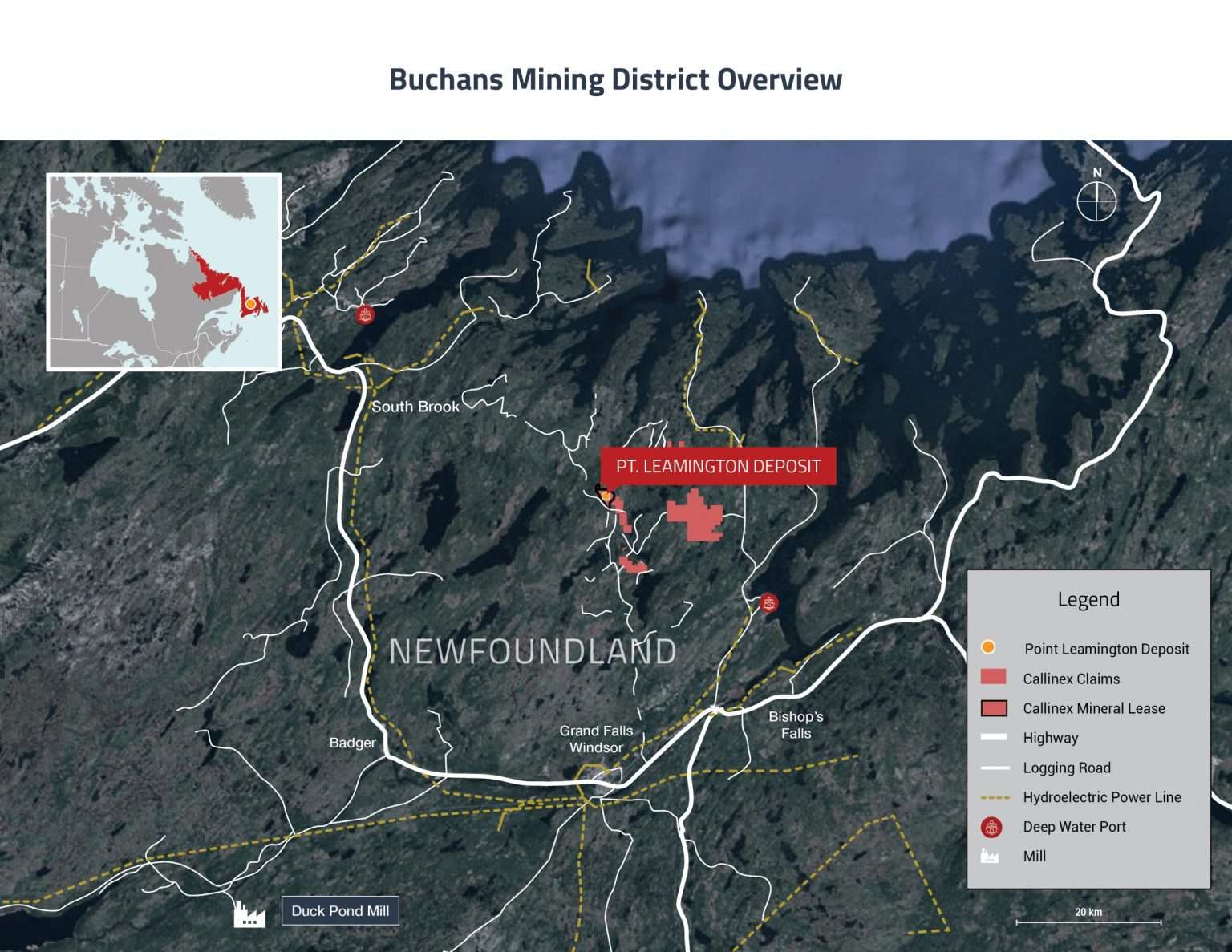
The camp setting supplies the precedent for multiple lenses. B26 lies 7 km southeast of the formerly producing Selbaie Mine, which provides the project with access to established infrastructure, and the property hosts two 8.3-km trends, one east-west and one north-west, each with limited past exploration. Deluce frames the camp's endowment plainly:
"The Selbaie mine was in production for 20 years, produced 53 million tons, a very good recovery, strong margin mine, and it really showcases the potential: this camp hosts very large-scale polymetallic VMS deposits. That's not always the case. More frequently in these VMS camps, you see smaller 5 to 10 million ton deposits, but this camp has the potential to host big systems."
Ownership consolidated shortly before the regional results. Abitibi exercised its option on SOQUEM Inc.'s remaining 20% interest in June 2026, taking the company to 100% ownership of B26; Deluce says the seven-year option agreement was completed in two and a half years. The transaction with SOQUEM, a subsidiary of Investissement Québec, included a 10-year right of first refusal for the adjacent Wagosic and Carheil properties, both owned by SOQUEM.
What to Watch Next
The nearest-term test of the copper-core interpretation is geophysical. All completed regional holes will be pulsed with downhole electromagnetic (EM) surveys to search for larger conductors sitting off the drill holes or along extensions, a direct check on whether the narrow intersections connect to something bigger. The drilling answer comes later: a follow-up programme at Target 1 is being designed for winter 2027, when frozen ground allows access to the regional sites, with the aim of defining the controls on mineralisation and stepping toward the interpreted copper-gold centre.
Coverage of the property remains thin, leaving the discovery odds uncertain: only three of seven priority targets have been tested, with four holes, and the separate corridor trending toward Selbaie remains untested. The regional work sits inside a fully funded two-year programme of up to 80,000 m of drilling across 2026 and 2027, backed by a treasury of approximately C$44 million (July 2026 corporate presentation).
A separate workstream runs on the deposit itself: an updated MRE and a preliminary economic assessment (PEA) for B26, both targeting the first quarter of 2027. Those studies concern the existing deposit rather than the new zone, so the regional story's dated markers are the EM results, the winter 2027 drilling, and any assays the current campaign adds in between.
FAQs (AI-Generated)
Analyst's Notes





Subscribe to Our Channel



Stay Informed






















