




Undervalued? Hot Chili Trades at 2.9x Discount as La Verde Resource Could Lift Costa Fuego NPV to $2B


Hot Chili (ASX:HCH) CEO Christian Easterday on La Verde's transformational discovery, a 2.9x valuation gap, and financing Costa Fuego without heavy dilution.
- Hot Chili trades at a 2.9x EV/lb discount and a 2.3x P/NAV discount to its independent-copper-developer peer group.
- A maiden La Verde resource estimate (targeting ~500Mt) is due before year-end and could lift Costa Fuego's post-tax NPV from $1.2B toward $2B.
- The Huasco Water asset offers a financing pathway aimed at covering a substantial share of Costa Fuego's equity requirement with minimal dilution.
- 40% of concentrate offtake and the bulk of gold production remain uncommitted, alongside a live strategic partnering process ahead of FID.
- FID is targeted for 2029 with first production guided for 2031, following a restated PFS and EIA submission (Q2 2027 target).
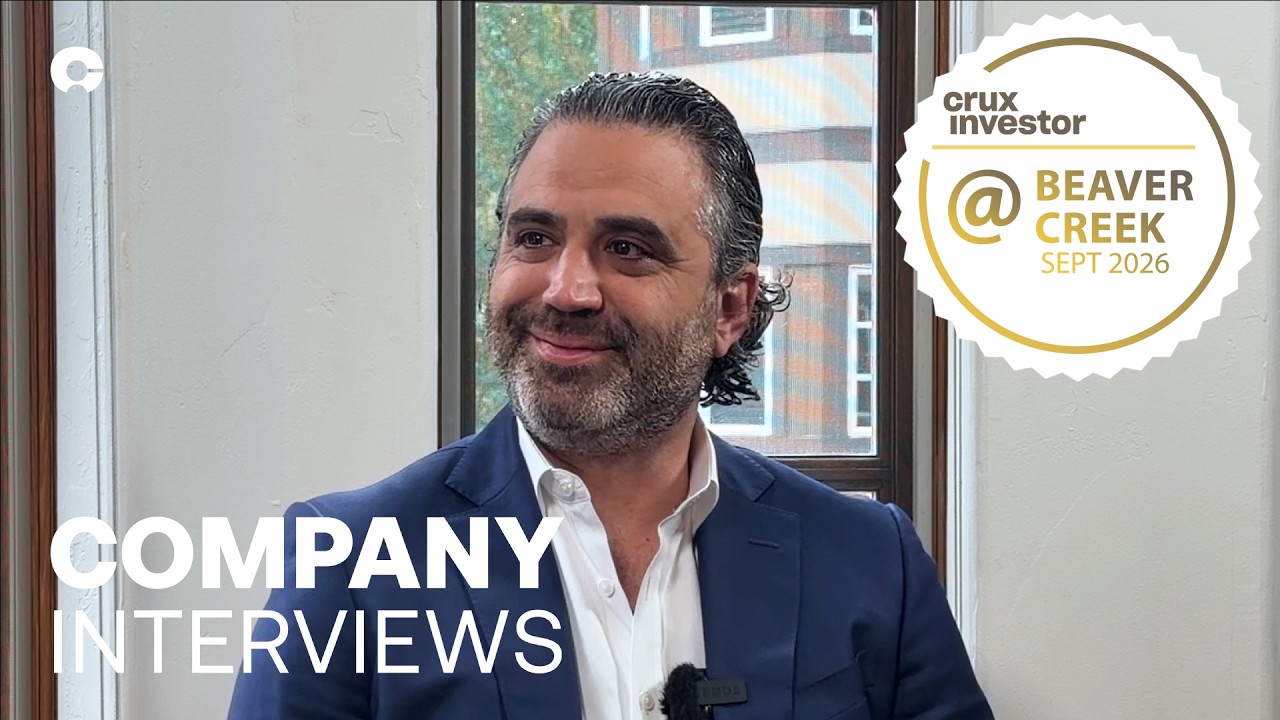
Copper has spent the past 15 months doing what analysts have predicted for years: overtaking iron ore as the metal the market can't stop talking about. Prices have run from roughly $2/lb to highs near $6.50/lb, and with majors like BHP, Rio Tinto and Glencore consolidating scarce large-scale assets, investors are hunting for the handful of independent developers still standing. Hot Chili Limited, advancing the Costa Fuego Copper-Gold Project on Chile's coastline, is one of only five independent copper developers globally with a project capable of over 100,000 tonnes of annual production. Managing Director and CEO Christian Easterday sat down with Crux Investor to explain why he believes the market still hasn't caught up with the story.
Financial Metrics and the Valuation Gap
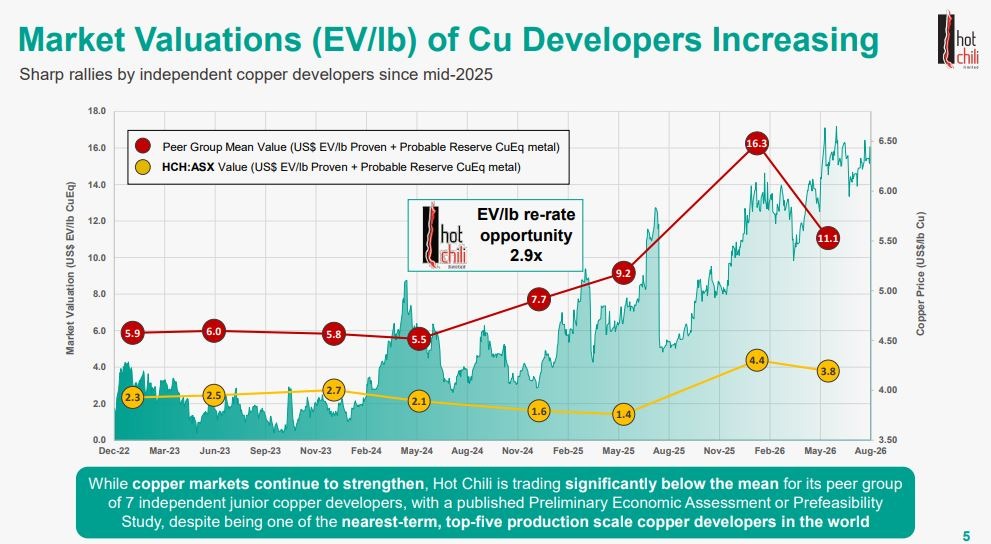
Hot Chili's share price has re-rated four-to-five-fold over the past 15 months, and the company points to two internal metrics as evidence there's more room to run. On an EV/lb basis, Hot Chili trades at roughly 3.8 cents per pound of reserve, against a peer group of large-scale copper developers averaging around 11 cents per pound - implying a 2.9x re-rating opportunity if the gap closes.
On a price-to-net-asset-value (P/NAV) basis, drawn from recent copper-sector transactions, the company sees a comparable 2.3x opportunity. As of 31 July 2026, Hot Chili's market capitalisation stood at approximately A$285 million, with A$46 million in cash and 202.8 million shares outstanding.
La Verde: The Growth Catalyst
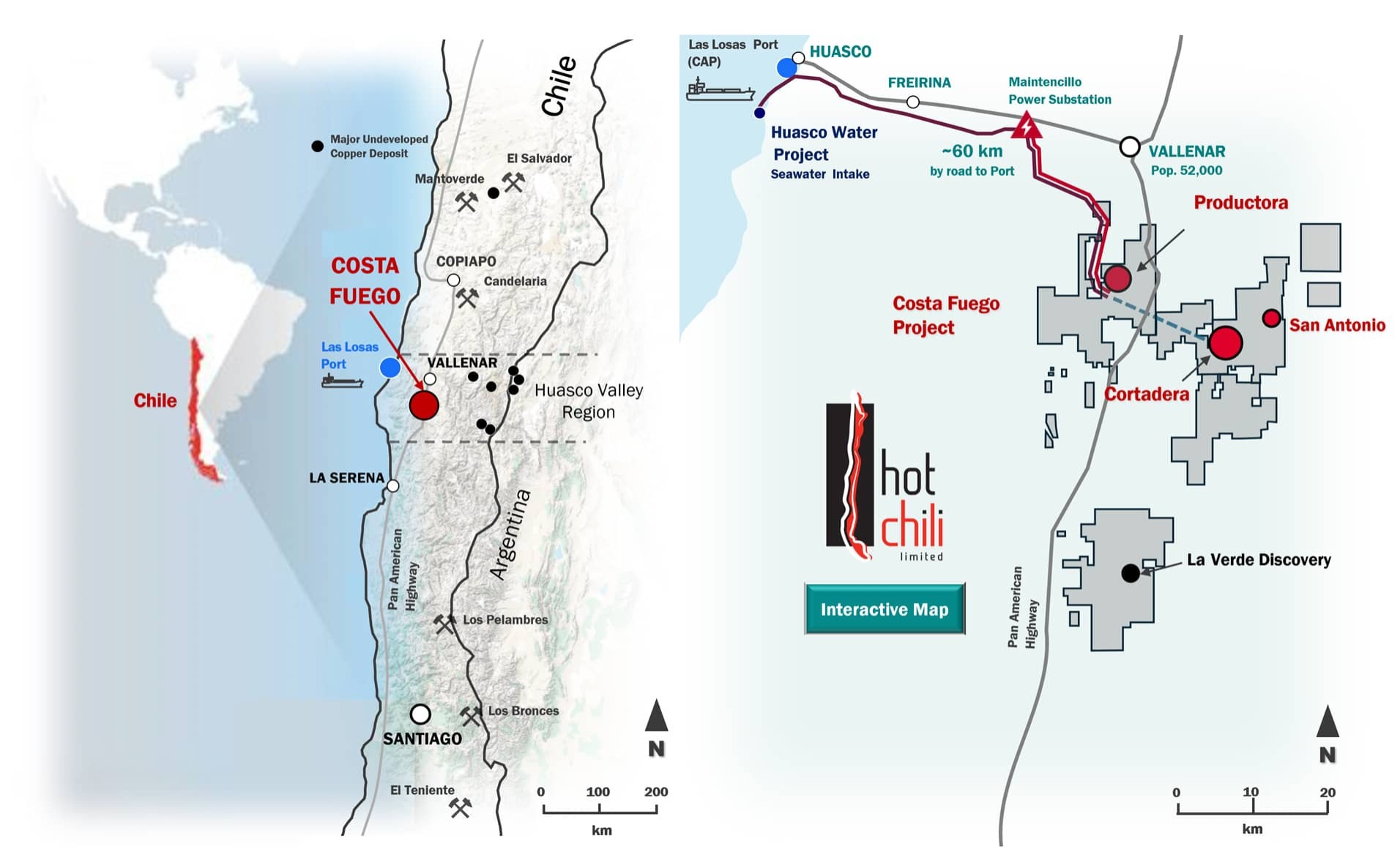
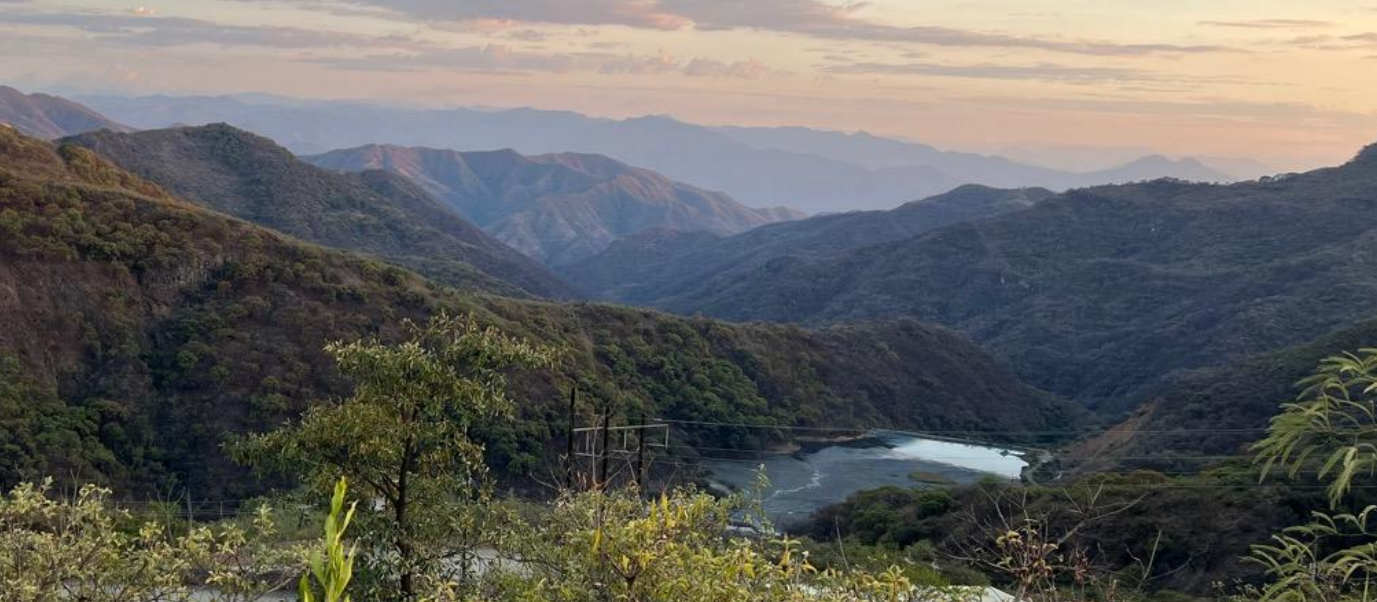
The reason Easterday believes those gaps are closing is La Verde, a copper-gold porphyry discovery roughly 35km southeast of Costa Fuego's planned central processing hub. Acquired in November 2024 and now the subject of an accelerating three-rig (soon to be four-rig) drilling campaign, La Verde is tracking toward a maiden resource estimate of approximately 500 million tonnes, expected before year-end.
Folding that into Costa Fuego's existing resource base would move Hot Chili from roughly the 10th-largest to the 6th-largest undeveloped copper resource globally among independently held projects, and would take the company's total resource base from around 1 billion tonnes toward 1.5 billion tonnes.
Project Economics
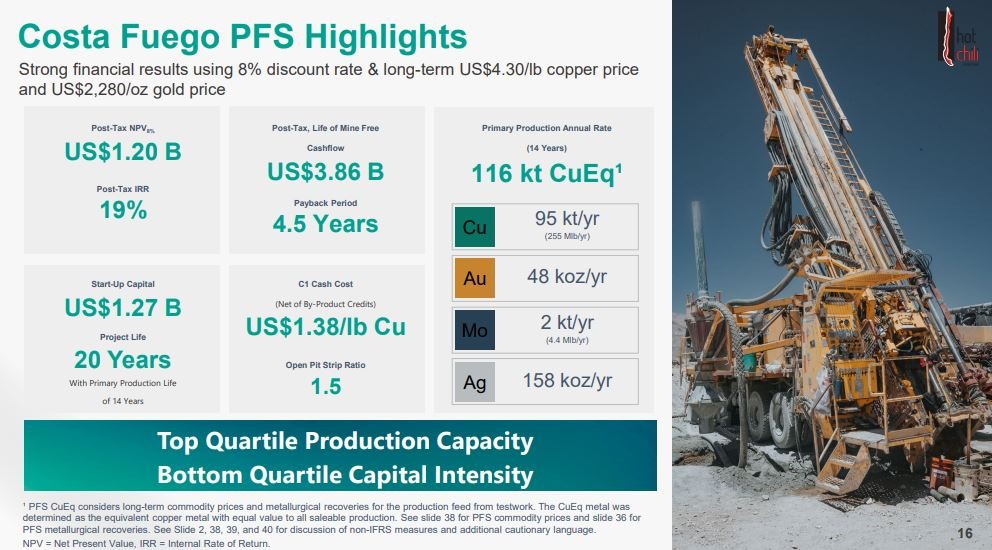
Costa Fuego's most recent Preliminary Feasibility Study (PFS), published in March 2025, outlined a 20-year mine life (14 years at primary production rates), average annual production near 116,000 tonnes of copper-equivalent, a post-tax NPV of US$1.2 billion and a post-tax IRR of 19% at a long-term copper price assumption of US$4.30/lb. Easterday's team is now restating that PFS to integrate La Verde, and he expects the resulting numbers to be materially stronger:
"When we're running numbers and seeing the post-tax NPV increasing from 1.2 billion towards 2 billion... it moves NPV post-tax from 1.2 to 2 billion, IRRs from 19 towards mid-30s. Then you're starting to approach ratios of around 2:1, and that becomes very, very attractive in this space."
Easterday also argues that integrating La Verde's higher-grade feed would shorten the project's payback period from roughly 4.5 years toward 2.5 years, and move Costa Fuego's cash cost from the second quartile toward the first quartile of the industry cost curve. Layered on top of that project-level improvement is a separate, unrelated tailwind: long-term consensus copper price forecasts have moved from US$4.30/lb 16 months ago to closer to US$4.79-4.90/lb today, and long-term consensus gold has moved from roughly US$2,280/oz to around US$3,600/oz - changes Easterday says are not yet reflected in the PFS numbers currently in the market.
Interview with Managing Director and CEO, Christian Easterday
Competitive Positioning
Hot Chili's pitch rests heavily on scarcity. Independent, large-scale copper developers not controlled by a major miner are, in Easterday's telling, a vanishing category:
"I think you're investing in one of only five copper developers that are in independent hands and not controlled by a major that have projects that are over 100,000 tonnes of annual production capacity."
He points to the large-cap M&A - OZ Minerals' roughly $10 billion takeover, and the ongoing Teck-Anglo American consolidation talk - as evidence that scarce, scaled, independent copper assets attract premium attention once they reach execution stage. Hot Chili's dual ASX/TSXV listing, its Glencore relationship (Glencore holds 7.5% of the company and an offtake agreement for up to 60% of concentrate for the first eight years, on benchmark terms), and its Chilean government-conferred "priority status" for permitting are all framed as derisking factors that separate Hot Chili from earlier-stage peers still working through permitting or financing uncertainty.
Financing Strategy
The financing question - how a company with a roughly A$285 million market cap builds a project with a US$1.27 billion start-up capital requirement - is central to the investment case, and Easterday leans on Hot Chili's Huasco Water asset as the answer. The company holds the only maritime licence with permitted seawater access in Chile's Huasco Valley, and its Costa Fuego PFS already incorporates a fully funded Stage 1 seawater supply (500 L/s, US$151 million construction capital, 19% post-tax IRR). A second maritime licence - enabling a larger, multi-user desalination business (Stage 2: 1,300 L/s, US$977 million post-tax NPV) supplying not just Hot Chili but neighbouring majors including BHP and Lundin's Vicuña district projects - has been advancing through Chilean approvals for roughly five years and was recently confirmed by the government to remain on track after an earlier delay tied to a change of administration.
"If you have $600-700 million of equity already taken care of and you haven't had to issue many or any shares at all, then you've effectively accounted for the dilution equation as to why most CEOs are not taking on big, ambitious, capital-intensive projects."
Beyond Huasco Water, Easterday notes the company has not yet touched two other levers: forward sales of its gold credit (48,000-70,000 oz/year once La Verde is integrated) or its uncommitted offtake - roughly 40% of concentrate production, an estimated 160,000 tonnes annually, in a concentrate market Easterday describes as structurally tight for the next five to ten years.
Investment Thesis for Hot Chili Ltd
- Scarcity premium: Hot Chili is one of only five independent (non-major-controlled) copper developers globally with +100,000tpa production potential - a shrinking category actively targeted by major-miner M&A.
- Valuation gap: Trading at roughly 3.8c/lb reserve versus an ~11c/lb peer average (2.9x EV/lb gap) and at a discount on P/NAV versus recent sector transactions (2.3x gap).
- La Verde optionality: A maiden resource estimate (targeting ~500Mt) due before year-end could move Costa Fuego's PFS economics from US$1.2B to as much as US$2B post-tax NPV and from 19% toward mid-30s% IRR - watch for the resource announcement and the restated PFS that follows it.
- De-risked financing pathway: The Huasco Water asset's Stage 1 (seawater) is already funded within the Costa Fuego PFS; Stage 2 desalination monetisation, if it proceeds, could materially reduce dilution risk on the main copper build.
- Untapped optionality: 40% of concentrate offtake and the bulk of gold production remain uncommitted, leaving room for additional value-accretive deals ahead of FID.
- Macro tailwind: Long-term consensus copper and gold price forecasts have both moved materially higher since the last PFS was priced, a benefit not yet reflected in currently published project economics.
- Watch items: Second Huasco Water maritime licence approval (pending, expected within coming months); maiden La Verde MRE (year-end target); restated Costa Fuego PFS; progress of the strategic partnering process.
Macro Thematic Analysis
The case for Hot Chili is inseparable from a broader structural argument about copper supply. Global fine copper metal demand currently sits around 26 million tonnes per year, with projections pointing toward 35-40 million tonnes within the next 8-10 years as electrification - driven by renewables build-out, AI-related data centre demand, and a resurgence in EV uptake - pulls an increasing share of global demand toward the metal. On the supply side, the traditional lever the industry has used to respond to previous price cycles, lowering cut-off grades, is largely exhausted: some operations are already processing ore at cut-off grades as low as 0.12-0.15% copper. Combined output from the world's five largest remaining independent 100,000tpa-scale copper developers totals only around 620,000-650,000 tonnes, nowhere close to closing the projected gap, while several majors are seeing supply disruptions outweigh brownfield expansion gains. Easterday frames the resulting dynamic in structural terms:
"This is economics 101. It's called inelasticity of supply response, and that is what is shaping this new copper supply cycle that we're moving into."
New discoveries of scale are also becoming rarer - the average time from discovery to production across the industry now runs to roughly 21 years - which is part of why independent, already-advanced developers like Hot Chili are attracting attention as one of the few realistic near-term supply responses available to the market outside of major-miner balance sheets. Whether that scarcity translates into the valuation re-rating the company is forecasting depends heavily on execution: successful integration of La Verde into a restated PFS, continued progress on the second Huasco Water licence, and ultimately a successful path to FID in 2029.
TL;DR
Hot Chili (ASX/TSXV: HCH) CEO Christian Easterday argues the market hasn't caught up with three converging catalysts at Costa Fuego, one of only five independent +100,000tpa copper developments left globally: a maiden La Verde resource estimate (targeting ~500Mt) due before year-end that could push the project's post-tax NPV from US$1.2 billion toward US$2 billion; a strategic Huasco Water asset that could fund much of the project's equity requirement without major shareholder dilution; and materially higher consensus copper and gold prices than the company's last published PFS assumed. Hot Chili trades at a 2.9x EV/lb discount to peers, with FID targeted for 2029 and first production in 2031.
FAQ (AI Generated)
Analyst's Notes





Subscribe to Our Channel







Stay Informed


