




Hormuz Truce Talks Split Crude Benchmarks as Brent's Premium Hits $12.68


US diesel export-ban fears are pressuring WTI while widening feedstock advantages for coastal refiners and exposing regional pricing risk.
- Brent fell 0.82% to $105.73 and West Texas Intermediate (WTI) fell 1.65% to $93.05 on September 25, 2026, as negotiators in New York weighed a phased deal to reopen the Strait of Hormuz.
- WTI is down 13% over six sessions and 6.42% on the week against Brent's 2.09% rise, leaving a $12.68 spread, the widest since May.
- Fear of a US diesel export ban rather than a crude surplus is largely responsible for the split, with retail diesel at $6.529 a gallon on September 21.
- Restoring the June 17 memorandum before the November 3 midterms could narrow the Brent-WTI spread, while no agreement could keep WTI in the low $90s and Brent above $100.
- No timetable has been published for a US export restriction, while a front-month Brent-WTI spread below $5 for 10 consecutive sessions would invalidate the spread trade.
Hormuz Talks Pull WTI Down 1.65% While Brent Holds Firm
Oil fell as US and Iranian negotiators in New York explored a phased path out of the war that would reopen the Strait of Hormuz and lift the US economic blockade. Brent fell 87 cents to $105.73 a barrel, while WTI fell $1.56 to $93.05.
WTI fell 13% over the prior six sessions and closed the week down 6.42%, while Brent rose 2.09%, widening the spread to $12.68, the widest since May. The split reflects location risk rather than a uniform crude selloff, with waterborne barrels carrying Hormuz chokepoint risk and Cushing barrels facing possible US export restrictions.
Diesel Export Ban Risk Widens the WTI Discount
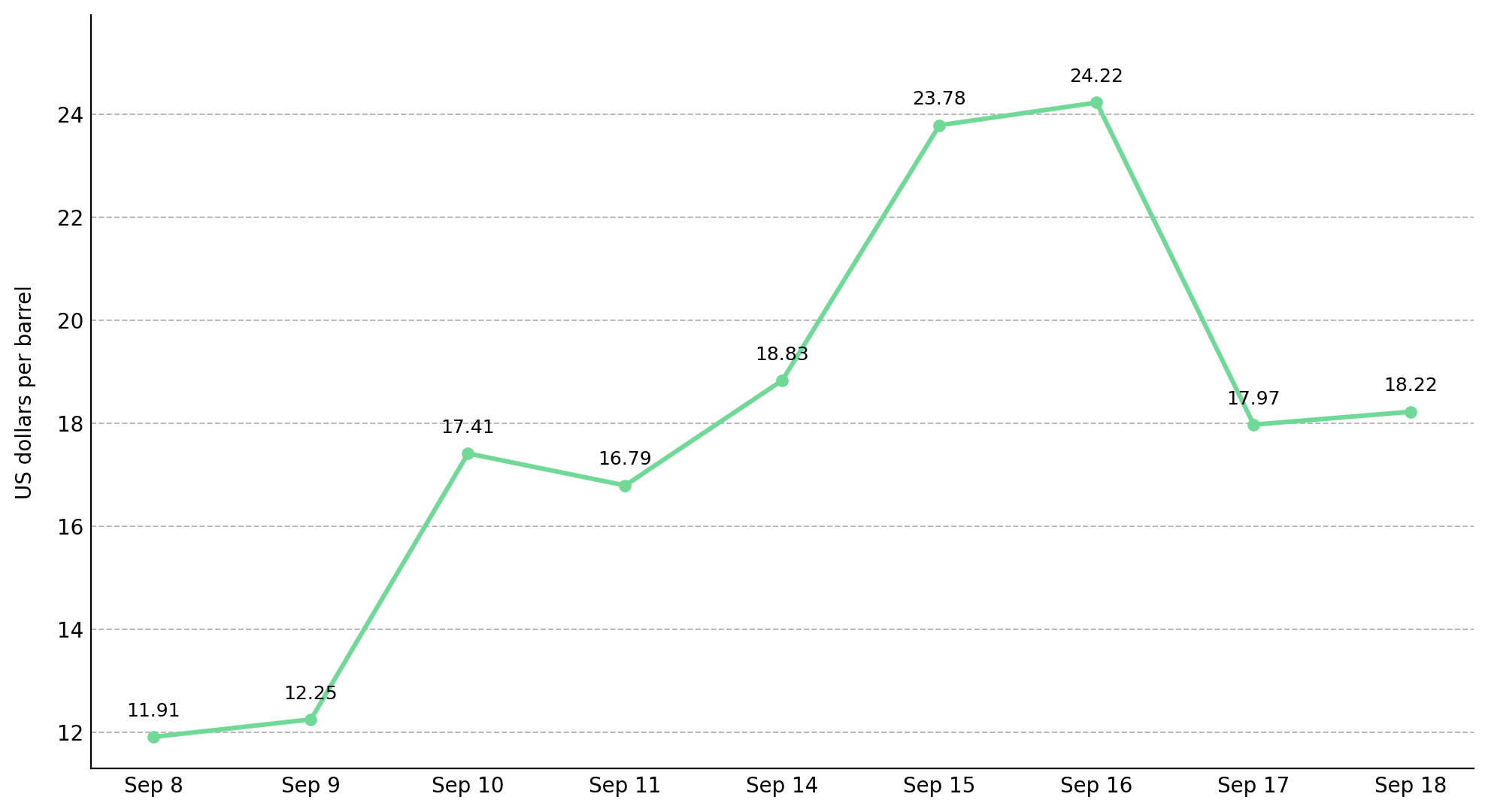
Fear of a US diesel export ban is widening the Brent-WTI split because restricting exports would increase domestic diesel supply. A ban would keep US distillate onshore, pressure refinery margins and runs, and reduce refiners’ demand for Cushing crude while waterborne barrels retain access to global markets. Retail diesel reached $6.529 a gallon on September 21, up 42.6% from July 6, strengthening the political case for intervention. The split predates Friday, with Brent’s spot premium over WTI widening from $11.91 to $18.22 a barrel between September 8 and 18.
Brent retains its premium because the same diplomacy failed before. The US and Iran agreed to reopen Hormuz in exchange for lifting the blockade under a June 17 memorandum, but the deal collapsed into renewed fighting, with no clear evidence yet that the current talks will prove more durable. Saudi Arabia also intercepted six Houthi ballistic missiles aimed at Taif and Yanbu that week, reinforcing the security risk supporting Brent prices.
June Deal Failure Sustains Brent Premium Ahead of US Midterms
The Brent-WTI split will not close on one diplomatic headline because geography drives different risks for each benchmark. Tim Waterer, Chief Analyst at KCM Trade, told Reuters:
"The unusually wide WTI-Brent spread also reflects the different regional risk profiles at play."
Waterborne Access Gives Coastal Refiners a Feedstock Cost Advantage
US coastal refiners benefit when they buy crude priced off WTI Cushing and sell distillate at Brent-linked international prices, because each $1 of spread lowers feedstock cost by $1 relative to product prices. Lower 48 producers priced off Cushing face the opposite effect, receiving $93.05 a barrel on September 25 versus $105.73 for waterborne crude.
The key test is whether an asset earns revenue against a waterborne benchmark or a landlocked hub. Linh Tran, Market Analyst at XS.com, says higher US crude inventories and possible diesel export curbs, rather than weak demand, are driving the WTI discount.
The timing remains uncertain because a US export restriction has no published schedule and the talks run through mediators, according to David Morrison, Senior Market Analyst at Trade Nation. A WTI-tracking exchange-traded fund carries US policy risk rather than the Hormuz premium, while a refining-margin position based on the $12.68 spread could lose value quickly if the June memorandum is restored. Position size, rather than entry timing, is the variable a retail holder can control.
What Ends the Brent-WTI Spread Trade
A single global crude price holds only while freight arbitrage keeps regional markets connected. A chokepoint closure combined with an export-restriction threat can split pricing between waterborne barrels carrying transit risk and landlocked barrels facing limited market access. Liquefied natural gas and fertilizer can face the same pricing split when fixed transit routes meet domestic supply restrictions.
The spread trade is invalidated if the front-month Brent-WTI spread settles below $5 for 10 consecutive sessions. That would reduce the feedstock discount for coastal refiners and improve relative pricing for Cushing-linked producers.
The opportunity now lies in the Brent-WTI spread, so weaker WTI does not make all US energy exposure bearish. A single crude price cannot capture both producer realizations and refinery input costs when regional benchmarks diverge. Repeated chokepoint closures increase the value of export terminals, coastal storage, and shipping because they preserve access to higher-priced waterborne markets.
Analyst's Notes





Subscribe to Our Channel









Stay Informed


