




Oil Slips on Iran Diplomacy Hopes, but the Diesel Shortage Remains


Brent slipped to $102 as Iran signaled openness to talks, but refinery damage, export bans and a shut Hormuz keep diesel short and US prices at record highs.
- Brent fell 0.9% to $102.16 a barrel on 24 September after Iran said it remained open to diplomacy, reversing part of a 4% gain the prior session.
- Refinery damage, Russia's export ban and a closed Hormuz keep diesel short. US distillate stocks fell 428,000 barrels while crude stocks rose 3 million.
- A settlement that reopens Hormuz would strip out the sea-route premium in Brent's $10.77 spread over WTI. Stalled talks rebuild it, as the prior session's 4% gain showed.
- A US diesel export ban could raise world prices by up to 100%, according to analysts. The White House has denied a plan, so the outcome cannot be forecast.
- The reopening of Hormuz alongside the lifting of the US blockade is the event that would turn diplomatic dips into lasting relief.
Iran Diplomacy Signals Pull Brent Back From a 4% Rally
Brent crude futures fell 92 cents, or 0.9%, to $102.16 a barrel at 0400 GMT on 24 September, and West Texas Intermediate (WTI) fell 0.8% to $91.39, reversing part of a 4% gain in the prior session (Reuters). The move followed a senior Iranian official's statement that Tehran remains open to diplomacy to end the US-Iran war and is reviewing Washington's response to its peace proposals.
Tehran's proposals put lifting the US naval blockade of Iranian ports and reopening the Strait of Hormuz first. Security chief Mohsen Rezaei told Reuters the Strait of Hormuz would not be reopened while Iran's conditions are not met. US diesel sits at a record $6.5107 a gallon, a shortage no crude move has relieved.
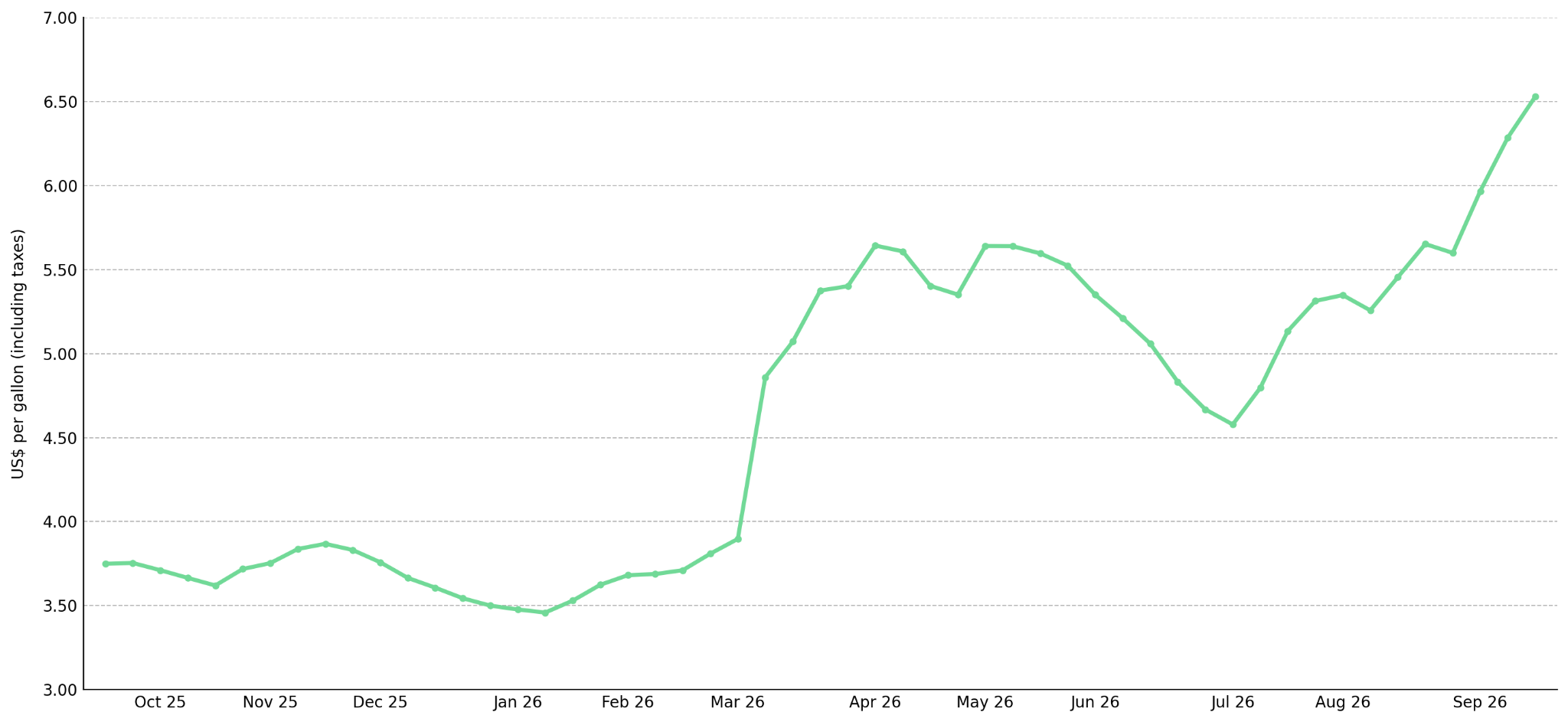
US Average On-Highway Diesel Retail Price, Weekly, 2025 - 21 September 2026. Source: US Energy Information Administration; Crux Investor Analysis.
Refinery Damage & Export Bans Drain Diesel Stocks as Crude Builds
Diesel supply has been cut at three points. Ukrainian strikes have hit Russian refineries. The war has damaged Middle East refineries and disrupted exports through Hormuz and the Red Sea. Russia, the world's second-largest diesel exporter, has banned exports until at least the end of September. EIA data show the result: US distillate stocks fell 428,000 barrels to 107.4 million last week, while crude inventories rose 3 million barrels to 426.4 million against an expected 641,000-barrel draw. Crude is available; refined fuel is not.
Peace terms keep the gap open. Iran's president told the UN General Assembly that Tehran would never surrender to US pressure. Secretary of State Marco Rubio said a deal would take hard work over time, adding that President Donald Trump retains military options (Reuters). Each statement extends the period Hormuz stays shut.
Stalled Peace Terms Leave Brent Carrying a Hormuz Risk Premium
The market has priced diplomacy as progress before any terms are agreed, and the benchmark most exposed to the shipping route has kept its premium.
Brent's spread over WTI, which carries that premium, stood at $10.77 a barrel on 24 September.
The cohort exposed is diesel-dependent industrial operators in import markets, whose fuel runs the machinery that makes and moves goods and industrial materials. If talks lift the blockade and reopen Hormuz, Brent sheds its sea-route premium first and the spread over WTI narrows. If talks stall, the 4% single-session gain on 23 September shows how fast the premium rebuilds. Diesel stays short either way until refineries recover.
The horizon runs from the end-September expiry of Russia's export ban to the 3 November US midterms, which drive calls for a US diesel ban.
US Diesel Export Ban Threat Raises Fuel Supply Risk for Import Markets
Diesel-dependent operators in import markets carry the first cost. Brazil, Chile, Mexico, Peru, Morocco, France and the UK rank among the top buyers of US diesel. US diesel exports reached a record 1.6 million barrels per day in August, up from about 1 million in February.
A US export ban is the swing variable. Energy economist Philip Verleger estimated a ban could raise world prices by as much as 100%. Citi warned even a partial ban could cause shortages in Europe, South America, Australia and Africa. Capital Economics warned a US surplus could force American refiners to cut runs within weeks, so domestic buyers gain little.
The White House denied a reported 90-day ban plan the day it surfaced, and Energy Secretary Chris Wright said a ban would not work, so the outcome is hard to forecast. Holders of diesel-dependent equities are left sizing up both outcomes, since a ban would lift import-market fuel costs within weeks.
Why an Iran Peace Deal Hits Brent Holders Harder Than US Producers
Brent's geopolitical premium can unwind in one session on a diplomatic headline, while refinery damage, export bans and a closed shipping lane outlast any headline.
Secretary of State Marco Rubio has said a deal would take hard work over a period of time, which leaves Brent carrying a Hormuz premium while talks run. Diplomatic headlines and recovering Gulf supply trim it; the prior session's 4% rise, amid US threats and Iran's vow never to surrender, shows how quickly it can return.
Brent-linked barrels carry the most downside to a settlement, since Brent holds the larger sea-route premium while WTI draws on insulated US supply. Publicly traded companies pumped 68% of Lower 48 oil and gas in 2025, so listed producers own most of the insulated side.
Analyst's Notes





Subscribe to Our Channel




Stay Informed


