




US Rare Earth Import Reliance Rose to 67% as Separation Capacity Lags


Depressed oxide prices have slowed mine and midstream spending, raising the long-term value of rare earth processing capacity built through the downturn.
- On September 24, 2026, US output of the two most-used rare earths covered 42% of domestic demand, while reliance on Chinese supply was set to extend into the 2030s.
- US mine production rose to 51,000 tons of rare-earth-oxide equivalent in 2025 from 45,500 tons, while net import reliance for compounds and metals rose to 67% from 53%.
- Extending China’s export-control delay beyond November 10 would carry US import dependence into 2027 after 21,000 tons of rare-earth compounds were imported in 2025, while a lapse would renew shutdown risk for magnet-dependent manufacturers.
- The White House’s January 2027 deadline to block Chinese rare earth imports conflicted with projected US import needs into the 2030s, leaving policy timing too uncertain to size a position.
- Neodymium-praseodymium oxide above its 2022 average of $124 per kilogram, versus $69 in 2025, would shift margin back to concentrate and reverse the current reading.
China Export Delay Keeps US Rare Earth Import Dependence in Place
The US will rely on Chinese rare earths well into the 2030s despite a domestic build-out. US output of the two most-used rare earths has more than tripled since January 2025, covering 42% of domestic demand. Extending China’s delay of export restrictions beyond November 10 was on the agenda for the Washington meeting between President Donald Trump and President Xi Jinping.
The shortage under negotiation is in processed material, not ore. US mine production of rare-earth concentrates rose to an estimated 51,000 tons of rare-earth-oxide equivalent in 2025 from 45,500 tons in 2024, while net import reliance for compounds and metals increased to an estimated 67% from 53%.
Separation Bottleneck Keeps US Rare Earth Output Below Consumption
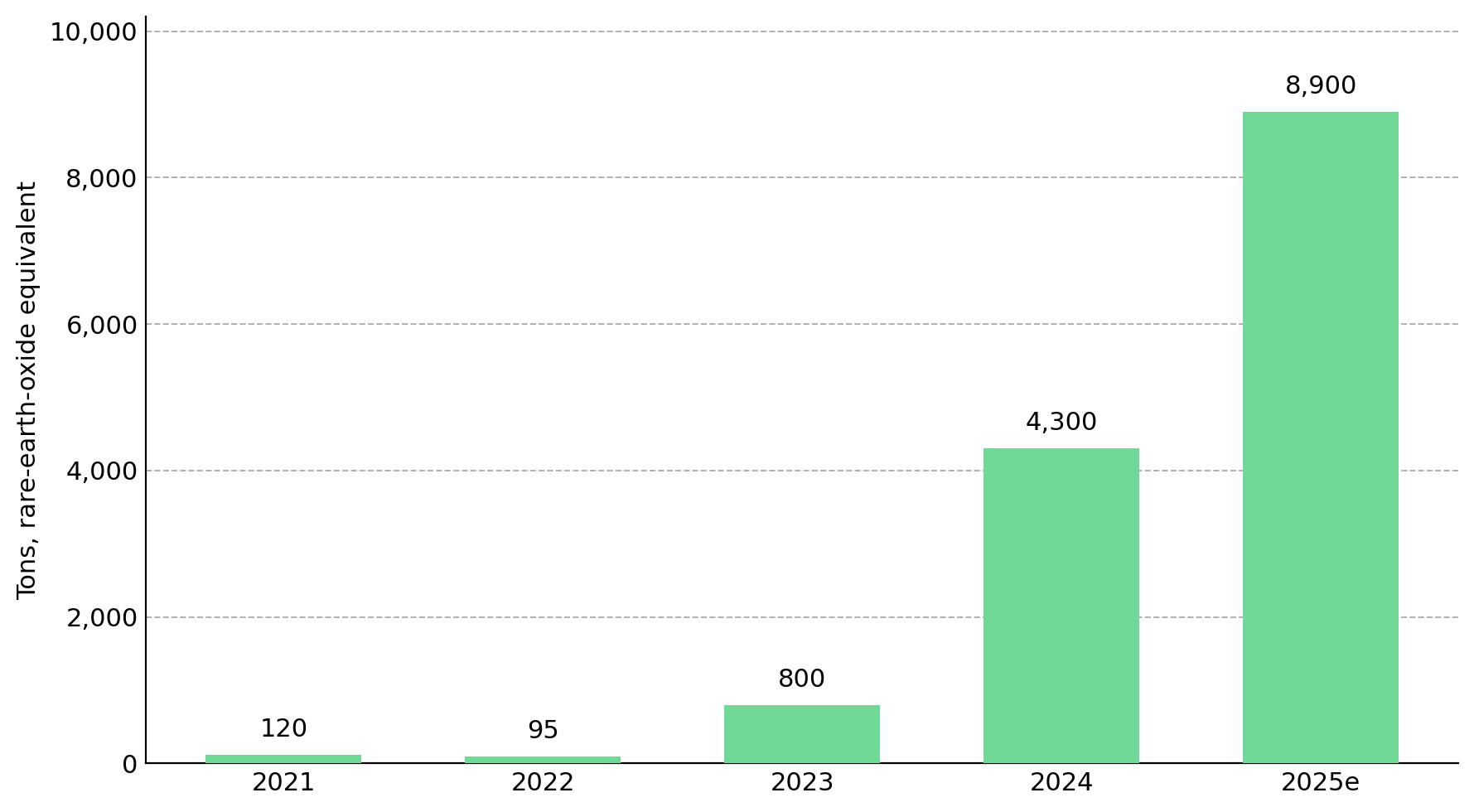
The 17 rare earths occur together and require chemical and mechanical separation before they become magnets, a process that is hard to master. US output of rare-earth compounds and metals rose to an estimated 8,900 tons in 2025 from 120 tons in 2021, against apparent consumption of 27,000 tons. The US exported 14,000 tons of ores and compounds in 2025 and imported 21,000 tons, locating the shortfall in separation rather than mining.
China mined 270,000 tons of the 390,000-ton global total in 2025 and tightened export controls on samarium, terbium, dysprosium, and yttrium before expanding them in October. China then suspended the October measures for one year while keeping the April controls in force. The White House’s January 2027 deadline to block Chinese rare earth imports is all but impossible to meet.
2031 Processing Timeline Keeps Heavy Rare Earth Supply Below Demand
Construction, not negotiation, is the bottleneck because the US processes almost none of the heavy rare earths used in military applications, with the first meaningful increase in output projected for 2031 and still below demand. Megan O'Connor, Chief Executive Officer of Nth Cycle, said the industry needs to build processing capacity as quickly as possible.
44% Lower Oxide Prices Compress Concentrate-Stage Developer Margins
Concentrate-stage rare-earth developers face the compression as neodymium-praseodymium oxide averaged $69 per kilogram in 2025, 44% below $124 in 2022. Concentrate sells at the oxide price less a buyer-set separation charge, while China’s 270,000 tons of the 390,000-ton global mine supply leaves that charge outside the seller’s control.
The operational test is whether an asset reaches separated oxide or metal at a site it controls. MP Materials began delivering magnets made from its own refined rare earths to General Motors. Todd Downing, Minerals Analyst at Project Blue, said replacing Chinese supply across the full value chain is much harder.
November 10 depends on negotiations, while the January 2027 ban is a feasibility judgment rather than a firm schedule, leaving developer equities exposed to full loss-of-capital risk if an extended delay unwinds the scarcity premium because pre-revenue developers have no earnings to offset lower prices.
What Drives Rare Earth Value Beyond Mining
The rare earth shortage under negotiation in Washington is in processing, as US mine output grew while import reliance rose and the country still lacks separated oxides, metals, and magnets.
For concentrate-stage rare-earth developers, valuation now depends on the separation step that converts concentrate into separated product. Any mine-supply scarcity premium embedded in the valuation should be treated as a valuation assumption, not a risk footnote.
Over the longer term, oxide prices 44% below their 2022 average have deterred mine and midstream spending needed for heavy rare earth supply, leaving a thinner pipeline next decade than current policy spending implies. For holders with multi-decade mandates, returns depend on separation capacity built at depressed oxide prices, not tonnage in the ground.
Analyst's Notes





Subscribe to Our Channel




Stay Informed



