




Dune Oil & Block M47: Why C-1 Is the Next Test for the 27.6-Million-Barrel 2C Resource


.png)
Dune Oil's C-1 well tests whether Block M47's 27.6-million-barrel 2C resource can support sustained production and commercial development after funding in Türkiye.
- North Field contains 27.6 million barrels of net 2C contingent resources attributable to Dune Oil's 29% working interest, but the resource remains distinct from reserves and has not yet demonstrated sustained commercial production.
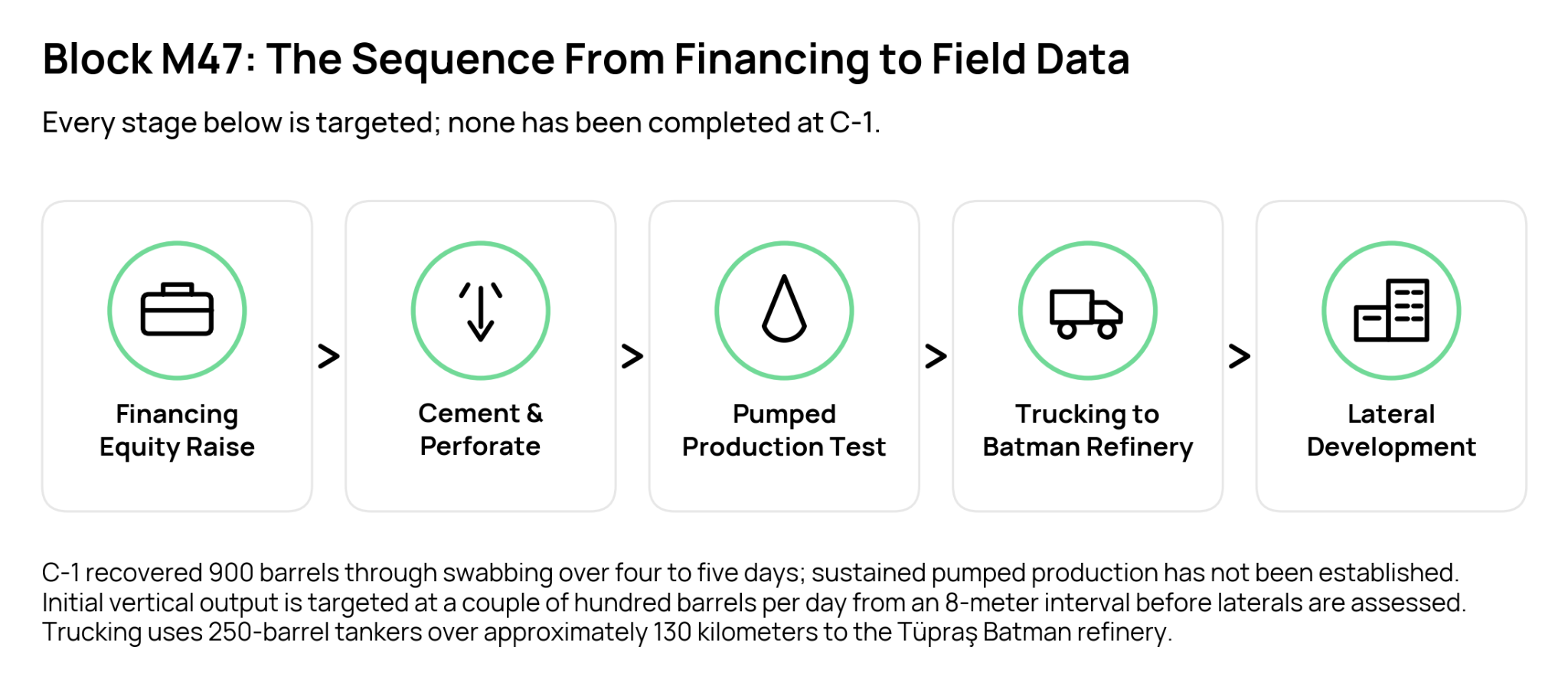
- C-1 recovered 900 barrels through swabbing over 4 to 5 days, with management now targeting cementing, perforation, artificial lift, and sustained production testing as the next operating step.
- Management is targeting initial vertical production before evaluating 300- to 500-meter laterals, making C-1 performance the operating input for the subsequent development method.
- Dune's September 2026 model estimates a $50-per-barrel netback at $72-per-barrel oil, using trucking to the Tüpraş Batman refinery, but these economics have not been demonstrated through Block M47 production.
- Financing is the first gating milestone: management identified a US$4.3 million funding requirement in September, while Dune separately reports approximately US$15 million in work-program funding to earn its 29% interest.
What Has Happened
Dune Oil Corp. (CSE: DUNE | OTCQB: TRLEF) has recovered oil from C-1, but Block M47 has yet to demonstrate sustained production. The company has an agreement to earn a 29% working interest in the southeastern Türkiye project and reports 27.6 million barrels of net 2C contingent resources at North Field based on the Chapman Petroleum Engineering evaluation with an effective date of December 31, 2025. Dune's onshore pivot and capital-allocation strategy is already examined, so the next test is whether financing and C-1 production can establish the operating basis for commercial North Field development.
The C-1 Well Is the First Production Test
C-1 recovered 900 barrels through swabbing over 4 to 5 days during the original test, but swabbed recovery does not establish sustained production. The pay zone still requires cementing, perforation, and flowing, with management targeting completion work followed by pumped production testing. Management was targeting the well to flow within the following 2 to 3 months, making that timing a management target rather than a completed milestone.
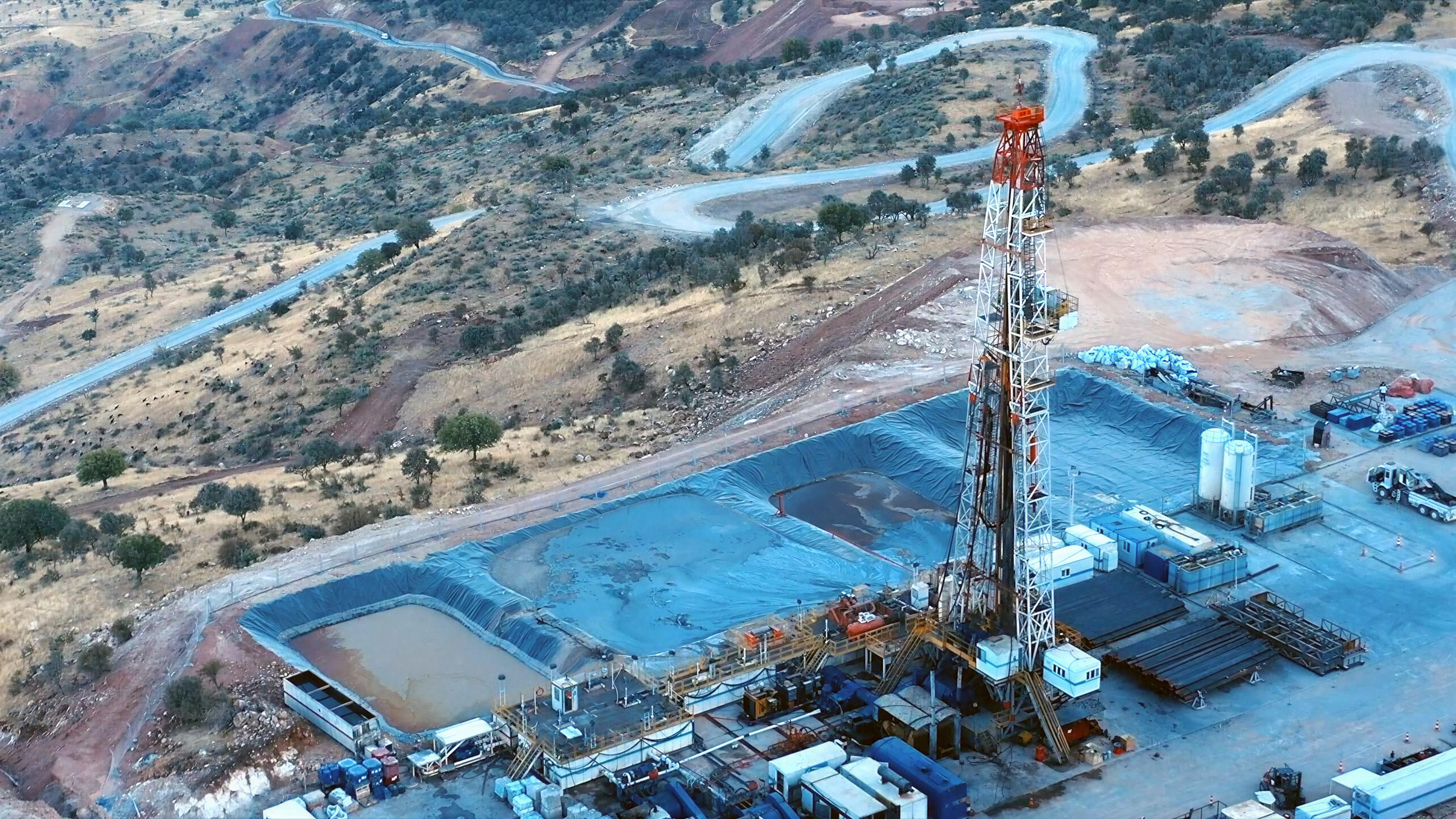
The completion method reflects the reservoir's low-pressure characteristics. Dune is targeting an 8-meter light-oil zone with approximately 8% porosity and intends to install a pump for initial production testing, while producing wells in the surrounding area use electrical submersible pumps to bring oil to the surface. The immediate technical question is whether C-1 can move from intermittent swabbed recovery to sustained pumped production from the targeted interval.
President & Chief Executive Officer, Dune Oil, Scott Lower explained the operating difference between the original test and the production method Dune is targeting:
“What happens is you need to be able to get this well flowing on its own power. Swabbing is when you’re lifting it out of the reservoir. What we have to do is cement it, perforate, and put in a pump for initial production testing.”
North Field's 27.6 million barrels remain 2C contingent resources rather than reserves. The company believes production testing could support converting part of its contingent resources into reserves, whereas Dune's resource disclosure states there is no certainty that any portion of its contingent resources will become commercially viable. Sustained C-1 production therefore provides operating evidence relevant to the commercial status of the existing discovery without guaranteeing reserve conversion.
Vertical Production Could Set Up a Broader Lateral Development Strategy
The company is targeting vertical production before determining whether lateral wells can become the broader development method for the North Field. Lower described a couple hundred barrels per day as the initial vertical production level management would target from the 8-meter interval, followed by a couple of months of operating data before considering a lateral of approximately 300 to 500 meters.
The vertical test is intended to establish oil production and water behavior before additional capital is committed to lateral development. Multiple laterals could subsequently be drilled from the same well pad if results support that method, while C-1 stopped short of the entire reservoir section and a subsequent well could drill deeper to test additional oil zones. The next development decision therefore depends on actual C-1 performance rather than the assumed productivity of future laterals.
Lower described how management intends to use vertical production data before committing to a lateral:
“You want to be able to size it up to make sure you get good oil, low water, no water breakthrough, and size it up for laterals. Then you can use the same well pad and drill two, three, four, five, or eight laterals off that pad, one after another.”
Neither lateral development nor multi-zone completion has yet been demonstrated at Block M47. Pending sustained vertical production from C-1 to establish oil production and water behavior, management can assess whether lateral development or deeper vertical appraisal is the next step to increase reservoir exposure. This keeps the immediate technical focus on establishing production from the existing targeted interval before committing capital to a broader development configuration.
Funding & Infrastructure Define the Route to Revenue
Dune has identified an initial route to market that uses 250-barrel tanker trucks to transport oil approximately 130 kilometers to the Tüpraş Batman refinery, allowing early production to be sold without waiting for dedicated Block M47 pipeline infrastructure. Dune's September 2026 financial model estimates a $50-per-barrel netback at $72-per-barrel oil, based on $9 per barrel in royalties, $8 per barrel in operating costs, and $5 per barrel in trucking costs. The company identifies its netback and payback figures as estimates, so actual C-1 production is required before those modeled economics can be compared with operating performance.
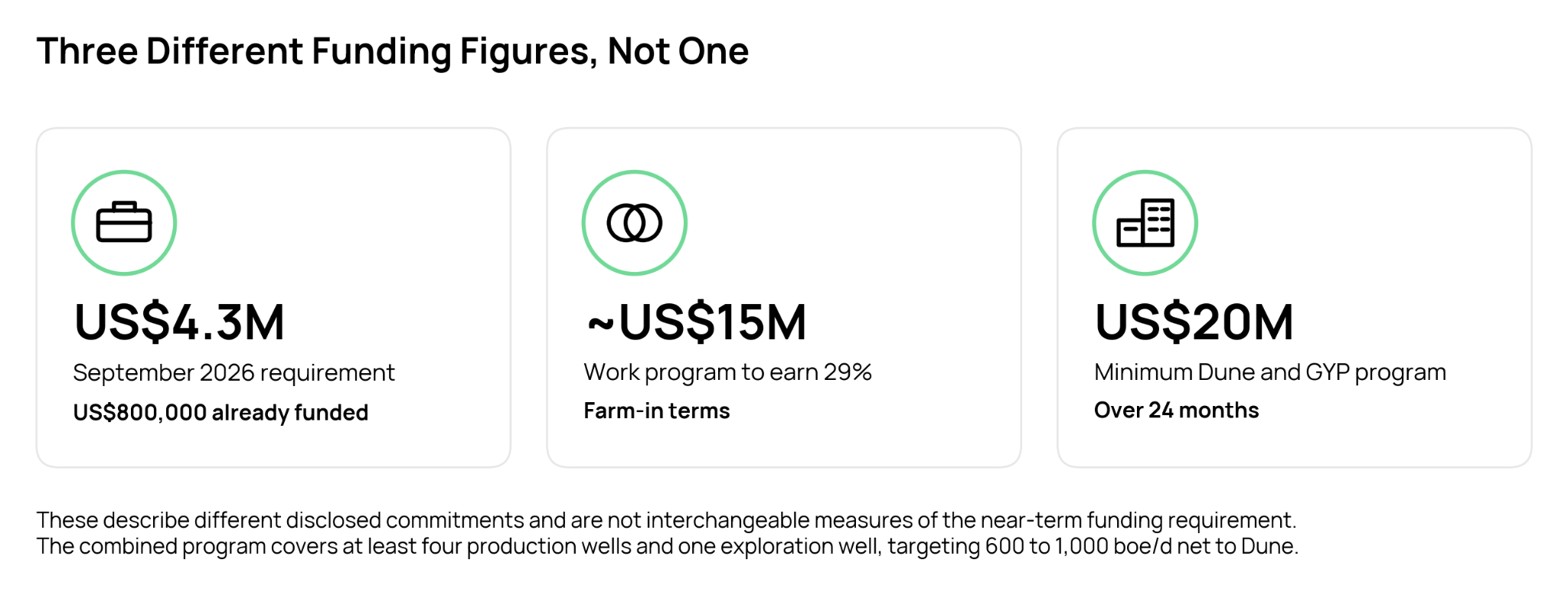
Dune needed US$4.3 million in September to fund its 2026 operational commitments and said US$800,000 had already been funded into the program. Separately, Dune's farm-in-terms call for approximately US$15 million of work-program funding to earn its 29% interest. The presentation also identifies a minimum combined capital program of US$20 million from Dune and GYP over 24 months. These figures describe different disclosed funding and program commitments and should not be treated as interchangeable measures of Dune's near-term funding requirement.
Lower identified equity as management's more likely source of pre-production capital:
“On a pre-production basis, it's more likely that it's going to be an equity raise. It's part of the recapitalization of the company, new equity into the company to fund this.”
The sequence from resource to potential revenue is therefore constrained first by capital availability: financing funds C-1 and development work; sustained production would establish saleable volumes; and trucking provides the proposed route to the refinery. This makes financing the first near-term gating event and C-1 performance the subsequent test of whether Dune's modeled operating economics can be demonstrated in the field.
North Field Commercialization Comes Before the Larger M47 Exploration Story
North Field and the wider Block M47 exploration portfolio represent different stages of potential value. North Field contains the existing 27.6-million-barrel net 2C contingent resource, while additional structures remain exploration opportunities dependent on future drilling. Dune is focused on C-1 because the well is already drilled, and management's goal is to reach cash flow, with additional wells in the same area contingent on C-1 establishing production.
The work program combines that development priority with longer-term exploration. Dune identifies at least 4 targeted production wells and 1 exploration well within the minimum US$20 million combined Dune and GYP program, targeting 600 to 1,000 barrels of oil equivalent per day net to Dune by the end of the work program. The company's disclosed sequence places capital raising, C-1 production testing, and North Block development ahead of full North Field development, while Mid or South prospect drilling remains a separate exploration target.
The distinction prevents future exploration potential from being treated as equivalent to the existing North Field discovery. Sustained C-1 production would provide evidence for subsequent North Field development, while Mid or South can contribute additional value only through future exploration success. Dune explicitly describes development of new discoveries from 2028 onward as contingent on discoveries at the South and Mid leads, leaving commercialization of the existing North Field resource as the nearer-term operating test.
Key Takeaways for Investors
Dune Oil's immediate investment case depends first on financing and then on C-1 performance. Lower identified US$4.3 million as the company's September requirement for 2026 operational commitments and described equity as the more likely pre-production financing route. Once funded, cementing, perforation, and pumped production testing at C-1 will determine whether the well can progress beyond the 900 barrels previously recovered through swabbing and establish sustained vertical production.
That production data determines the next development decision. Management intends to assess vertical performance for a couple of months before considering 300- to 500-meter laterals, while Dune's modeled $50-per-barrel netback at a $72-per-barrel oil price remains to be demonstrated through actual production. The 27.6-million-barrel net 2C contingent resource represents the existing North Field opportunity, while additional value from the Mid and South leads remains dependent on future exploration success.
FAQs (AI-Generated)
Analyst's Notes





Subscribe to Our Channel

.png)

.png)
.png)
Stay Informed


