




Oil’s 2027 Supply Recovery Pressures Long-Lead Projects & Lowers Mining Costs


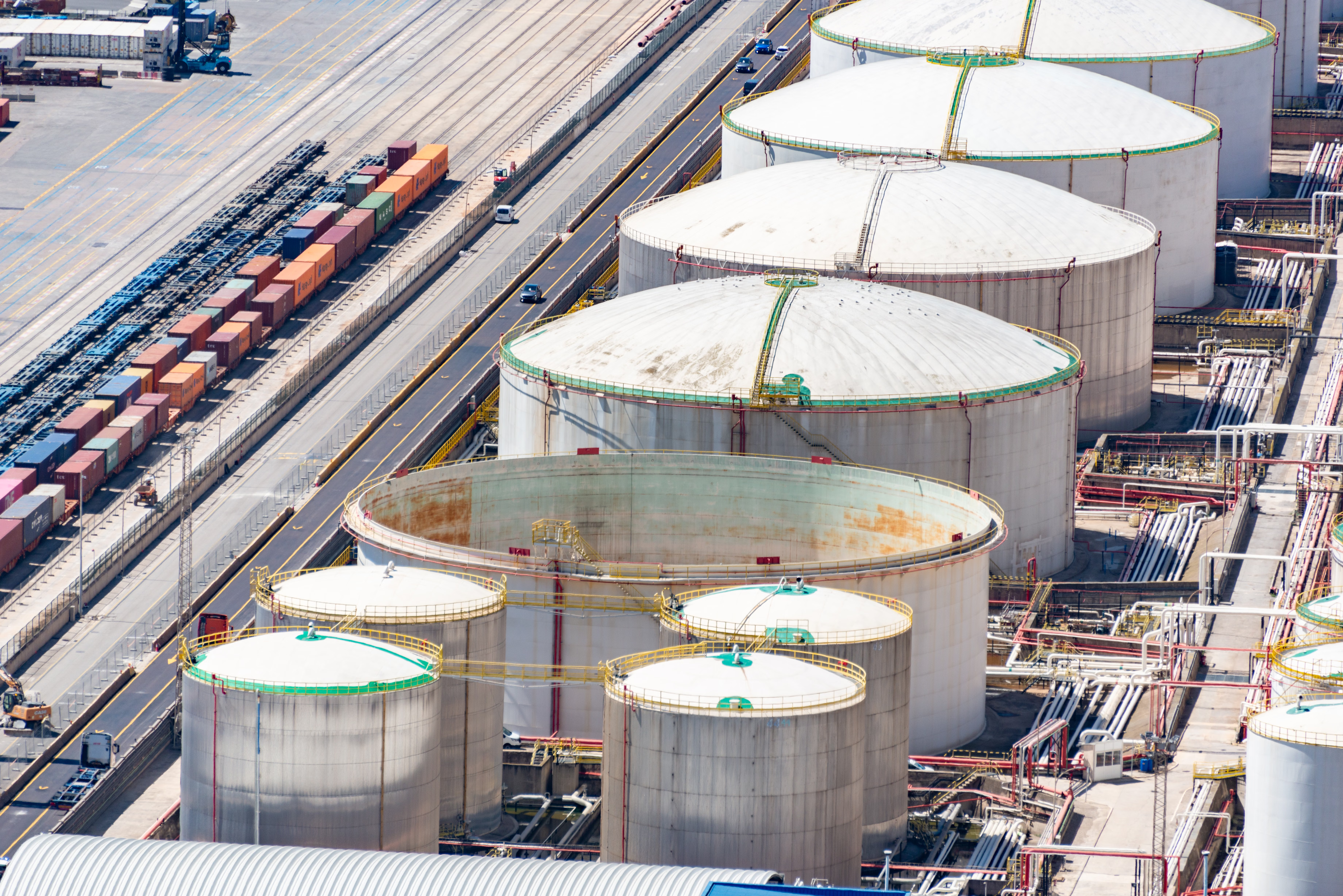
Oil’s projected 2027 supply recovery pressures oil projects with longer timelines while lowering future mining costs.
- International Energy Agency (IEA) forecasts global oil supply rising by 8.3 million barrels per day to 110.3 million in 2027, compared with demand growth of 2.4 million barrels per day, raising the prospect of a surplus that would pressure oil prices.
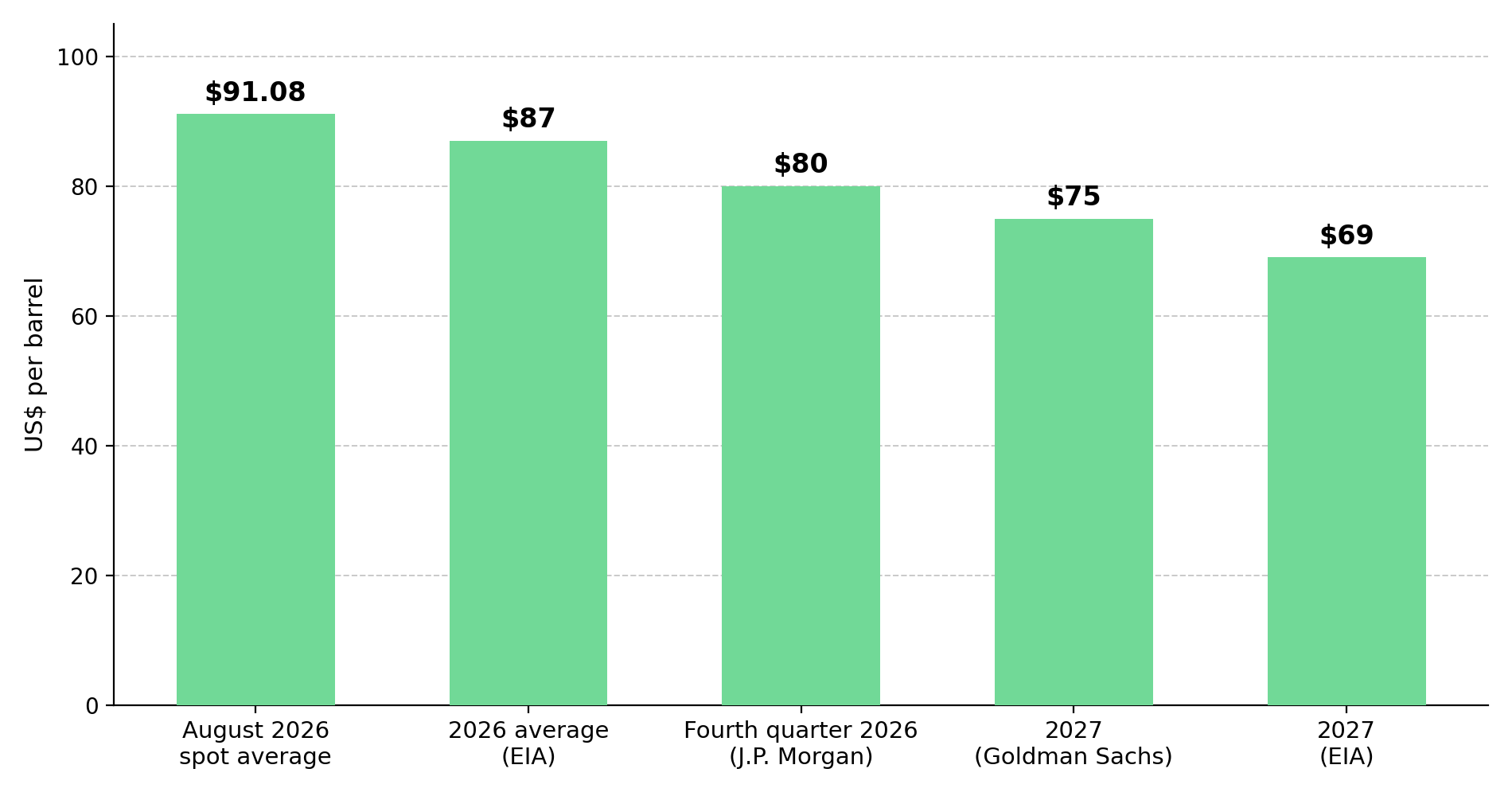
- US Energy Information Administration (EIA) forecasts that Brent will average approximately $87 per barrel in 2026 before falling $18 to $69 in 2027 as most Gulf crude production returns near pre-conflict averages, lowering projected revenue for developments entering production after the recovery.
- Spot Brent near $96 per barrel is $27 above EIA’s 2027 forecast, supporting current cash flow while favoring projects that reach production before prices decline.
- With Brent forecast to fall $27 by 2027, payback period and first-revenue timing determine which projects capture current prices before supply recovers.
- Contingent resources are not reserves; converting them requires appraisal and development funding, which can dilute existing shareholders before production generates revenue.
8.3 Million Barrel-per-Day Oil Supply Rebound Signals Weaker 2027 Price Support
IEA forecasts global oil supply falling by 4.3 million barrels per day to 102 million in 2026, then rebounding by 8.3 million barrels per day to 110.3 million in 2027. With demand forecast to grow by 2.4 million barrels per day in 2027, supply would increase roughly three and a half times faster, raising surplus risk and weakening oil price support.
The forecast rebound comes from restoring shut-in Gulf production rather than developing new reservoirs. Approximately 8.3 million barrels per day of Gulf output was offline in July 2026 despite existing wells, gathering systems, and terminals. Restored export access could therefore return supply faster than new capacity can be developed. IEA identifies a potential supply overhang of up to 4 million barrels per day from the fourth quarter of 2026, which could rebuild global stocks toward their February 2026 level by mid-2027 and weaken oil price support.
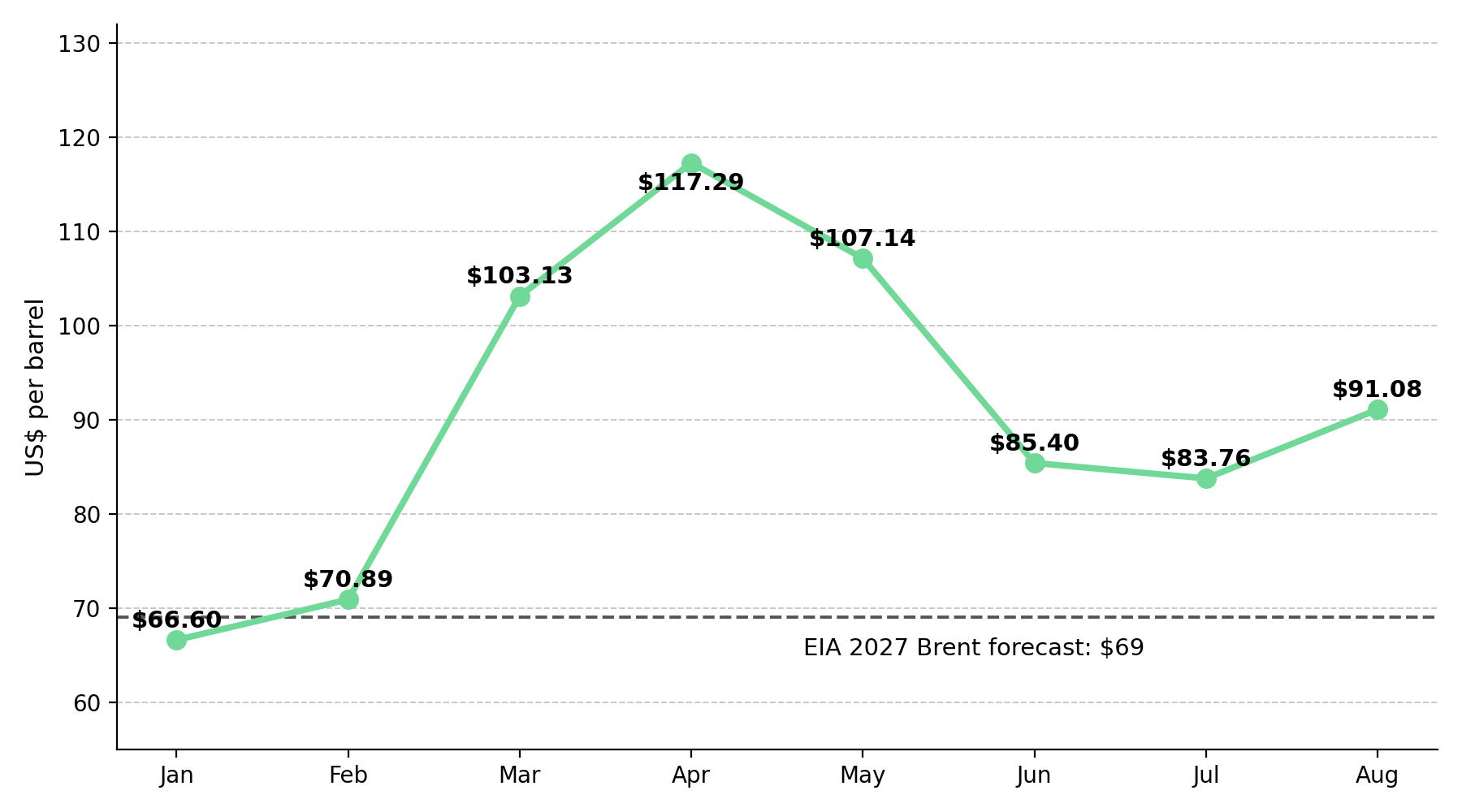
EIA forecasts Brent averaging approximately $87 per barrel in 2026 before falling to $69 in 2027 as most Gulf crude production returns near pre-conflict averages. Brent traded near $96 per barrel in the first week of September, $27 above the 2027 forecast. Projects reaching sales before that decline can capture higher prices and recover capital sooner.
Oil Demand Forecasts Align for 2027 as Faster Supply Recovery Raises Surplus Risk
The International Energy Forum (IEF) comparison of monthly agency reports shows 2026 global oil demand estimates ranging from a 1.6 million barrels per day contraction at the IEA to 0.6 million growth at the Organization of the Petroleum Exporting Countries (OPEC), with EIA forecasting a 1.2 million contraction. The 2.2 million barrels per day range shows how assumptions about transit disruption and elevated fuel prices limit confidence in any single 2026 demand estimate.
OPEC raised its 2027 demand growth forecast from 1.9 million to approximately 2.2 million barrels per day, while the IEA raised its forecast to 2.4 million. The resulting 200,000 barrels per day spread is far narrower than the 2.2 million range for 2026. Both outlooks depend on transit routes reopening and lower fuel prices restoring consumption.
Supply is forecast to recover faster than demand because shut-in capacity can restart before consumption fully rebuilds. A project reaching first revenue in the fourth quarter of 2026 would enter a market with an IEA-projected deficit of 1.8 million barrels per day. By the fourth quarter of 2027, the same project would enter after a forecast supply rebound of 8.3 million barrels per day. Schedule therefore determines which price period first production captures, while geology determines resource size.
Brent’s $18 Projected Decline Increases the Value of Exploration Assets
Net present value discounted at 10% (NPV10%) measures discounted cash flow across a field’s operating life, while payback period shows how quickly a project recovers its upfront capital. With Brent forecast to fall $18 per barrel between 2026 and 2027, earlier production carries more value than later output. First-revenue timing and payback therefore show whether a project can recover capital before the forecast price decline.
Dune Oil holds a 29 percent interest in the Block M47 North Field light oil discovery in southeastern Turkey. An independent evaluation estimated 27.6 million barrels of best-estimate contingent resources net to the company, with an unrisked NPV10% of US$734 million. The company plans two-dimensional seismic work and production testing of the existing C-1 well in fall 2026, followed by additional drilling in late 2026. These steps could support reserve conversion and move the asset toward its target of 600 to 1,000 barrels of oil equivalent per day net by the end of the two-year work program.
Scott Lower, Chief Executive Officer of Dune Oil, outlines Turkey’s oil import needs and production growth:
“Turkey is a massive oil importer. It’s the biggest importer in the region, fifth biggest importer in the world. This area now contributes 60% of the country’s oil production, and it’s going to keep going up from there. We’re selling at top dollar, and you’re selling to the refinery that’s just up the road. They’ll buy every bit of it because they’re displacing Russian, Iranian, and Iraqi oil.”
A project that recovers its well cost within one quarter limits exposure to a 2027 price decline because the oil-price assumption only needs to hold until capital is repaid. Netbacks tested across several price points show whether production continues to cover operating, royalty, and transport costs as Brent falls. Projects retaining positive netbacks near $65 per barrel depend less on prices staying above $90 and can reduce reliance on external financing for later wells.
16-Year Mine Timelines Make Permitting Progress & Future Fuel Costs Critical to Valuation
S&P Global found an average discovery-to-production lead time of 16 years, compared with 14 years for 203 operating mines and nearly 30 years for 29 nonoperating assets that had completed feasibility studies. The study identifies permitting issues and permit revocations as the leading cause of delays for mines targeting production from 2026 onward. Because mine development takes years rather than quarters, projects now in feasibility are unlikely to begin production before the forecast 2027 oil-price decline.
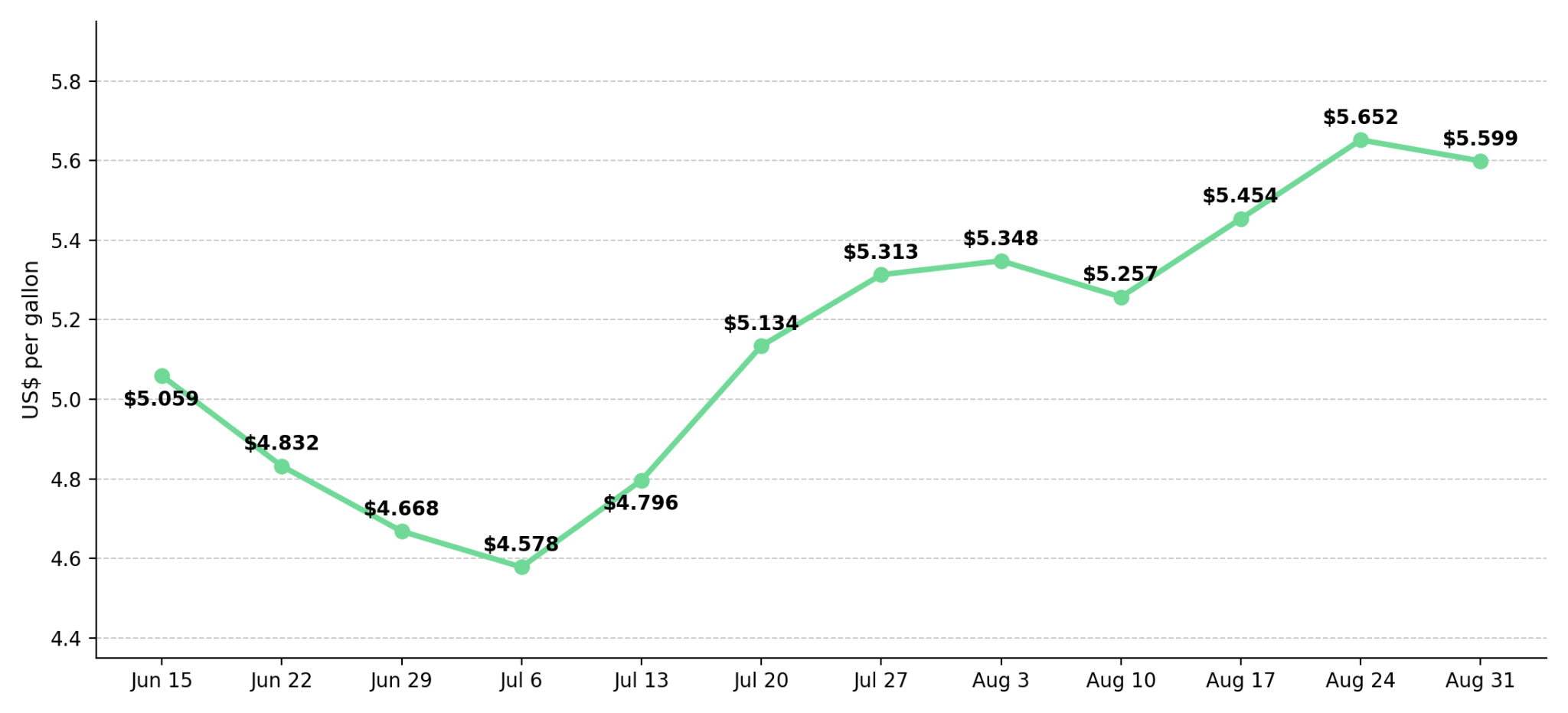
If Brent’s forecast decline lowers diesel and freight prices in 2027, mining projects commissioning later could begin with lower operating costs than mines running today. The EIA reported a US national average on-highway diesel price of $5.599 per gallon for the week of August 31, 2026, up $1.865 from a year earlier. Feasibility studies using this 2026 diesel price may overstate 2029 all-in sustaining cost if fuel costs fall as forecast.
Oil and mining projects face the same financing question: whether production begins before or after forecast changes in commodity prices and operating costs. For oil projects, payback period and first-production date show whether capital can be recovered before Brent declines. For mining projects, permit status, construction readiness, and capital intensity show how much capital must be committed before lower fuel costs can improve operating economics.
Gulf Export Recovery Could Rebuild Inventories & Weaken Oil Prices in 2027
The projected 2027 supply recovery depends largely on shut-in Gulf production returning. EIA forecasts most Gulf crude production recovering near pre-conflict averages in early 2027, while disruptions of roughly 0.6 million barrels per day continue through year-end. A slower recovery would extend the deficit and support prices, while a faster return would bring surplus risk forward. Project valuations should therefore test first-production dates and payback periods against both recovery timelines.
Three scheduled updates will test whether Gulf production is returning as forecast. Seven core OPEC and allied producers are scheduled to meet on September 6, 2026, after completing the rollback of a voluntary cut of 1.65 million barrels per day; their fourth-quarter production decision will indicate whether they see a continuing deficit or rising surplus risk. EIA’s September 9 Short-Term Energy Outlook and the IEA’s mid-September Oil Market Report will update the Brent forecast, Gulf production recovery, and projected supply balance.
With global observed inventories below 7.9 billion barrels, an additional supply loss could keep oil prices elevated and delay the forecast decline into 2028. A negotiated recovery in transit volumes could restore supply sooner and bring the decline forward. Producing and near-production assets carry less timing risk because their economics do not depend on the exact date of the 2027 supply recovery.
The Investment Thesis for Oil & Gas
- IEA forecasts global oil supply rising by 8.3 million barrels per day in 2027 against demand growth of 2.4 million barrels per day, raising surplus risk and weakening oil price support.
- EIA forecasts Brent falling $18 from approximately $87 per barrel in 2026 to $69 in 2027, making first-revenue timing a valuation input alongside net present value because later production would receive lower prices.
- Explorers and developers with short payback periods can recover capital before the forecast declines to a $69 Brent average in 2027, reducing exposure to lower prices.
- Projects requiring less upfront capital per unit of annual production can begin generating cash flow and repay funding before the forecast 2027 supply recovery, while capital-intensive developments risk entering production after prices decline.
- Netbacks tested across multiple oil prices show which assets retain positive operating margins at the forecast 2027 Brent average of $69 per barrel and which depend on prices near $96.
- Permit status and construction readiness help determine whether a mine reaches production after fuel costs decline, while payback period shows whether an oil project can recover capital before Brent falls.
Oil prices affect the two sectors differently because they determine revenue for oil producers and influence diesel and freight costs for mines. A supply recovery that lowers Brent can reduce revenue for oil projects reaching production later while improving the cost base of mining projects still under development. Timing therefore matters in both sectors. Short payback periods and early production limit oil-price exposure, while permit status, construction readiness, and realistic fuel assumptions determine whether mine valuations reflect the costs likely to prevail when production begins.
TL;DR
Global oil supply is projected to rise 8.3 million barrels per day in 2027, more than three times expected demand growth, as shut-in Gulf production returns. EIA sees Brent falling from about $87 per barrel in 2026 to $69 in 2027, making first-revenue timing, payback, and capital intensity central to oil-project economics. Exploration assets closer to development can capture higher prices sooner, while contingent resources still require appraisal and funding. For mining, the same oil decline may lower diesel and freight costs, but 16-year average development timelines make permit progress and realistic future fuel assumptions essential. Gulf exports and inventory rebuilding will determine whether the price decline arrives sooner or later.
FAQs (AI-Generated)
Analyst's Notes





Subscribe to Our Channel


.png)

.png)

.png)
Stay Informed


