




Vendor & Export Credit Support Push Atlas Salt Past C$300 Million in Funding


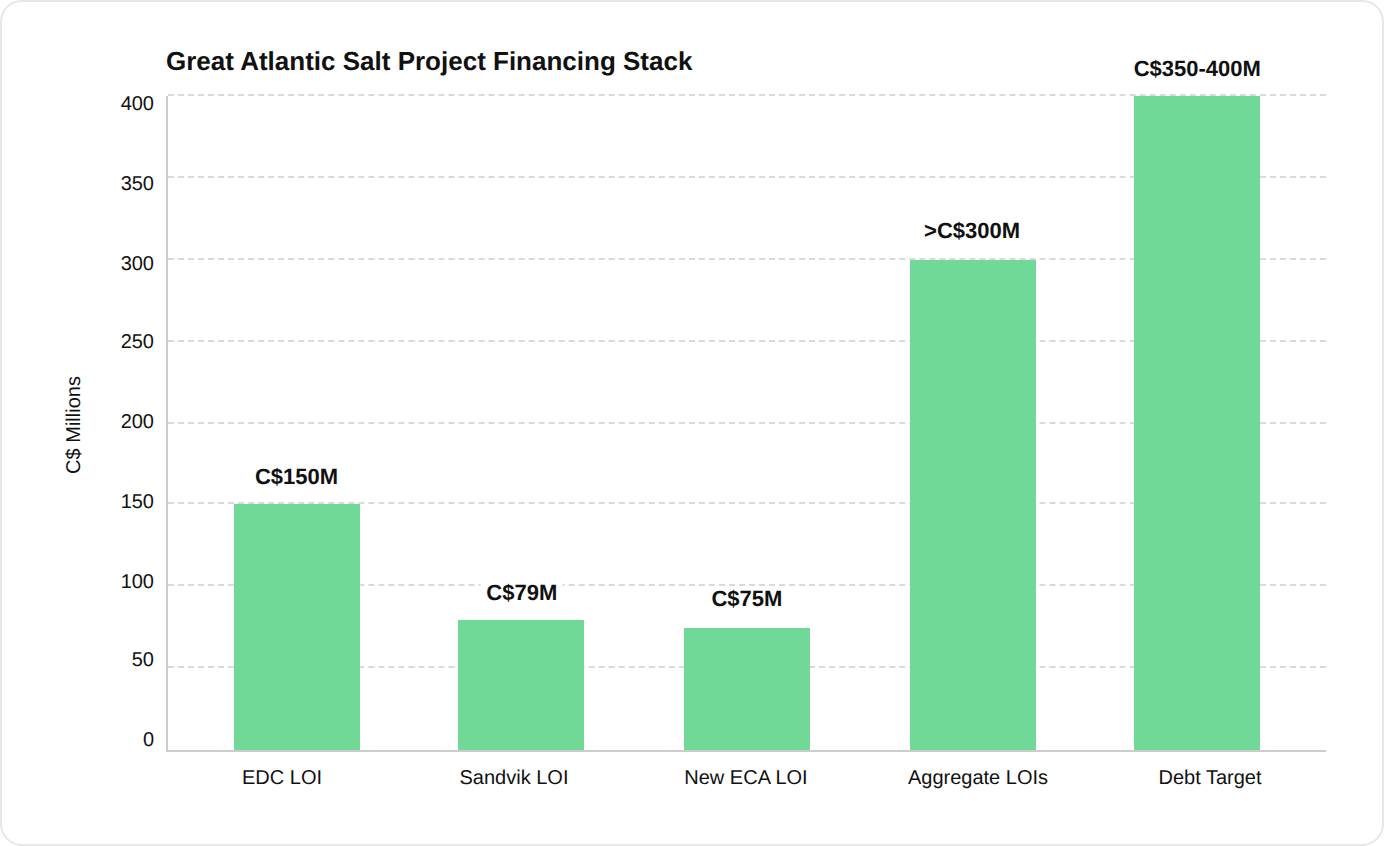
Atlas Salt’s Great Atlantic Salt Project now has over C$300M in financing LOIs, backed by Sandvik and export credit agencies, as it targets C$350M-C$400M in debt.
- Atlas Salt's aggregate financing Letters of Interest (LOIs) for the Great Atlantic Salt Project now exceed C$300 million, after new C$79 million (Sandvik) and C$75 million (a new export credit agency) additions to the existing C$150 million Export Development Canada (EDC) LOI.
- The company is targeting a debt-weighted C$350 million to C$400 million senior secured package, a structure its own investor materials frame as minimizing equity dilution.
- All three LOIs remain non-binding; none convert automatically into committed capital, and Atlas Salt has flagged that a commercial bank syndicate still needs to be assembled around them.
- The Updated Feasibility Study (UFS) is the basis lenders use to underwrite: C$920 million after-tax net present value at an 8% discount rate (NPV8%), a 4.2-year payback, and C$188 million in average annual free cash flow (FCF) over a 25-year mine life.
- If the LOIs fail to convert to definitive agreements, the company's own disclosure states only that there is no assurance financing will be completed on the terms contemplated - it does not specify what the fallback would be.
What Has Happened
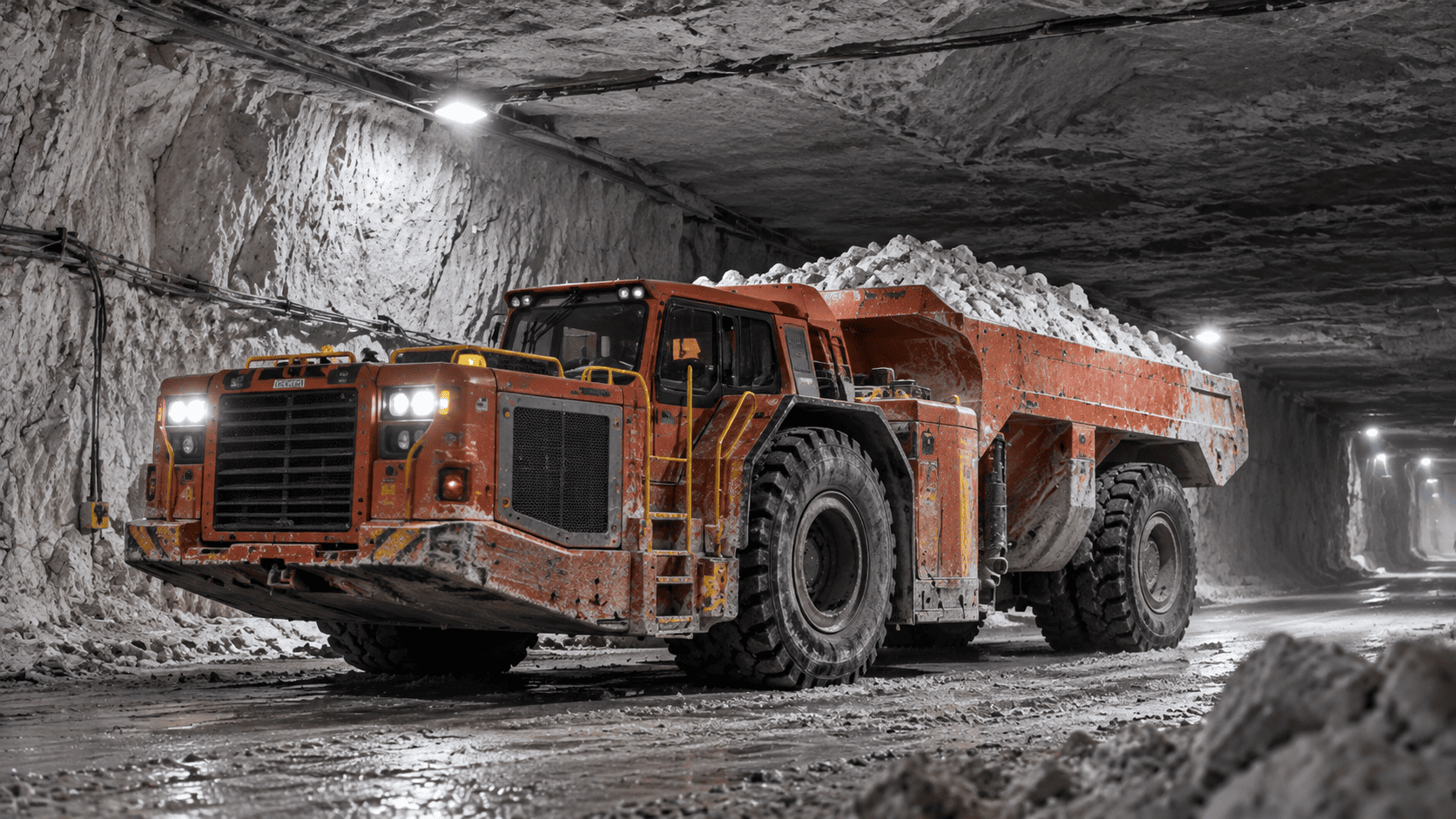
Atlas Salt Inc. (TSXV: SALT | OTCQX: SALQF | FSE: 9D00) announced on September 1, 2026, that Sandvik has advanced its prior Memorandum of Understanding (MOU) into a non-binding Letter of Interest (LOI) for equipment financing of up to approximately C$79 million, and that a new export credit agency (ECA) has separately issued a non-binding LOI for up to C$75 million tied to that Sandvik equipment supply. Combined with the previously disclosed C$150 million EDC LOI, aggregate financing LOIs for the Great Atlantic Salt Project now exceed C$300 million, against a targeted C$350 million to C$400 million senior secured debt package anchored by the Updated Feasibility Study (UFS).
What Conversion Would Actually Change
The significance of this stack lies less in the individual LOI sizes and more in how a debt-weighted structure affects the company's capital structure. Atlas Salt's own investor materials describe the target financing profile as one that supports minimum equity dilution and enables rapid deleveraging into an eventual capital-return phase of buybacks and dividends. Per those same investor materials, the company is targeting an allocation of 50% of free cash flow (FCF) to shareholder returns in years 1 through 8, rising to over 90% from year 9 onward once debt obligations are satisfied; the underlying UFS free cash flow supporting that target averages approximately C$161 million annually in the earlier period and approximately C$203 million annually thereafter.
At 150 million shares outstanding, the targeted allocation works out to roughly C$0.53 per share in the earlier period and C$1.22 per share once the higher allocation applies, falling to C$0.27 and C$0.61 per share respectively at 300 million shares outstanding. Financing construction primarily through senior secured debt and vendor support, rather than issuing new equity to cover the C$589 million pre-production capital estimate, is the mechanism by which that targeted per-share allocation is preserved rather than diluted.
Why Lenders Are Comfortable Anchoring to a Feasibility Study
The debt-weighted structure only works because salt's demand profile removes a variable that complicates financing for most mining projects: commodity price risk. Unlike gold or silver, which trade on second-by-second exchange pricing and expose lenders to price volatility over a construction and ramp-up period, salt is priced through an opaque, regionally negotiated market with deicing demand that holds steady through economic downturns; price movement tends to come from the upside, when a severe winter strains supply, rather than the downside. That stability is what lets lenders size a debt package against the UFS's projected cash flows rather than a commodity-price forecast: a 21.3% post-tax internal rate of return (IRR), a C$920 million after-tax net present value at an 8% discount rate (NPV8%), and a 4.2-year payback at 4.0 million tonnes per annum of steady-state production.

President and Chief Executive Officer of Atlas Salt, Nolan Peterson, has made the same connection between demand stability and financeability:
"Because the demand side is so stable, it allows us to get financing, and then that helps us to be the first mine to be built in the last 25 years or at least start on that."
What to Watch Next
The open question is not whether the LOIs exist, but whether they convert. Atlas Salt's own risk disclosures acknowledge that the financing may not close on the contemplated terms, or at all, and list failure to secure necessary financing as one of the risks it flags. The markers to track from here are the formation of the commercial bank syndicate, progress on converting the C$300 million-plus in LOIs into binding commitments, and whether the final package lands within the targeted C$350 million to C$400 million senior secured range.
FAQs (AI-Generated)
Analyst's Notes





Subscribe to Our Channel





Stay Informed


