How ATHA Energy's C$63 Million Financing Removes Dilution Risk



ATHA Energy's C$63M financing eliminates near-term dilution risk while its Lac 50 Deposit exploration target of 60.8-98.2Mlbs U₃O₈ and 12km mineralized corridor advance the uranium investment case.
- ATHA Energy completed an approximately C$63 million financing on February 5, 2026, materially reducing near-term dilution risk and funding continued exploration at its Angilak Uranium Project without immediate market dependence.
- The Lac 50 Deposit hosts a 2024 NI 43-101 exploration target of 60.8–98.2 million pounds U₃O₈ at grades of 0.37-0.48%, with geophysical surveys confirming conductive horizons extending beyond one kilometer in depth.
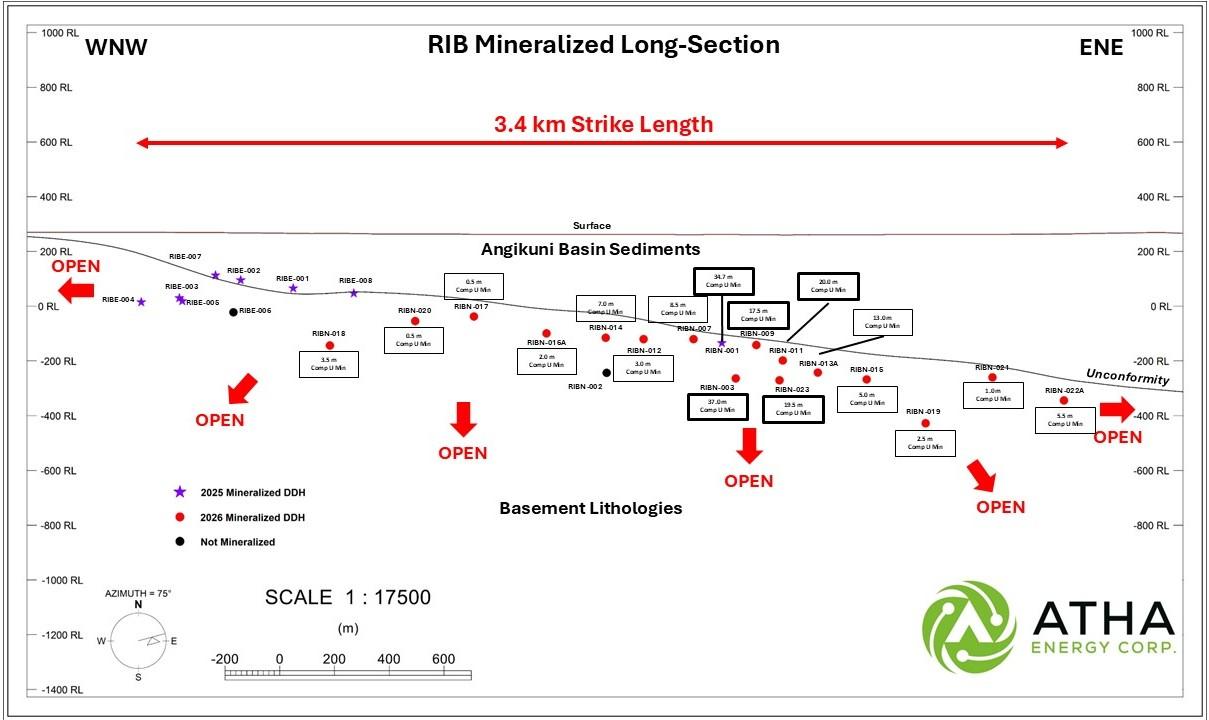
- The 12-kilometer Mineralized RIB Corridor has delivered uranium mineralization in 45 of 46 drill holes since acquisition, including composite intercepts exceeding 26 meters and peak radiometric readings above 55,730 counts per second.
- A 10% carried interest in projects operated by NexGen Energy and IsoEnergy provides passive exposure to additional Canadian uranium assets without incremental capital expenditure.
- Western uranium supply constraints and U.S. strategic reserve considerations reinforce the geopolitical value of scalable, jurisdiction-stable Canadian uranium assets.
Understanding How Dilution Risk Works
Junior exploration companies generate no revenue, meaning the only way to fund drilling programs is by issuing new shares. Each time new shares enter the market, existing shareholders own a smaller percentage of the company, even if the underlying assets haven't changed. If a company adds 10% to its share count, all existing shares effectively fall in value by the same proportion. In down markets, the problem compounds: lower share prices mean it takes more shares to raise the same amount of cash, making dilution worse. Over time, share counts can balloon from 30-40 million to 500 million or more, steadily eroding per-share value. Companies that secure non-dilutive financing, such as convertible debt or carried interest structures, reduce this risk by accessing capital without issuing new equity immediately.
Financing Structure & Balance Sheet Position
ATHA Energy's February 2026 financing addresses this risk directly. The approximately C$63 million closing provides capital through two instruments: a USD$25 million debt facility that can convert into company shares at C$0.85 per share if defined conditions are met, and a C$28.75 million share placement structured to give Canadian investors a tax deduction in exchange for funding exploration activity. The debt carries a five-year term at 12% annual interest, paid partly in cash and partly in shares. Critically, neither instrument required ATHA to issue new shares at current market prices, meaning existing shareholders were not diluted to fund the raise.
Capital Allocation & Operational Runway
The closing eliminates near-term equity raises, extends the operational runway through the current exploration season, supports scaled activity at the Angilak Project, and reduces the risk of forced financing at unfavorable terms during periods of uranium price volatility.
Troy Boisjoli, Chief Executive Officer of ATHA Energy, describes the company's forward operational position:
"Our intention is to move these projects forward in earnest... Moving into delineation infill, project advancement is a natural progression based off of where we're at."
Lac 50 Deposit: Exploration Target Scale & Depth Configuration
The 2024 NI 43-101 technical report established a conceptual exploration target of between 60.8 and 98.2 million pounds U₃O₈ at the Lac 50 Deposit, with grades ranging from 0.37% to 0.48%. It is important to note that an exploration target is a conceptual estimate of potential quantity and grade - it is not a mineral resource estimate under NI 43-101, is inherently uncertain, and there is no guarantee that further exploration will result in the delineation of a compliant resource.
The Athabasca Basin hosts some of the highest-grade uranium deposits in the world, including operations at McArthur River and Cigar Lake. The economics of uranium development are capital-intensive, and resource bases of 50 to 100 million pounds or more are generally considered necessary to support feasibility-level capital commitments, though this threshold varies by deposit type and price environment. At its midpoint, the Lac 50 exploration target approaches that development-relevant range.
ATHA's 2025 drilling program reinforces the scale potential at Lac 50. Troy Boisjoli, Chief Executive Officer, describes the program's results:
"We expanded the deposit in all directions. We did 10,000 meters, went 25 for 25, wrapped an exploration target around it that shows significant scale potential within that area."
The 12-Kilometer Mineralized RIB Corridor: Geological Continuity & Hit Rate
Since ATHA's acquisition of the project, 45 of 46 drill holes along the Mineralized RIB Corridor have intersected uranium mineralization. The corridor extends across 12 kilometers of stacked graphitic shear zones. In exploration risk assessment, hit rate functions as a probabilistic indicator of geological continuity. A near-perfect hit rate materially reduces geological risk, which in turn affects both the probability of resource conversion and the discount rate assumptions applied by institutional capital.
Troy Boisjoli, Chief Executive Officer, describes the exploration outcome:
"RIB in particular now has conductive corridors that are mineralized over 12 km. Multiple drill holes in each area, we have not missed yet... When you think about that from an exploration perspective, that's a bit hard to get your head around... We've had a 100% success rate."
Intercept Quality & Mineralization Style
Notable drill results from the corridor include composite uranium mineralization over 26.3 meters, continuous mineralization over 13.6 meters, and peak radiometric readings above 55,730 counts per second in announced hole RIBN-DD-001. The mineralization exhibits the hallmarks of unconformity-style uranium deposits, including basement-hosted vein systems, hematite alteration, and silicification overprinting.
The mineralization style affects future enterprise value per pound (EV/lb) valuation multiples, as unconformity-associated deposits have generally commanded premium valuations relative to other deposit types. The geological consistency across 12 kilometers improves confidence in deposit continuity.
On the corridor's comparison to established Athabasca Basin discoveries, Troy Boisjoli, Chief Executive Officer, notes:
"The discovery hole at Arrow... very similar grades, very similar thicknesses that we're seeing in the discovery hole at RIB North."
Land Position & Embedded Portfolio Optionality
ATHA holds over seven million acres across major Canadian uranium basins, including the Athabasca Basin, the Thelon and Angikuni subbasin, and the Central Mineral Belt. In uranium exploration, district-scale control carries strategic value by reducing competitor encroachment on adjacent structures, increasing the statistical probability of further discovery, and enhancing the asset's appeal for strategic consolidation.
Troy Boisjoli, Chief Executive Officer, describes the company's basin position:
"We have full control over the Angikuni basin, that's a sub-basin to the Athabasca... We're in sole control of an entire uraniferous basin here... We're in control of an entire district."
The 10% Carried Interest Structure
ATHA retains a 10% carried interest in exploration projects operated by NexGen Energy and IsoEnergy. Under a carried interest arrangement, ATHA participates in project upside without funding its proportionate share of exploration expenditures until a defined development threshold is reached. This structure provides downside capital protection while preserving exposure to resource growth.
For institutional investors, a carried interest resembles an embedded royalty-style asset — providing optionality without ongoing capital dilution. For retail investors, it functions as diversified exposure to additional Canadian uranium projects without incremental share issuance.
Western Uranium Supply Constraints
The uranium supply landscape has shifted from cyclical to structurally constrained. Troy Boisjoli, Chief Executive Officer, frames the demand and supply dynamic from a utility perspective:
"The macro environment in the uranium sector is unequivocally unlike any time I've seen in my career. The sentiment, the real demand that's being built up, coupled with some of the supply-side risk, is a structural setup like we have not seen in the uranium space."
The supply chain retains heavy concentration in geopolitically sensitive jurisdictions, while domestic North American production capacity remains insufficient to meet utility demand. Canadian uranium assets therefore carry a jurisdictional premium in the current procurement environment.
Canada ranks consistently among the world's most attractive mining jurisdictions. Saskatchewan ranked seventh and Newfoundland and Labrador ranked fourth globally in the Fraser Institute's most recent Annual Survey of Mining Companies. For institutional investors, jurisdictional placement reduces permitting risk, sovereign risk, and ESG uncertainty. ATHA's portfolio is positioned entirely within Canadian jurisdictions.
Risk Assessment: Variables That Could Affect the Thesis
Objective analysis requires explicit downside framing. The primary risks to ATHA's investment thesis include uranium price retracement from current levels, the inherent uncertainty in converting an exploration target to a compliant NI 43-101 mineral resource, permitting timelines in Nunavut, capital cost inflation during any future development phase, and potential dilution from conversion of the outstanding debenture.
These variables directly influence discount rates - commonly applied in a range of 8% to 12% in uranium development NPV modeling, depending on jurisdiction and development stage - and sensitivity analysis on internal rate of return assumptions. For retail investors, they represent concrete risk-of-loss factors that must be weighed alongside the geological and financial positives.
The Investment Thesis for ATHA Energy
- The February 2026 financing closing eliminates near-term dilution risk, enabling ATHA to advance exploration without returning to equity markets on unfavorable terms.
- The Lac 50 exploration target of 60.8–98.2 million pounds U₃O₈ approaches the scale threshold generally associated with development-stage capital commitments, with depth extension to beyond one kilometer validating further resource growth potential.
- The 12-kilometer Mineralized RIB Corridor, with a near-perfect drill success rate across 45 of 46 holes, provides geological continuity that supports both resource conversion probability and premium EV/lb valuation treatment relative to lower-confidence exploration assets.
- A 10% carried interest in NexGen Energy and IsoEnergy-operated projects provides passive upside exposure to additional Tier-1 Canadian uranium assets without incremental capital deployment.
- Exclusive basin control across over seven million acres in stable Canadian jurisdictions positions ATHA as both an organic development story and a credible strategic consolidation candidate in an environment of structural Western uranium supply constraints.
If ATHA Energy were to issue no additional press releases through the remainder of 2026, the structural investment case would remain intact. The company holds a funded balance sheet following the February closing, a district-scale exploration portfolio with near-perfect drill continuity across 12 kilometers, passive optionality through its carried interests, and full positioning within stable Canadian jurisdictions at a time of structural Western uranium supply constraint.
In an exploration sector frequently defined by speculative catalysts, the more durable analytical question is whether existing fundamentals justify capital allocation in the absence of immediate news flow. On current evidence, ATHA's investment case rests less on future headlines than on the geological scale and balance sheet strength already established at Angilak.
TL;DR
ATHA Energy closed a C$63 million financing in February 2026, removing near-term dilution risk and funding continued exploration at its Angilak Uranium Project in Canada. The Lac 50 Deposit carries a conceptual exploration target of 60.8–98.2 million pounds U₃O₈, approaching thresholds associated with development-stage capital commitments, while geophysical surveys extend prospective depth beyond one kilometer. The 12-kilometer Mineralized RIB Corridor has returned uranium mineralization in 45 of 46 drill holes. A 10% carried interest in projects operated by NexGen Energy and IsoEnergy adds passive portfolio optionality. With over seven million acres across stable Canadian jurisdictions and structural Western uranium supply constraints reinforcing jurisdictional premiums, ATHA's investment case rests on balance sheet strength and geological endowment rather than near-term promotional catalysts.
FAQs (AI-Generated)
ATHA Energy closed an approximately C$63 million financing comprised of a USD$25 million unsecured convertible debenture and a C$28.75 million brokered private placement of charity flow-through shares. The debenture carries a five-year term at 12% interest (8% cash, 4% shares) with a conversion price of C$0.85 per share. For investors, the significance lies in runway: the financing is designed to fund exploration through the current season without requiring ATHA to return to equity markets, materially reducing the near-term dilution risk that typically weighs on junior exploration-stage companies.
The 2024 NI 43-101 technical report established a conceptual exploration target of 60.8–98.2 million pounds U₃O₈ at grades of 0.37–0.48% at the Lac 50 Deposit. Critically, an exploration target is not a mineral resource estimate under NI 43-101 - it is inherently uncertain and there is no guarantee that further exploration will result in a compliant resource. That said, at its midpoint the target approaches the 50–100 million pound threshold that analysts generally associate with development-stage feasibility commitments, providing relevant scale context in uranium specifically.
Since ATHA's acquisition of the Angilak Project, 45 of 46 drill holes along the 12-kilometer Mineralized RIB Corridor have returned uranium mineralization — an effectively perfect hit rate. The corridor features stacked graphitic shear zones consistent with unconformity-style uranium deposit characteristics, including basement-hosted vein systems, hematite alteration, and silicification. For investors, a near-perfect hit rate reduces geological risk, supports resource conversion probability, and typically warrants premium enterprise value per pound (EV/lb) treatment relative to lower-confidence exploration assets.
Under a carried interest structure, ATHA participates in project upside without funding its proportionate share of exploration expenditures until a defined development threshold is reached. This effectively functions as an embedded royalty-style asset — providing exposure to additional Tier-1 Canadian uranium assets operated by established, well-capitalized peers, without requiring incremental share issuance or capital deployment from ATHA. For retail investors, it represents low-cost diversification; for institutional investors, it resembles optionality with downside capital protection.
Key risks include uranium price retracement from current levels, the inherent uncertainty in converting an exploration target to a compliant NI 43-101 mineral resource, permitting timeline uncertainty in Nunavut, capital cost inflation during any future development phase, and potential dilution from conversion of the outstanding convertible debenture. Institutional investors should factor these variables into discount rate assumptions — typically 8–12% in uranium development NPV modeling depending on jurisdiction and stage — and sensitivity analysis on internal rate of return projections.
Analyst's Notes





Subscribe to Our Channel







Stay Informed