




i-80 Gold Secures $500M Non-Dilutive Financing to Advance Nevada Development Portfolio


.webp)
i-80 Gold secures $500M non-dilutive financing for Nevada development plan; eliminates overhang, accelerates Mineral Point, targets 2027 Lone Tree completion.
- $500 million non-dilutive financing secured through $250M Franco-Nevada royalty (1.5% stepping to 3% in 2031) and $250M prepaid facility from National Bank and Macquarie Bank
- Fully funded through Phase 1 and 2 of three-phase development plan at current gold prices, with recapitalisation expected to complete by end of Q1 2026
- Covenant flexibility achieved through competitive process involving five term sheets and three committed offers, allowing working capital facility and operational adaptability
- Lone Tree plant refurbishment on track for completion by end of 2027, eliminating $1,000-1,500/oz toll milling losses currently impacting Granite Creek Underground operations
- Mineral Point flagship project accelerated with $50M allocated for 2026 resource expansion, infill drilling, pre-feasibility engineering, and initial permitting work
i-80 Gold (TSX:IAU) has successfully closed a transformative $500 million financing package that removes a longstanding overhang and provides the capital certainty required to advance its three-phase Nevada development plan. The non-dilutive structure combines streaming economics with prepaid metal deliveries, offering management operational flexibility while maintaining shareholder value. This transaction represents a critical inflection point for the company as it transitions from development uncertainty to execution mode across multiple underground mining projects.
The Financing Structure: Royalty & Prepaid Components
The financing comprises two equal $250 million tranches designed to minimise shareholder dilution while providing adequate capital for the company's multi-year development timeline. Franco-Nevada, a long-time partner across multiple companies with CEO Richard Young, contributed the first tranche through a royalty structure that begins at 1.5% across the portfolio through 2030, then escalates to 3% from 2031 onward as production scales. This graduated structure acknowledges the company's near-term capital needs while aligning with Franco-Nevada's preference for exposure to future production growth.
The second tranche consists of a prepaid facility with National Bank and Macquarie Bank, with $150 million drawable at closing. Under this arrangement, i-80 Gold has pre-sold approximately 40,000 ounces representing roughly 10% of production over a 30-month delivery period. The net realised price averages $3,750 per ounce after accounting for all fees and interest costs. Combined with refinancing existing convertible debt and the potential sale of a non-core Encore asset, management expects to achieve full funding for Phases 1 and 2 by quarter-end.
Competitive Process Delivers Covenant Flexibility
The financing process benefited significantly from competitive tension among potential capital providers. Young noted:
"We received five term sheets. We actually got three committed term sheets. So, in order for the banks to get the business, they had to compete with the other committed term sheets we got."
This competition proved more valuable for covenant flexibility than for pricing optimisation, as management prioritised operational freedom over marginal cost savings.
Key covenant wins include provisions for a working capital facility to bridge the 120-150 day lag between toll milling deliveries and payment receipt. Additionally, the company secured flexibility to stockpile material in 2027 as the Lone Tree plant refurbishment nears completion, allowing a strategic shift from toll milling to internal processing that will capture $1,000-1,500 per ounce in margin improvement. These operational provisions, initially resisted by lenders, ultimately became necessary concessions to win the mandate against competing offers.
Toll Milling Operations Drive Margin Recovery Opportunity
Granite Creek Underground currently represents i-80 Gold's sole operating mine, with production processed through a third-party toll milling arrangement that costs the company between $1,000 and $1,500 per ounce in margin leakage. As the company ramps up its second underground mine through 2026, this toll milling exposure will double before the Lone Tree autoclave refurbishment eliminates the dependency entirely. The refurbishment timeline targets completion by the end of 2027, at which point both operating mines will benefit from internal processing economics.
The Lone Tree facility represents critical infrastructure for the company's medium-term strategy, as it will process refractory ore from multiple underground operations while capturing margin currently surrendered to toll operators. Management's $50 million 2026 budget allocation toward this refurbishment reflects the priority placed on achieving processing independence and the accompanying economic benefits.
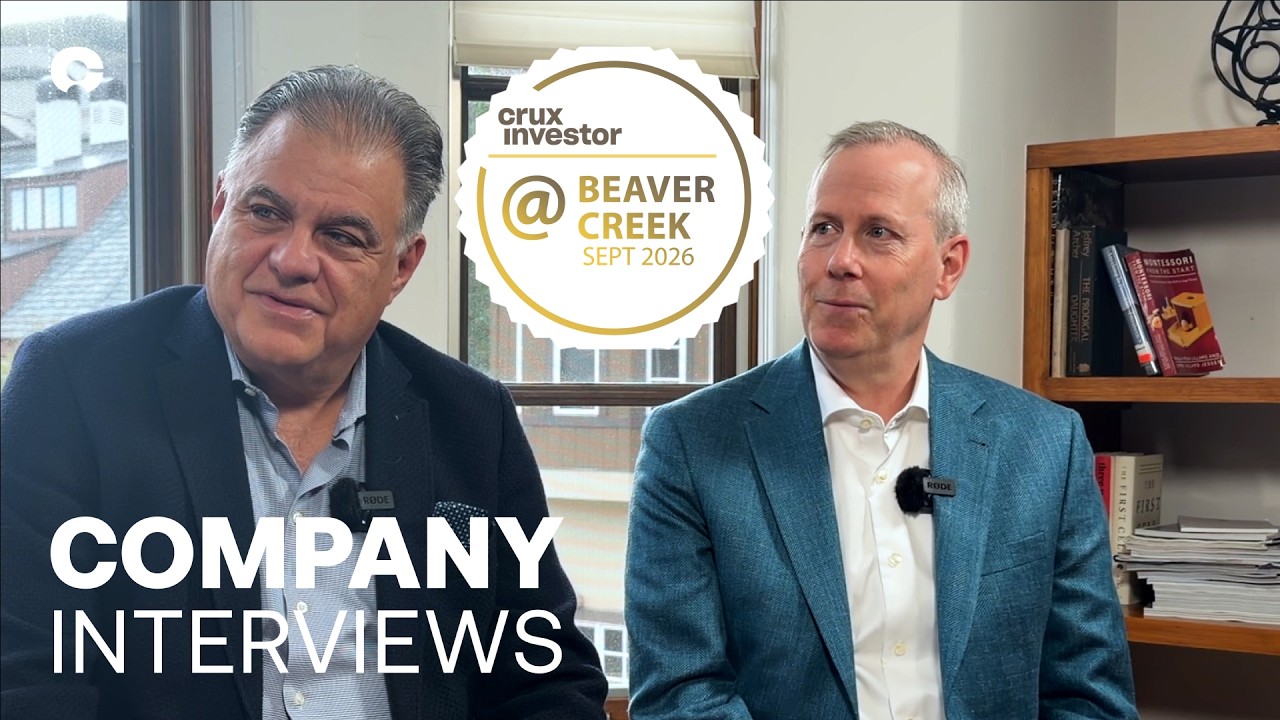
Interview with President & CEO, Richard Young
Advancing the Technical Development Pipeline
The company delivered preliminary assessments for five gold projects in 2025 alongside a technical study for the Lone Tree plant refurbishment, establishing a baseline development framework for the portfolio. For 2026, the focus shifts to feasibility studies for Granite Creek and Cove underground mines, with results expected to demonstrate improvements over the preliminary assessments through ongoing infill and step-out drilling programs. Management has deliberately positioned these studies as conservative benchmarks, setting expectations for upside as technical work progresses.
A third underground mine at Archimedes is currently undergoing Phase 4 drilling with results scheduled for early 2027. The phased approach to feasibility studies reflects management's prioritisation of near-term production assets while maintaining technical progress across the broader portfolio. All three underground projects share similar geological characteristics within Nevada's Battle Mountain-Eureka Trend, providing operational synergies as the company scales production.
Accelerating Mineral Point Development
The financing package enables significant acceleration of Mineral Point, the company's flagship asset and largest resource base. Young emphasised:
"Mineral Point is our most valuable asset. It's our biggest asset and the sooner we can put that into production the better for our shareholders."
The 2026 work program allocates $50 million specifically to Mineral Point for resource expansion drilling, infill programs, pre-feasibility engineering, and initial permitting activities - work that was previously deferred pending financing certainty.
Management expects to deliver a pre-feasibility study in the first half of 2027, followed by full feasibility study work through the balance of that year. This accelerated timeline reflects strategic prioritisation of the asset with the highest value potential within the portfolio. The technical work will need to address both resource confidence and permitting pathways for what represents a longer-dated but potentially transformative production asset.
Recapitalisation Transforms Balance Sheet Position
Beyond the immediate $500 million, management indicated potential need for an additional $100-200 million to complete the full recapitalisation, though at $5,000 gold prices the company projects full funding across all three development phases without equity issuance. Any incremental debt would likely take the form of a revolving credit facility at lower cost than the current prepaid structure. Young noted:
"We feel that it's a key milestone for us and our shareholders. By the time we finish this quarter to understand what the capital structure looks like, then I think investors and potential new investors can focus on the quality of the assets and the upside within each of those assets."
This perspective reflects management's view that capital structure uncertainty has obscured fundamental asset value in the market. With financing resolved, the investment narrative can shift from balance sheet risk to operational execution and resource quality across a portfolio of Nevada-based gold projects in various development stages. The non-dilutive financing structure preserves shareholder economics while providing multi-year capital certainty through a period when many development-stage miners face difficult equity market conditions.
Measuring Success Through Execution Milestones
Management will measure success against the preliminary assessments delivered in 2025, with focus on demonstrating value improvement through feasibility studies and drill results. Key 2026 deliverables include completing Lone Tree refurbishment on schedule and budget, publishing improved feasibility studies for Granite Creek and Cove, and advancing Archimedes and Mineral Point technical work according to plan. The company reports progress against these milestones to its board while maintaining awareness of external capital markets expectations.
The strategic emphasis remains on producing more gold at similar or lower costs while accelerating project timelines where possible. Time value of money considerations drive prioritisation decisions, particularly regarding Mineral Point's advancement within the development queue. With capital structure certainty achieved, execution risk becomes the primary focus for management and investors evaluating the company's ability to deliver on its three-phase development plan.
The Investment Thesis for i-80 Gold
- Non-dilutive financing eliminates capital structure overhang while preserving shareholder economics through development cycle, with recapitalisation complete by Q1 2026
- Nevada-based asset portfolio provides geographic concentration in Tier-1 mining jurisdiction with established infrastructure and favorable permitting environment
- Immediate margin expansion opportunity through Lone Tree refurbishment (2027 completion) eliminates $1,000-1,500/oz toll milling losses across growing production base
- Multiple near-term catalysts including Granite Creek and Cove feasibility studies (2026), Archimedes Phase 4 results (early 2027), and Mineral Point pre-feasibility (H1 2027)
- Competitive tension in financing process delivered covenant flexibility for working capital facility and operational adaptability during production ramp
- Mineral Point flagship acceleration with $50M 2026 budget allocation positions highest-value asset for earlier production timeline
- Conservative baseline assessments establish framework for demonstrable value improvement through infill drilling and technical advancement
- Three-phase development plan fully funded at current gold prices without additional equity dilution required
- Focus on execution metrics rather than share price creates accountability framework around technical milestones and operational delivery
Macro Thematic Analysis
i-80 Gold's financing success reflects broader capital market dynamics favoring Nevada-based gold development assets in a high-price environment. The competitive financing process, yielding five term sheets and three committed offers, demonstrates renewed lender appetite for quality jurisdictional exposure as gold maintains elevated levels above $5,000 per ounce. Nevada's established mining infrastructure, favorable permitting framework, and geological prospectivity continue attracting capital despite challenging broader equity markets for development-stage miners.
The non-dilutive structure preserves shareholder value while capturing lender interest in production exposure through royalties and prepaid deliveries. Young's observation that "in order for the banks to get the business, they had to compete with the other committed term sheets we got" encapsulates the negotiating leverage available to well-positioned Nevada developers in the current market.
TL;DR
i-80 Gold secured $500M in non-dilutive financing ($250M Franco-Nevada royalty + $250M bank prepaid) to fund its three-phase Nevada development plan through recapitalisation completing Q1 2026. The competitive process (5 term sheets, 3 committed) delivered covenant flexibility for working capital and operational adaptability while management accelerates Mineral Point flagship development and targets 2027 Lone Tree plant completion to eliminate $1,000-1,500/oz toll milling losses. Multiple feasibility studies in 2026-2027 provide near-term catalysts as the company transitions from capital structure uncertainty to operational execution.
FAQ's (AI Generated)
The non-dilutive structure preserves shareholder value while providing operational flexibility. Traditional equity would dilute ownership, while the competitive process enabled covenant terms that support working capital needs and strategic operational decisions through the development cycle.
Completion is targeted for the end of 2027. The refurbishment eliminates $1,000-1,500 per ounce in toll milling charges currently impacting Granite Creek operations and will similarly benefit the second underground mine as it ramps production through 2026.
Mineral Point represents the company's largest and most valuable resource. The financing enables $50M in 2026 spending for resource expansion, pre-feasibility work, and permitting, advancing the asset's production timeline to maximise shareholder value from the highest-quality project.
Five term sheets and three committed offers forced lenders to compete on covenant flexibility rather than just pricing. This secured provisions for working capital facilities and operational adaptability that were initially resisted but became necessary to win the mandate.
The royalty starts at 1.5% across the portfolio through 2030, then increases to 3% from 2031 onward. The graduated structure acknowledges near-term capital needs while providing Franco-Nevada greater exposure as production scales and the portfolio matures.
Analyst's Notes





Subscribe to Our Channel

.jpg)


Stay Informed






















