




ICSG's Confirmed Copper Surplus Diverges From Bullish Prices, Testing Whether Future Demand Closes Gap


ICSG's growing copper surplus and record inventories challenge rising prices as markets bet future demand will absorb expanding supply.
- The International Copper Study Group (ICSG) reported world mine production fell 1.9% in the first five months of 2026, while world refined production grew about 3%, widening the gap between mine output and refined copper production.
- ICSG's preliminary refined copper balance showed a 221,000-tonne surplus over the first five months of 2026, nearly double the 117,000-tonne surplus a year earlier, showing physical copper availability increased despite weaker mine supply.
- Combined exchange inventories across the London Metal Exchange (LME), COMEX and Shanghai Futures Exchange (SHFE) reached 1,065,512 tonnes at the end of June 2026, their highest level since May 2003 and 43% higher than at the end of 2025, indicating that readily deliverable copper continued to accumulate despite stronger prices.
- Despite the confirmed surplus and higher exchange inventories, the LME cash price averaged $13,112.67 per tonne through June 2026, up 32% from the 2025 annual average, leaving prices at odds with ICSG's reported physical market balance.
- Company-level developments across Chile, the Vicuña district, North America, and Australia highlight where future copper supply could emerge as producers seek to offset disruptions such as Chile's 8.8% production decline and Indonesia's 38% decline in concentrate output.
Mine Supply Falls 1.9% as Chile & Indonesia Weigh on Output, Putting H2 Supply Recovery in Focus
ICSG's preliminary data for the first five months of 2026 show world copper mine production fell 1.9%, as a 3.4% decline in concentrate output outweighed a 3.5% increase in solvent extraction-electrowinning (SX-EW) production. The decline was concentrated in a few producing countries, making the causes important for assessing second-half supply recovery.

Chile saw mine production fall 8.8%, driven by lower output at El Teniente, Escondida, Los Pelambres and Spence. Concentrate production fell 10.7%, while SX-EW output declined 1.8%. Indonesia's concentrate production fell 38% as constraints at the Grasberg mine continued to limit output, while the Democratic Republic of Congo (DRC) kept mine production broadly unchanged because a 7.2% increase in SX-EW output offset a 31% decline in concentrate production at the Kamoa mine. These losses were partly offset by a 3.4% increase in Peru's mine output from Antamina, Las Bambas and Antapaccay, alongside roughly 23% concentrate production growth in Mongolia as the Oyu Tolgoy underground project ramped up.
China & DRC Lift Refined Output, Expanding Physical Copper Supply
World refined copper production grew 3% over the first five months of 2026, with primary production up 2.5% and secondary production up 5.5%. Nearly all of that growth came from China and the DRC, which together account for about 58% of global refined copper production and increased output by a combined 6.3%, while refined production in the rest of the world declined about 1.3%.
Chile's refined copper production declined 11%, a sharper fall than mine production, as electrolytic output dropped 29% because of smelter operational constraints and maintenance, while SX-EW output declined 1.8%. Refined copper output across Asia excluding China grew only 0.5%, despite India's production rising about 30%. Meanwhile, global secondary refined production increased 5.5%, largely because of higher output in China, showing that scrap continued to support Chinese refined copper production during the first five months of 2026.
ICSG's Copper Surplus Doubles Year on Year, Reinforcing Higher Physical Supply
World apparent refined copper demand rose 2.2% over the first five months of 2026. Apparent refined copper demand outside China grew about 1%, while Chinese apparent demand, excluding changes in bonded and unreported stocks, increased about 3% despite a 17% decline in the country's net refined copper imports, with China accounting for about 59% of global refined copper demand during the period.

ICSG's preliminary refined copper balance showed an apparent surplus of about 221,000 tonnes over the first five months of 2026, compared with about 117,000 tonnes over the same period in 2025. After adjusting for an estimated 29,000-tonne decline in China's bonded stocks at the end of 2025, the refined copper balance still showed a surplus of about 189,000 tonnes.
Copper Prices Rise 32% Despite Record Stocks, Reflecting Expectations of Future Supply Tightness
Combined inventories across the LME, COMEX and SHFE totalled 1,065,512 tonnes at the end of June 2026, their highest level since May 2003. Inventories increased by 321,397 tonnes, or 43%, from the end of December 2025, almost entirely because of stock builds at the LME and COMEX of 179,525 tonnes and 151,482 tonnes, respectively, while SHFE inventories declined by 9,610 tonnes.
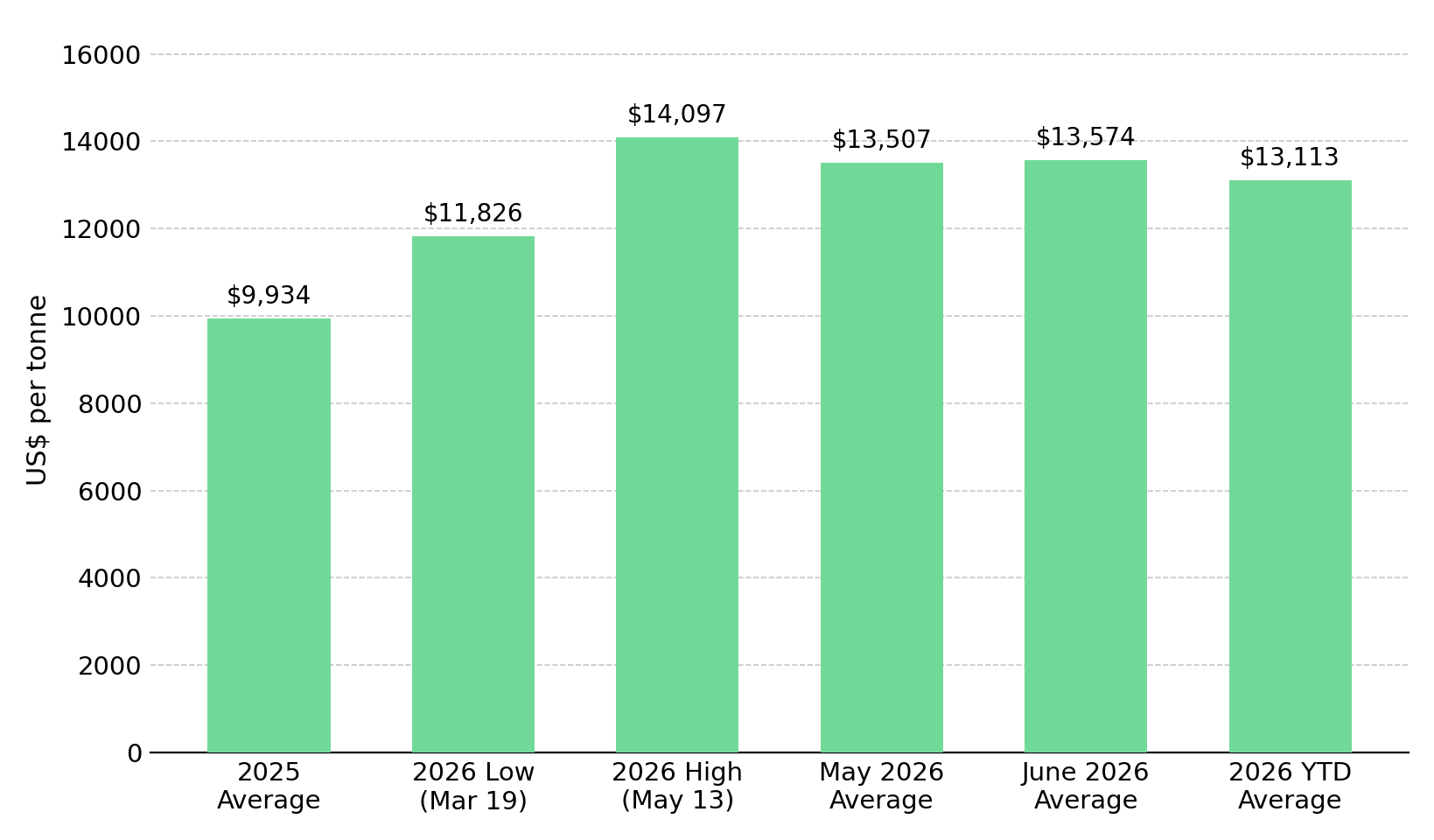
Despite the growing refined copper surplus and higher exchange inventories, the average LME cash price for June was $13,574.32 per tonne, up 0.5% from May's average of $13,507.13 per tonne. The LME cash price reached a 2026 high of $14,097 per tonne on May 13 and a low of $11,826 per tonne on March 19, leaving the year-to-date average at $13,112.67 per tonne, 32% above the 2025 annual average.
Copper prices have remained elevated because parts of the market are pricing future supply conditions rather than today's inventories. J.P. Morgan forecasts a 330,000-tonne refined copper deficit for 2026, driven by hyperscale data center demand, while Section 232 uncertainty has shifted inventories toward COMEX without changing the global surplus.
Chile's Mine Supply Constraints Increase the Importance of Its Development Pipeline
ICSG's country data show Chile's mine output fell 8.8% over the first five months of 2026 because of lower production at several of its largest operations. As the world's largest copper producer, Chile's production shortfall increases the importance of new projects that can replace lost mine supply and improve the country's production profile as existing operations recover or new capacity comes online.
Marimaca Copper is advancing toward construction of its Marimaca Oxide Deposit in Chile's Antofagasta Region while continuing to expand the nearby Pampa Medina sulfide discovery. Step-out hole SPRD-07 returned 20 meters grading 2.65% copper and 13.9 g/t silver from 564 meters, including 6 meters at 6.11% copper and 24.0 g/t silver, confirming high-grade mineralization beyond previous drilling. Hole SPRD-08B also intersected mineralization in basement metasediments for the first time, indicating potential for mineralization to extend into a previously untested host rock. Hayden Locke, President and Chief Executive Officer of Marimaca Copper, outlines the project's long-term copper potential:
"We are starting to delineate a potentially world-class sediment-hosted copper deposit in Chile's low coastal range, 50 km from a port, with access to all of the infrastructure benefits that the Marimaca project has."
Fitzroy Minerals is drilling the Buen Retiro Copper Project near Copiapó, where recent drilling continued to return broad copper intercepts, including 111.9 meters grading 0.97% copper from 21.1 meters and 147.7 meters grading 0.41% copper from 26.3 meters. Four rigs are active across Buen Retiro, including one currently drilling the Tenorita trend's northeast extension, with that drill-out targeted for completion in August 2026 ahead of a planned Pre-Feasibility Study (PFS). Merlin Marr-Johnson, President and Chief Executive Officer of Fitzroy Minerals, highlights the tightening global copper supply:
"Vast amounts of money are going just to maintain production. It's only an increase of about 100,000 tonnes after spending over $50 or $60 billion. Metal prices have to rise as demand is strong."
Vicuña District Drilling Expands the Future Copper Pipeline Beyond Chile's Existing Mines
The importance of new copper supply extends north into the Vicuña district along the Argentina-Chile border, where BHP and Lundin Mining's Filo del Sol discovery has drawn a growing number of explorers targeting the same mineralized trend.
Mogotes Metals is drilling the Albor target at its Filo Sur project, immediately along strike from Filo del Sol. Recent drilling returned 180.0 meters grading 0.98% copper equivalent from 108.0 meters, including 58.0 meters at 1.77% copper equivalent. The reported copper-equivalent grades are based on assumed rather than tested metallurgical recoveries, while assays from two additional holes remain pending. Allen Sabet, Chief Executive Officer of Mogotes Metals, explains why major discoveries attract industry attention:
"There have been no other large discoveries like Filo in the last 30 years. When you start to clip into something like that, it attracts interest regardless of whether you want it or not."
Restart-Ready North American Projects Provide the Fastest Path to New Copper Supply
If J.P. Morgan's deficit outlook proves more accurate than ICSG's surplus outlook, speed to production becomes as important as project scale. Projects with existing infrastructure and advanced resource definition can reach production faster than greenfield developments, regardless of jurisdiction.
Selkirk Copper is advancing Yukon's past-producing Minto mine toward a restart decision while continuing its Phase 2 drill program, with recent step-out drilling at Minto East returning 4.28% copper equivalent in hole 26SCM178. A Mineral Resource Estimate (MRE) and Preliminary Economic Assessment (PEA) are expected within July 2026, ahead of a Feasibility Study planned for the third quarter. The project also benefits from an existing 4,100-tonne-per-day processing plant and underground infrastructure. Colin Joudrie, President and Chief Executive Officer of Selkirk Copper, outlines the planned production profile for Minto mine:
"Our target is a 12 to 15-year mine life, processing 4,100 tonnes per day and producing approximately 30,000 tonnes of contained copper equivalent annually."
Abitibi Metals holds the B26 deposit in Quebec's Abitibi Greenstone Belt, where a 2026 Mineral Resource Estimate defined 25.3 million tonnes grading 2.1% copper equivalent, containing an estimated 775 million pounds of copper. The company secured 100% ownership of B26 in June 2026 and has fully funded up to 80,000 meters of drilling across 2026 and 2027 to support further resource growth and conversion. Jon Deluce, Founder and Chief Executive Officer of Abitibi Metals, highlights growing demand for quality copper development projects:
"Quebec is a very sought-after jurisdiction. A lot of the multi-million-ounce-equivalent developers have been taken over over the last two years, and I don't think this M&A will stop. There are very few multi-million-ounce developers available in the market, and producers are printing record levels of cash flow while they're still behind the eight ball on replenishing exploration and development targets."
Allied-Jurisdiction Exploration Expands Future Copper Supply in Lower-Risk Regions
The focus on new copper supply extends beyond the Western Hemisphere, and Australia's large copper resource base makes it a natural next step in the global development pipeline.
Cobra Resources is drilling the Manna Hill project in South Australia, a jurisdiction containing around 70% of Australia's copper reserves. Recent drilling intersected bornite mineralization from 220 to 257 meters in one hole and a large anhydrite breccia zone from 190 to 220 meters in another, which the company considers indicative of a fertile porphyry copper system. Rupert Verco, Chief Executive Officer and Managing Director of Cobra Resources, discusses expanding a larger copper system:
"What we're seeing now is not just shallow oxides. We're seeing deep depth continuity of these sulfides. We're adding considerable scale, and that's something that's pretty exciting."
Grasberg Mine's Mud Rush & DRC's Seismic Event Rapidly Shift Global Copper Supply Expectations
ICSG attributes Indonesia's 38% decline in concentrate production to the severe mud rush at the Grasberg mine in September 2025, while the DRC's Kamoa mine recorded a 31% decline following a 2025 seismic event, more than offsetting the country's 7.2% growth in SX-EW output and leaving overall mine production broadly unchanged. Because both declines stemmed from site-specific disruptions rather than declining resource quality, concentrate production could recover as remediation and mine restoration progress through the second half of 2026.
If Grasberg and Kamoa recover through the remainder of 2026, mine supply could improve further, widening ICSG's refined copper surplus unless demand accelerates enough to absorb the additional output. Whether current prices prove sustainable therefore depends less on today's physical balance than on whether second-half demand develops quickly enough to validate the market's more bullish expectations.
The Investment Thesis for Copper
- The pace at which the current refined copper surplus narrows will determine how quickly additional mine supply is required, making changes in the physical market balance a primary driver of copper project valuations.
- Development-stage projects and restart-ready assets with existing infrastructure can advance toward production faster than greenfield developments, allowing them to respond more quickly if stronger copper prices continue to support new mine supply.
- Exploration success in established mining districts expands the future copper supply pipeline and can increase interest once drilling demonstrates the scale and grade needed to support economically viable mines.
- Stable permitting regimes, established infrastructure, sufficient cash runway, and clearly defined technical milestones reduce execution risk, making jurisdiction and capital discipline important screening criteria across the copper development pipeline.
- Demand from electrification and data center construction supports stronger long-term copper consumption, even as current physical market data continue to indicate a refined copper surplus.
ICSG data show a refined copper surplus that has roughly doubled year on year, exchange inventories at their highest since 2003, and prices still about 32% above last year's average. Until stronger demand absorbs the surplus or prices realign with current fundamentals, companies with high-quality assets, low execution risk, and clear development pathways remain best positioned.
TL;DR
ICSG data show the global copper market remained in a physical surplus during the first five months of 2026, with refined production outpacing mine supply and exchange inventories reaching their highest level since 2003. Despite these fundamentals, copper prices remain elevated because markets are pricing future supply tightness driven by electrification and data center demand rather than current inventories. The article examines where new supply could emerge across Chile, the Vicuña district, North America, and Australia, while highlighting how localized disruptions in Indonesia and the DRC could reverse as operations recover. Ultimately, whether copper prices remain supported depends on future demand absorbing today's surplus.
FAQs (AI-Generated)
Analyst's Notes





Subscribe to Our Channel













Stay Informed


