




Indonesia's Nickel Problem Isn't Price, It's Who Can Buy It


Indonesia’s 40 ESG gaps restrict nickel market access, creating premium potential for compliant, lower-emission supply despite LME oversupply.
- London Metal Exchange (LME) nickel futures closed at $16,878 per tonne on August 27, 2026, while spot at $16,724 created a $154 futures premium that signaled near-term oversupply.
- LME nickel stocks rose 0.8% from 266,172 tonnes on July 31, 2026, to 268,314 tonnes in August, while prices averaged $16,753 and fell 2.15%, reinforcing near-term oversupply.
- An analysis reported on August 28, 2026 found that only 2 of 42 international environmental, social, and governance (ESG) parameters aligned with Indonesia’s regulatory framework, potentially limiting access to markets that require those standards.
- Pyrometallurgical processing emits 40 to 42 tonnes of carbon dioxide per tonne of nickel, increasing carbon costs and market-access risk.
- Indonesia’s nickel exports rose about 12-fold from $3 billion in 2014 to $37 billion in 2025, but carbon-intensive processing now limits market access and favors lower-emission supply.
Refined Surplus Lifts LME Stocks 0.8%, Shifting Nickel Value Toward Market Access
Despite refined surpluses and weak Chinese demand that pushed Chinese stainless steel futures below 14,000 yuan per tonne, LME nickel held above $16,800 and closed at $16,878 per tonne. Cash at $16,660 traded $180 below the three-month contract, confirming near-term supply pressure.
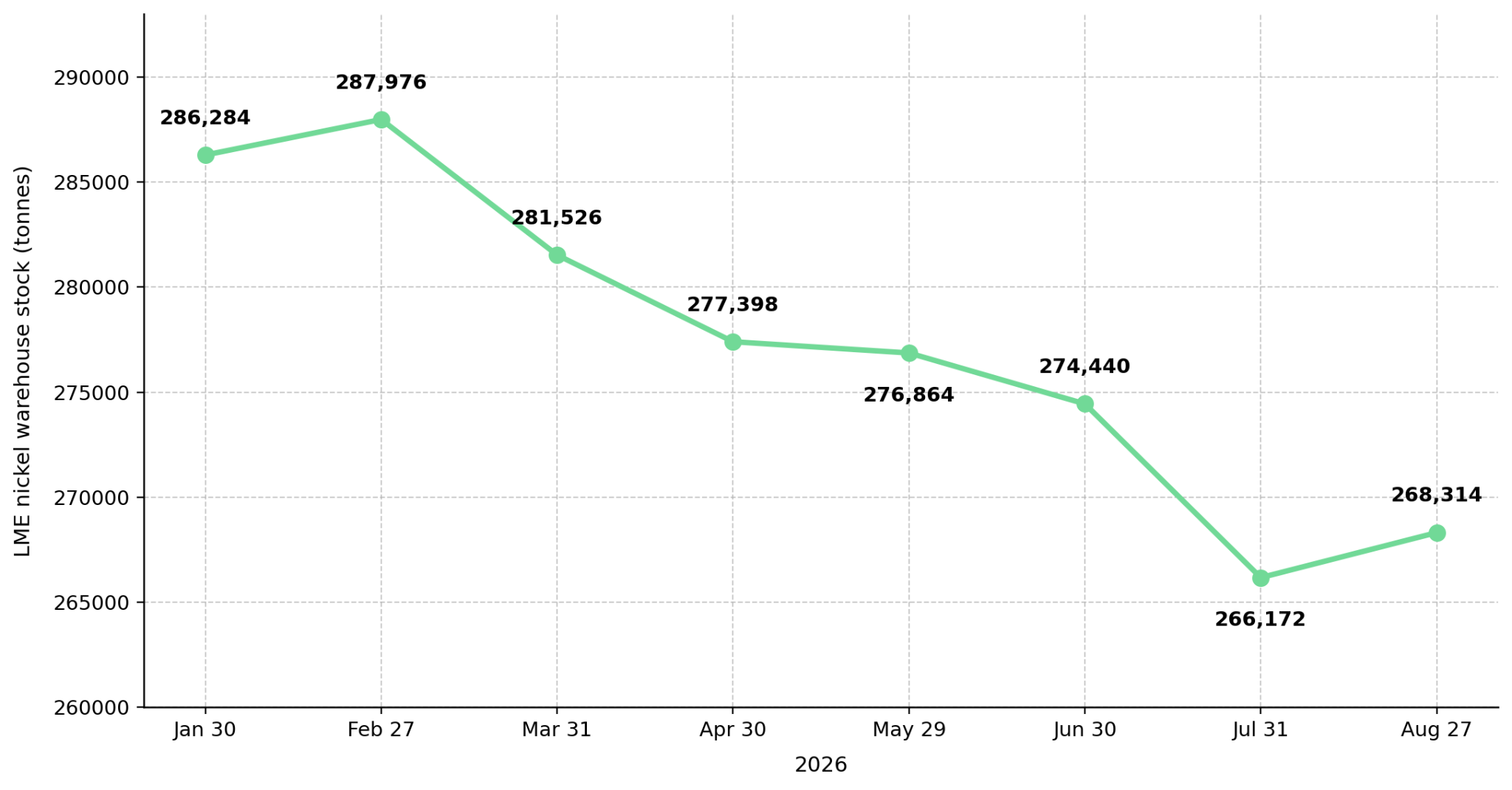
LME stocks rose 0.8% in August to 268,314 tonnes as prices fell 2.15%, although the $16,753 monthly average remained 1.39% higher for the year. The stock build confirms oversupply, but Indonesia’s tighter constraint is market access rather than volume.
RKEF Drives 40-42 CO2 per Tonne, Redirecting Capital Toward Lower-Emission Nickel
Indonesia’s downstream nickel boom relies on carbon-intensive rotary kiln electric furnace (RKEF) processing to convert ore into nickel pig iron and ferronickel, putting market access and financing at risk. This exposure favors lower-emission supply that meets buyer standards.
Natan Adhynagara, Mining and Mineral Expert at Indonesia’s National Economic Council, estimated that pyrometallurgical production emits 40 to 42 tonnes of carbon dioxide per tonne of nickel. Nickel smelters require continuous high-load power, so lower-carbon replacements must provide reliable electricity at scale. Joko Widajatno Soewanto, an advisor to the Indonesian Nickel Miners Association, identified processing-stage emission cuts as a main industry challenge, favoring lower-emission producers in standards-based markets.
Indonesia’s 40 ESG Gaps Restrict European Access, Creating Premium Potential for Compliant Nickel
A gap analysis involving Indonesia’s Coordinating Ministry for Economic Affairs and the World Resources Institute found that only 2 of 42 international ESG parameters aligned with roughly 117 domestic sustainability regulations, leaving 40 gaps that limit market access and favor compliant supply.
If the 40 gaps remain through 2027, Indonesian nickel will continue serving stainless steel and Chinese buyers while LME stocks hold near 268,314 tonnes. If buyers price Nickel Mark certification and carbon-footprint disclosures into contracts, compliant producers could realize prices above the LME quote, making it a floor for qualifying supply.
Natan Adhynagara, Mining and Mineral Expert at Indonesia’s National Economic Council, said European market access requires compliance with the Initiative for Responsible Mining Assurance, Responsible Minerals Initiative, Copper Mark, and Nickel Mark, alongside the EU Carbon Border Adjustment Mechanism. Indonesia’s roadmap targets an 81% reduction in nickel-industry emissions by 2045, providing a measurable path toward wider market access.
Buyer Carbon Standards Reorder Nickel Valuations, Improving Higher-Cost Low-Emission Assets
Nickel assets are now ranked by both cash cost and carbon intensity. Abundant ore and cheap captive coal power keep Indonesian laterite operations low on cash costs, but pyrometallurgical output emits 40 to 42 tonnes of carbon dioxide per tonne of nickel, compared with 28.7 tonnes at a hydropower-based producer. Carbon requirements can therefore reorder asset valuations and favor lower-emission supply.
Canadian and Australian sulfide operations and hydrometallurgical plants powered by hydro or geothermal energy may rank worse on cash costs but better on carbon intensity. Because the LME price does not reflect emissions or compliance, audited credentials can give higher-cost assets a market-access advantage.
Signals That Separate Oversupply From Scarcity Value
A refined nickel surplus serving the stainless steel market is capping prices, with LME stocks up 0.8% in August to 268,314 tonnes and the monthly average at $16,753.
Aligning the 40 remaining international parameters would open Europe to more Indonesian nickel, widening Western supply and pressuring prices. If the gaps remain, compliant producers retain a market-access advantage that the LME quote does not capture.
Track LME stocks and settlements alongside progress on the 40 regulatory gaps and the number of Nickel Mark-assessed operations to separate oversupply pressure from compliance-driven value. Reprice exposure only when contract terms confirm a compliance premium, because spot commentary does not establish realized value.
Analyst's Notes





Subscribe to Our Channel





Stay Informed


