




Iran Strike Deferral Lifts Crude as Distillate Scarcity Decides Refining Returns



Gulf Coast refiners ran at 95.9% capacity while US distillate stocks remained 9% below average, highlighting the value of diesel output and export access.
- Brent rose 2.45% to $111.49 a barrel and West Texas Intermediate (WTI) gained 2.39% to $99.47 on 22 October 2026, following reports of possible renewed US and Israeli strikes on Iran after the 3 November midterms.
- US distillate inventories rose 1.7 million barrels to 104.3 million in the week ending 16 October 2026, but remained 11.3 million below a year earlier and 9% below the five-year average.
- Gulf Coast refiners operated at 95.9% of capacity in the week ending 16 October 2026, up from 92.0% a year earlier, leaving little room to increase output and rebuild distillate inventories before peak winter demand.
- Gasoil inventories were unlikely to recover before the second half of 2027, supporting diesel prices near twice crude levels and stronger refining margins.
- US distillate inventories exceeding 115.6 million barrels would close the year-over-year deficit and could narrow the scarcity premium supporting refining margins.
Iran Strike Reports Lift Brent to $111.49
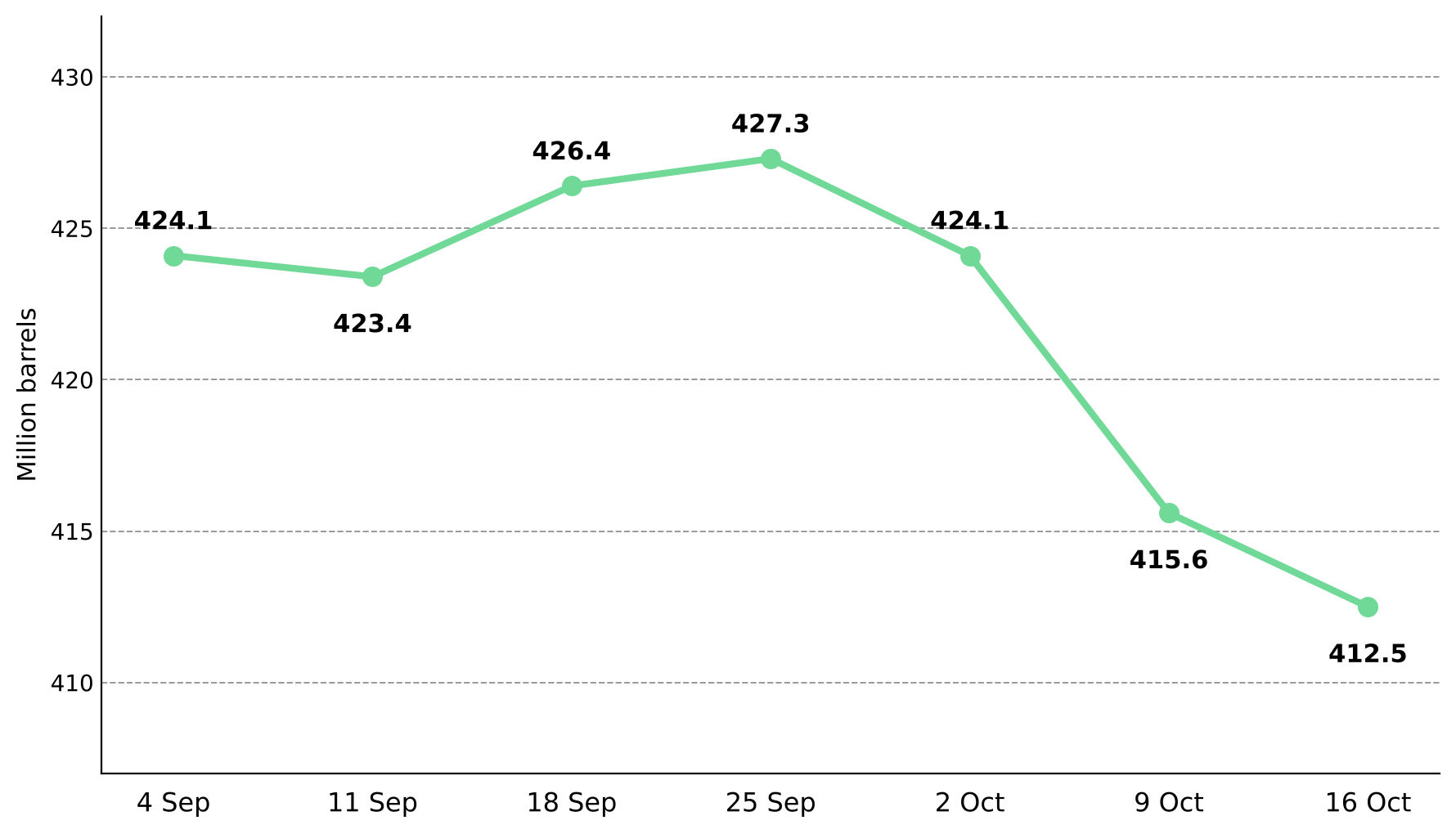
Brent rose 2.45% to $111.49 a barrel and WTI gained 2.39% to $99.47 following reports of plans for renewed US and Israeli strikes on Iran after the 3 November midterms. US commercial crude inventories also fell 3.1 million barrels to 412.5 million, 3% below the five-year average, reducing the supply buffer against disruptions.
Crude's rise partly reflects the risk of renewed strikes on Iran, while distillate shortages already support refining margins. US distillate inventories stood at 104.3 million barrels, 11.3 million below the year-earlier level of 115.6 million, a gap that lower crude prices alone cannot close.
High Refinery Utilization Limits Distillate Inventory Recovery
US refiners processed 16.65 million barrels a day at 93.4% of capacity, with Gulf Coast utilization rising to 95.9% from 92.0% a year earlier. Distillate output increased to 5.232 million barrels a day from 4.632 million, yet inventories rose only 1.7 million barrels. US refining capacity fell to 18.044 million barrels a day from 18.160 million, limiting room to increase output and supporting the value of existing distillate-capable refineries.
Global diesel exports fell 700,000 barrels a day year over year in September, as a 1.3 million-barrel-a-day decline from Russia and the Middle East was only partly offset elsewhere. Global gasoil production also fell 1.7 million barrels a day to 27.2 million in the third quarter of 2026, tightening diesel supply ahead of winter and supporting refining margins regardless of strike timing.
Gasoil Shortfalls Sustain Diesel Prices Despite Weaker Demand
Global oil demand is forecast to fall 2.5 million barrels a day in the fourth quarter of 2026, with diesel accounting for 25% of the decline. Yet gasoil supply remains insufficient to rebuild inventories before the second half of 2027, supporting diesel prices and refining margins despite weaker demand. David Wagner, Head of Equity and Portfolio Manager at Aptus Capital Advisors, noted that $100 oil now places less pressure on US households because gasoline accounts for half the share of disposable income it did a decade ago.
Diesel Price Premium Favors Refiners Over Freight Operators
Diesel prices near twice crude levels pressure freight and marine shipping margins when contracted rates limit fuel-cost recovery. Upstream holdings and crude-linked funds benefit from rising oil prices, while refiners can capture additional value from the wider diesel-to-crude price spread.
Higher distillate yields and export access position refiners to benefit from stronger diesel margins. Gulf Coast refiners operated at 95.9% of capacity, with distillate inventories at 44.4 million barrels, down from 45.1 million a year earlier, while East Coast refiners ran at 80.8%, with stocks falling to 21.0 million from 26.8 million.
Crude positions tied to unconfirmed strike timing risk losses if the geopolitical premium fades. Weekly distillate inventories, however, confirm a supply shortage that can support refining margins even if crude prices retreat.
How Does Refining Scarcity Support Valuations
Crude supply recovered to 102.3 million barrels a day in September, but distillate inventories remained low, favoring refineries with the capacity to convert crude into diesel.
Gulf Coast refiners with high distillate yields and export access can capture wider diesel-to-crude price spreads, making refining margins and processing capacity key valuation factors beyond crude prices alone.
Years of limited refining investment have made distillate-processing capacity scarce, giving existing refiners an advantage that a diplomatic settlement cannot quickly eliminate.
Analyst's Notes





Subscribe to Our Channel








Stay Informed


