




Brent Hits Five-Month High Despite Falling Demand as Attacks Set the Price



Brent hit a five-month high on Gulf attacks despite falling oil demand. Thin stocks and near-zero spare capacity keep a temporary risk premium in oil prices.
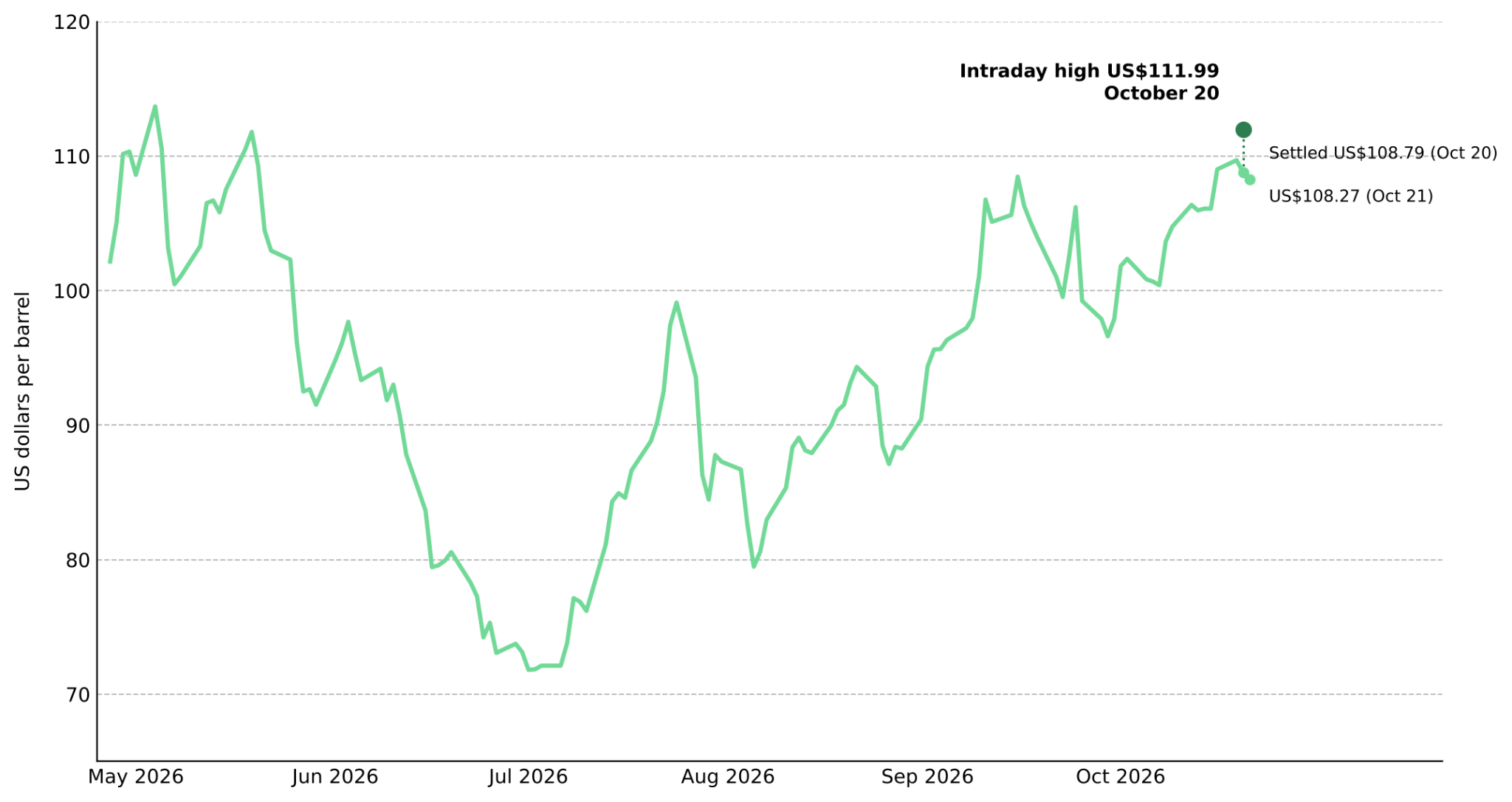
- Brent crude touched $111.99 a barrel on October 20, a five-month high, after Yemen's Houthis claimed attacks on Saudi energy sites and shiptracker Kpler counted at least 18 vessel attacks in two weeks.
- The rally runs against the IEA's October report, which forecasts 2026 oil demand falling 2.6 million barrels a day and shows Gulf crude exports recovering to 13.9 million barrels a day in September.
- Prices hold because the buffer is gone: global oil stocks sit 509 million barrels below end-February levels and OPEC+ can add only 0.27 million barrels a day at short notice.
- Mediation between Iran, Saudi Arabia and the Houthis has no timetable, so oil producer gains resting on the risk premium can reverse within one session, as on October 20.
- A Brent settlement back below $100 a barrel would show the market has stopped paying for attack risk.
Attacks on Saudi Oil Sites and Tankers Push Brent to a Five-Month High
Brent crude futures touched $111.99 a barrel on October 20, the highest in five months, after Yemen's Iran-aligned Houthis claimed attacks on a Saudi Aramco site at Yanbu, the Shaybah oilfield and the Riyadh and Abha airports, Reuters reported. Saudi authorities did not confirm the claims. Brent settled at $108.79, then rose 85 cents to $109.64 early on October 21, while US West Texas Intermediate (WTI) gained 76 cents to $98.58.
The attacks now reach beyond the Strait of Hormuz, the Gulf's main shipping lane. Kpler counted at least 18 vessel attacks over two weeks. LSEG analysts said Iran is targeting ships as far south as the Gulf of Oman, threatening loadings outside the Gulf and the ship-to-ship transfers, where cargoes move between tankers at sea, supporting Middle East exports.
Depleted Stocks and Near-Zero Spare Capacity Leave Brent Exposed to Each Attack
The International Energy Agency (IEA) forecasts 2026 oil demand falling 2.6 million barrels a day (mb/d), while September supply rose 2.5 mb/d to 102.3 mb/d as Gulf crude exports recovered 4.4 mb/d to 13.9 mb/d, above 75% of pre-war levels. Most of the recovery came back through Hormuz, where flows rose 3.7 mb/d to 10.9 mb/d, while bypass routes around the strait added 970,000 barrels a day.
The market pays for the risk because nothing cushions a loss. Global observed oil stocks stood 509 million barrels below end-February levels, on-land stocks sit at their lowest since at least 2016, and OPEC+ effective spare capacity, the output producers can add at short notice, is 0.27 mb/d, according to the IEA. The agency left its outlook largely unchanged because of the October Houthi attacks and describes the supply recovery as fragile.
Falling Oil Demand Fails to Cap Prices While Gulf Export Routes Stay at Risk
The cohort selling into the premium is oil producers whose barrels avoid Hormuz and the Red Sea: Brent futures rose 13% from early September (IEA) on route risk the cohort does not carry.
In the fundamental case, Gulf flows hold and supply rebounds 7.7 mb/d in 2027 (IEA), so the premium fades and producer revenue falls with it. In the escalation case, a strike disables the Yanbu outlet, spare capacity replaces almost none of the lost volume, and physical prices lead: Dated Brent, the price of physical North Sea cargoes, already traded near $134 when the IEA went to press.
The IEA's next monthly report decides between the cases through its Gulf export figures, and the horizon runs to year-end, through which the IEA keeps oil balances in deficit. The reversal trigger is a Brent settlement below $100 a barrel, the level Reuters says the attacks have held prices above, which would cut realised prices for the cohort.
Gulf Route Risk Splits Oil Producer Returns as Brent Holds Above $100
Margin pressure lands first on refiners buying Brent-linked crude and paying war-inflated freight. The IEA reported freight and crude costs crushed European and Asian refining margins in September, while US refining margins hit new highs.
The test separating producers is whether barrels can move when a route closes. The IEA's September output table shows Saudi Arabia, owner of the East-West bypass, lifting crude production to 8.30 mb/d from 5.97 mb/d, while Kuwait's output fell to 1.49 mb/d from 2.04 mb/d. Route access, not reserves, set the direction of output.
Iranian Foreign Minister Abbas Araqchi said Saudi Arabia and the Houthis have not answered Iran's offer to broker talks, and Brent fell in the October 20 session after Iran's president discussed mediation with Pakistan's army chief. A retail portfolio holding oil producers bought near $110 Brent carries a real risk of losing the gains in a single session. The timing cannot be traded with any edge, which leaves position size as the variable a retail holder controls.
Brent’s Premium Looks Temporary as 2027 Supply Returns
Brent’s five-month high reflects an oil market with no supply buffer, not one short of demand. The premium rests on attack risk to Gulf shipping lanes and the Saudi bypass route, while falling demand and the 2027 supply rebound point to a looser market once Gulf routes reopen.
Oil producers whose barrels avoid Hormuz and the Red Sea are earning a premium for risk they do not carry, revenue worth valuing as temporary rather than as a new price base.
New oil fields deliver into the looser market of 2027, leaving explorer and developer economics to stand on post-premium prices. Resources outside Hormuz hold the lasting value, as the war has shown what supply able to bypass the strait is worth.
Analyst's Notes





Subscribe to Our Channel







Stay Informed


