Goldstorm PEA to Test a 200,000 to 300,000 Ounce-a-Year Mine Concept


Tudor Gold is finalizing a Goldstorm PEA, and the resource cut-offs, recoveries, and mine concept it will be read against are already public.
- Fuse Advisors Inc. is finalizing a preliminary economic assessment (PEA) on an underground mine at Goldstorm.
- As of October 2026, management's target was a mine producing about 10,000 tons per day, yielding 200,000 to 300,000 ounces (oz) of gold per year.
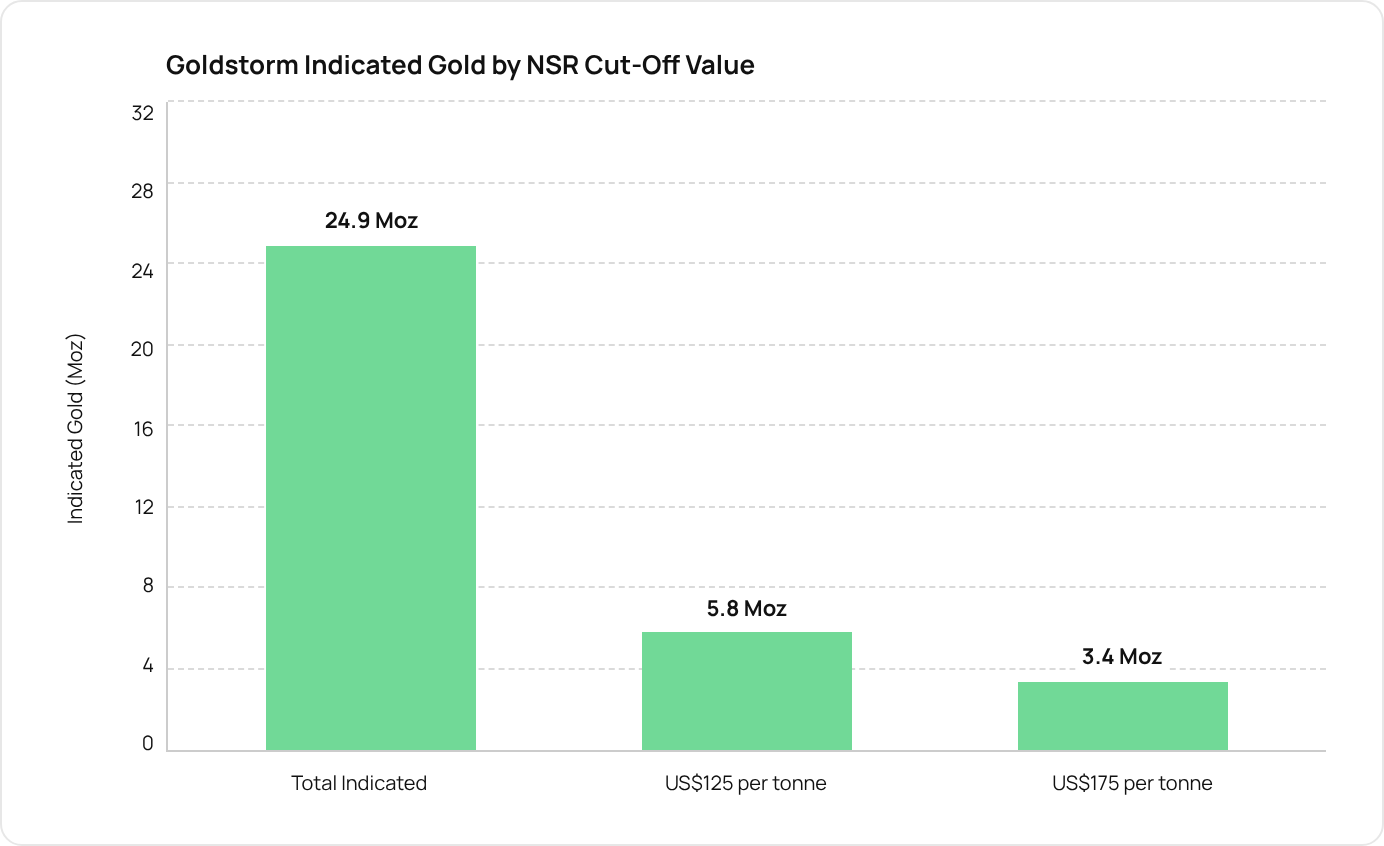
- At a US$125-per-tonne net smelter return (NSR) cut-off value, Goldstorm holds 5.8 million ounces (Moz) of Indicated gold.
- The Lower Zone gold concentrate recovered 87.3% of the gold in metallurgical testing.
- Completing the PEA is 1 of 7 objectives Tudor Gold set for 2026.
Tudor Gold (TSXV: TUD) has retained Fuse Advisors Inc. to prepare a preliminary economic assessment (PEA) on an underground mine at the Goldstorm Deposit. Goldstorm sits within the 80%-owned Treaty Creek Project in the Golden Triangle of northwestern British Columbia. As of October 14, 2026, the study was being finalized. Three sets of figures bearing on the study are already published: a 2026 resource estimate with higher-grade sensitivities, metallurgical results for each zone of the deposit, and an operating concept management has described since April 2026. When the PEA arrives, its figures can be read against each of them.
A Study Being Finalized
The PEA examines the potential for an underground operation focused on the higher-grading gold outlined in the 2026 resource estimate for Goldstorm, released in January 2026. Tudor Gold's strategy names the PEA as its first step toward production.
Completing the PEA is 1 of 7 objectives Tudor Gold set for 2026. As of October 2026, the refined resource estimate and the metallurgical program are complete, and the PEA remains open. A permit application has also been filed to build an underground ramp to drill the SC-1 Zone, which Tudor Gold plans to follow up on to assess the potential for a high-grade underground mine.
Tudor Gold's April 2026 target was to complete the study in the summer. As of October 9, 2026, Tudor Gold expected to announce the results before the end of the year.
The Mine Management Has Described
As of October 9, 2026, management's target was an underground mine of about 10,000 tons a day using long-hole stoping, a method that drills and blasts large blocks of rock between underground levels. The mine would produce 200,000 to 300,000 ounces (oz) of gold per year over a mine life of 30 years or more, compared with 20 years or more in April 2026. It is modeled on the Young-Davidson mine in Ontario. In April 2026, the concept also used a slightly higher cut-off grade, the lowest grade of rock treated as ore, and paste backfill, a cemented mix that fills the mined-out space. These figures describe a target, and the PEA will publish its own.
The concept also includes a sequence for the cut-off grade over the life of the mine. In April 2026, President and Chief Executive Officer of Tudor Gold, Joseph Ovsenek, laid out how the cut-off grade would fall once capital is repaid:
"The way we would work it is you start off with a higher-grade cut-off, you get your capital cost all paid for, you're producing, you're going well, and then you drop your cut-off, you bring more of these other shapes in, and then eventually you're mining down in this area cuz all your capital's paid for, and then you can actually afford to drop your cut-off and keep your production up. So, this is going to be a long life mine at Treaty Creek."
For initial mine development, Tudor Gold is assessing higher-grade gold-copper mineralization of 2 to 3 grams per tonne (g/t).
Resource Tonnage at Higher Cut-Offs
Goldstorm's indicated resource totals 24.9 million ounces (Moz) of gold, 148.7 Moz of silver, and 3.048 billion pounds of copper, from 912.3 million tonnes grading 0.85 g/t gold, 5.07 g/t silver, and 0.15% copper. The 2026 estimate also reports the resource at 2 higher net smelter return (NSR) cut-off values. NSR measures the value of the metal in a tonne of rock after smelting and transport costs, and a higher cut-off value keeps fewer tonnes of higher-grade rock.
At a US$125-per-tonne NSR cut-off value, the Indicated resource is 102.1 million tonnes at 1.78 g/t gold for 5.8 Moz of gold. At US$175 per tonne, it is 45.1 million tonnes at 2.33 g/t gold for 3.4 Moz. In April 2026, management expected the PEA to use a lower cut-off value than in the US$175-per-tonne case.
Ovsenek links the shapes at the US$125-per-tonne cut-off to whether stopes, the underground openings from which ore is mined, can be laid out around them:
"What you can see is these shapes hang together quite well, even though we've upped the cut-off, they're still nice solid bodies, which means you can put mine plans around, lay out some stopes, and be able to mine them."
The cut-off value the PEA adopts is the figure to compare against the US$125-per-tonne and US$175-per-tonne cases.
Recoveries From Each Zone
Tudor Gold has completed its metallurgical program, producing a concentrate, the product left once most waste rock is separated from the valuable minerals, from each zone. Gold recovery reached 87.3% in the Lower Zone gold concentrate and 86.3% in the Upper Zone gold concentrate, with copper recoveries of 90.6% and 90.4%, respectively.
The Central Zone test feed graded 0.60% copper, against 0.06% in the Upper Zone feed, and its combined concentrate recovered 94.1% of the copper and 82.1% of the gold. A blended sample of the zones, at a test feed grade of 3.00 g/t gold, recovered 80.3% of the gold and 89.1% of the copper.
What the PEA Will Put Numbers To
Tudor Gold's management team discovered, developed, and operated the Brucejack Gold Mine 20 kilometers to the south. Ovsenek led the Pretium Resources executive team that advanced Brucejack from discovery to commercial production in under 8 years. As of October 2026, management wanted to see whether the capital cost could be kept within the 1.5 billion range. A mine of that size, as Ovsenek describes it, is one his team can build and finance:
"When you put that all together, that's a mine our team is comfortable we can build. We can raise the capital to build that, and we can advance that to a mine."
When the results are released, the study's cut-off value, production rate, mine life, capital cost, and recoveries can be compared directly with the published figures. Those are the 5.8 Moz and 3.4 Moz higher-grade tranches, the 10,000-ton-a-day and 30-plus-year targets, the 1.5 billion capital range management wanted to see, and the zone recoveries of 82.1% to 87.3% gold.
FAQs (AI-Generated)
Analyst's Notes





Subscribe to Our Channel




Stay Informed