IsoEnergy Pursues Three-Continent Uranium Strategy as Supply Gap Widens & Tony M Decision Nears



IsoEnergy advances uranium assets across Canada, the US, and Australia as 2026 drilling expands Hurricane's mineralised footprint and Tony M moves toward a production decision.
- IsoEnergy's 2026 winter drilling program at its Larocque East project in Saskatchewan found strong signs of uranium mineralisation in a previously unrecognised fault structure at the Hurricane deposit, with the best result returning radioactivity readings more than 7 times higher than the threshold typically used to define uranium mineralisation in the Athabasca Basin.
- Uranium mineralisation has now been traced across a 540-metre corridor east of the Hurricane deposit's known boundary, with multiple drill holes confirming radioactive material at consistent depths, while laboratory grade results remain pending and will determine whether a formal resource update is required.
- The Hurricane deposit's last published mineral resource estimate (MRE) dates to July 2022 and does not reflect two subsequent years of drilling; the deposit sits 40 kilometres from a processing mill that will face a significant supply shortfall as the Cigar Lake mine, currently producing approximately 18 million pounds of uranium per year, winds down toward closure by the mid-2030s.
- At the Tony M Mine in Utah, IsoEnergy is midway through a bulk sampling and processing trial designed to confirm the economics of a production restart, with laboratory test work already showing uranium recovery rates exceeding 90% and engineering studies reducing the infrastructure upgrades required before a restart decision can be made.
- The pending acquisition of Australian developer Toro Energy would more than double IsoEnergy's current uranium resource base to 133 million pounds, adding a large-scale Australian project to an already diversified portfolio at a time when the World Nuclear Association projects global uranium demand will reach approximately 390 million pounds by 2040 against only 179 million pounds of identified supply.
IsoEnergy (TSX: ISO | NYSE American: ISOU) has completed its early 2026 drilling campaign at its Larocque East project in Canada, where results from its flagship Hurricane uranium deposit came in stronger than planned, prompting the company to add four additional drill holes beyond the original program. The standout result came from a previously overlooked geological structure that returned some of the highest radioactivity readings seen on the property to date, with follow-up holes confirming that uranium is present across a much wider area than the company's last formal resource estimate, published in 2022, had captured. Laboratory results that will convert those radioactivity readings into actual uranium grades are still pending. At the same time, IsoEnergy is running a large-scale ore sampling trial at its Tony M Mine in Utah, testing whether the site can be economically restarted as a producing uranium mine. The company is also working to close its acquisition of Australian uranium developer Toro Energy, a deal that would more than double IsoEnergy's total uranium resource base and extend its footprint into Western Australia.
The Supply Gap That Is Reshaping Uranium Strategy
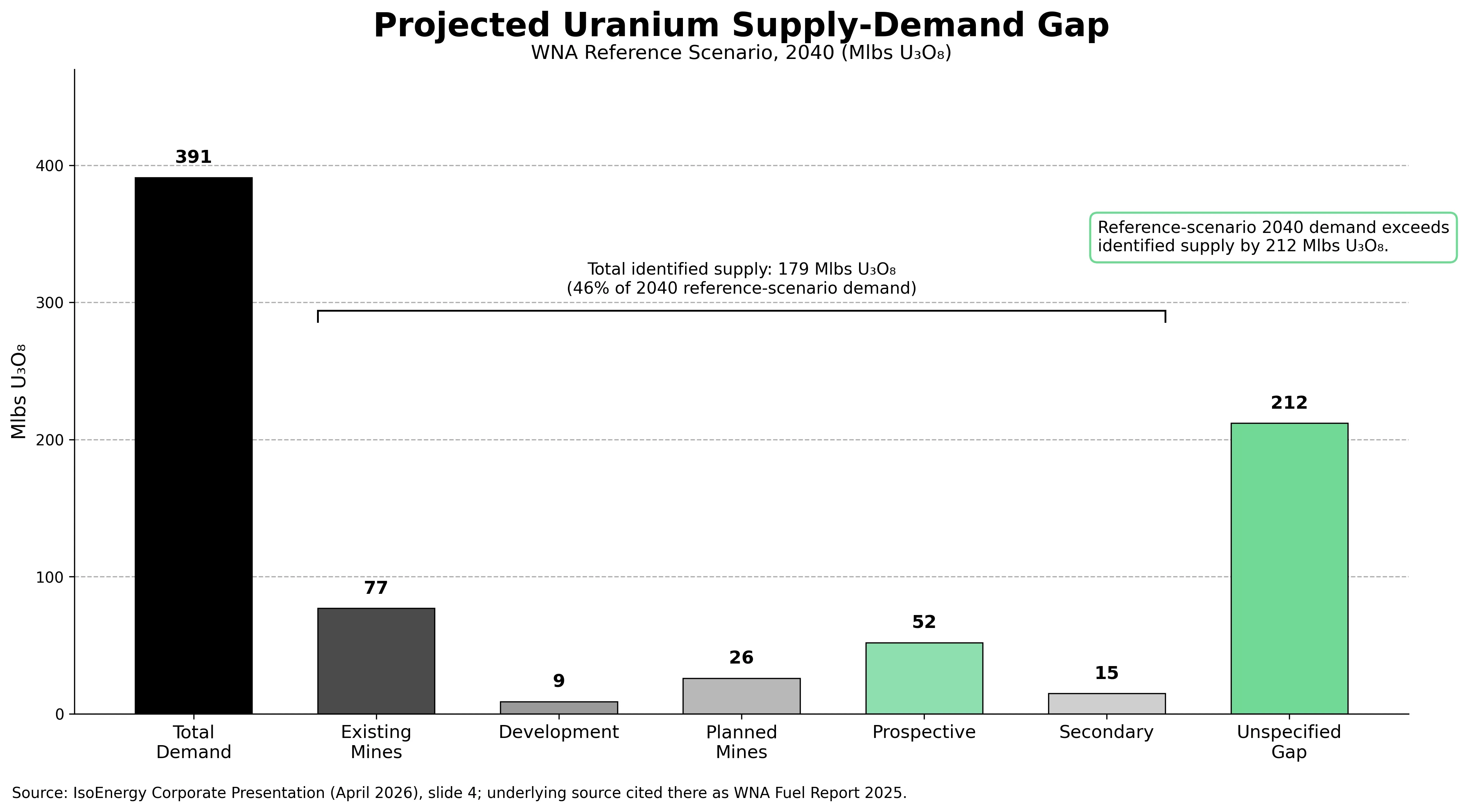
The macro context underpinning IsoEnergy's current positioning is not subtle. According to the World Nuclear Association's 2025 Nuclear Fuel Report, global uranium demand under the reference scenario is projected to reach approximately 390 million pounds of uranium oxide (U3O8) by 2040, rising from approximately 170-179 million pounds consumed annually in 2024-2025. Under the upper scenario, 2040 demand could reach approximately 530 million pounds; the lower scenario puts the figure at approximately 279 million pounds.
IsoEnergy's corporate disclosures, citing WNA Fuel Report 2025 Table 5.14, put total identified supply from all sources, including existing mines, development projects, planned mines, prospective sources, and secondary supply combined, at 179 million pounds, representing 46% of 2040 reference demand. The residual gap unaccounted for by known sources stands at 212 million pounds. These sub-component figures are drawn from a proprietary WNA data table and have not been independently verified from public sources; however, the directional conclusion that identified supply covers less than half of 2040 reference demand is consistent with all publicly available WNA and independent analyst sources.
That arithmetic has strategic consequences for companies like IsoEnergy. It places a premium not just on resource size, but on jurisdictional reliability, processing access, and project stage diversification, precisely the variables the company is attempting to address across its current portfolio. Uranium developers operating in stable, allied jurisdictions with existing permitting infrastructure are increasingly positioned as a distinct category from those operating in higher-risk geographies, and IsoEnergy's asset base in Saskatchewan, Utah, Virginia, and Western Australia is deliberately concentrated within that narrower set.
Tony M: Bulk Sampling Moves the Utah Mine Toward a Decision Point
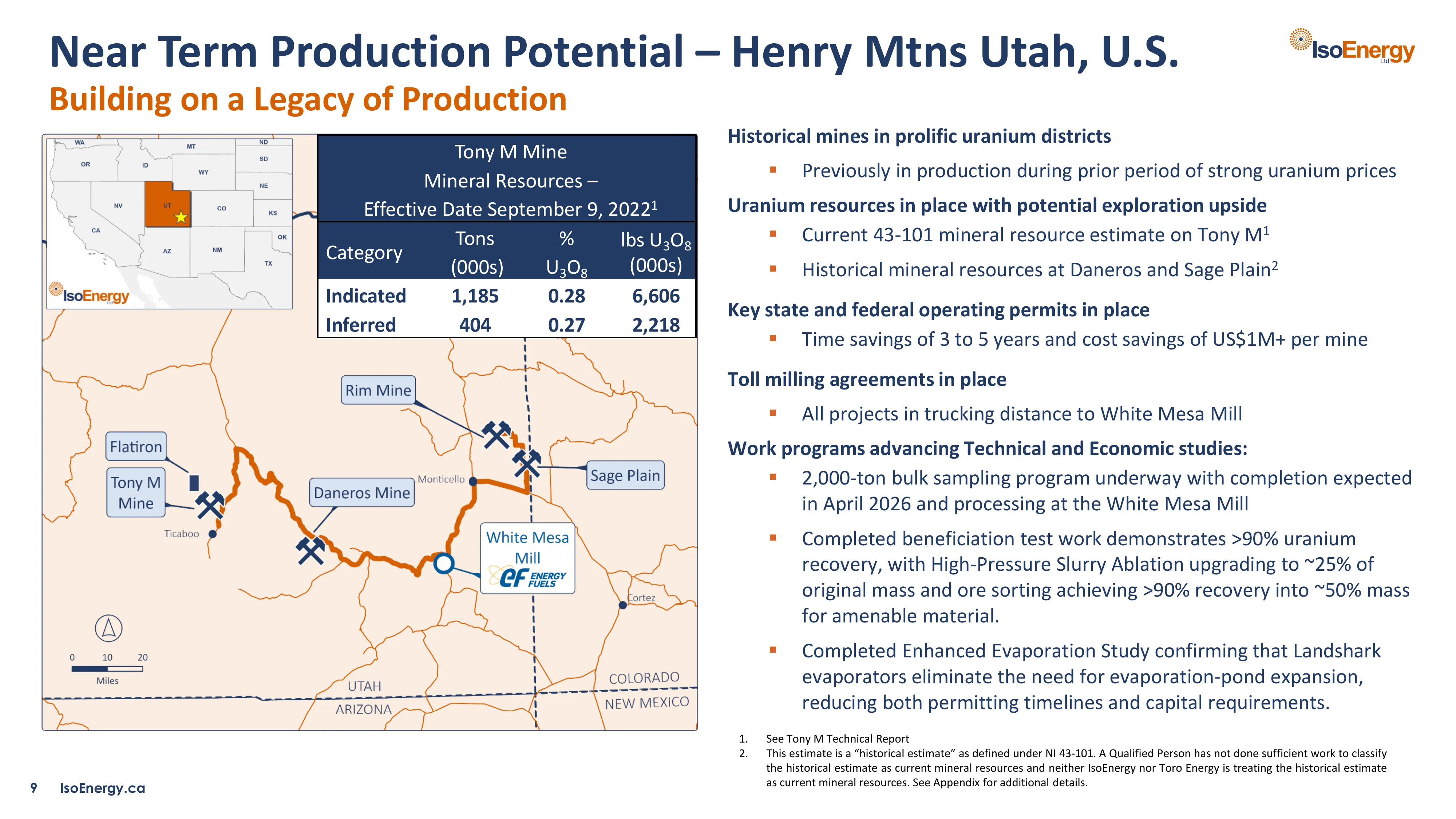
The most immediate potential catalyst in IsoEnergy's portfolio is the Tony M Mine in Utah's Henry Mountains, where the company is targeting a production decision contingent on results from a 2,000-ton bulk sampling program. That program was underway as of early April 2026, with completion and processing at the White Mesa Mill targeted for the same month. The Tony M carries a current National Instrument 43-101 mineral resource estimate, effective September 9, 2022, of 1.185 million tonnes at 0.28% U3O8 for 6.606 million pounds indicated, plus 404,000 tonnes at 0.27% for 2.218 million pounds inferred.
The mine sits alongside the Daneros and Rim mines, both carrying historical estimates, and all three are within trucking distance of Energy Fuels' White Mesa Mill in Utah, giving IsoEnergy toll milling access without the capital requirement of building its own processing facility. The company states that existing state and federal operating permits represent time savings of 3 to 5 years and cost savings of more than US$1 million per mine relative to a greenfield permitting process. Beneficiation test work has demonstrated uranium recovery exceeding 90%, with High-Pressure Slurry Ablation (HPSA) upgrading ore to approximately 25% of original mass, and ore sorting achieving more than 90% recovery into roughly 50% of original mass for amenable material.
A completed Enhanced Evaporation Study has confirmed that Landshark evaporators can eliminate the need for evaporation-pond expansion at the site, reducing both capital requirements and permitting timelines. A separate 15,000-foot drill program is underway at the adjacent Flatiron target to follow up on historical potential. A production decision at a permitted, past-producing mine with toll milling access and demonstrated processing recoveries would represent a meaningful step for the broader US uranium sector, which has struggled to rebuild domestic production capacity for the better part of a decade.
Hurricane: A New Fault Zone, Expanded Strike, & Pending Assays
The Larocque East project in Saskatchewan hosts IsoEnergy's Hurricane deposit, which carries what the company describes as the highest-grade published indicated uranium resource globally. The July 2022 mineral resource estimate puts indicated resources at 63,800 tonnes at an average grade of 34.5% U3O8 for 48.6 million pounds, with a high-grade core of 38,200 tonnes at 52.1% accounting for 43.9 million pounds of that total. That estimate has not been updated since 2022, meaning results from two subsequent years of drilling, including the 2026 winter program completed April 7, are not yet reflected in the stated resource.
Dan Brisbin, Vice President of Exploration, said the South Trend result and step-out holes extending up to 560 metres along strike continue to highlight the area's prospectivity:
"Results to date are being used by our project team to reinterpret the faults that control uranium mineralization along the South Trend and suggest potential for additional mineralization in areas that remain underexplored.
Philip Williams, Chief Executive Officer and Director of IsoEnergy, said the 2026 winter program was delivered safely, efficiently, and ahead of its original scope:
"The team delivered an expanded program, safely and efficiently, producing some of the most encouraging results we've seen along the South Trend and demonstrating the scale of the opportunity in this underexplored corridor. Upon receipt of assay results, the team will design an aggressive follow-up program to further test the South Trend as part of our 2026 summer exploration drilling."
The Toro Acquisition: Adding Australian Scale
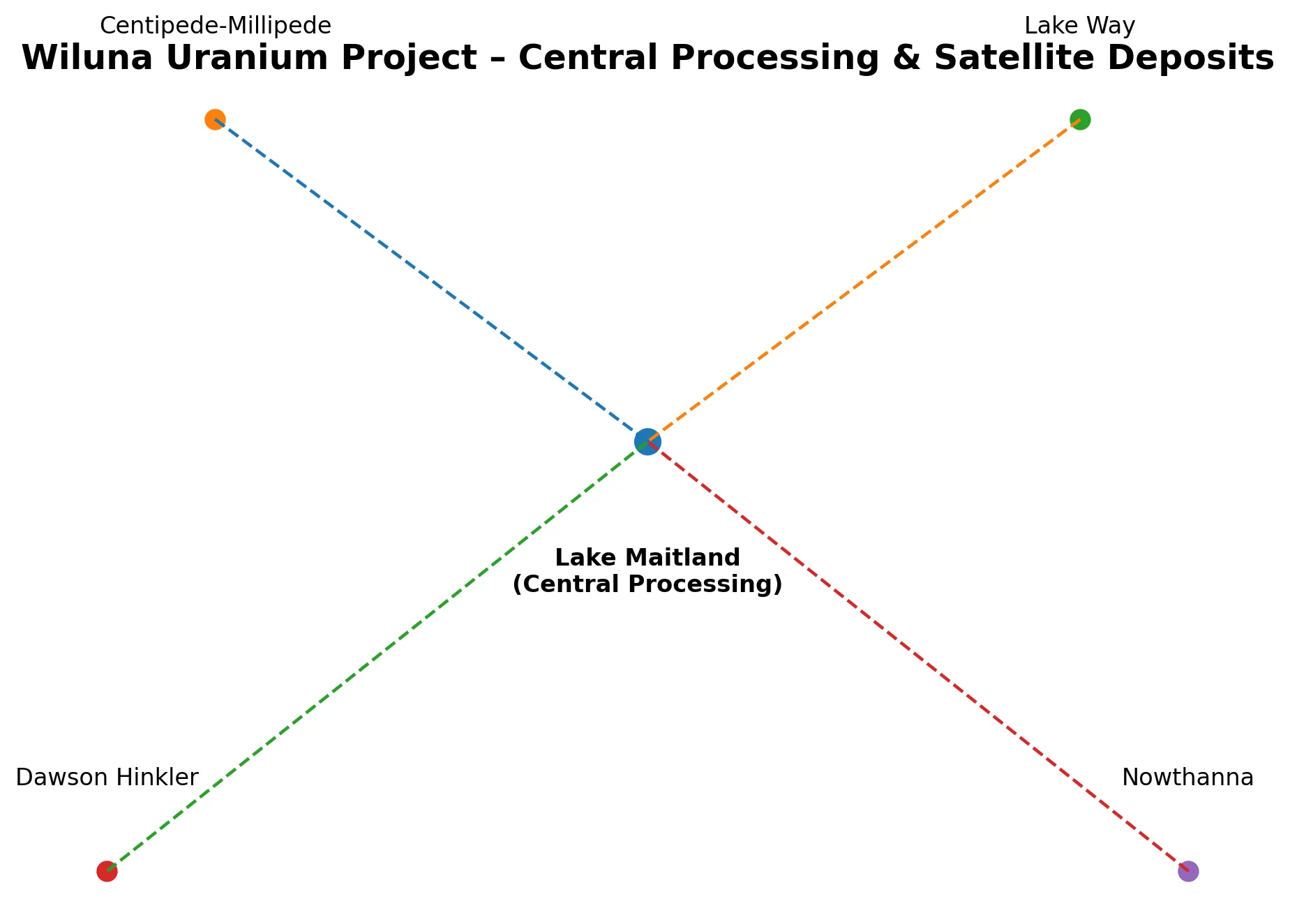
The pending acquisition of Toro Energy, announced in October 2025 and still subject to completion at the time of writing, would add the Wiluna Uranium Project in Western Australia to IsoEnergy's portfolio, along with a collection of additional Australian assets at exploration and development stage. On a pro forma basis, the combined entity would carry current NI 43-101 resources of 133 million pounds measured and indicated, a 141% increase over IsoEnergy standalone, and 39.4 million pounds inferred, a 704% increase, plus a further 154 million pounds M&I and 88 million pounds inferred in historical resources.
The Wiluna project is a shallow, carbonate-hosted uranium system in Western Australia's northern goldfields. It carries stated JORC resources of 77.8 million tonnes at 403 parts per million for 69.1 million pounds U3O8 measured and indicated, plus a regional package of a further 9 million pounds M&I and 23.2 million pounds inferred. Japan Australia Uranium Pty and Itochu hold a right to acquire a 35% interest in Lake Maitland for US$39.6 million, a potential mechanism for funding development without full equity dilution, while Western Australia's ranking of sixth globally on investment attractiveness in the 2025 Fraser Institute Survey of Mining Companies provides a relatively clear jurisdictional read for potential partners and lenders.
The strategic logic of the Toro acquisition is essentially additive diversification. Bulk resource tonnage in a permissive Australian jurisdiction, with shallow open-pit potential and existing infrastructure proximity, provides a volume-oriented counterweight to the high-grade but capital-intensive underground development implied at Hurricane. A scoping study on the Lake Maitland deposit is already in place, and the company lists conversion of that scoping study to a Preliminary Economic Assessment (PEA) as a potential next step following transaction close.
Financial Position & Market Context
As of early April 2026, IsoEnergy held pro forma cash and equivalents of approximately C$143.8 million and an equity portfolio valued at approximately C$47.3 million, for a combined liquid asset base of roughly C$191 million. Basic market capitalisation stood at approximately C$965 million on a pro forma basis. NexGen Energy holds approximately 27.9% of the combined entity on a pro forma basis, providing a degree of ownership stability that smaller uranium developers typically lack.
Eight analyst firms cover IsoEnergy with buy ratings, with price targets ranging from C$18.00 (TD Securities) to C$28.00 (Paradigm Capital) against a share price of C$14.85 as of April 10, 2026, implying consensus target upside of roughly 21% to 88% depending on the firm. The disconnect between current price and analyst targets is not unusual for uranium developers at this stage of the cycle, where asset-level technical progress and uranium spot price direction are the principal re-rating drivers.
With pro forma cash of approximately C$144 million and an equity portfolio of approximately C$47 million, IsoEnergy carries sufficient liquidity to fund concurrent work programs across multiple assets without near-term financing pressure. That financial flexibility is a material distinction at a stage of the cycle where many smaller uranium developers are constrained in their ability to run simultaneous drilling, technical studies, and corporate development activity.
What to Watch Next
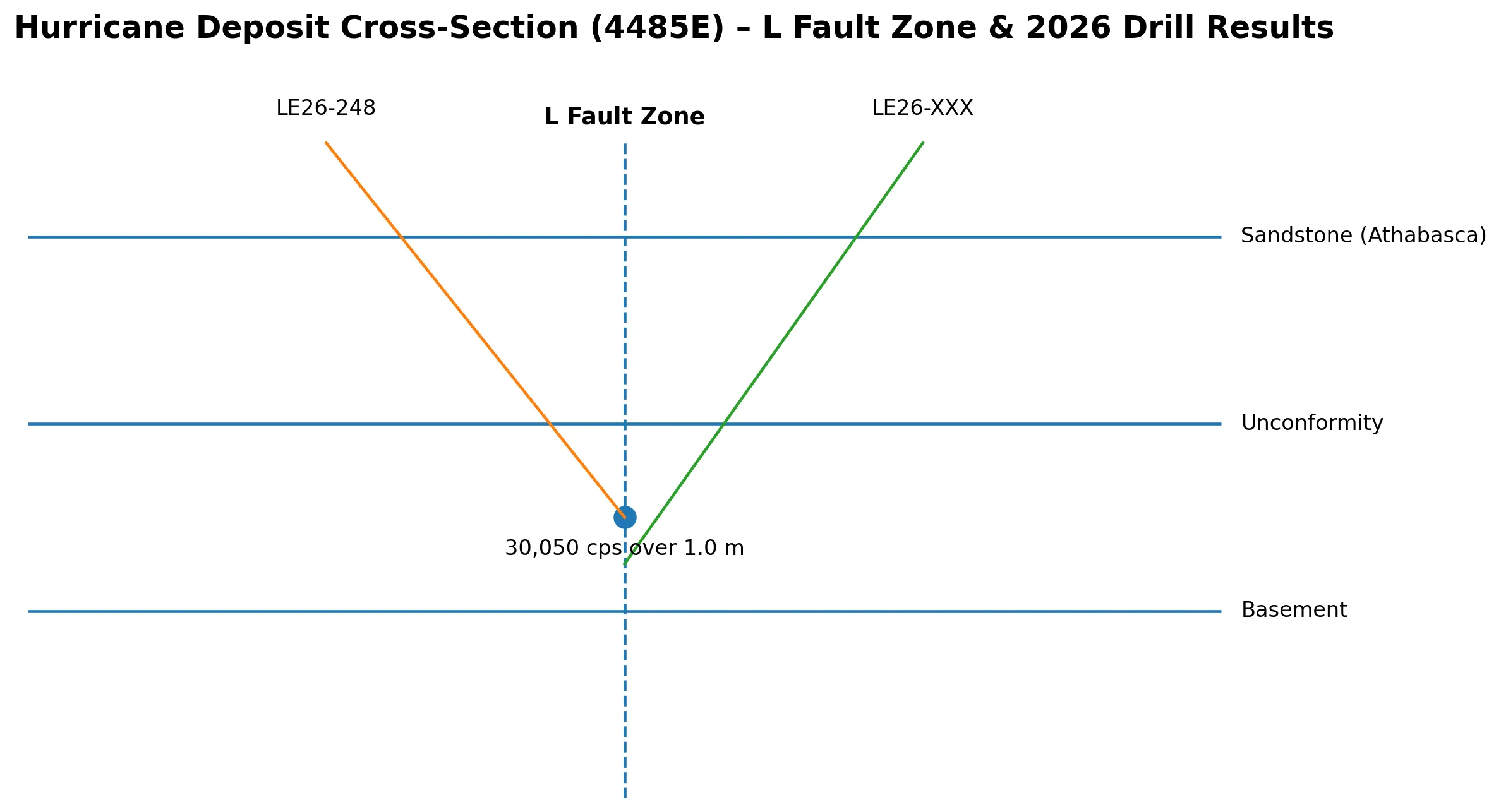
The most immediate near-term catalyst is the receipt of assay results from the 2026 winter drill program at Larocque East. The radioactivity data already released, particularly the 30,050 cps over 1.0 metre in LE26-248 within the newly defined L Fault Zone and confirmed mineralisation across a 540-metre South Trend strike extent, will be converted to uranium grade figures once the Saskatchewan Research Council completes its analysis. Those grades will determine whether a resource estimate update is warranted and will shape the design of the summer follow-up program.
Completion of the Tony M bulk sampling program and subsequent processing at White Mesa Mill will supply the primary technical and economic inputs for a production restart decision. The Toro acquisition also remains subject to shareholder, regulatory, and stock exchange approvals, and its completion will determine whether the pro forma resource and financial figures presented become operative. Readers should also monitor whether IsoEnergy moves to a PEA at Hurricane, which would represent the first formal economic framing of the deposit and a major milestone in the development timeline.
For the longer-dated call options, Coles Hill in Virginia at 132.93 million pounds indicated (historical estimate) and Matoush in Quebec at 12.3 million pounds indicated (historical estimate), any movement in the regulatory or legislative environments governing uranium mining in those jurisdictions would immediately change the development calculus. Progress at the Dorado Nova discovery within the IsoEnergy-Purepoint joint venture, which returned assays of 8.1% U3O8 over 0.4 metres in a new Athabasca Basin discovery, also warrants attention as a potential early-stage resource growth opportunity. The supply mathematics underlying IsoEnergy's positioning are unlikely to resolve quickly, and developers with advanced projects, existing permits, and processing access will remain a focal point for institutional capital tracking the sector.
FAQs (AI-Generated)
Analyst's Notes





Subscribe to Our Channel


.jpg)






Stay Informed