Kazatomprom's Supply Deal With India Removes Liquidity From an Already-Deficient Uranium Market



Kazatomprom's India supply deal locks up primary uranium, shrinking open-market liquidity and widening the scarcity premium for producers and developers.
- The Kazatomprom-India agreement commits a meaningful share of primary uranium supply to long-term bilateral delivery, reducing the volume available for spot and discretionary term market transactions.
- Kazatomprom's confirmed 2025 production of 25.8 thousand tonnes underscores the scale of what is now being allocated bilaterally, with 2026 guidance targeting 27,500 to 29,000 tonnes subject to ongoing operational constraints including sulphuric acid availability.
- Reduced spot market liquidity amplifies price volatility, with fewer pounds available for open-market discovery and a shrinking pool of uncontracted supply for utilities that have delayed long-term procurement.
- Producers with low-cost structures and contract visibility are positioned to capture expanding margins, while advanced-stage developers in Tier-1 jurisdictions gain improved financing conditions as utilities seek to lock in future production.
- Asset quality, jurisdiction, and capital discipline are the variables that determine which companies benefit from uranium price appreciation and which absorb cost overruns or financing delays that price gains cannot offset.
A Bilateral Deal That Reduces Open-Market Supply Volume
The Kazatomprom–India agreement reflects a broader shift in how governments treat uranium: as a matter of energy security rather than commodity procurement. Countries with domestic nuclear programs and insufficient domestic production are prioritizing bilateral supply arrangements over open market reliance.
With Kazatomprom recording confirmed 2025 production of 25.8 thousand tonnes, the scale of its bilateral commitment with India represents a significant constraint on what remains available for open-market purchase.
Unlike spot transactions or short-term contracts, this deal locks in physical uranium concentrate deliveries over a multi-year horizon. Those pounds will not contribute to price discovery in spot or term markets. This represents a tightening of free-float supply, a critical but often underweighted component of commodity valuation. As bilateral agreements displace open-market procurement, the volume of uranium available for price discovery compresses, and the price sensitivity of remaining spot transactions increases proportionally.
This mechanism has played out in LNG, rare earth elements, and battery metals, where government procurement priorities redirected supply away from discretionary markets, leaving spot prices more sensitive to marginal volume changes than underlying demand shifts would otherwise justify. Uranium procurement is following the same sequence for the same reason: energy security policy is overriding commodity market logic.
A Structural Deficit Meets Contractual Lock-Up
The uranium market has been operating in supply deficit conditions, with reactor demand exceeding mine output and requiring the shortfall to be met through secondary sources including stockpiles, underfeeding, and recycled material. As primary mine supply remains the critical long-term constraint, any bilateral agreement that removes primary production from open-market availability deepens the effective deficit facing uncontracted buyers.
Kazatomprom's own output faces additional operational constraints. ISR uranium extraction depends on sulphuric acid as an essential processing reagent, and supply limitations for that input have shaped the company's production guidance. Even at the scale of the world's largest producer, unconstrained output is not achievable, and an increasing portion of available production is now committed under long-term bilateral arrangements.
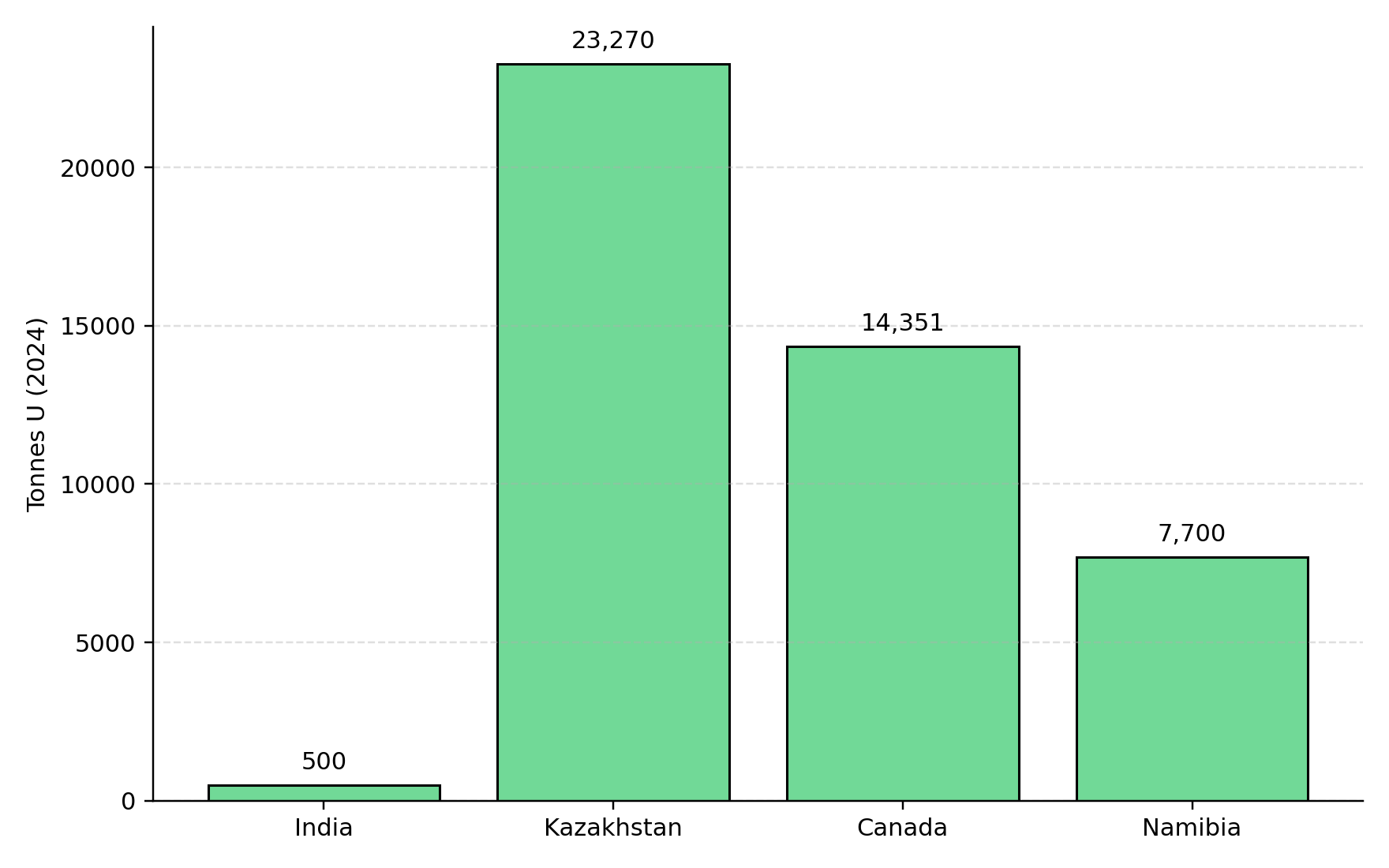
India's reactor build-out adds volume pressure to this dynamic. The country currently sources only a portion of its domestic uranium requirements from domestic production and is targeting significant imports through 2033 to fuel its reactor build-out. By securing long-term supply from Kazatomprom, India addresses an energy security constraint, but at the direct expense of liquidity available to other global buyers.
Producers and developers in Western-aligned jurisdictions - Canada, the United States, and Australia - are increasingly the preferred counterparties for utilities and governments managing supply chain exposure. Assets in these jurisdictions are attracting a premium in institutional valuations, as the distinction between commodity uranium and politically secure uranium becomes a harder filter in fund mandates.
Producers: Margin Expansion & Contract Visibility
Producers with low-cost structures capture the direct financial benefit of supply tightening through the combination of rising contract prices and operating leverage in low AISC production models. In-situ recovery production avoids the capital expenditure and dilution risk associated with conventional underground development, which means margin expansion at higher contract prices flows more directly to cash generation.
Energy Fuels, the largest US uranium producer, produced over one million pounds in 2025 and is targeting 1.5 to 2.5 million pounds in 2026 - the highest guidance range of any US-listed uranium producer. Mark Chalmers, Chief Executive Officer of Energy Fuels, describes the company's structural differentiation:
"Energy Fuels is a unique company because it is focused on building a critical mineral hub that revolves around the uranium business, and we've made remarkable progress over the last five years... Having uranium, rare earth, and heavy mineral sands, we have over 10 critical minerals that really stands out from others."
In October 2025, the company completed a $700 million convertible senior notes offering oversubscribed by more than seven times, at a 0.75% annual coupon rate, arranged through a major tier-one investment bank within one week of the decision to proceed. Mark Chalmers notes:
"We're pushing close to a billion dollars of deployable capital... We did that in a week from the time we decided to the time the money was in the bank."
enCore Energy operates as an ISR-focused producer and consolidator, with active production underway at its Alta Mesa Central Processing Plant, which commenced operations in Q2 2024, and at its Rosita Central Processing Plant. William Sheriff, founder of enCore Energy, frames the scale threshold that defines ISR viability:
"In terms of the ISR business, you're going to have to have some producers that produce more than a million pounds a year, or you're going to be essentially running a mom-and-pop grocery store on the corner."
Developers: Scarcity Premium & Financing Tailwinds
Advanced-stage developers with high-grade, permitted assets in Tier-1 jurisdictions are capturing a scarcity-driven rerating as utilities seek to contract future production. The fewer uncontracted pounds in development, the higher the value assigned to each permitted tonne on a credible delivery timeline.
IsoEnergy is a uranium developer advancing assets across Canada, the United States, and Australia. Its Hurricane deposit, in Canada's Athabasca Basin, holds an indicated resource of 48.61 million pounds U₃O₈ at 34.5% grade, confirmed in the July 2022 NI 43-101 technical report authored by SLR Consulting. Philip Williams, Chief Executive Officer, describes IsoEnergy’s asset advantage:
"Hurricane, the highest-grade uranium resource in the world, where we made a discovery in 2018 and put a resource out in 2022, 34.5% grade, 48.6 million pounds, an extraordinary asset that crosses a property border."
A recent equity raise targeting $50 million attracted over $300 million in demand more than six times oversubscribed with NexGen Energy holding approximately 30% of the company.
Atomic Eagle's Muntanga Project in Zambia holds 40.0 million Measured and Indicated pounds of U₃O₈ with shallow open-pit geometry and confirmed recovery rates above 90%, trading at A$2.53 per pound of M&I resource, a material discount to listed peers Deep Yellow at A$5.42 and Bannerman Energy at A$3.33. Backed by A$20 million in cash against an enterprise value of A$101 million, the company enters 2026 fully funded, with a JORC Exploration Target publication and upgraded resource estimate among near-term re-rating catalysts.
Exploration Exposure: Resource Definition Upside
ATHA Energy controls more than 7 million acres across Canada's Athabasca Basin and adjacent uranium belts, with resource definition drilling determining whether that land position converts into development-stage assets during a period of tightening long-term supply.
At this stage, the company represents a land-position play rather than a development-stage asset: resource definition drilling is ongoing, and the investment thesis rests on whether that acreage converts into delineated resources during a period of tightening long-term supply. That conversion risk places ATHA in a different risk category than permitted developers, with a return profile that is more sensitive to drill results than to near-term contract pricing.
The Investment Thesis for Uranium
- The structural gap between mine production and reactor demand cannot be closed by secondary sources alone, supporting long-term price strength independent of near-term sentiment cycles.
- Bilateral supply agreements, most visibly the Kazatomprom–India deal, are progressively removing primary production from open-market circulation, compressing liquidity and amplifying the scarcity value of uncontracted pounds available for term contracting.
- Tier-1 assets defined by grade, jurisdiction, permitting status, and infrastructure access command a premium that widens as politically secure uranium supply becomes a hard filter in institutional investment mandates.
- ISR production, characterized by lower capital intensity and faster ramp timelines relative to conventional underground mining, provides operating leverage in a rising price environment without proportional increases in cost exposure.
- Developers holding permitted, advanced-stage assets with demonstrated access to institutional capital carry materially lower execution risk than the broader developer peer group, a distinction that becomes more pronounced as market volatility increases.
- Ongoing consolidation of the US ISR segment is concentrating production capacity and resource control, improving the risk-adjusted return profile of producers that scale above the threshold required to secure long-term utility offtake agreements.
The relevant question is how that transition reprices risk across the value chain. Producers with contracted revenue and low operating costs carry the least exposure to spot market volatility. Developers with permitted assets in Tier-1 jurisdictions hold the scarcest category of resource: pounds that utilities can actually contract against on a credible timeline.
The Kazatomprom-India agreement accelerates a market transition that was already underway. As bilateral arrangements absorb an increasing share of primary production, utilities that have deferred long-term contracting face a shrinking pool of uncontracted supply and less favorable negotiating positions with each contracting cycle that passes. The window for securing future production at current term prices narrows as more pounds are committed to sovereign counterparties before reaching open-market negotiation.
TL;DR
Kazatomprom's long-term uranium supply agreement with India redirects a meaningful share of primary production away from open-market circulation, compressing spot liquidity in a market already running a structural deficit between mine output and reactor demand. With Kazatomprom's 2025 output confirmed at 25.8 thousand tonnes and 2026 guidance constrained by sulphuric acid availability, bilateral lock-up deepens the effective supply shortage facing uncontracted buyers. Producers with low-cost ISR operations and contract visibility capture direct margin expansion, while advanced-stage developers in Tier-1 jurisdictions, Canada, the US, and Australia. attract institutional capital as utilities race to secure future production before remaining uncontracted pounds disappear into sovereign procurement channels.
FAQs (AI-Generated)
The agreement commits a multi-year volume of physical uranium concentrate to bilateral delivery between Kazakhstan and India, removing those pounds from open-market spot and term transactions. Because Kazatomprom is the world's largest uranium producer — with 2025 output confirmed at 25.8 thousand tonnes — the volume being redirected is large enough to meaningfully compress available market liquidity, amplifying price sensitivity for the uncontracted supply that remains.
Global reactor demand currently exceeds primary mine production, with the gap historically filled by secondary sources including stockpiles, underfeeding at enrichment facilities, and recycled material. Those secondary sources are finite and declining in availability. As primary mine output fails to keep pace with reactor demand growth — particularly from countries like India, China, and South Korea expanding their nuclear fleets — the structural deficit is expected to persist and widen without significant new mine development.
Producers with low all-in sustaining costs and existing contract visibility capture the most direct benefit. In-situ recovery operations — including Energy Fuels, targeting 1.5 to 2.5 million pounds in 2026, and enCore Energy, running active ISR production at Alta Mesa and Rosita — benefit from lower capital intensity and faster response times relative to conventional underground mining, meaning margin expansion at rising contract prices flows more directly to cash generation.
When fewer pounds are available for open-market price discovery, the price impact of marginal volume changes increases. A smaller pool of uncontracted supply means individual transactions carry greater weight in setting reference prices, and utilities that have deferred long-term procurement face less favorable negotiating positions with each contracting cycle. This dynamic has previously played out in LNG and battery metals markets where government procurement redirected supply away from discretionary trading.
Advanced-stage developers holding permitted, high-grade assets in Tier-1 jurisdictions — such as IsoEnergy's Hurricane deposit in Canada's Athabasca Basin at 34.5% grade — carry materially lower execution risk than exploration-stage companies because their resources are defined, their regulatory pathways are established, and utilities can contract against their production on credible timelines. Exploration-stage companies like ATHA Energy, by contrast, represent land-position plays where the investment thesis depends on drill results converting acreage into delineated resources, placing them in a higher-risk category with returns more sensitive to exploration outcomes than to contract pricing.
Analyst's Notes





Subscribe to Our Channel















Stay Informed