




Lifezone's Hydromet Technology: The Science Behind the PGM Recycling Pilot


Lifezone Metals completed 1,179 pilot tests producing refined platinum, palladium, and rhodium from US autocats. Here is how the Hydromet process works and what the pilot results confirm.
- Lifezone Metals completed a 24-month, 1,179-test pilot programme at Simulus Laboratories in Perth, Australia, producing the first refined samples of platinum, palladium, and rhodium from US-sourced spent autocatalytic converters.
- The company's Hydromet flowsheet centres on a closed pressure oxidation vessel whose sealed architecture structurally eliminates sulfur dioxide emissions, rather than relying on a downstream abatement system.
- Pilot-stage recoveries reached above 99% for platinum and palladium and 95% for rhodium, but purity targets above 99.95% for platinum and palladium and above 99.9% for rhodium remain outstanding at the conclusion of the campaign.
- The US platinum group metals (PGM) recycling project is being developed in partnership with Glencore, which has invested $1.5 million for a 6% equity stake and holds an active option to fund 50% of the project's capital expenditure.
- A board-approved financial investment decision (FID) is targeted for the second quarter of 2026, with the first planned commercial module expected to deliver an annual output of 220,000 ounces of platinum, palladium, and rhodium.
What Has Happened
Lifezone Metals (NYSE: LZM) announced in April 2026 the conclusion of a 24-month pilot programme involving 1,179 individual tests processing one ton of US-sourced spent autocatalytic converter monolith material. Testing was conducted at Simulus Laboratories in Perth, Australia, with pilot plant work continuing through the first quarter of 2026. The campaign produced the first-ever refined samples of platinum, palladium, and rhodium from US autocatalytic converters using the company's Hydromet flowsheet. That flowsheet has been locked down to inform design criteria for a planned US commercial plant, with engineering design and feasibility study work described as nearing completion. A board-approved financial investment decision (FID) is targeted for the second quarter of 2026, to be followed by construction of a first commercial module projected to produce 220,000 ounces of platinum, palladium, and rhodium annually.
How the Hydromet Process Works
The Hydromet flowsheet centres on a pressure oxidation vessel that operates as a completely closed system, where conventional smelting applies an open vessel heated to above 1,000 degrees Celsius to melt concentrate; the pressure oxidation route applies elevated temperature and pressure within a sealed environment. Exact operating parameters are determined during design-criteria optimisation; figures such as 220 versus 235 degrees Celsius are subject to that process, but the closed architecture remains constant across configurations.
From the pressure oxidation vessel, the flowsheet proceeds through high-leach extractions, purification steps, separation steps, and direct reduction to refined metallic products. In base metal applications, the intermediate product is a pregnant solution that is neutralised and processed by solvent extraction or electrowinning to produce metal briquettes, rounds, or cathodes. The sequential integration of these stages into a single flowsheet is the feature from which Lifezone derives both its pipeline compression claim and its emissions profile.
Chief Financial Officer of Lifezone Metals, Ingo Hofmaier, is direct about what the closed vessel means for emissions:
"In our case, it's a pressure cooker that is completely closed up, and there's no emissions out of that process ultimately."
Emissions Profile & Energy Efficiency Relative to Smelting
The zero sulfur dioxide claim derives from the closed-vessel architecture rather than from a downstream gas-treatment system. Because the pressure oxidation vessel does not vent to the atmosphere, sulfur compounds generated during oxidation remain contained within the process rather than being released as sulfur dioxide gas. The zero sulfur dioxide outcome is therefore a structural design property, not one contingent on the performance of a secondary installation.
The energy and carbon dioxide comparisons are characterised differently in the available materials. The Hydromet route is stated to require far less primary energy than smelting and to generate less carbon dioxide per tonne of metal than conventional pyrometallurgical smelting and refining. Both comparisons are directional: no quantified baseline for conventional smelting energy consumption is provided, and no specific carbon dioxide differential figure appears in the available materials. Whether those advantages hold across varying feedstock compositions at commercial throughput is not resolved by the pilot data.
Pipeline Compression & Capital Intensity
The shorter production pipeline arises from the same integrated architecture. Conventional pyrometallurgical processing routes move platinum group metals (PGMs) through multiple discrete stages across extended timeframes, keeping metal locked within the production system throughout. The Hydromet flowsheet's sequential combination of leaching, purification, and reduction shortens the in-process period, thereby compressing working capital requirements relative to conventional approaches.
Capital intensity improvement is characterised directionally in the available materials. The process is described as more scalable and as demonstrating improvements in capital intensity compared to conventional methods, but no specific capital cost figures or a differential against a conventional smelter are provided. The partnership structure with Glencore is directly relevant to how capital requirements may be managed: Glencore has invested $1.5 million for a 6% equity stake and holds an active option to fund 50% of the project's capital expenditure. Grant applications were submitted in January 2026 to support the transition from pilot to commercial activities.
Pilot Results & What They Do and Do Not Confirm
The 1,179-test campaign confirmed recoveries exceeding 99% for platinum and palladium and 95% for rhodium. Stage 1 purities exceeded 99% for platinum and palladium. Those figures establish that the flowsheet can extract and concentrate PGMs from US-sourced spent autocatalytic converters at a recovery rate that supports the mechanical feasibility of the process sequence.
What the pilot has not yet confirmed is the purity performance required for refined product delivery. Further optimisation is targeting purities above 99.95% for platinum and palladium and above 99.9% for rhodium; those thresholds remain unmet at the conclusion of the campaign. The commercial-scale efficacy and reliability of the Hydromet technology are identified as a stated risk factor in the company's own materials. Management characterises scale-up risk as manageable given the widespread use of pressure oxidation in the gold mining industry, though that assessment applies to the core unit operation rather than to the full PGM-specific flowsheet.
Chief Technology Officer of Lifezone Metals, Dr. Mike Adams, frames the recovery figures within the full scope of the test campaign:
"The test work confirmed high recoveries (up to 99% platinum and palladium and 95% rhodium, as per test no. 0172) of these critical metals to platinum, palladium, and rhodium metal products, using our technology. Through completing an extensive 1,179 tests, this step-change result supports our objective: to demonstrate that Lifezone's Hydromet Technology can process and recover PGMs from responsibly sourced spent automotive catalytic converters in a cleaner and more efficient way than conventional smelting and refining methods."
FID, feasibility study finalisation, and purity optimisation remain the outstanding proof points between the pilot result and the production target.
Broader Context - US Supply Chain & Domestic PGM Position
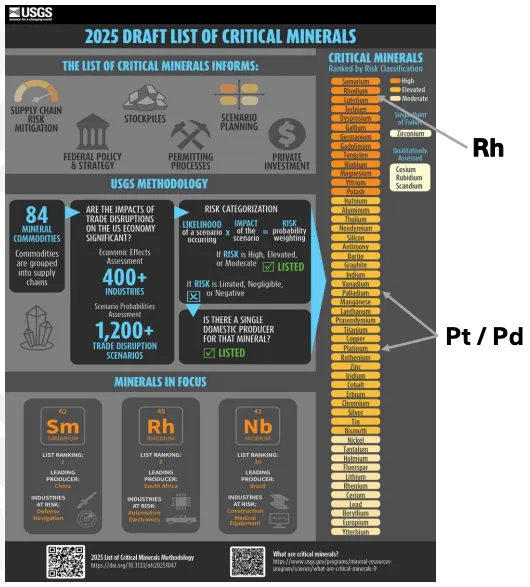
The US currently imports approximately 2 million ounces of PGMs annually, primarily from Russia and South Africa. Rhodium is ranked within the highest supply chain risk category on the United States Geological Survey (USGS) 2025 draft list of critical minerals. That context positions a domestic recycling facility producing rhodium, platinum, and palladium from US-sourced feedstock as directly relevant to active federal supply chain priorities.
Lifezone's planned US facility is intended to source feedstock and refine it entirely within the domestic supply chain, vertically integrating the scrappage-to-metal process chain. The first module's projected annual output nearly matches that of the US's single significant primary PGM mine. The module's projected rhodium output alone would be more than five times the annual output of the country's only producing primary mine.
Chief Executive Officer of Lifezone Metals, Chris Showalter, puts the recycling ambition in strategic terms:
"Our customised flowsheet lays a strong foundation for the Company's overarching aspiration to become the US' closed loop, traceable and responsibly sourced critical metals solution."
What to Watch Next
The two most proximate markers are the board-approved FID and the resolution of outstanding purity optimisation. Whether the FID proceeds on schedule, and on what technical basis it is supported, will indicate whether the pilot-stage flowsheet is considered sufficient to underpin commercial plant design criteria. Purity targets of 99.95% for platinum and palladium, and 99.9% for rhodium, will determine the commercial product specifications the facility can offer at first production.
Beyond those immediate markers, the commercial-scale performance of the Hydromet flowsheet is the defining unresolved proof point. Risk factors identified include significant variations between estimates and actual capital and operating costs, delays in obtaining required approvals, and commodity price fluctuations. Glencore's exercise or non-exercise of its option to fund 50% of capital expenditure will signal its assessment of commercial viability at the time of the decision.
FAQs (AI-Generated)
Analyst's Notes





Subscribe to Our Channel




.png)
.png)




Stay Informed


