




Limited Ex-China Supply Drives Rare Earth Prices to 5x Levels


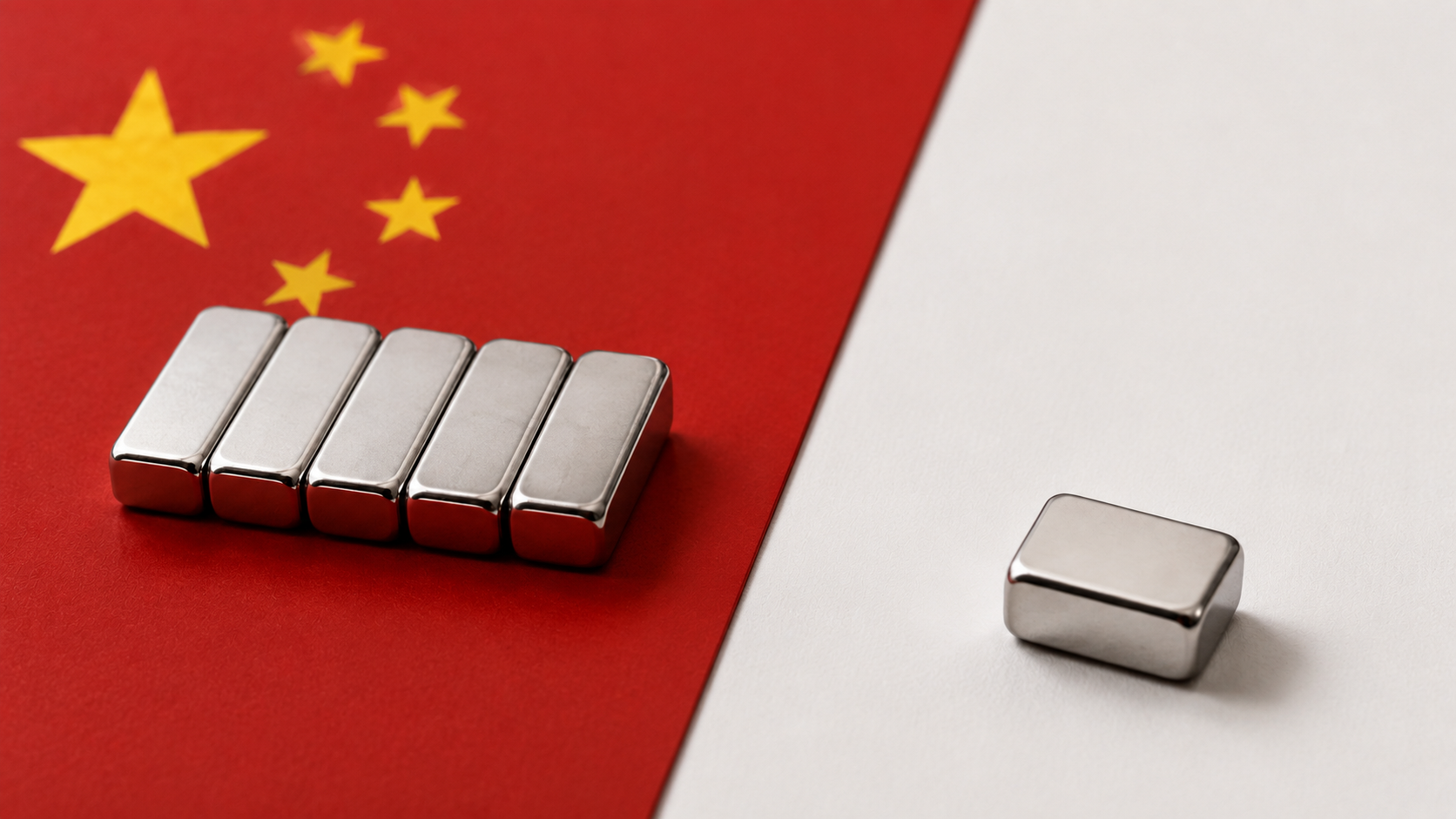
Limited ex-China supply drives rare earth prices to 5x Chinese levels, while qualified supply and binding contracts determine which projects secure revenue.
- European erbium prices rose more than 50% from June through August 2026, while July South Korean import prices for graphite anode material fell 20% year on year, showing that being classified as critical does not guarantee higher prices.
- According to the International Energy Agency (IEA), European dysprosium, terbium, and gallium prices are about five times Chinese domestic prices, while germanium is nearly three times higher, showing that Western buyers pay more when non-Chinese supply is limited.
- The IEA’s 2035 base case shows that rare earth refining capacity outside China can process about two thirds of expected mined supply, while planned magnet plants can use only one third, making processing and magnet production the main capacity constraints rather than mine supply.
- Producers and developers with binding sales contracts and committed financing have clearer routes to construction and revenue, while explorers with inferred resources and limited cash face higher dilution and capital-loss risk.
- Rare earths account for less than 1% of a vehicle’s value, and tripling their prices would add only 0.1% to a car’s cost, allowing automakers to pay more for non-Chinese supply and favoring producers with long-term sales contracts over those dependent on spot sales.
China’s November 10 Export-Control Deadline Drives Ex-China Prices to 5x
European erbium prices rose more than 50% from June through August 13, 2026, versus about 40% in China, as buyers accumulated material before the November 10 expiration of China’s export-control suspension, although China had not denied licenses, cut quotas, or blocked shipments. Demand from fiber optics, lasers, and AI data centers reduces erbium’s reliance on the automotive cycle, supporting demand when vehicle production slows.
European prices for gallium, dysprosium, and terbium are about five times Chinese domestic levels, while germanium is almost three times higher. This gap means Chinese domestic prices no longer represent what Western manufacturers pay, making them an unreliable benchmark for valuing non-Chinese supply. China’s April 2025 export controls on samarium, gadolinium, terbium, dysprosium, lutetium, scandium, and yttrium remain in force, while the November 10 expiration applies only to the suspension of broader licensing rules for manufacturers outside China.
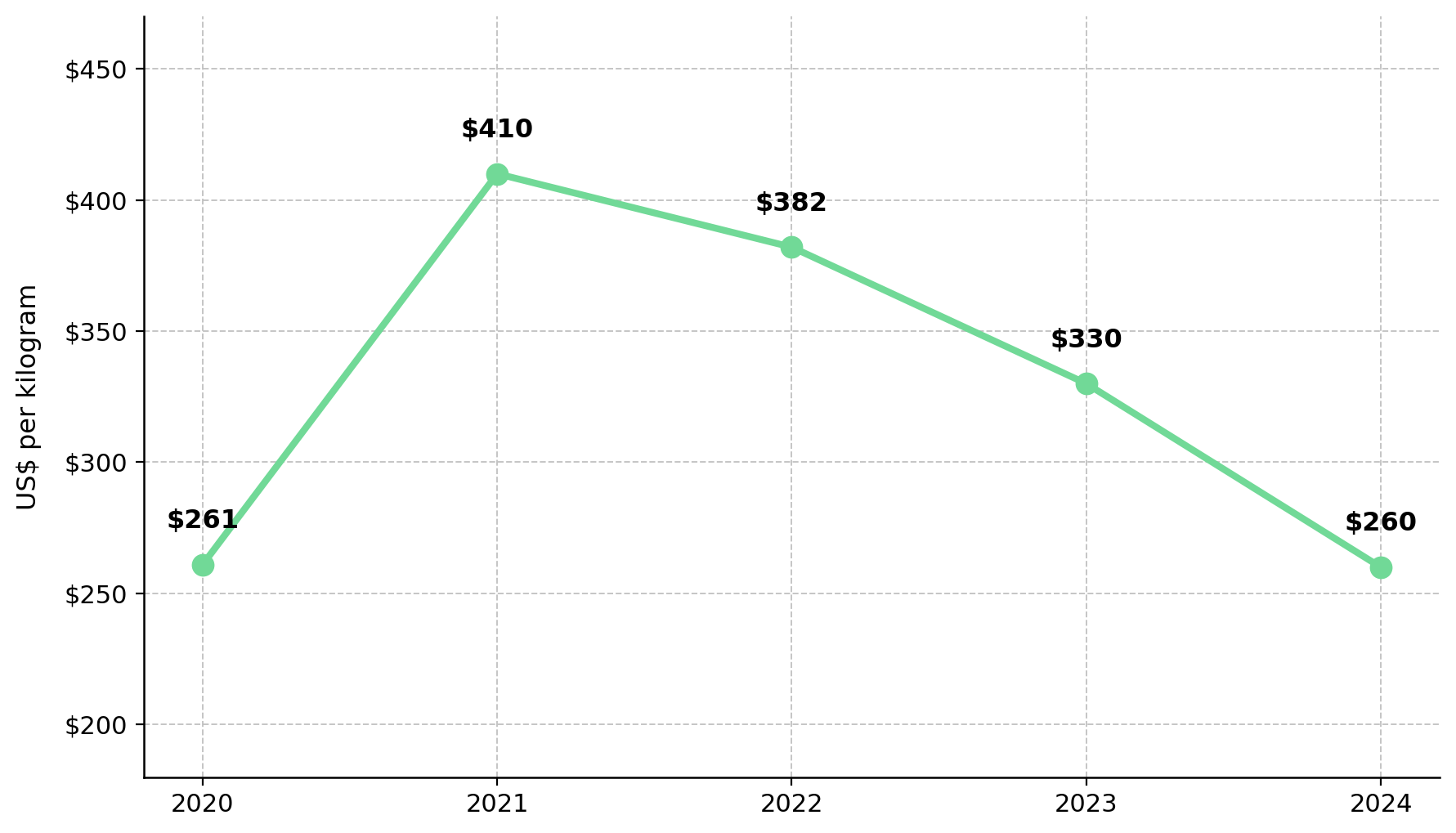
Full implementation of China’s expanded export controls could put about US$6.5 trillion of annual manufacturing output outside China at risk across the automotive, high-tech, defense, and energy sectors, according to IEA. Manufacturers can reduce this risk only by securing material that meets their specifications, directing the price premium toward qualified suppliers rather than companies holding undeveloped deposits.
ITC Ruling Blocks 160% Graphite Duties, Preserving China’s Price Advantage
The US Department of Commerce’s February 11, 2026 final determination set proposed countervailing and antidumping duty rates on Chinese active anode material at 66.68% and 93.5%, respectively, which would have raised the total tariff burden to about 220% after three existing layers totaling 60%. On March 12, 2026, the US International Trade Commission (ITC) found that Chinese imports had not delayed the establishment of a domestic active anode industry, blocking both orders and removing the proposed 160.18% duty layer.
In July 2026, South Korean anode material import prices averaged US$3.80 per kilogram, down 20% year over year, while natural graphite averaged US$1.40 per kilogram, down 12%. Despite two years of tighter export controls and tariffs, Chinese material delivered to South Korea became cheaper, weakening the economics of higher-cost non-Chinese projects. A full disruption of battery-grade graphite trade could put more than US$300 billion of annual manufacturing output outside China at risk, but that risk has not raised import prices or improved the competitiveness of higher-cost alternatives.
Rising Section 45X Thresholds Direct Demand Toward Contracted Non-Chinese Supply
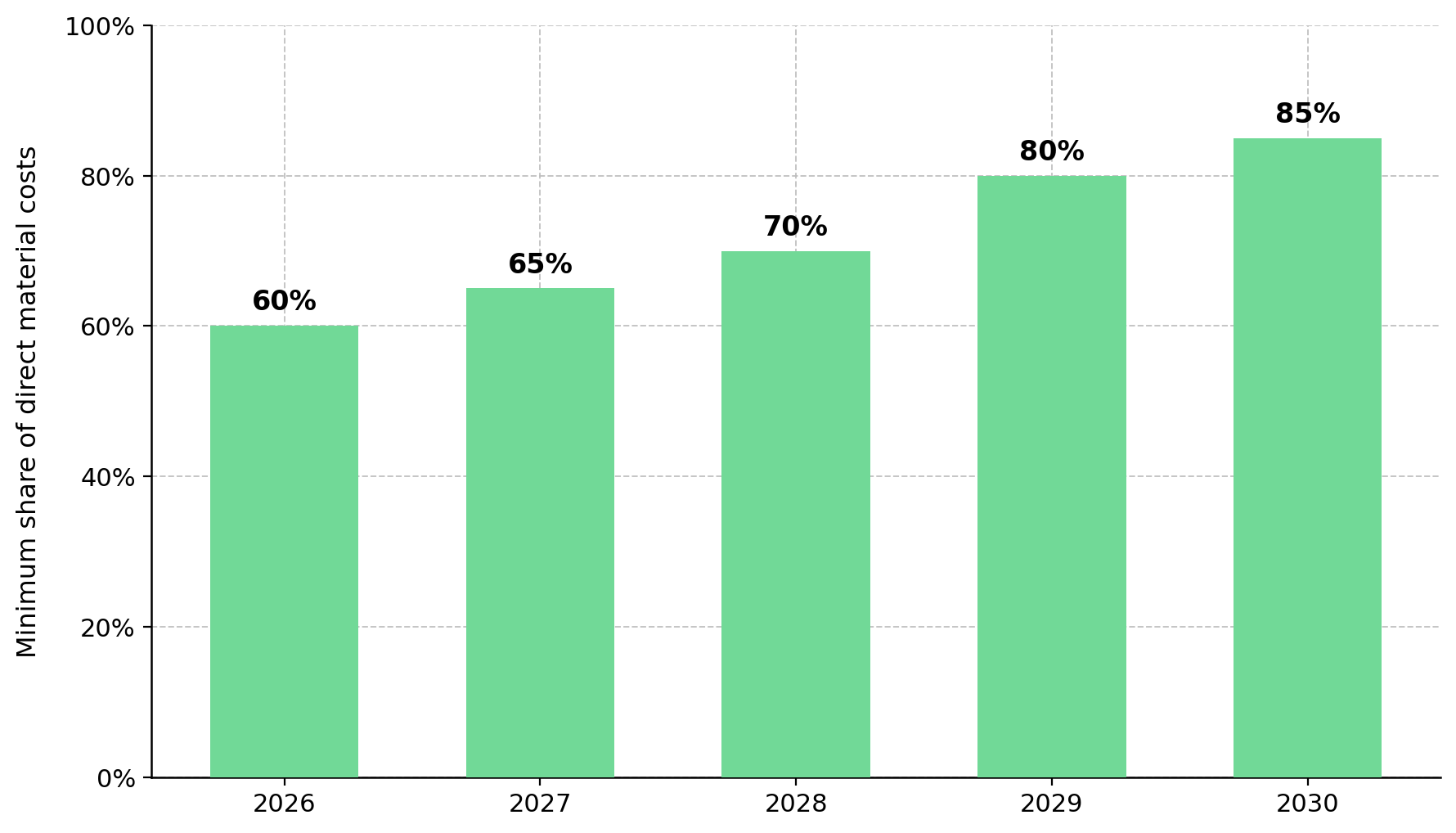
The US Department of the Treasury and Internal Revenue Service (IRS) issued Notice 2026-15 on February 12, 2026, requiring manufacturers claiming the Section 45X advanced manufacturing production credit to calculate the share of direct material costs not attributable to prohibited foreign entities. For battery components, the threshold starts at 60% in 2026 and rises to 65% in 2027, 70% in 2028, 80% in 2029, and 85% from 2030. Unlike antidumping and countervailing duties, which require an affirmative ITC injury finding, missing the Section 45X threshold removes credit eligibility for that component and pushes manufacturers toward traceable, compliant anode material even when spot graphite prices remain weak.
Rare earths account for around 40% of permanent magnet costs but less than 1% of a vehicle’s value, so tripling their prices would add only 0.1% to a car’s cost. Critical minerals account for roughly one-quarter of battery cell costs but about 3% of an average electric vehicle’s price, according to IEA, allowing manufacturers to pay more for secure supply with limited impact on vehicle prices. Manufacturers can pay this premium through multi-year procurement contracts, favoring producers with compliant supply under contract over those relying on spot sales.
Critical Mineral Listing Cannot Offset Weak Titanium Pigment Demand
Titanium appears on the November 2025 US List of Critical Minerals and, in metal form, on the EU’s May 2024 critical raw materials list, yet these designations have not supported feedstock prices. Weak pigment demand has reduced mineral sands revenue and left synthetic rutile capacity idle, showing that producers will not operate upgrading capacity without sufficient commercial demand.
Weak Pigment Demand Cuts Mineral Sands EBITDA Margin to 9% & Idles Rutile Kilns
Iluka Resources reported first-half 2026 mineral sands revenue of AUD 433 million, down 22% year over year, while underlying mineral sands earnings before interest, tax, depreciation, and amortization (EBITDA) fell 81% to AUD 41 million, reducing the EBITDA margin to approximately 9% from 39%. Blended realized revenue from zircon, rutile, and synthetic rutile fell 18.9% year over year to US$1,699 per tonne, while both synthetic rutile kilns remained idle, reducing production spending but removing their near-term revenue contribution until pigment demand improves.
Rutile-Led Project Economics Benefit From Low-Cost Graphite & Rare Earth Byproducts
Sovereign Metals completed a definitive feasibility study (DFS) for Kasiya showing a pre-tax net present value at an 8% discount rate (NPV8) of US$2.2 billion, a 23% internal rate of return (IRR), and US$727 million of capital to first production, alongside planned annual output of 222,000 tonnes of natural rutile and 275,000 tonnes of flake graphite. The 3.0-times NPV-to-capital ratio and potential heavy rare earth byproduct could add value beyond the current DFS, but construction still depends on mining licence approval, binding offtake agreements, and development financing.
Ben Stoikovich, Chairman of Sovereign Metals, connects China’s graphite dominance to Kasiya’s rutile advantage:
“China produces around 1.2 million tonnes per annum of natural graphite, about 75% of global supply, at an average production cost of US$257 a tonne. The rest of the world simply cannot compete. Demand for many higher-cost projects is unlikely unless the often-predicted dramatic increase in global graphite demand materializes. It’s actually a high-value rutile titanium project where the graphite comes out as a byproduct at the very, very low cost of US$241 per tonne.”
Acquiring Metals & Magnet Capacity Shortens the Path to Contracted Supply
By 2035, rare earth refining capacity outside China can process roughly two-thirds of expected mined supply, while planned magnet plants can use only one-third, making magnet production the tighter constraint. Acquiring existing metal, alloy, and magnet facilities removes the need to build and qualify each stage from scratch, shortening the path to commercial production and customer contracts. Resource-based valuation multiples may therefore understate companies with facilities that meet customer specifications and overstate deposits without processing access or sales contracts.
Energy Fuels moved closer to acquiring Australian Strategic Materials (ASM) after 98.23% of shareholders voted in favor of the transaction on August 12, 2026, with implementation expected on August 28 subject to court approval. ASM would add commercial-scale metals and alloys production to Energy Fuels’ rare earth oxide capacity, while the separate Vacuumschmelze acquisition could extend the business into finished magnets, giving the company control over more of the Western supply chain if both transactions and planned facilities are completed.
Mark Chalmers, President and Chief Executive Officer of Energy Fuels, links full rare earth processing with non-Chinese demand:
“To really compete with China, you have to have all those steps. You can’t be missing a step in the middle of it. A lot of the off-takers are also wanting non-China supply. There’s an option there with regard to supplying them with floor prices.”
Higher Ex-China Costs Direct Capital Toward Permitted, Contracted Projects
Projects outside China must fund construction, operations, and customer qualification before earning revenue. These requirements direct capital toward permitted projects with binding sales contracts, while early-stage resources face financing delays and equity dilution.
Ex-China Refining Capital Costs Run Up to 150% Higher, Raising Funding Requirements
Capital costs for refining projects outside China are 20% to more than 150% higher, while operating costs average around 50% higher, according to IEA. Feedstock and energy prices, limited technical expertise, infrastructure gaps, and lengthy permitting timelines drive the difference, contributing to the roughly US$60 billion needed over the next decade to diversify magnet rare earth supply chains.
Critical mineral investment fell 9% in 2025, while exploration spending dropped more than 10%, reducing funding for future projects. Advanced-economy public finance commitments reached roughly US$65 billion, more than four times the 2023 level, according to IEA, but commitments do not finance construction until they are disbursed. Projects with credible economic studies, permits, and binding sales contracts are better placed to convert those commitments into construction funding.
Resource Expansion & Economic Studies Advance PGM Projects Outside Russia & South Africa
ValOre Metals holds a 2.198-million-ounce inferred resource of platinum, palladium, and gold at Pedra Branca in Brazil, grading 1.08 grams per tonne across 63.3 million tonnes. Five zones drilled in 2023 remain outside the resource estimate, leaving expansion potential, while the preliminary economic assessment (PEA) targeted for the fourth quarter of 2026 will provide the project’s first major test of economic viability.
Thiago Diniz, Vice President of Exploration at ValOre Metals, identifies the concentrated geography of global PGM supply:
"Palladium platinum is well known and produced only in certain regions of the globe. The company is advancing one of the very few palladium-platinum assets outside Russia and South Africa. Being able to advance a project outside of that small space is actually an opportunity."
US$60 Billion Rare Earth Investment Requirement Favors Contracted Projects, While Platinum Tracks Deficits
According to IEA, refining projects outside the dominant supplier face capital costs 20% to more than 150% higher and operating costs around 50% higher than projects within the dominant supplier. Higher feedstock and energy prices, limited technical expertise, infrastructure gaps, and lengthy permitting timelines raise funding requirements and delay commercial production. Diversifying magnet rare earth supply chains would require roughly US$60 billion over the next decade, favoring projects with committed financing and binding sales contracts over those still seeking both.
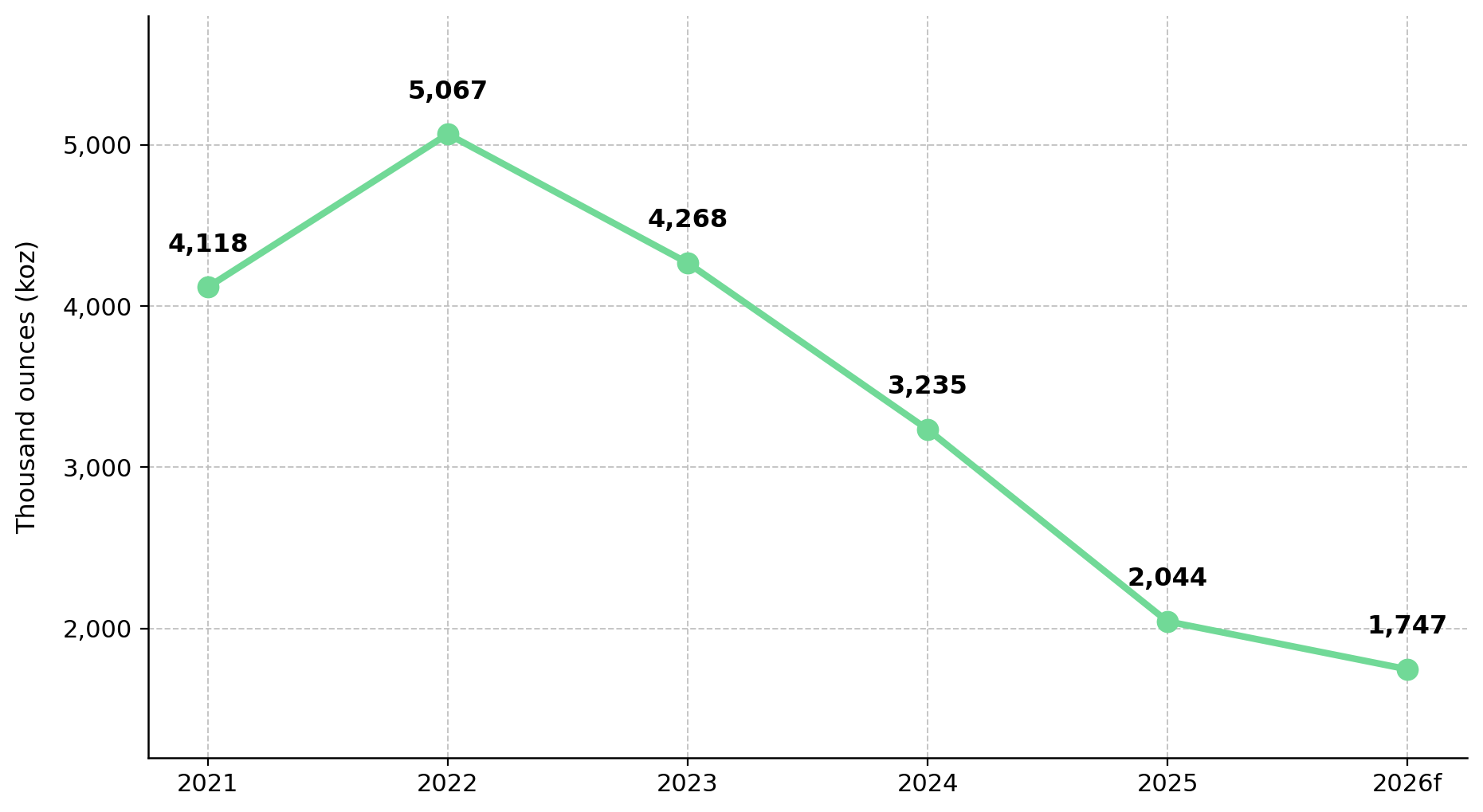
Platinum is the exception because its price responds primarily to the physical market balance and investment flows rather than customer qualification. The World Platinum Investment Council’s (WPIC) forecast shows a fourth consecutive deficit of 297,000 ounces in 2026 and year-end above-ground stocks of 1,747,000 ounces, equivalent to less than three months of demand. Accordingly, platinum warrants its own allocation and risk limits rather than being combined with rare earths, graphite, and titanium feedstocks.
The Investment Thesis for Critical Minerals
- Critical status alone does not raise prices; producers with customer-ready material and binding sales contracts have clearer revenue and financing paths, while undeveloped resources and non-binding agreements do not.
- Producers with metal, alloy, and magnet facilities can convert rare earth oxides into customer-ready products, while planned magnet capacity outside China can use only one-third of expected mined supply, making downstream capacity the tighter constraint.
- Sourcing thresholds for battery components rise from 60% in 2026 to 85% from 2030, requiring manufacturers to increase compliant material use to preserve the tax credit, while antidumping and countervailing duties require an affirmative ITC injury finding.
- Rare earths account for less than 1% of a vehicle’s value, and tripling their prices would add only 0.1% to a car’s cost, giving automakers room to pay more for secure supply and favoring producers with long-term sales contracts over spot-dependent suppliers.
- Explorers with inferred resources and no funded economic studies rely more heavily on equity financing, increasing dilution and capital-loss risk even when underlying metal prices rise.
Erbium and graphite moved in opposite directions despite both being classified as critical because price premiums depend on deliverable material that meets customer requirements. Companies with processing capacity and binding sales contracts have clearer revenue paths, while feasibility-stage and exploration assets still depend on funding and firm customer commitments. Allocation should therefore follow commercial readiness rather than critical designation.
TL;DR
Critical designation alone does not support prices. European heavy rare earth prices trade at about five times Chinese levels because qualified non-Chinese supply is limited, while South Korean graphite anode import prices fell 20% despite tariffs and export controls. Binding contracts, customer qualification, processing capacity, and committed financing determine which projects can reach construction and revenue. Rare earth magnet production remains the tighter downstream constraint, and ex-China refining costs can run up to 150% higher. Rutile prices remain tied to pigment demand, while platinum follows physical deficits, including a forecast 297,000-ounce shortfall in 2026. Commercial readiness, not resource size alone, should guide capital allocation.
FAQs (AI-Generated)
Analyst's Notes





Subscribe to Our Channel











Stay Informed



