




88% US Titanium Import Reliance Supports New Rutile Development



US titanium import reliance and established African supply routes strengthen the case for new high-grade rutile development.
- US net import reliance for titanium mineral concentrates reached 88% in 2025 as imports rose to 730,000 tonnes of titanium dioxide content and apparent consumption reached 900,000 tonnes.
- Titanium mineral concentrate imports increased 12% in 2025 and supplied most of the 10% increase in US apparent consumption, while domestic mine production remained at 100,000 tonnes.
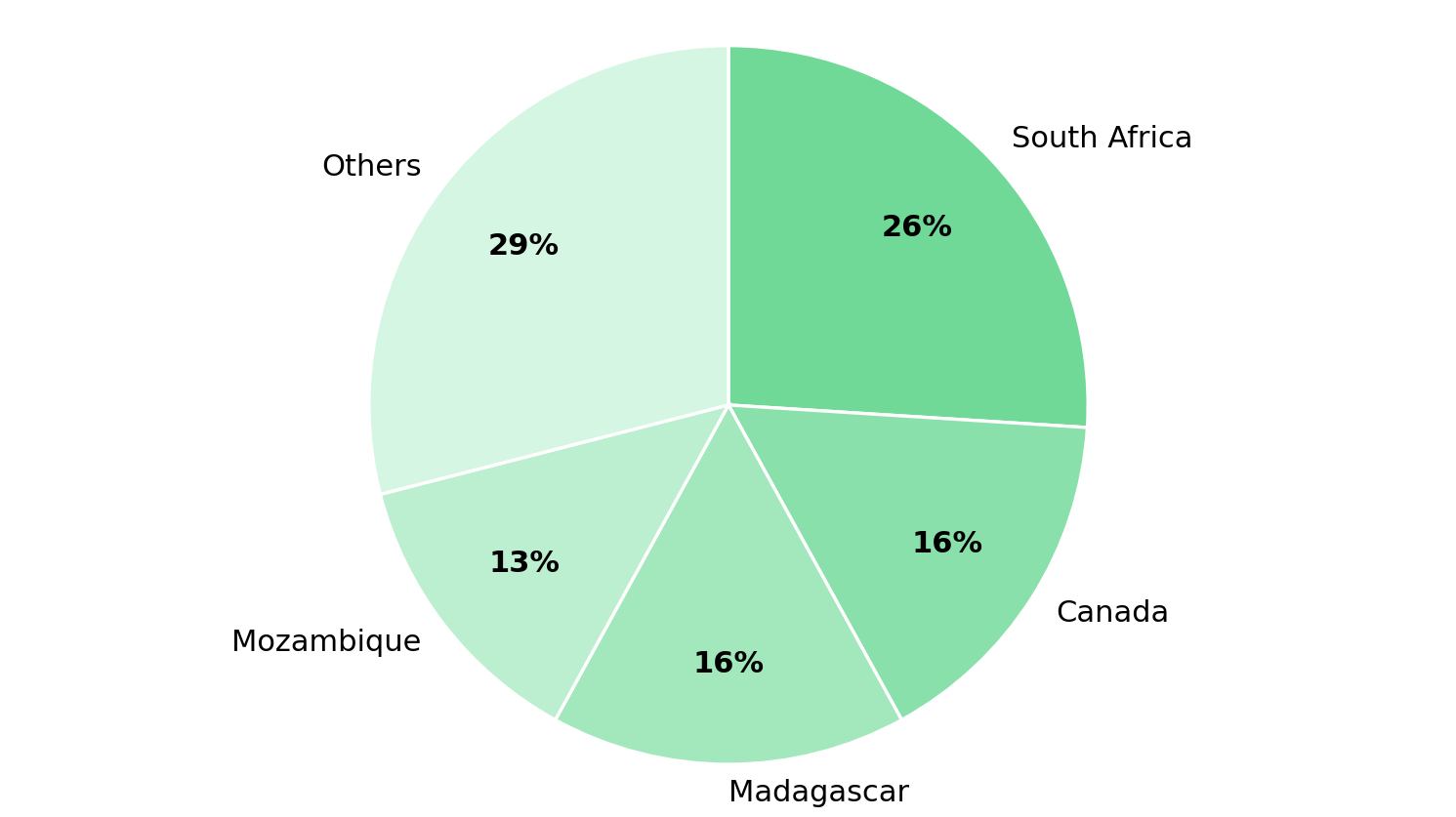
- South Africa supplied 26% of US titanium mineral concentrate imports during 2021-2024, while Madagascar supplied 16% and Mozambique supplied 13%.
- More than 95% of US titanium mineral concentrates are consumed by titanium dioxide pigment producers, providing an established industrial demand base for imported feedstock.
- Natural rutile grading at least 95% titanium dioxide carried a US$1,140 per tonne benchmark in 2025, compared with US$400 per tonne for bulk ilmenite and leucoxene.
12% Import Growth Pushes US Titanium Reliance to 88%
US dependence on imported titanium mineral feedstock increased in 2025 as consumption grew faster than domestic mine supply. The US Geological Survey (USGS) estimates that titanium mineral concentrate imports reached 730,000 tonnes of titanium dioxide content, while apparent consumption increased to 900,000 tonnes and domestic production remained at 100,000 tonnes. Net import reliance consequently reached 88%, up from 87% in 2024.
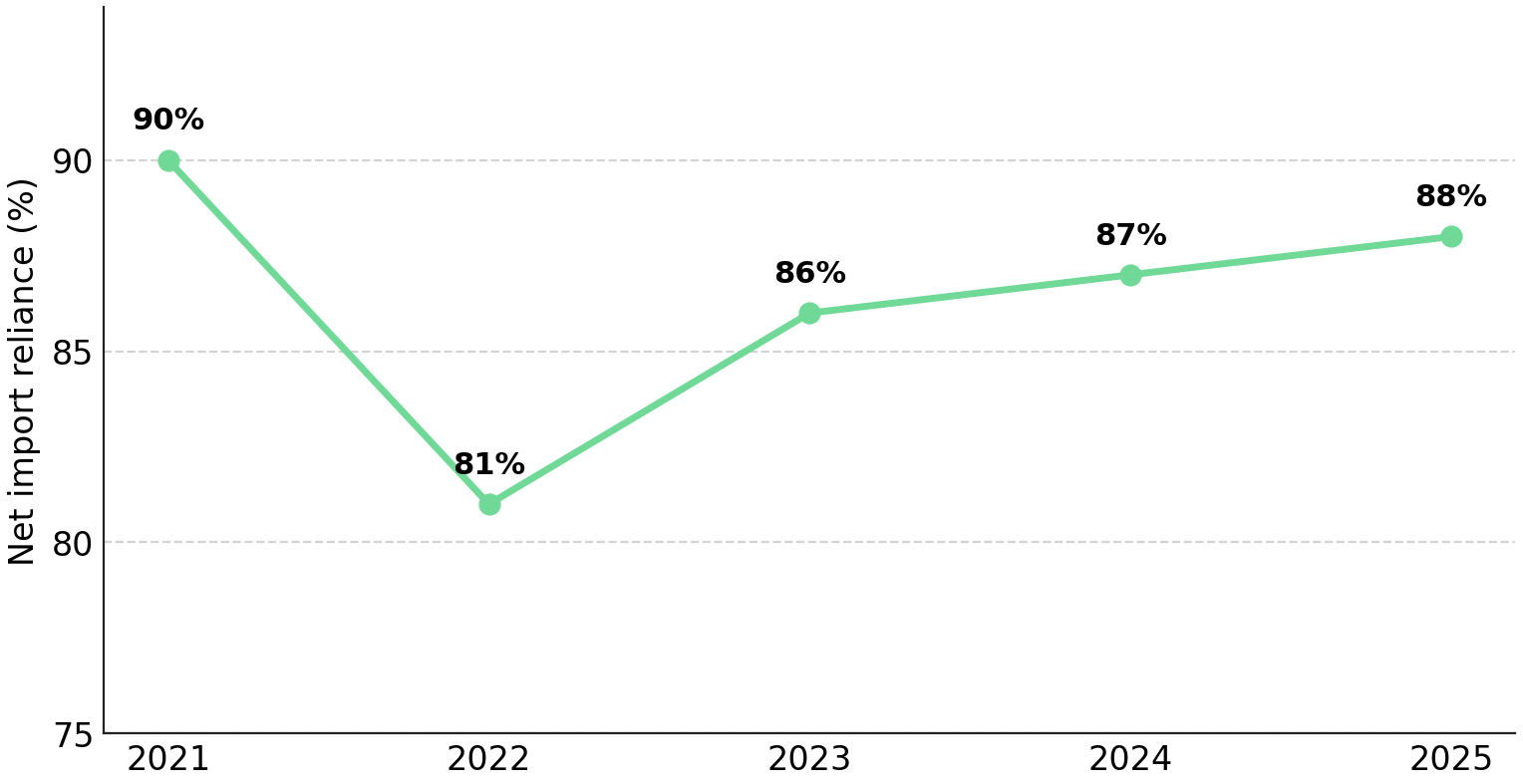
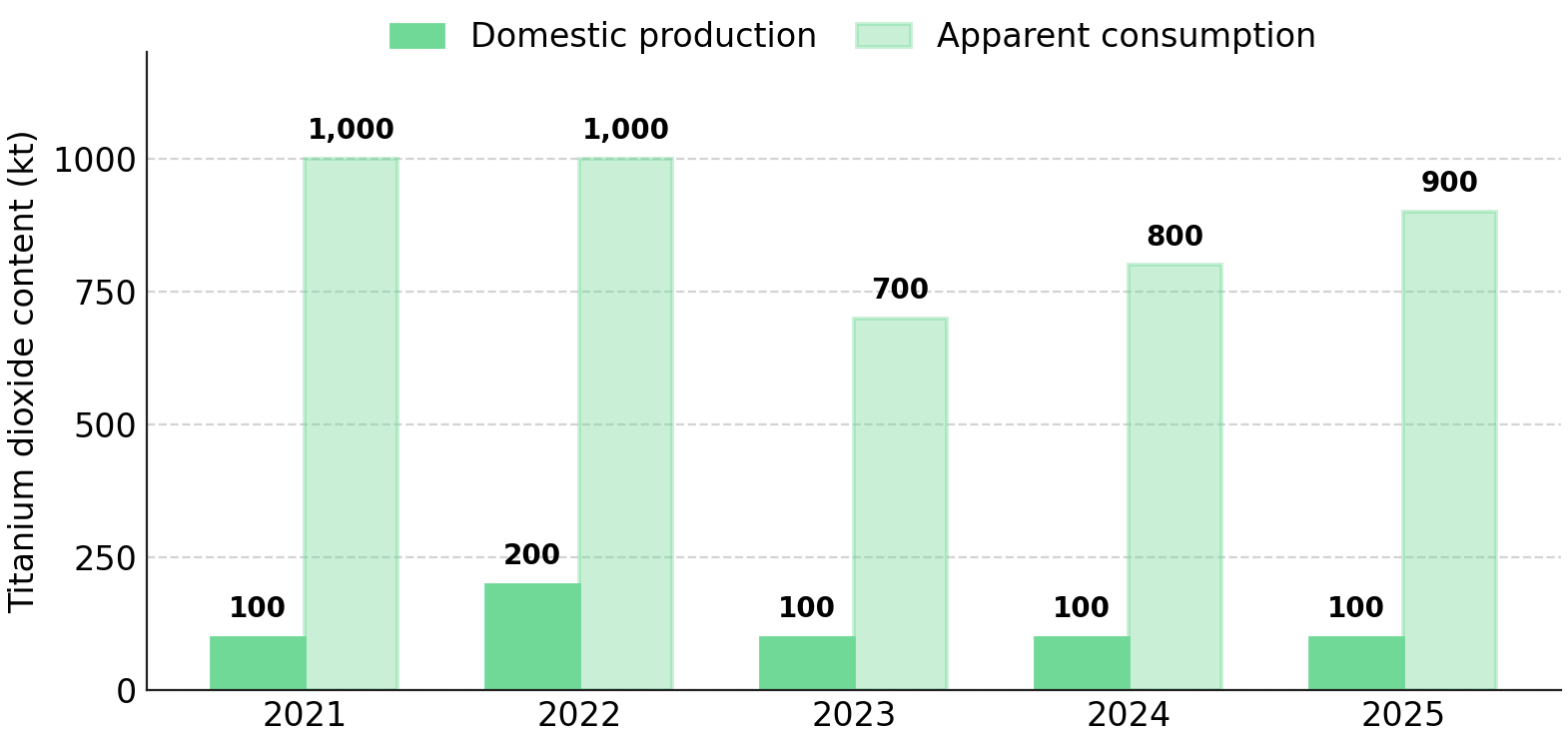
The dependence extends beyond a single year. US net import reliance stood at 90% in 2021, 81% in 2022, 86% in 2023, 87% in 2024, and 88% in 2025. Domestic mine production reached 200,000 tonnes of titanium dioxide content in 2022 but returned to 100,000 tonnes in each of the following three years, leaving imported concentrates responsible for most US feedstock requirements.
Import Growth Supplies Most of 2025 Consumption Increase
The 2025 increase in US titanium mineral consumption came primarily through foreign supply. USGS estimates that apparent consumption increased 10% from 2024, driven mostly by a 12% increase in imports, while domestic mine production remained unchanged. Imports rose from 658,000 tonnes of titanium dioxide content in 2024 to 730,000 tonnes in 2025, directly increasing exposure to overseas titanium feedstock.
The estimated value of titanium mineral and synthetic concentrates imported into the US reached US$720 million in 2025. The combination of higher import volumes and 88% net import reliance gives new export-oriented titanium projects access to a market where foreign feedstock already supplies most domestic requirements.
Pigment Demand Anchors Titanium Feedstock Consumption
Titanium mineral concentrate demand is supported primarily by the titanium dioxide pigment industry. More than 95% of titanium mineral concentrates consumed in the US are used by domestic titanium dioxide pigment producers, with the remainder serving applications including welding products, chemicals, carbides, and titanium metal. Titanium dioxide pigments are used mainly in paints, paper, and plastics, linking concentrate consumption to large industrial end markets.
This demand profile gives new rutile developments exposure to an established volume market rather than a single specialized application. Titanium mineral concentrate consumption is closely tied to titanium dioxide pigment production, with demand for its principal applications linked to changes in gross domestic product.
African Supply Already Anchors US Titanium Imports
Existing African supply to the US positions new regional projects within an established titanium import network. Additional rutile production from the region can target a market where South Africa, Madagascar, Mozambique, and Sierra Leone already supply multiple forms of titanium feedstock, reducing the need to establish a new regional trade route.
Mozambique Leads US Ilmenite Supply
The African share remained significant in 2025. Through July, Mozambique supplied 44% of US ilmenite imports, ahead of Madagascar at 35%, while South Africa supplied 20% of US rutile imports and 65% of titanium slag imports. Sierra Leone supplied 18% of imported rutile and 78% of synthetic rutile.
These flows show that US titanium processors already source multiple titanium feedstocks from African producers. For new projects in southeastern Africa, market access therefore depends less on establishing a new regional trade pattern and more on delivering competitive products into an existing import network.
African Production Supports Large Export Volumes
Africa also contains several of the world's largest titanium mineral producers. Mozambique produced approximately 1.9 million tonnes of ilmenite on a titanium dioxide content basis in 2025, while South Africa produced approximately 1.3 million tonnes. Mozambique and South Africa ranked behind China as the second- and third-largest titanium mineral concentrate producers during the year.
Natural rutile forms a smaller high-grade segment of the titanium feedstock market. Global rutile mine production at approximately 450,000 tonnes of titanium dioxide content in 2025, with Sierra Leone producing 110,000 tonnes and South Africa producing 100,000 tonnes. This smaller production base gives new natural rutile projects a different market position from the much larger ilmenite segment.
High-Grade Rutile Carries Higher Feedstock Pricing
Product grade influences titanium feedstock pricing because different minerals contain different concentrations of titanium dioxide and require different processing routes. USGS reports a 2025 benchmark of US$1,140 per tonne for bulk rutile grading at least 95% titanium dioxide, compared with US$400 per tonne for bulk ilmenite and leucoxene and an average imported ilmenite unit value of US$300 per tonne.
The rutile benchmark declined from US$1,300 per tonne in 2024 to US$1,140 per tonne in 2025, even as US concentrate imports increased. New rutile projects therefore require competitive mine and logistics costs alongside high product grade because import growth alone does not remove exposure to commodity pricing.
Nacala Corridor Gives Malawian Rutile Export Access
Landlocked Malawi requires transport infrastructure to connect mineral production with international customers. The World Bank describes the Nacala Corridor as a multimodal route linking Nacala Port with major locations across Mozambique, Malawi, and Zambia, giving Malawi access to the Indian Ocean through road and rail infrastructure.
Approximately US$6.2 billion has been invested in regional transport infrastructure along the corridor over the past decade, including railway construction, rehabilitation, port development, and upgrades to rail branches in Malawi and Mozambique. Nacala's redeveloped general cargo port became fully operational in 2023, expanding the infrastructure available for regional exporters.
Corridor Investment Reduces Route-to-Market Constraints
Transport performance has improved alongside the infrastructure investment. Nacala Port import transit times fell from 10 days in 2017 to seven days in 2024, while export transit times fell from four days to three days. A World Bank transport project approved in June 2025 is targeting further improvements in connectivity and resilience along the Nacala Corridor through 2030.
For a bulk mineral project, an established rail and port route converts an inland resource into exportable supply while transport costs remain part of the delivered product economics. This infrastructure is particularly relevant for high-volume developments that require reliable movement from mine site to seaborne markets.
US Feedstock Dependence Supports High-Grade Rutile Development
US titanium mineral consumption reached 900,000 tonnes of titanium dioxide content in 2025, while domestic production remained at 100,000 tonnes, leaving imports to supply most domestic requirements. The Nacala Corridor gives Malawi access to regional rail and port infrastructure through Mozambique, which already supplies titanium feedstock to the US. New high-grade rutile projects in the region can therefore target an import-dependent titanium market through an established African trade route.
Sovereign Metals completed Kasiya’s definitive feasibility study (DFS), defining a development case targeting 222,000 tonnes per annum of natural rutile grading above 95% titanium dioxide alongside graphite production. The US$2.204 billion pre-tax net present value at an 8% discount rate (NPV8%), 23% pre-tax internal rate of return (IRR), and US$727 million initial capital requirement provide clearer parameters for financing, while the planned Nacala Corridor export route, submitted mining license application, and ongoing offtake discussions establish a more defined pathway for bringing a large-scale, high-grade rutile source to market.
Ben Stokovich, Chairman of Sovereign Metals, explains why Kasiya is primarily a rutile project:
“It's the largest rutile deposit ever discovered, and globally it ranks as the second largest natural graphite deposit. Kasiya is a primary rutile deposit, and the graphite will be produced as a byproduct.”
Import Reliance Supports New Rutile Supply
US titanium mineral demand continues to exceed domestic mine supply by a wide margin. Apparent consumption reached 900,000 tonnes of titanium dioxide content in 2025, while domestic production remained at 100,000 tonnes, leaving imports to supply most of the market and pushing net import reliance to 88%. Imports also increased 12% during the year, showing that higher domestic consumption translated directly into greater demand for foreign titanium feedstock.
That dependence creates an established market for additional export-oriented supply rather than requiring new rutile projects to create demand from scratch. African producers already account for significant shares of US titanium mineral imports, while more than 95% of US concentrate consumption serves titanium dioxide pigment production, providing a large industrial demand base. New high-grade rutile projects with defined transport routes can therefore enter an existing international feedstock market where imported material already supplies most US consumption.
The Investment Thesis for Titanium
- An 88% US net import reliance leaves titanium mineral consumption dependent on foreign feedstock, supporting market access for new export-oriented supply.
- A 12% increase in imports supplied most of the 10% increase in US apparent consumption during 2025, linking higher demand with additional overseas material.
- African producers already supply large shares of US titanium imports, giving new regional developments an established trade network rather than an untested export route.
- Natural rutile grading at least 95% titanium dioxide carries a higher benchmark price than lower-grade ilmenite feedstock, increasing the importance of product grade for development-stage projects.
- Established rail and port infrastructure can reduce the route-to-market constraints facing landlocked mineral developments seeking access to international processors.
- Completed feasibility work, permitting progress, and advancing offtake agreements give development-stage projects clearer pathways from mineral resources to commercial supply.
US dependence on imported titanium feedstock, combined with established African supply routes and broad industrial demand, supports the case for additional high-grade rutile development. Projects that pair product quality with competitive costs, defined transport infrastructure, and credible paths to market are better positioned to supply an import-dependent titanium chain and convert new mineral resources into commercial feedstock.
TL;DR
US titanium mineral consumption remains heavily dependent on foreign feedstock, with net import reliance reaching 88% in 2025 as imports increased 12%. African producers already supply significant volumes of ilmenite, rutile, synthetic rutile, and titanium slag into the US market, creating an established trade network for additional regional supply. More than 95% of US titanium mineral concentrates serve titanium dioxide pigment production, supporting broad industrial demand. High-grade natural rutile also carries higher benchmark pricing than lower-grade feedstocks. For new African developments, product quality, competitive costs, permitting progress, offtake agreements, and access to export infrastructure such as the Nacala Corridor determine the pathway to commercial supply.
FAQs (AI-Generated)
Analyst's Notes





Subscribe to Our Channel





.jpg)



Stay Informed


