




Magna Terra's Atlantic Canada Copper-Gold Discovery and Partner-Funded Drilling at Optioned Projects


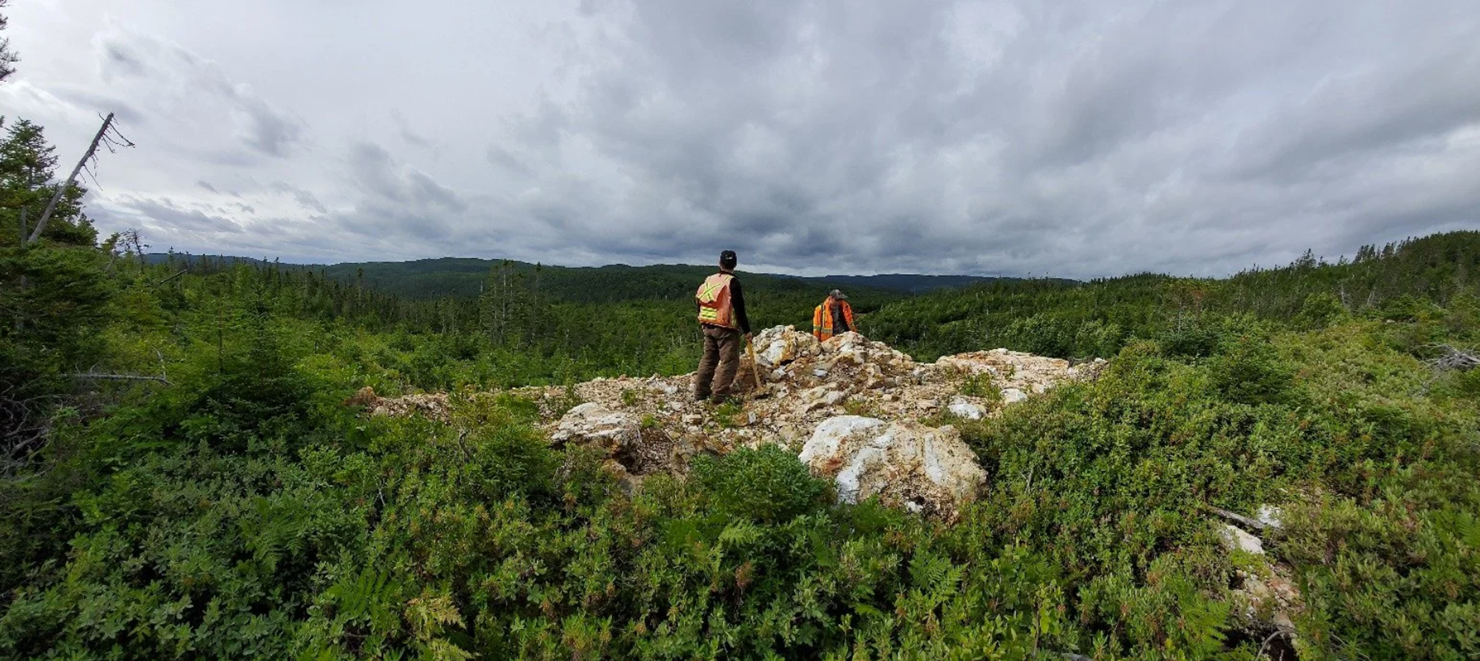
Magna Terra Minerals (TSXV:MTT) advances copper-gold discoveries in Atlantic Canada while Gold Hunter and Lunex drill its optioned Newfoundland and Argentina projects.
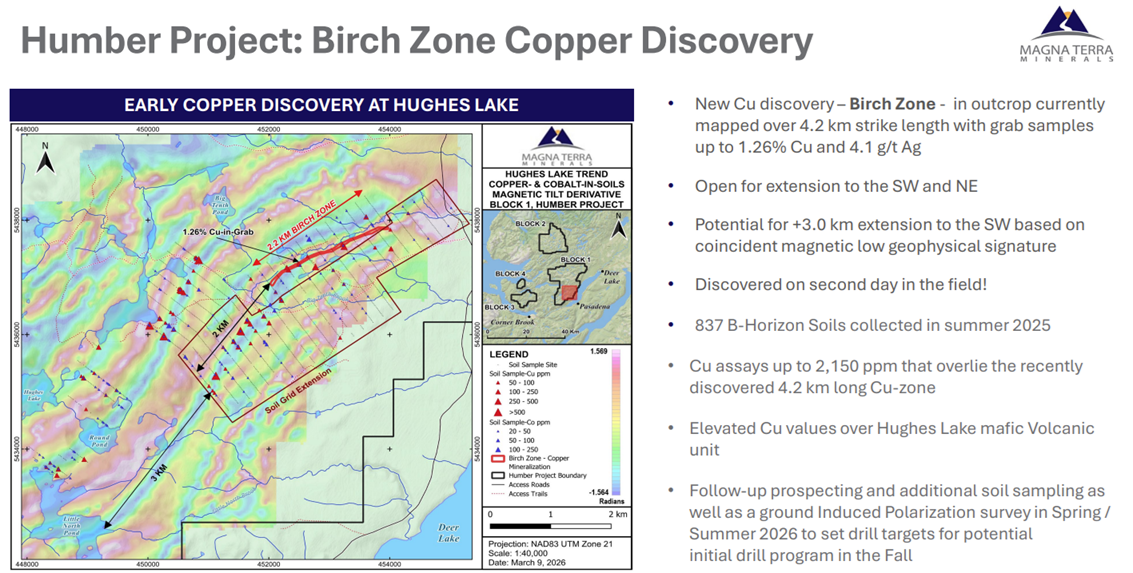
- Magna Terra's copper discovery at the Humber project's Birch Zone extends over 4.2 kilometres of strike with grab samples up to 1.26% copper.
- The company's management team previously grew the Goldboro gold deposit from 700,000 ounces to over 3 million ounces, and applies the same approach to its current portfolio.
- Optioned partners Gold Hunter Resources and Lunex Metals are independently drilling Magna Terra's Great Northern and Luna Roja projects, generating cash and news flow without dilution.
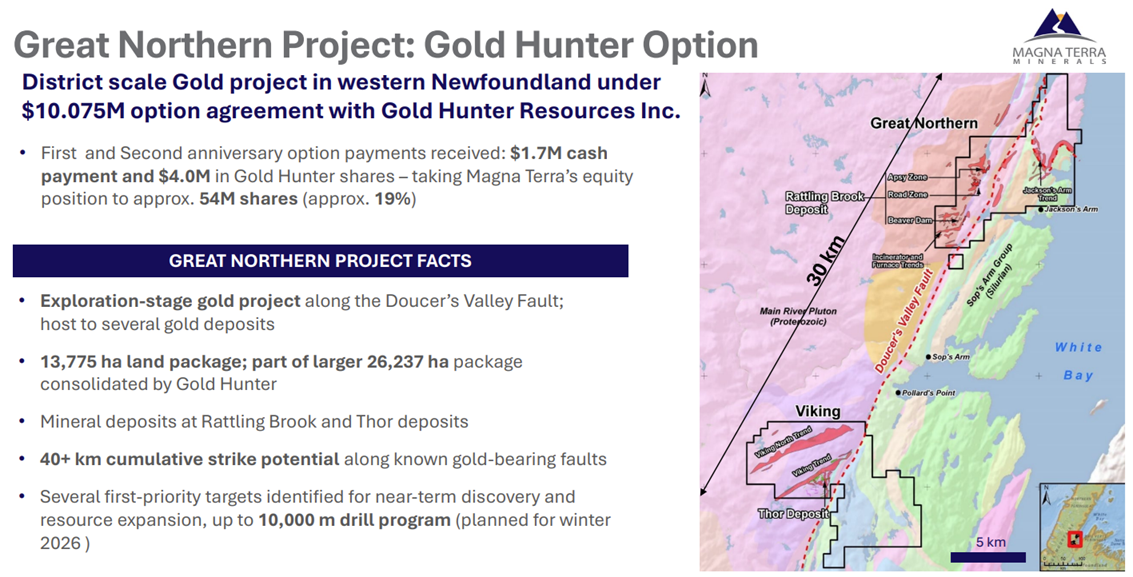
- Magna Terra holds an approximate 19% equity stake in Gold Hunter Resources, giving it leveraged exposure to that company's 10,000-metre drill programme.
- Management indicated additional financing will likely be needed to advance the Humber project past target definition.
Atlantic Canada's gold camps have delivered some of the sector's most closely watched resource growth stories of the last decade, and Magna Terra Minerals (TSXV:MTT) is betting that its four-project exploration pipeline across Newfoundland and New Brunswick can repeat that pattern. President and CEO Lewis Lawrick built his track record at Anaconda Mining, which became Signal Gold and grew the Goldboro deposit in Nova Scotia from roughly 700,000 ounces to more than 3 million ounces before merging with NexGold. That same technical team, led by chief geologist Dave Copeland and senior geologist Tanya Tettelaar, is now applying the same systematic approach to Magna Terra's own ground, while a pair of optioned projects in Newfoundland and Argentina generate news flow and non-dilutive cash without pulling management's attention away from its core targets.
Humber Copper-Cobalt: A First-Mover Land Position
Humber is Magna Terra's most technically distinctive asset: a 50,000-hectare, 100%-owned position in western Newfoundland staked entirely on the company's own regional data analysis, with no underlying royalties or option payments. The team identified the ground as prospective for sedimentary-hosted stratiform copper mineralisation, the deposit style behind the Kalahari and Central African copperbelts, and made a surface discovery on only the second day of fieldwork.
The resulting Birch Zone now extends over 4.2 kilometres of strike with grab samples up to 1.26% copper and 4.1 g/t silver, and management sees potential for a further 3-kilometre extension based on a coincident magnetic low. A ground Induced Polarization survey is planned for spring/summer 2026 to define targets for a potential first-pass drill programme in the fall.
Track Record and Team
Lawrick has been associated with four companies that were subsequently acquired, and leans heavily on that history repeating itself.
"When Signal acquired that project in 2017, it was a inferred resource around 700,000 ounces. Through our work, that project is now 3,000,000+ ounces, fully permitted, and facing into a updated feasibility which will effectively determine an investment and development decision. I truly believe it's going to be the next gold mine developed in Atlantic Canada."
Copeland's Atlantic Canada credentials and Tettelaar's role advancing Newfoundland's Valentine Lake deposit (now a 5-million-ounce resource under Equinox Gold) underpin management's argument that its geological read on the region is differentiated and not generic.
Interview with Lewis Lawrick, President & CEO of Magna Terra Minerals
Two New Brunswick Bets
In the historic Bathurst Mining Camp, Magna Terra has consolidated more than 31,000 hectares along strike of Canadian Copper's Murray Brook and Caribou deposits. Trenching at the Boudreau Brook-Fossil Hill Trend has returned copper values in outcrop that Lawrick described in double-digit percentages, consistent with historic grab samples of up to 16.65% copper and 0.64% cobalt at the Fossil Hill zone, alongside gold assays up to 5.23 g/t at Fournier Lake.
Prospect Or's Dream, a newly staked epithermal gold project acquired via option from local prospectors, has mapped a boulder field and quartz vein system over a minimum 7.2-kilometre strike length, an early enough stage that Lawrick was careful to caveat that specific target types are still being defined, but distinctive enough that the company geologist told him he had never seen a quartz boulder field of that scale.
Optionality Through Gold Hunter and Lunex
Rather than fund every project itself, Magna Terra has monetised non-core ground through option deals that generate cash while preserving upside. The Great Northern and Viking projects are optioned to Gold Hunter Resources for total consideration of $10 million, and Gold Hunter commenced a 10,000-metre diamond drill programme at Great Northern in June 2026. Magna Terra holds approximately 55 million Gold Hunter shares, an undiluted 19% interest, making it the largest shareholder.
In Argentina, the Luna Roja project is optioned to Lunex Metals (formerly Andean Metals) for $2.375 million. Lunex's initial 2,517.5-metre drill programme returned step-back holes including 23.1 metres at 0.36 g/t gold and 61.76 g/t silver, and identified a new mineralised centre at Estrella del Norte more than two kilometres north of the historic Cruz del Sur discovery.
Financial Position and Shareholder Alignment
Magna Terra held just over $1 million in cash, with total working capital of approximately $3.5 million once marketable securities including its Gold Hunter stake are factored in. The company will need to raise additional capital to fund a drill programme at Humber once targets are finalised. Shareholder alignment is a recurring theme: significant investor Michael Gentile holds roughly 17% of the company, management and insiders hold a further 13%, and Lawrick points to that ownership structure as central to Gentile's decision to take a position.
"We have maintained a very tight capital structure. If you asked Mike the question, what was the most defining aspect of the company that drove him to take a significant shareholding, it would be that we've been very prudent managers of our capital structure. And we've done that because we're major shareholders."
Catalysts and Risks
Near-term catalysts include Humber drill targets expected by fall 2026, continued Gold Hunter drilling at Great Northern, further Lunex results at Luna Roja, and geophysics at Prospect Or's Dream this August. The core risk is the flip side of the diversified-portfolio strategy Lawrick describes: with four of its own projects still at the target-generation stage rather than drill-confirmed resources, any one asset disappointing needs to be weighed against the portfolio's other "shots on goal," and the company will need fresh financing to advance Humber past this year's target definition work.
The Investment Thesis for Magna Terra Minerals
- Management's Atlantic Canada track record of growing Goldboro from 700,000 ounces to over 3 million ounces at Signal Gold is a direct analogue for the exploration approach being applied at Humber and Rocky Brook.
- Humber offers genuine first-mover exposure to an unproven but potentially district-scale copper-cobalt system, acquired entirely through staking with no underlying royalty burden.
- The Gold Hunter and Lunex option structures generate news flow and partial funding from two actively drilled projects without diluting Magna Terra shareholders.
- A tight share structure, with roughly 30% held by management, insiders and a single significant shareholder, aligns incentives but also limits free float and liquidity.
- The company will need additional financing to advance Humber past target definition, which is a near-term dilution risk investors should watch for.
- Monitor Gold Hunter's ongoing 10,000-metre drill results at Great Northern and further Lunex assays from Luna Roja as potential re-rating catalysts for Magna Terra's equity stakes in both.
- Prospect Or's Dream and Rocky Brook remain earlier-stage than Humber; specific drill targets and mineralisation style at both are still being defined.
Macro Thematic Analysis
Magna Terra's strategy reflects a broader shift among junior explorers toward capital-efficient portfolio models: rather than relying solely on dilutive equity raises, the company has used option and partnership agreements to fund itself while retaining exposure to the upside. That approach is particularly relevant in Atlantic Canada, where consolidation is already underway: Canadian Copper's acquisition of the Caribou Mill infrastructure, and Kinross's earn-in on the Puma discoveries in the Bathurst Camp both point to renewed institutional interest in a jurisdiction the Fraser Institute ranks among the world's more attractive for investment. Newfoundland and Labrador's ranking as the 8th most attractive jurisdiction globally for investment attractiveness gives Magna Terra's Humber and Great Northern positions a policy tailwind that pure exploration economics alone wouldn't provide.
The Argentina side of the story carries a different macro signal. Lawrick's account of Magna Terra's difficulty raising capital for Luna Roja prior to 2024 despite an initial discovery in 2019 reflects the currency and political risk that kept many North American investors away from Santa Cruz Province for years. The recent influx of capital and companies into the Deseado Massif, including the Lunex option and the broader activity Lawrick references around Argentina Metals, suggests that risk premium is compressing. For a portfolio like Magna Terra's, where the Argentine assets were carried for years on option payments rather than active exploration spend, a re-rating of jurisdictional risk could unlock value that has sat dormant in the company's book for the better part of a decade.
TL;DR
Magna Terra Minerals (TSXV:MTT) is advancing four wholly-owned exploration projects across Newfoundland and New Brunswick, led by a management team that previously grew the Goldboro gold deposit from 700,000 ounces to over 3 million ounces at Signal Gold. A new copper discovery at the Humber project's Birch Zone now extends over 4.2 kilometres of strike, while trenching at Rocky Brook in the Bathurst Mining Camp has returned high-grade copper and gold values. Meanwhile, optioned partners Gold Hunter Resources and Lunex Metals are independently drilling Magna Terra's Great Northern and Luna Roja projects, generating news flow and cash - Magna Terra holds a 19% equity stake in Gold Hunter - without diluting shareholders. The company will need fresh financing to advance Humber past target definition.
Frequently Asked Questions (FAQs) AI-Generated
Analyst's Notes





Subscribe to Our Channel



.png)
.png)




Stay Informed


