




NexMetals Grows Selebi to 51 Mt, Targets Non-Dilutive Financing


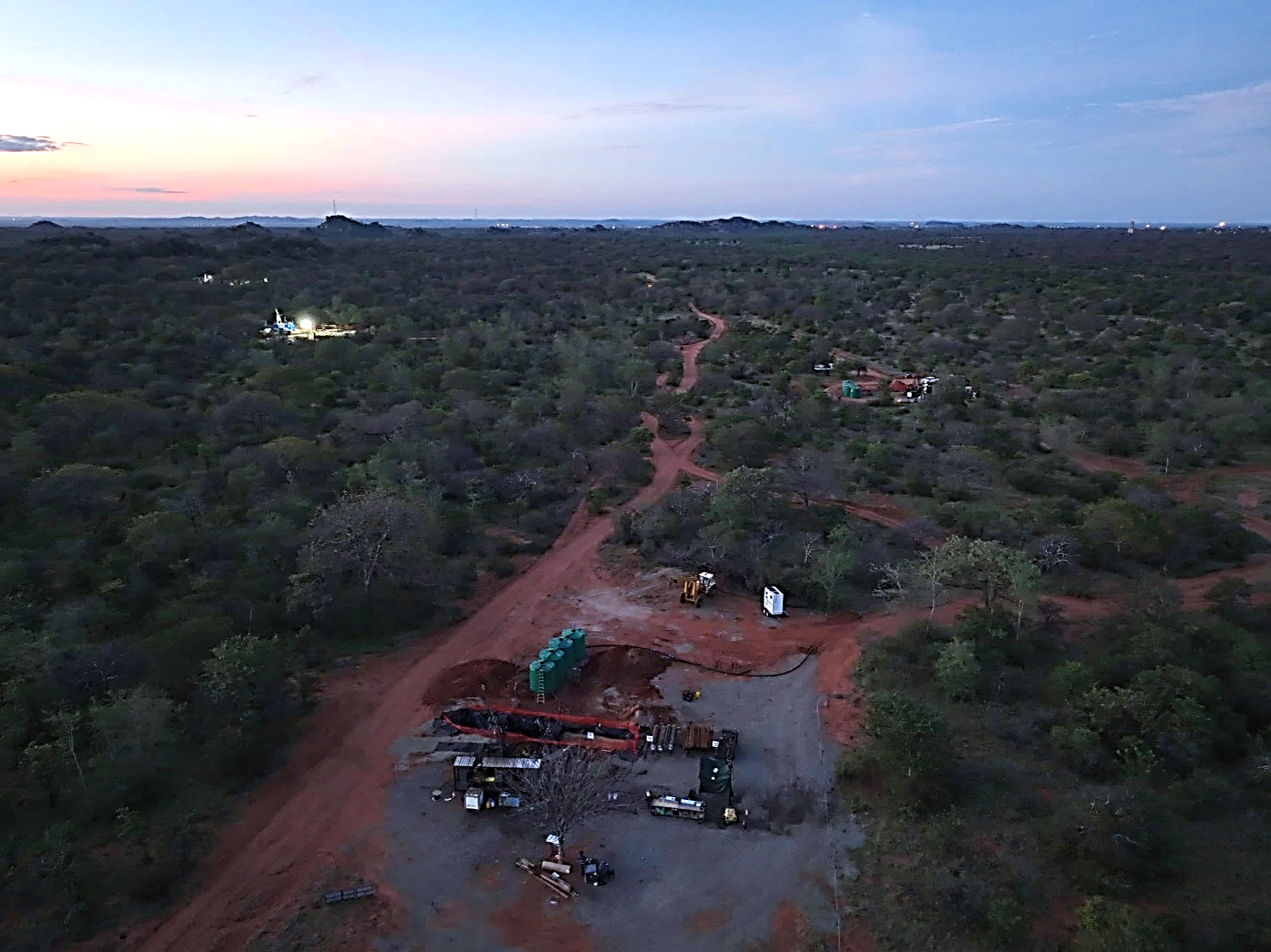
NexMetals grows Selebi copper-nickel resource to 50.9 Mt, nearly triples Selebi North Indicated tonnes and extends its PEA to rethink mine design.
- NexMetals has grown its combined Selebi copper-nickel resource from roughly 28 Mt in 2024 to 50.9 Mt in 2026, while Selkirk's contained metal rose 70%.
- Conversion drilling lifted Selebi North's Indicated resource by 198% to 8.95 Mt and raised copper and nickel grades.
- More than 90% of Selebi Main's 72% resource increase came from the Flexure Zone, where up to a third of the conductor plate is still untested.
- New drilling and evidence of a possible intrusive keel make the roughly 1.5-kilometre corridor between Selebi North and Selebi Main a priority exploration target.
- The Selebi PEA has been extended to rethink shaft placement, and with about C$10.5 million in cash the company is pursuing non-dilutive funding through National Bank.
Copper-nickel sulphide deposits that combine scale, grade and existing infrastructure are scarce. NexMetals Mining Corp. (TSXV:NEXM, Nasdaq:NEXM) is working to show that its past-producing Selebi Mines and nearby Selkirk Mine in Botswana belong in that group. Five months after setting out its plans on Crux Investor in May, CEO Sean Whiteford returned to report on what the drill bit has delivered.
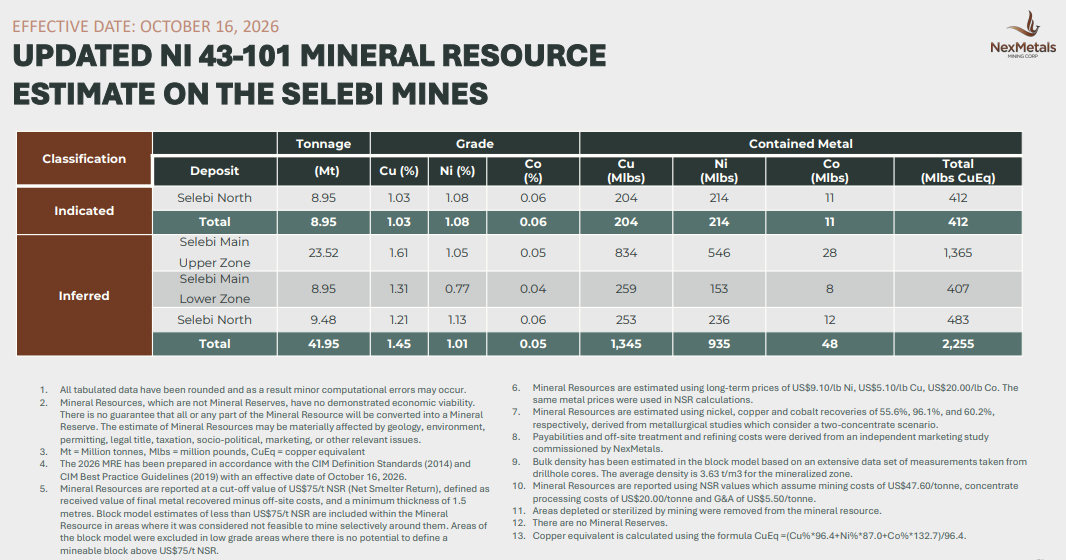
The headline result is growth at both assets. Combined Selebi resources rose from roughly 28 million tonnes (Mt) in the 2024 estimate to 50.9 Mt, while Selkirk's contained metal grew by 70%. The same drilling has also complicated the timeline. The company has extended work on the Selebi preliminary economic assessment (PEA) to reconsider where future infrastructure should go. It is also running a funding review with the stated aim of avoiding a dilutive equity raise.
Selebi North: Conversion Drilling Lifts Tonnes and Grade
Selebi North's Indicated resource rose 198% to 8.95 Mt grading 1.03% copper and 1.08% nickel, up from 3.00 Mt at 0.90% copper and 0.98% nickel in 2024. Whiteford described this as infill and conversion drilling rather than new discovery. The company has drilled 42,633 metres in 92 holes since the 2024 data cut-off. That work converted about 20% of previously Inferred material to Indicated and also lifted grades. Inferred resources at Selebi North rose 63% to 9.48 Mt grading 1.21% copper and 1.13% nickel.
Grade improves with depth. Whiteford said both copper and nickel grades rise as drilling moves deeper at Selebi North, a trend the company's release also reports. In total, Selebi North now hosts about 18.4 Mt, with roughly half in the Indicated category. Cobalt, at 0.06%, has been included in the estimate for the first time.
Asked how much of the growth reflected metal prices rather than drilling, Whiteford said the price effect largely cancelled out. The 2024 estimate used a higher nickel price but a much lower copper price than today.
Existing Underground Development Supports a Faster Restart
The Selebi operations did not close because the ore ran out. Production ceased in 2016 after the previous owner's smelter failed in 2015. Whiteford said that history leaves the mines in an unusual position for a restart project:
"There's... roughly two years worth of underground development already in place at both Selebi North and Selebi Main. You can go underground at both mines... see the massive sulphides, see the drill holes, they're waiting to be loaded and blasted."
A good share of the Selebi North Indicated tonnes sits within that developed area, which Whiteford said would let mining restart quickly. A concentrator and tailings facility would still need to be built. The Selebi North shaft needs only some refurbishment, and Whiteford cited a potential rate of 750,000 tonnes per year from that deposit.
Selebi Main: The Flexure Zone Drives a 72% Increase
Selebi Main's Inferred resource rose 72% to 32.47 Mt grading 1.53% copper and 0.98% nickel, split between an Upper Zone and a Lower Zone. Whiteford said more than 90% of the increase came from the Flexure Zone, which was not a defined target a year ago. The zone sits within a borehole electromagnetic (BHEM) conductor plate measuring about 700 metres by 700 metres. He estimated that between a quarter and a third of that plate has not yet been tested by a drill hole. Drilling so far has followed a trend of thicker, higher-grade massive sulphides.
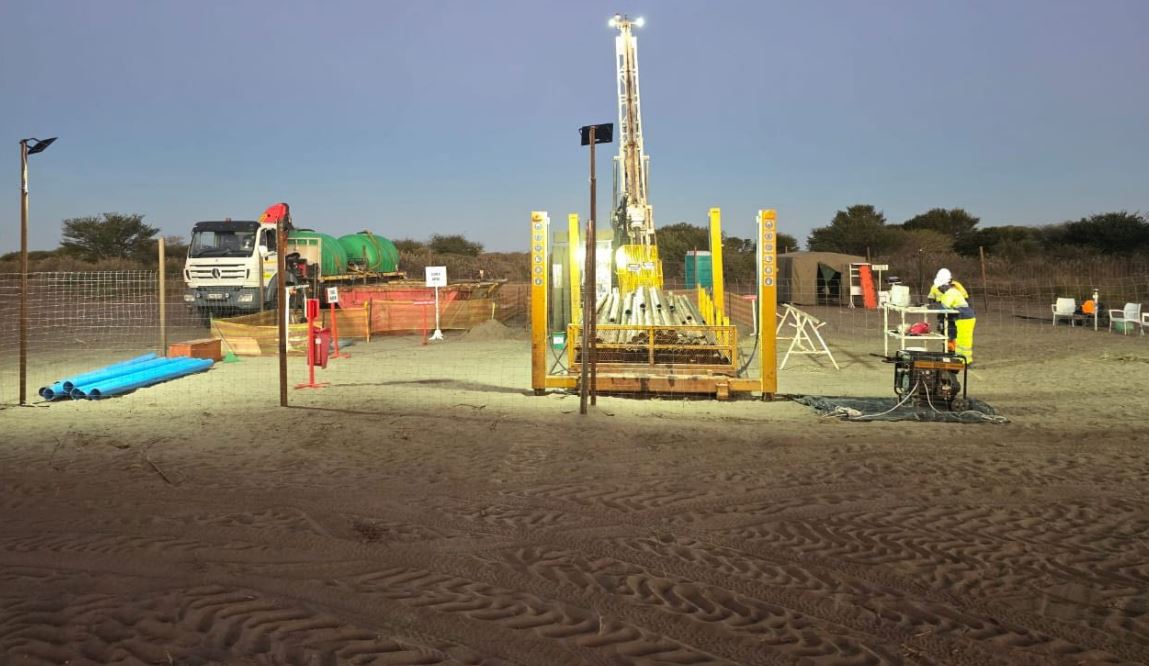
The next phase at Selebi Main is mainly conversion. Current drilling at roughly 200-metre spacing supports the Inferred classification. Whiteford said the company plans to tighten spacing to about 100 metres to reach Indicated, which he views as sufficient for the resource base. Part of the budget will still go to expansion drilling, and five drill rigs remain on site.
A Possible Connection Between the Two Deposits
The idea that Selebi North and Selebi Main might join through a "hinge zone" dates back to the original asset purchase. For close to three years of drilling, the evidence pointed the other way, with Selebi North striking away from Selebi Main. Deeper drilling has changed that picture. Whiteford likened the new geometry to a hockey stick. The South Limb flattens at depth and turns toward Selebi Main, and its copper grades are rising toward levels seen at Selebi Main.
A second line of evidence comes from the rocks themselves. Dr Peter Lightfoot, a consulting geologist to the company and former Chief Geologist at Inco/Vale, has reinterpreted rocks historically logged as amphibolite as altered primary igneous rocks. The most magnesium-rich samples, from deep holes SMD-25-202 and SMD-25-204, contain fresh olivine. That feature is characteristic of the keel of an intrusion, the deepest part of the body, where dense magmatic sulphide can accumulate.
Whiteford said the roughly 1.5-kilometre area between the deposits is now wide open for exploration. A couple of holes into it already show keel geochemistry and high-grade massive sulphides, although over thinner widths. The task is to find where the sulphides thicken. TECT Geological Consulting, a structural geology group from Cape Town, is on site to map where folding may have concentrated mineralisation and to guide drill targeting.
Interview with Sean Whiteford, CEO of NexMetals Mining
PEA Extended to Rethink Mine Design
Resource growth has changed the engineering questions. A year ago, the company planned to install a shaft at Selebi Main by raise boring from existing underground workings. Whiteford said that location no longer makes sense, because the resource is now larger, thicker and higher grade and continues down plunge. The historical Selebi Main shaft already sits two to three kilometres from current mining areas, and Whiteford does not want to repeat that outcome.
The best site for any new shaft may lie in the undrilled ground between the two deposits. The company has therefore allowed more time on the Selebi PEA to study extracting Selebi Main material through existing underground infrastructure without a new shaft. Options include conveyors, a RailVeyor system and trucking. The PEA will also consider Selebi North on a standalone basis. No revised completion date has been given.
Metallurgy is the other open variable. The resource estimate assumes nickel recovery of 55.6%, compared with 96.1% for copper. Whiteford said copper recovery is not the issue. Nickel, he noted, has always been harder to float. Testwork so far has used only mechanical flotation, and alternatives such as Jameson cells have not been tested. The company hopes to lift nickel recovery into the 60% range, which Whiteford said would be significant for overall economics. The final flowsheet will also depend on the blend of ore from each deposit, and the Selebi Main mining rate is not yet decided.
Selkirk: A Larger Open-Pit Resource
Selkirk's June 2026 estimate lifted contained metal by 70%, with total tonnes rising from 44 Mt in 2024 to 93.3 Mt. Indicated resources stand at 78.2 Mt grading 0.66% copper equivalent (CuEq), with a further 15.1 Mt Inferred at 0.60% CuEq. That equates to about 1.3 billion pounds of CuEq on a 100% basis. Whiteford attributed the growth mainly to improved metallurgical recoveries. DRA Global has been engaged to complete a PEA while the company evaluates strategic options. Whiteford said Selkirk is one of the assets the company wants to monetise.
Funding & the Share Price
NexMetals held about C$10.5 million in cash at the end of September. Whiteford said this carries the company into the new year, with drilling and both PEAs continuing. He acknowledged that market expectations of a capital raise are weighing on the share price. His response points to a different route:
"Importantly, what we put out in our press release this week is that we've engaged National Bank... in a process to do a non-dilutive financing. That is our goal... to do whatever we can to not have to go back to the market for a dilutive equity financing."
National Bank of Canada Capital Markets was engaged earlier in 2026 to evaluate funding alternatives across the company's assets. The company states there is no guarantee the review will result in a transaction. At C$2.05 on October 19, 2026, NexMetals had a basic market capitalisation of about C$73 million.
The Investment Thesis for NexMetals Mining
- Resource scale is established. Selebi hosts 8.95 Mt Indicated and 41.95 Mt Inferred, and Selkirk adds 78.2 Mt Indicated and 15.1 Mt Inferred.
- Existing development lowers restart risk. About two years of underground development at both Selebi deposits could allow mining to start quickly, although a concentrator and tailings facility are still needed.
- The corridor between the deposits is the main exploration upside. Geometry, keel geochemistry and BHEM data all point to the roughly 1.5-kilometre gap as a priority target.
- Financing is the key near-term risk. Cash lasts into the new year, and the National Bank review will decide whether shareholders face dilution.
- Monitor the Selebi PEA trade-off study. Shaft location and mining rate remain open, and a revised completion date is still to come.
- Nickel recovery is a value lever. Lifting recovery from 55.6% into the 60% range would improve project economics.
- Watch for a Selkirk transaction. Monetising Selkirk would be the clearest path to non-dilutive funding for Selebi.
Macro Thematic Analysis
Large, high-grade magmatic sulphide deposits supply a meaningful share of the world's nickel, copper, cobalt and platinum group metals, and they are hard to find. Most new nickel supply in recent years has come from Indonesian laterite deposits. Sulphide deposits in stable jurisdictions, with copper as a major co-product, therefore hold strategic interest for Western buyers and governments focused on critical minerals.
Selebi fits that profile, and the latest geology adds to the case. The keel concept Dr Lightfoot has applied is a well-established exploration tool in this deposit type. Whiteford put it directly:
"Norilsk, Voisey's Bay, Eagle, Tamarack... they all use the keel as a vector into additional metal."
Keels can concentrate thick, high-grade sulphide in predictable positions. If the Selebi intrusion behaves the same way, the corridor between the two deposits could yield better-defined targets than simple step-out drilling. The company notes that later folding may also have moved sulphides, as at Thompson and Birchtree in Manitoba, and the structural study aims to separate these two controls.
Copper's role in the economics is also growing. The 2026 estimate uses a long-term copper price of US$5.10/lb, and the 2026 Selebi resource carries more contained copper than nickel. For a company with brownfield infrastructure in a jurisdiction the Fraser Institute ranks first in Africa, the combination of copper growth and nickel-cobalt optionality supports the broader critical metals story. The open question is whether NexMetals can fund the work needed to prove it without heavy dilution.
TL;DR
NexMetals Mining Corp. has grown its Selebi copper-nickel resource in Botswana from about 28 Mt to 50.9 Mt, with Selebi North Indicated tonnes up 198% to 8.95 Mt at higher grades and Selebi Main Inferred up 72% to 32.47 Mt on the back of the Flexure Zone. Selkirk's contained metal rose 70%. New drilling shows Selebi North turning toward Selebi Main, and a possible intrusive keel points to a high-priority corridor between the deposits. The Selebi PEA has been extended to rethink shaft placement. With about C$10.5 million in cash, the company is pursuing non-dilutive financing through National Bank and wants to monetise Selkirk.
FAQs (AI Generated)
Analyst's Notes





Subscribe to Our Channel


Stay Informed


