




Cobra Confirms Shallow Copper at Manna Hill as Porphyry Case Strengthens


Cobra Resources' first Manna Hill assays confirm shallow copper in two new skarns and porphyry-style alteration at Blue Rose, South Australia.
- Cobra's first laboratory assays have confirmed shallow copper at Blue Rose West, Shadow Rose and Neptune Rose, replacing earlier visual and handheld XRF indications.
- Sample drillhole returned 32m at 0.70% Cu from 52m in potassic altered, non-skarn rock beside a large magnetic anomaly, which management sees as possible evidence of a porphyry intrusion.
- Shadow Rose returned 58m at 0.46% Cu from just 12m, and Managing Director and CEO Rupert Verco says a potential 2km strike zone remains to be tested.
- The programme has been extended to 64 holes and is reported as fully funded, with porphyry-targeted holes and first Netley Hill drilling to follow.
- Manna Hill has no Mineral Resource or recovery data yet, and the company expects to weight spending roughly 60/40 toward its rare earth project over the next year.
Laboratory assays have now caught up with the field observations at the Manna Hill Copper Project in South Australia. Cobra Resources plc (LSE:COBR) has reported the first analytical results from its slim-line reverse circulation (RC) programme, and they confirm shallow copper in two newly identified skarns. More importantly for the long-term case, one hole has returned copper outside the skarn altogether, in rock that management interprets as porphyry-style alteration.
That distinction sits at the heart of the investment question. A shallow skarn corridor can support a modest open-pit story. A skarn system linked to a buried porphyry intrusion is a different proposition in scale, and it is the kind of target that larger copper producers actively pursue. Cobra has spent much of 2026 building evidence for the second interpretation. These assays are the clearest step yet in that direction, although they remain early-stage exploration results with no Mineral Resource defined.
From Field Observations to Assay-Backed Discoveries
Two weeks earlier, the company's update rested on visual logging and handheld XRF readings, which give only a semi-quantitative read on grade. The new assays from ALS Laboratories in Perth replace those indications with laboratory numbers across three holes.
At Blue Rose West, drillhole returned 32m at 0.70% copper and 0.07 g/t gold from 52m, including 12m at 1.13% Cu from 56m and a further 4m at 1.33% Cu from 78m. At the new Shadow Rose skarn, drillhole intersected 58m at 0.46% Cu and 0.15 g/t Au from just 12m, including 42m at 0.56% Cu from 22m and 10m at 1.09% Cu. while Neptune Rose drill returned 10m at 0.39% Cu and 0.06 g/t Au from 104m, alongside a narrow 2m gold interval of 0.51 g/t from 98m.
All of these are downhole lengths, and the company expects true widths to be narrower. Even so, the combination of near-surface starting depths and continuous intervals is what an open-pit explorer needs to show at this stage. Thirty-two holes totalling more than 2,800m have been completed so far, and the programme has been extended to 64 holes on the back of these results.
Why Blue Rose West Changes the Conversation
The standout result is not the highest grade but the host rock. MHRC0029 sits outside the mineralised skarn, in strongly potassic altered rock, and roughly 600m beyond the 1.6km of strike previously defined at Blue Rose. Potassic alteration is a classic feature of the core of a porphyry copper system. Rupert Verco, Managing Director and Chief Executive Officer, explained why the hole's position matters as much as its grade:
"What's really interesting about it is it sits right up against a large magnetic anomaly and that's possibly the [porphyry] intrusion. So really exciting and it's a step change in potential scale for this project."
The obvious challenge is whether the potassium simply reflects a naturally potassium-rich rock rather than alteration from an intrusion. Verco said the team now has a better understanding of how the local sediments and their typical alteration look in this zone. He added that other elements are also elevated in the interval, which points to an intrusive rock type rather than a sediment. Earlier deep diamond drilling at Blue Rose had already logged hydrothermal breccias, which also fit a larger intrusion-related system.
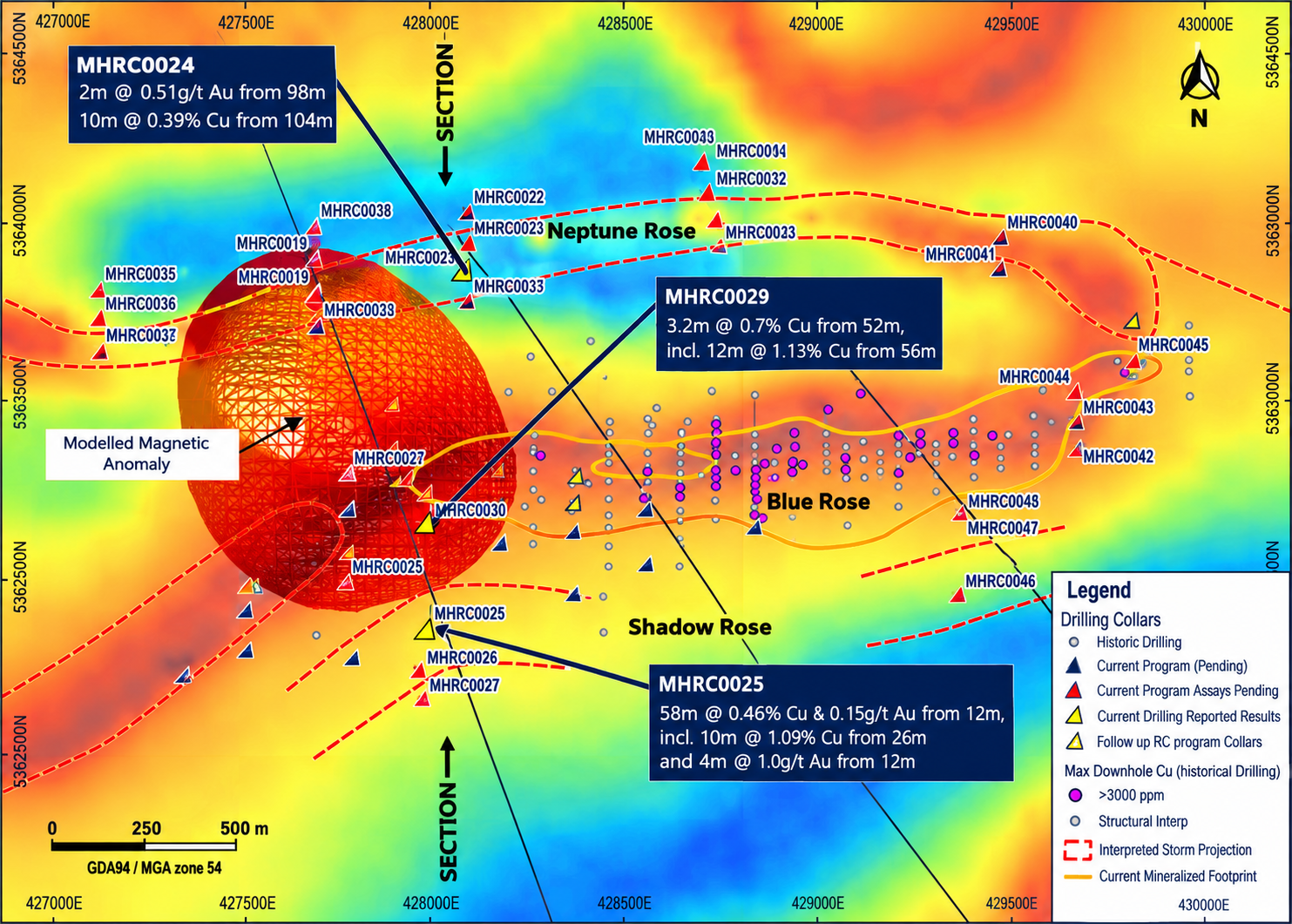
Source: News Release, Drill Results New Copper Discoveries Manna Hill
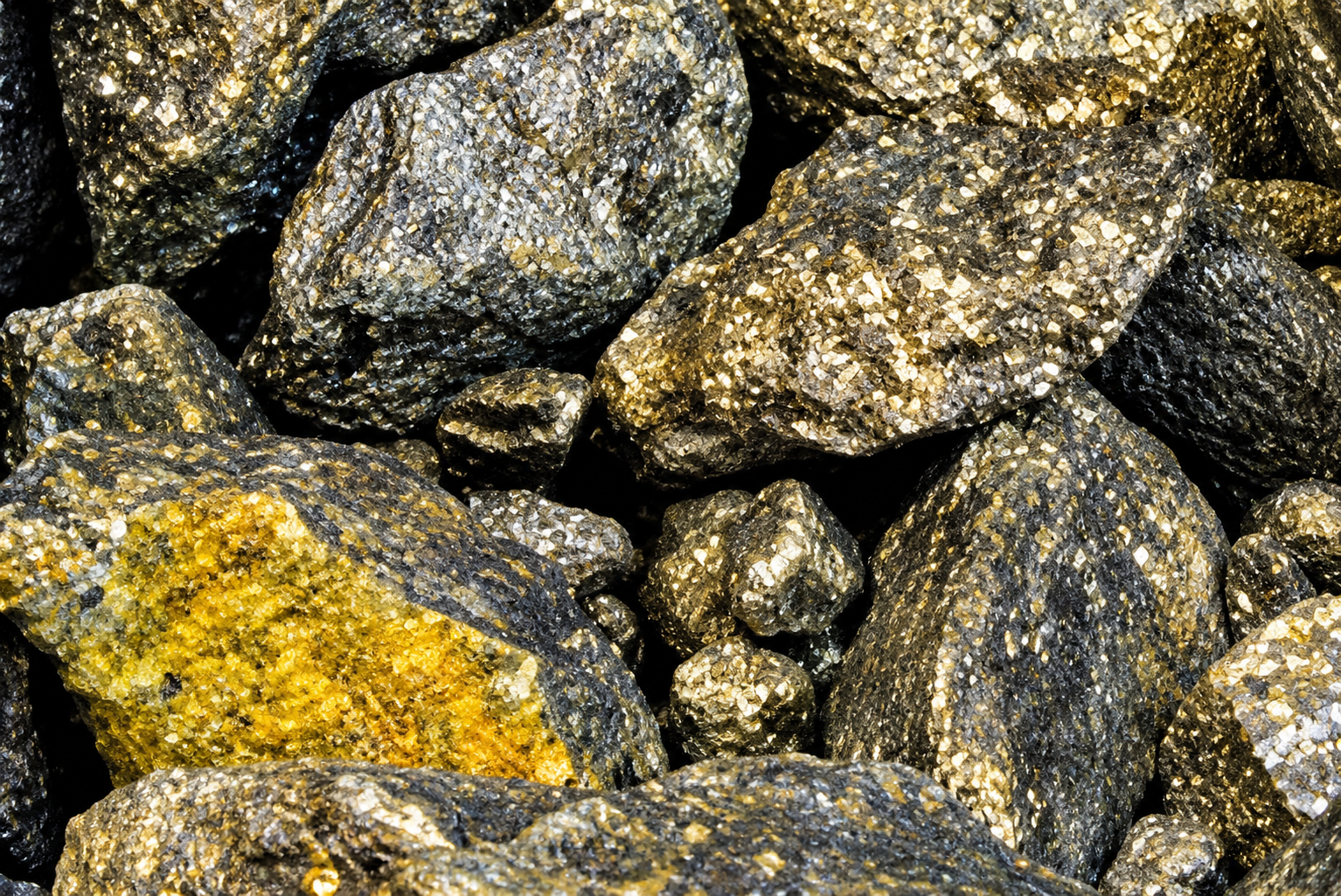
The mineralisation itself also supports the porphyry reading. Most of the MHRC0029 interval associated with the potassic alteration is sulphide from around 50m, and the release includes a photograph of coarse chalcopyrite and pyrite in chips grading 1.7% Cu. Six additional holes have been designed to test the modelled magnetic body and establish how large the copper-potassic zone might be.
Shadow Rose and Neptune Rose Broaden the Footprint
While Blue Rose West carries the porphyry argument, the two new skarns carry the near-surface tonnage argument. Shadow Rose lies about 200m south of Blue Rose discovery, and its 58m intercept starts at only 12m depth. Verco said the company potentially has a 2km strike zone to test along trend from this intersection toward outcropping skarn exposure. Four further holes are planned to test that strike extent.
Two further Shadow Rose holes are awaiting assays, strong copper oxides from 10m to 34m and intermittent sulphides from 66m to 100m and moderate copper oxides from 26m to 40m. Neptune Rose, about 500m north of Blue Rose, is interpreted as a northern fold limb of the Blue Rose skarn host. Its first assays are more modest, with a second hole also pending.
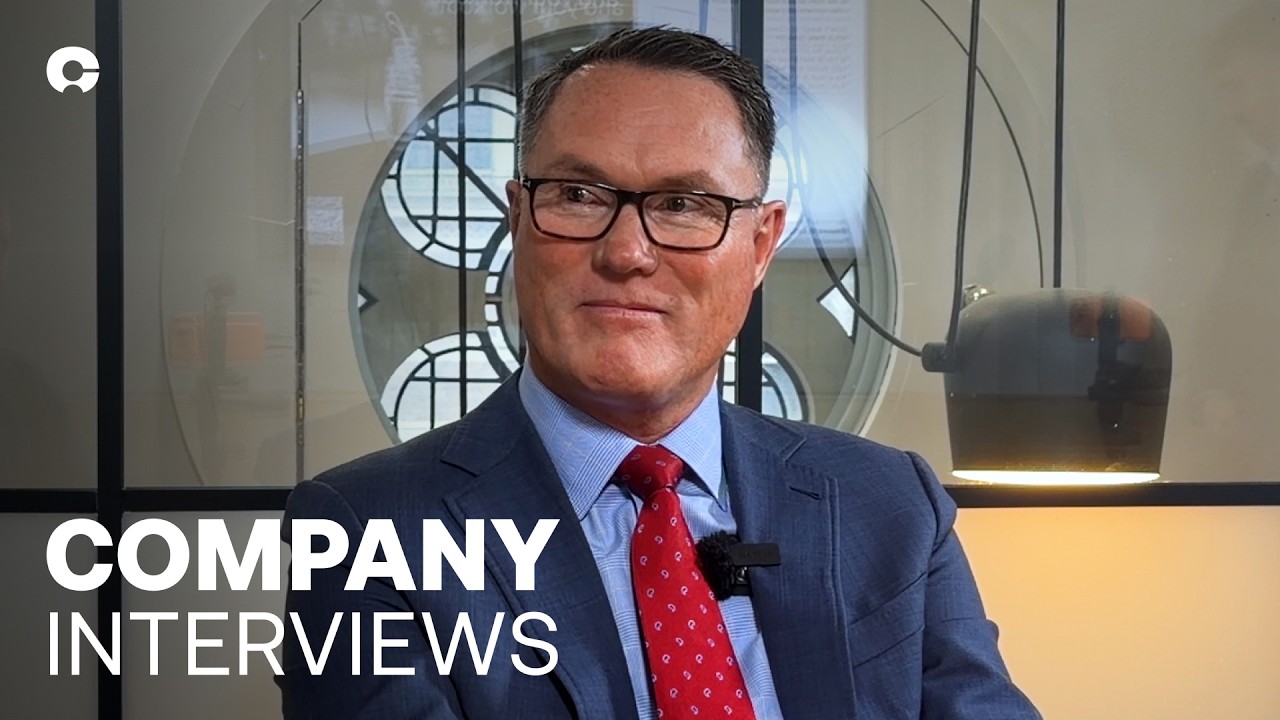
Interview with Rupert Verco, Managing Director and CEO, Cobra Resources
Structural Controls Shaping Upcoming Drilling Campaigns
Converting these intercepts into a resource depends on understanding their orientation. Verco said the dip direction of the new mineralisation still needs to be validated, and only more drill data across a wider area can do that. If the zones prove to be stratigraphic repeats within the skarns, he expects the mineralisation to be close to vertical. That would give the company a reliable basis for calculating true widths from its angled holes.
Verco described the remaining programme as broadly balanced between follow-up and new targets. He indicated roughly six to ten holes for the porphyry target and a further 15 to 20 across Blue Rose and Shadow Rose. The programme also includes Cobra's first drilling at the Netley Hill porphyry target, which carries known shallow mineralisation. According to Verco, it will be the first time Netley Hill has been drilled in over 20 years. Drilling at Netley Hill and Anabama Hill is scheduled for completion in November 2026.
Not all of the scale work depends on the drill bit. Cobra is running a large petrophysical programme on core drilled earlier in the year. Once the rock properties are understood, the team plans to select the most effective geophysical method and reprocess its existing data to map these zones. A detailed drone magnetic survey over Blue Rose and the surrounding prospects is also planned.
Deep Sulphide Raises Processing Considerations
The deeper picture remains supportive. Verco said earlier diamond drilling intersected sulphides down to around 320m to 350m, which gives the system real depth continuity. The new shallow sulphides at Blue Rose show that the near-surface copper is not simply an oxide halo. There is primary mineralisation beneath it.
Metallurgical testwork will follow this drilling. The company plans to sample a range of material to assess flotation options for sulphides and alternative processing routes for oxides. For now, Verco was clear about the order of priorities:
"Our main focus at present is to show this district scale. Scale first and then we'll address the [metallurgy] on this one. But with the sulphide mineralisation, we expect it to be fairly amenable to traditional flotation techniques."
That sequencing is reasonable for an explorer at this stage, but it does leave recovery assumptions untested. Oxide processing in particular remains an open question for any future economic study.
Budgetary Balance Across Dual Commodity Portfolios
Cobra says the extended programme is fully funded, including the additional holes, helped by a recent run of warrant exercises. Verco expects further copper results to reach the market over the coming weeks.
Over the next 12 months, Verco expects spending to split roughly 60/40 in favour of the company's rare earth project over copper, reflecting an upcoming pilot or small-scale production study for in situ recovery (ISR) at Wudinna. The board will assess the rare earth financing strategy and expects to pursue strategic offtake partnerships to help fund that project. Verco said the company needs to stay prudent with capital and maximise value for shareholders. Continued copper success should support that aim.
Investment Thesis for Cobra Resources
- Assays have converted visual and handheld XRF observations into confirmed copper intercepts at three targets, with Shadow Rose mineralisation starting at just 12m.
- Copper in potassic altered, non-skarn rock beside a large magnetic body at Blue Rose is the clearest near-surface evidence to date for a porphyry source at Manna Hill.
- Higher-grade cores of 1.09% to 1.33% Cu within broader intercepts underpin the case for a shallow, low strip ratio open-pit concept.
- The extended 64-hole programme is reported as fully funded, which limits near-term financing pressure on the copper programme
- Key watch-items are the pending assays from MHRC0026, MHRC0027 and MHRC0019, and the six holes targeting the magnetic anomaly.
- Risks include unconfirmed true widths, untested metallurgy (particularly for oxides) and the absence of any Mineral Resource estimate.
- Capital allocation is tilted toward rare earths over the next year, so the copper programme competes with a second development asset for funding and attention.
Macro Thematic Analysis
Copper exploration has become a contest for scale. Producers and investors continue to look for deposits that can support long-life, low-cost operations, and genuinely new porphyry discoveries in stable jurisdictions are rare. South Australia already hosts some of the world's major copper-gold systems, which gives explorers in the state a geological and regulatory backdrop that investors understand.
Within that setting, a company like Cobra is effectively offering two layers of optionality. The first is near-surface skarn copper that could, if drilling confirms continuity, support a shallow, low strip ratio open-pit concept. The second is a deeper porphyry source that would change the scale of the project entirely. Verco framed the near-surface opportunity in economic terms:
"When you have something so shallow and pretty good grades, like seeing 10 to 12m intersections at over 1 to 1.2%, when you have those kind of economic enablers with the widths that we're seeing, we think that by stepping out and testing more of that shallow scale. We can deliver something that's going to support some very good economics."
The logic is that each shallow step-out also adds geochemical data that helps vector toward the porphyry source. If it works, the company builds an inventory and a deeper target at the same time. The market typically rewards that kind of compounding evidence before a resource is published, but it also punishes programmes that fail to show continuity. Shallow copper with early sulphides also matters for development pathways, since it can lower upfront strip and haulage costs compared with deep underground projects. For junior explorers, that profile tends to attract interest from larger operators looking for growth options.
TL;DR
Cobra Resources has released the first laboratory assays from its Manna Hill copper programme in South Australia, confirming shallow copper in two new skarns and in porphyry-style potassic alteration at Blue Rose. MHRC0029 returned 32m at 0.70% Cu from 52m beside a large magnetic anomaly that management believes may be the porphyry intrusion, while Shadow Rose returned 58m at 0.46% Cu from 12m. The programme has grown to 64 holes and is reported as fully funded. Pending assays, six holes into the magnetic body and first Netley Hill drilling are the next catalysts. True widths, metallurgy and a rare earth-weighted budget remain the key open questions.
FAQ (AI-generated)
Analyst's Notes





Subscribe to Our Channel






Stay Informed


