How to Invest Like an Asset Manager



Top junior mining investor Michael Gentile of Bastion caps losses with 1% entries, contrarian timing, insider ownership tests and strict dilution limits.
- Junior mining returns are uneven, so a portfolio built to absorb many small failures can still compound through a few large winners.
- Capital deployed when the outlook is positive but sentiment is negative captures the widest discounts, provided the holding period runs five to 10 years.
- Staged funding tied to milestones turns position sizing into the main tool for controlling risk in a sector where most projects never become mines.
- Management teams that own a meaningful share of the company, bought with their own cash, tend to defend shareholders against dilution during downturns.
- Exploration, studies and construction require different skills, and boards that bring in mine builders at the right stage keep the path to value intact.
Michael Gentile, founding partner and senior portfolio manager at Bastion Asset Management, is a top shareholder in more than 30 junior mining companies. His approach starts from an uncomfortable premise. He expects about 70% of what he buys never to become a mine, and he regards 20% to 30% of investments going all the way as a good result.
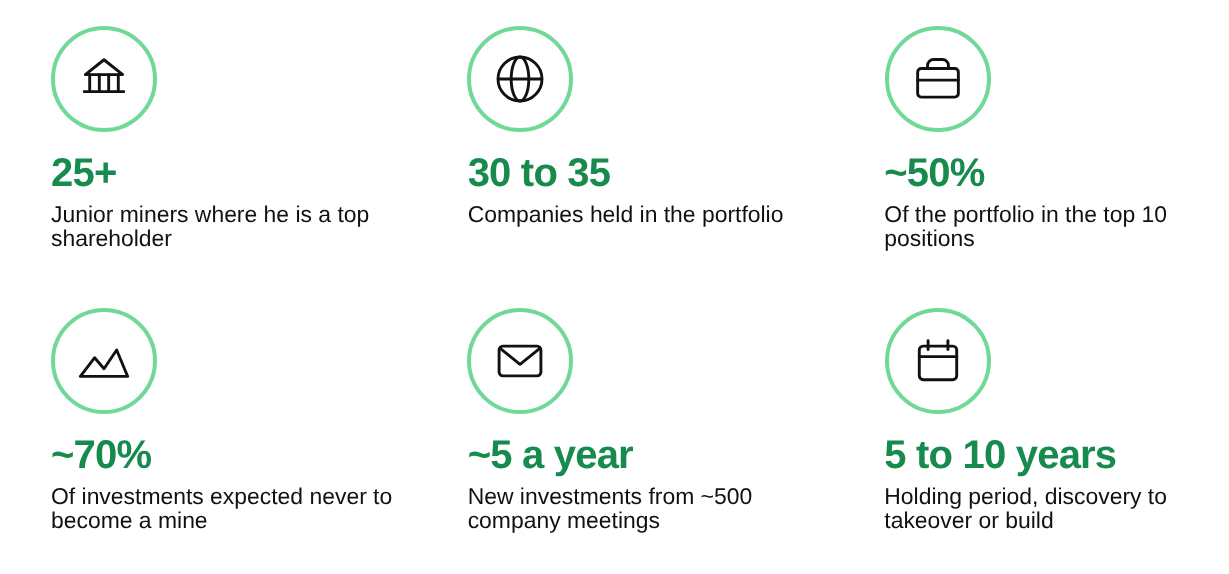
Michael Gentile's Junior Mining Portfolio. Source: Crux Investor Analysis
Returns therefore depend less on picking every winner than on controlling what each failure costs. Gentile's process combines contrarian timing, staged position sizing, strict management tests, and a firm line on dilution, which explains why he holds the companies he does.
Junior Mining Rewards Buyers Who Wait Out the Slump
Gentile invests most heavily when his outlook for metals is positive, and market sentiment is negative. The lesson dates back to the start of his career, when crude oil traded at $10 per barrel, against forecasts of $5, and then rallied to $140. In January and February 2026, with the junior market running hot, the few companies he liked were either too expensive or had easy access to capital elsewhere.
The mid-2026 pullback reversed the picture. Bullish sentiment on the NYSE Arca Gold BUGS Index (HUI) fell to near zero, and net speculative positioning in Comex gold sat at minus 10% to minus 20%. Gentile responded with his largest four-month capital deployment to date. He does not sell on price alone, separating pullbacks within a bull market from genuine changes to his macro outlook. Gentile describes the environment he considers ideal:
"My favorite environment in the commodity market is kind of where we're entering back into now, which is my outlook is positive, but the sentiment is negative. That is actually the best place."
His five- to 10-year holding period reflects the typical time from discovery to an asset desirable enough to be acquired or built, and he has recorded five or six takeovers in eight to nine years of full-time junior investing. He is not a permanent bull: in a frothy market, he would move 40% - 50% of the portfolio into cash.
Small First Bets Let the Winners Pick Themselves
Gentile holds 30 to 35 companies, with about half the portfolio in the top 10 positions. He makes about five new investments a year out of roughly 500 company meetings.
A 1% Entry Caps the Cost of Being Wrong
Each new position starts with 1% of his available capital, buying 5% to 20% of a company, usually at a market value below $30 million to $50 million. If the company delivers, he adds roughly four more tranches of similar size through later financings over about five years, taking the position to about 5% of book capital. Gentile describes his cut-off rule:
"My first ticket is 1% of my available capital... If they're not delivering, either disappointed me, geologically speaking, or management-wise or strategy-wise, I turn off the tap. So in that case, the most I can lose is 1% of my available capital."
A one-page note for each holding sets out why he owns the stock and what he expects over three to five years; when the criteria no longer apply, he sells. Decisions to add capital follow the same logic and rest on today's market value against realizable value, not his entry price. He kept buying Maple Gold Mines, an explorer in Quebec's Abitibi region, after its shares rose 400% to 500%, because its deposit had grown by about 80%.
Ownership Stakes of 5% to 20% Give Him a Voice on the Register
Disclosed holdings sit inside his target range. Gentile owns 13.6% of Group Eleven Resources, an explorer in Ireland, alongside Glencore at 12.8%. Its Ballywire discovery has 3.2 kilometers of mineralized strike and no resource yet. He holds 11.4% of Capitan Silver, an explorer running a 60,000-meter drill program at Cruz de Plata in Durango, Mexico, ahead of a first resource.
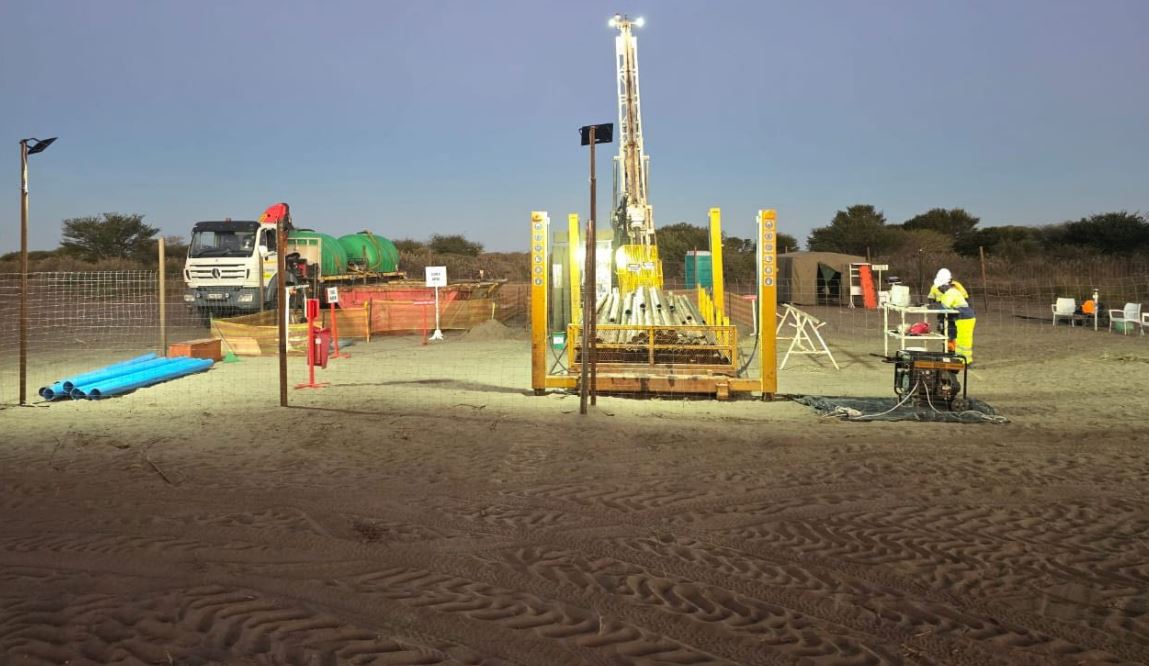
Earlier-stage positions follow the same small-ticket logic. Leviathan Metals is drilling next to MMG's Khoemacau operation in Botswana. Valkea Resources is exploring about 15 kilometers from the Kittilä deposit in Finland, and Roscan Gold holds permits contiguous to B2Gold's Fekola mine in Mali. In Atlantic Canada, Magna Terra Minerals holds about 150,000 ounces of Inferred gold resources at Cape Spencer, New Brunswick.
Management Money on the Line Protects Shareholders
Cheap options and gifted stock do not count. He also asks whether a team has built a mine or advanced an asset to a good exit, and he wants technical and financial strength in the same team. He walks away from good assets run by teams he does not trust, and he takes no salary, fees or consulting income from his companies.
Insider Buying Separates Owners From Renters
In Gentile's view, insider ownership is the clearest guide to how a team will behave under pressure. He explains why the level of ownership matters:
"If you have management and board that owns 10 to 30% of the company, when the going gets tough, they roll up their sleeves, and they protect shareholders at all costs."
Galway Metals, an advanced explorer in New Brunswick targeting a preliminary economic assessment in early 2027, met the test. Management, insiders and family hold 15%, and Gentile became the largest shareholder after investing in September 2026.
The pattern repeats across the portfolio. Management and the board own about 40% of Solstice Gold, an Ontario explorer, and insiders hold about 16% of NiCAN, a Manitoba explorer. At Silver Crown Royalties, a silver royalty company, management took up more than half of a C$1.00 private placement.
Dilution Does More Damage Than a Bad Drill Hole
Gentile ranks financing mistakes above exploration failure, because dilution can wipe out the return even when the project succeeds:
“They end up diluting themselves so badly that the mine goes on to production, but you don’t make any money. That to me is a travesty. I can accept bad geology... but finding a winner and not getting paid for it is a disaster.”
Many of Gentile’s companies cut general and administrative costs to $300,000 to $400,000 a year in 2022 and 2023, halted promotional spending and deferred salaries or took them in shares. Management at Astra Exploration, an explorer in Argentina in which Gentile holds 15%, suspended salaries entirely. He also aims to fund companies 12 to 24 months in advance, so none have to raise money during a market downturn.
Buying Cheap Ground Beats Drilling in a Downturn
At Big Ridge Gold, Gentile chose consolidation over drilling while the market priced ounces below their discovery cost:
“What’s the point of drilling for ounces when you’re going to find them for 15 or 20 and you’re trading at five? It’s just massively dilutive for shareholders... They had a 50% interest in the project. They consolidated that to 100% ownership at a very low price in the middle of the bear market.”
The stock traded at $5 to $10 per ounce in the ground, while new discoveries would have cost $15 to $20 per ounce. The company instead consolidated its Hope Brook project from 50% to 100%, bought out a 20% shareholder block that had weighed on the stock, and removed a $5 million to $10 million earn-in commitment. Gentile then lifted his stake from 10% to 20%. Hope Brook, a past producer, holds 1.13 million indicated ounces, and drilling resumed in August 2026.
Balance sheet repair follows the same principle. McFarlane Lake Mining carried US$15 million of debt against a C$40 million to C$50 million market value, with warrants held by fast-money investors. Gentile’s cheque and an early warrant exercise cleared the debt, and the stock moved from about $10 per ounce to $50 to $60 per ounce.
Exploration Teams Rarely Build the Mine
Discovery, economic studies and construction each require different expertise. Gentile relies on mine builders, geologists and engineers, and his management test includes recognising when the current team is no longer the right one.
Radisson Mining Resources, a developer at O'Brien in Quebec's Abitibi region with a 2025 preliminary economic assessment, followed the sequence. At 400,000 to 900,000 ounces, mine builders considered the deposit too small. Pierre Beaudoin joined the board once it passed one million ounces, and under Chief Executive Officer Matt Manson, the resource has grown to 2.3 million ounces. Agnico Eagle invested C$57 million for a 10.45% stake in September 2026 to fund underground access targeted for 2029.
A handoff can also mean a sale. Gentile accepted IAMGOLD's offer for Northern Superior Resources at about US$80 per ounce, judging IAMGOLD's shares to be the better vehicle. In a share-based sale, Gentile looks at what the acquirer’s shares are likely to do after the deal, not just the headline premium:
“When you’re selling your company, the paper you get back is really important, and IAMGOLD’s paper has gone up 50, 60% since the transaction.”
A Repeatable System Matters More in a Volatile Sector
Gentile's results rest on four connected disciplines. Capital goes to work when sentiment is weakest. Initial positions of 1% cap the cost of the 70% of investments expected to fall short, while follow-on tranches concentrate capital in companies hitting milestones. Insider ownership and firm limits on dilution protect each shareholder's claim on a discovery, and handoffs to mine builders or acquirers convert ounces in the ground into realized value.
Each discipline addresses a distinct way junior investments lose money: buying at the wrong price, overcommitting to a failing investment, losing value to dilution, and stalling at the development stage.
The Investment Thesis for a Junior Mining Portfolio
- Periods of negative sentiment combined with a positive metals outlook offer the widest discounts, and pullbacks within a bull market are buying windows rather than exit signals.
- Small initial positions, with follow-on capital tied to milestones, limit any single failure to a fixed share of capital and allow concentration to build from results.
- Management ownership of 10% to 30%, bought with cash, signals how a team will act when capital is scarce.
- Share count growth during a downturn deserves more scrutiny than a weak drill result, and companies trading below the cost of discovery gain more from consolidation than from drilling.
- Boards should change as projects move toward construction, and the choice of acquirer matters as much as the price.
The mid-2026 pullback left sentiment depressed while the outlook for metals stayed positive, a combination Gentile describes as his favorite environment. Over the next five to 10 years, a small number of juniors will advance from discovery to acquisition or construction, and most will not.
Outcomes will turn on the structure around each asset: who owns the shares, how capital is raised and when a team steps aside for builders or buyers. Portfolios sized to survive repeated failures, and concentrated only as milestones are met, stand to capture the gains when a takeover or mine build arrives.
TL;DR
Michael Gentile, a top shareholder in more than 25 junior mining companies, expects about 70% of his investments to never become mines, so his process focuses on limiting the cost of each failure. He invests most heavily when his metals outlook is positive and sentiment is negative, as during the mid-2026 pullback, and holds for five to 10 years. Each position starts at 1% of capital, with follow-on tranches only upon meeting milestones. He backs management teams that own 10% to 30% of their companies with their own cash, treats dilution as the main threat to returns, and prefers consolidation over drilling when ounces trade below discovery cost. Boards should bring in mine builders or sell, as projects advance.
FAQs (AI-Generated)
Analyst's Notes





Subscribe to Our Channel









Stay Informed