New Mines Are Scarce; Target Funded Mining Juniors Before Major Project Milestones


Takeover premiums near 70% and a thinning pipeline of build-ready mines are pushing mining M&A toward earlier-stage juniors with scale and funding.
- Record producer margins have not carried through to junior valuations, leaving undeveloped deposits priced well below recent takeover values.
- Major producers have acquired most of the build-ready projects available, which moves buying interest toward projects still several years from production.
- Takeover premiums near 70% in 2026 have reset the reference price for undeveloped ounces held by juniors.
- Buyers place more weight on scale and district control than on single high-grade deposits, while royalties offer exposure to the cycle without construction risk.
- Funding runway, rather than metal prices alone, decides which juniors keep advancing through market pullbacks.
Producer Margins $3,000 an Ounce Leave Junior Valuations Behind
Gold set a record quarterly average of US$4,873 an ounce in the first quarter of 2026, after peaking at US$5,405 an ounce in January, according to the World Gold Council. Average all-in sustaining costs rose 16% year on year to US$1,785 an ounce, yet producer margins climbed 134% to a record US$3,076 an ounce. Gold has since eased to US$4,189 an ounce as of 16 October 2026, 4.1% lower for the year, a price still more than double the first-quarter average cost of production.
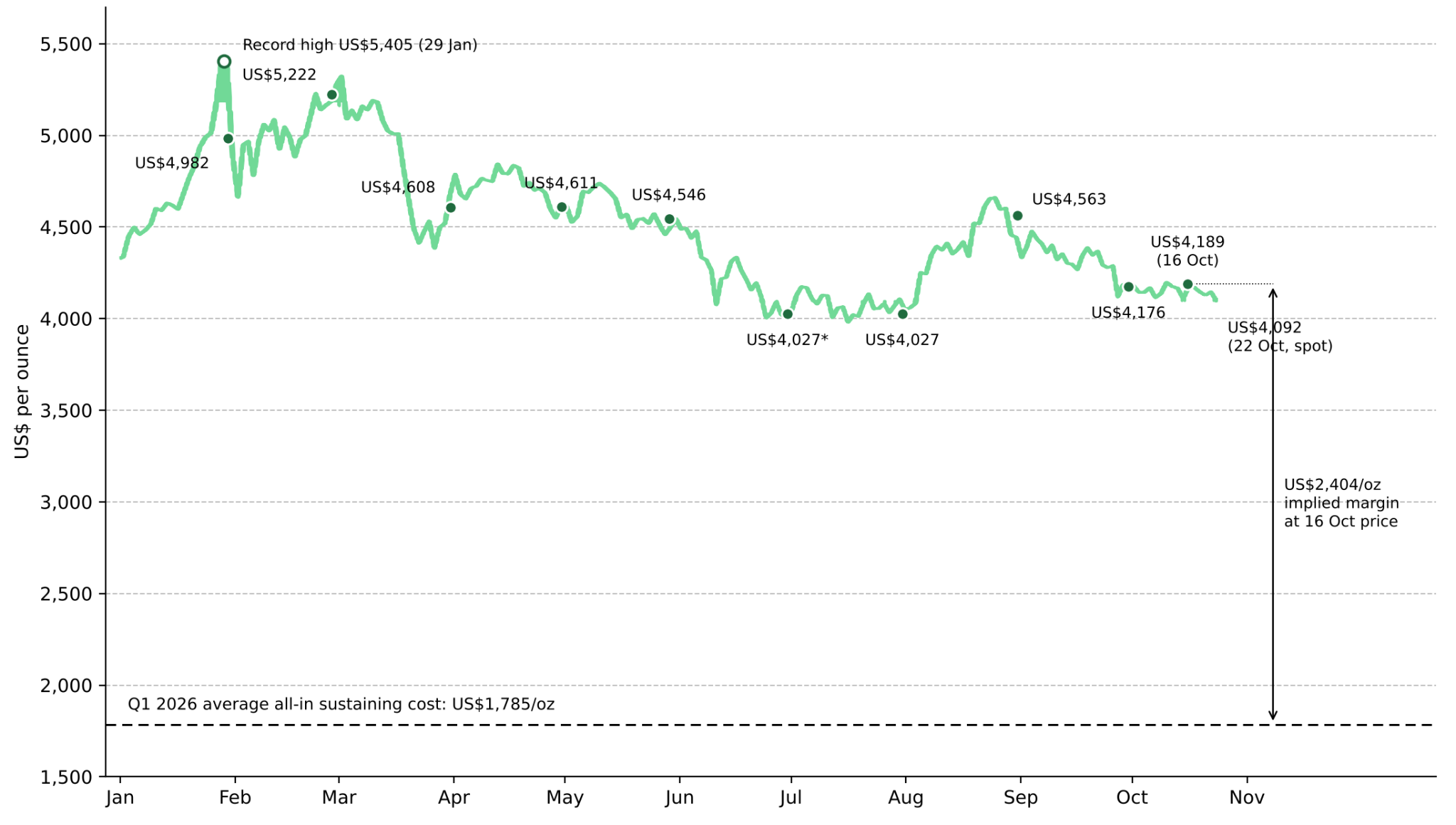
Junior valuations have not followed. Peer groups in October 2026 company presentations place development-stage gold projects at an average of US$48 per resource ounce on an enterprise value basis, and C$103 per ounce on a market capitalization basis. Producers, meanwhile, have turned record cash flow into stronger balance sheets. A host of producers now hold net cash positions; AngloGold Ashanti moved from net debt to net cash, and Newmont returned US$2.7 billion to shareholders in the first quarter while approving a further US$6.0 billion share buyback. The result is buying capacity across the sector, combined with a standing need to replace reserves as existing mines deplete.
The gap between producer cash flow and junior pricing defines where capital moves next. The further a project sits from production, the more its value depends on scale, location and funding rather than on the gold price alone.
Gentile Values Ounces Only Where a Path to Production Exists
Michael Gentile, co-founder of Bastion Asset Management and a top shareholder in more than 25 junior mining companies, applies a simple valuation rule to undeveloped deposits. An ounce in the ground carries one of two values: zero if the deposit never becomes a mine, or far more than junior equities currently imply if it does. Gentile holds positions in, or advises, five of the six companies discussed below.
Gentile’s screen starts with stage. Investment comes only after a discovery, avoiding the failure rate of pre-discovery exploration, and requires a path to production or acquisition within two to 10 years. Location ranks ahead of grade: a 3 to 4 grams per tonne deposit next to existing infrastructure is more favorable than a 7 grams per tonne deposit in a remote region, because the capital required decides the return.
Management teams are expected to have built mines or sold projects to major producers before, with boards and management owning 10% to 30% of the company through shares bought with their own cash. Companies in Gentile’s portfolio are also financed 12 to 24 months ahead of need.
The criteria carry more weight now because the supply of projects meeting them has narrowed, while the price buyers pay for qualifying ounces has risen. Gentile states the valuation gap plainly:
"Ounces have two values to me... they're either worth zero or they're worth a heck of a lot more than the stocks are trading today."
Takeover Premiums Near 70% Signal a Thinning Pipeline of Build-Ready Projects
Gentile points to two 2026 transactions as reference points. G Mining Ventures acquired G2 Goldfields for about US$600 an ounce, and Agnico Eagle acquired Rupert Resources for about US$500 an ounce, both at premiums near 70%. Gentile links the higher prices to a shortage of near-term supply:
"Anything within 6 months to 18 months of getting a permit and close to a construction decision that had attractive economics, most of that's also been acquired, so the cupboard is kind of bare... It's now natural that you're seeing assets like Rupert get acquired that are still several years away."
Galway Metals holds 2.7 million ounces of gold at Clarence Stream in New Brunswick, 1.42 million of them indicated at 1.62 grams per tonne, with 88% inside open-pit shells and an antimony resource alongside. A Preliminary Economic Assessment is targeted for early 2027, backed by C$24.2 million in cash and no debt.
McFarlane Lake Mining reported 6.16 million ounces at its Juby Gold Project in Ontario’s Abitibi region, including 1.07 million ounces indicated at 0.96 grams per tonne. The company closed a C$17.25 million buy deal, paid down more than US$13 million of debt to leave US$1.7 million outstanding, and plans a 50,000-meter drill program ahead of a 2027 scoping study. Mark Trevisiol, President & Chief Executive Officer, expects drilling to prove up a global-scale resource:
"We’re very confident in the geology… You're starting to look at 500,000 ounces a year and really get to the scale that is a global setting scale."
Scale Draws Buyers Before Deposits Are Fully Defined
Gentile expects the deals most likely in the next 12 to 24 months to involve projects able to reach production within two to 10 years. Rupert Resources was acquired several years before first production, which places study-stage and late-exploration projects within reach of buyers for the first time in the current cycle.
Size, rather than study completion, increasingly determines which projects attract attention, since a buyer assessing replacement production needs a deposit large enough to justify the capital.
Astra Exploration is drilling La Manchuria in Argentina's Santa Cruz province, where intercepts include 20.5 meters at 10.4 grams per tonne gold and 810 grams per tonne silver. Four parallel zones remain open, and a 10,000 to 20,000-meter program runs into 2027, funded by about C$13.7 million in cash as of June 2026. Brian Miller, Chief Executive Officer, explains why a resource estimate is on hold:
“We weren’t going to do an updated mineral resource until we could outline a million ounces... What we’re focusing on right now is trying to get to that million-ounce threshold and demonstrating size and scalability with it.”
The size of a deposit also shapes who is likely to buy it. A smaller deposit suits an open-pit starter operation and a regional producer, while a larger discovery widens the field to mid-tier and senior producers seeking growth.
Majors Pay for District Control Over Single Deposits
Major producers seek 20 to 30 years of production around an existing operation, as Agnico Eagle has built in Finland. Ground beside a major's operating mine carries value beyond its own geology, because a discovery there extends the life of an established hub and gives the neighboring operator a direct reason to buy. The same logic applies across commodities. A copper or zinc producer expanding an established camp weighs adjacent ground by geological continuity and shared operating base, not by a standalone study, which brings discovery-stage projects into view earlier than a remote deposit of similar size.
Leviathan Metals holds the Central Copper Project in Botswana’s Kalahari Copper Belt, adjacent to Khoemacau, which MMG acquired in 2023 for US$1.9 billion and which hosts measured and indicated resources of 94 million tonnes at 1.8% copper. Leviathan’s ground covers about 20 kilometers of the deposit-hosting contact, with drilling under way and C$9.25 million in cash. Jeremy Crozier, Chief Operating Officer, describes how MMG has committed capital to the Kalahari Copper Belt since its purchase:
“MMG acquired this property for $1.9 billion about two years ago. The global resources in excess of 450 million tons close to 2% copper... Since that acquisition, MMG invested a further $900 million in the property to double the throughput.”
Group Eleven Resources is drilling its Ballywire discovery along a six-kilometer trend in Ireland, next to Glencore's Pallas Green deposit of 45.4 million tonnes at 8.4% zinc and lead combined. The company is ramping up to 70,000 meters with four to five rigs and has shifted its focus toward copper-silver structures, which align with the European Union's Critical Raw Materials Act. Bart Jaworski, Chief Executive Officer, explains the reasoning behind Gentile’s investment:
“Glencore had a large discovery next to our ground… He realized we don’t need to actually find that much to light up the camp vis-a-vis what’s going on across the fence with Glencore’s ground.”
Royalties Capture the Cycle Without Construction Risk
Exposure to higher metal prices does not require development risk. Silver produced as a byproduct at gold, copper and polymetallic mines often goes unmeasured by the operator, which leaves revenue available to a royalty holder willing to finance the producer in exchange for a share of output. The operator gains capital without diluting shareholders, and the royalty holder gains production without funding a mine.
Silver Crown Royalties acquires silver-only royalties registered on title, with minimum delivery obligations and staged payments. Six royalties have closed at a portfolio internal rate of return above 30% at current silver prices, drawing on a pipeline of about 2,400 operating mines with byproduct silver. Michael Gentile, Silver Crown’s Strategic Advisor, explains how structure limits risk:
"These are take-or-pay... if for whatever reason the silver is not there that quarter or that month, they're still paying us and the gold is driving the revenue."
Funding Runway Decides Which Juniors Advance Through Market Pullbacks
Gentile expects geopolitical tension to support gold over the medium to long term while producing short-term market dislocations. Junior equities absorb the sharpest moves in such periods, and companies forced to raise capital into a falling market dilute shareholders at the point of lowest valuation. Financing 12 to 24 months ahead allows a company to keep drilling through a closed market rather than pausing work to raise money.
The buying cycle described above rewards projects still advancing when buyers arrive. Producer cash flow, depleted build-ready pipelines and takeover premiums near 70% have widened the window for study-stage, discovery-stage and district-scale projects. Projects funded through their next drill program or study can reach a buyer's threshold, while unfunded projects risk stalling before buyer demand reaches them.
The distinction carries most weight for projects approaching a defined threshold: a resource estimate near one million ounces, a first economic study, or a second discovery in an established camp. Each milestone moves a project from speculative ground toward the stage buyers now target, and reaching it on schedule depends on capital raised before markets turn.
The Investment Thesis for Earlier-Stage Mining Projects
- Takeover pricing near 70% premiums sets the benchmark for undeveloped ounces; per-ounce valuations well below recent deal values mark where re-rating potential sits for projects with a credible route to production.
- Scale toward roughly one million ounces, or district-level potential, carries more weight with buyers sizing replacement production than grade alone.
- Ground beside an operating major gives a discovery a natural buyer and a shared operating base, bringing earlier-stage projects into view before a standalone study.
- Cash runway of 12 to 24 months against the drill or study schedule separates funded catalysts from dilution risk.
- Insider ownership of 10% to 30%, bought with cash, signals alignment through financing cycles.
- Royalties with minimum delivery terms provide exposure to the same cycle with lower construction and operating risk.
Producer cash flow has built buying capacity across the sector just as the pipeline of build-ready projects has thinned. Takeovers at premiums near 70% show buyers will pay for undeveloped ounces years before first production, provided scale, location and funding support a mine. The next stage of the cycle depends on how quickly study-stage and discovery-stage projects convert drilling into defined ounces, how far district positions beside operating majors extend established camps, and whether funding holds through periods of market stress. Valuation gaps between junior trading levels and takeover pricing remain wide, and the projects positioned to close the gap are the ones advancing on schedule with capital in place, while royalties offer a route into the same cycle without construction risk.
TL;DR
Record gold producer margins, which reached US$3,076 an ounce in the first quarter of 2026, have not carried through to junior valuations. Development-stage peers trade near US$48 per resource ounce, while 2026 takeovers of G2 Goldfields and Rupert Resources were priced at about US$500 to US$600 an ounce at premiums near 70%. With most build-ready projects already acquired, buyers are moving toward study-stage and discovery-stage deposits, where scale toward one million ounces and ground beside operating majors carry more weight than grade alone. Royalties offer exposure to the same cycle without construction risk. Funding runway of 12 to 24 months decides which juniors keep advancing through market pullbacks and reach the thresholds buyers now target.
FAQs (AI-Generated)
Analyst's Notes





Subscribe to Our Channel








Stay Informed