




OPEC+ Restores 3.5M bpd, but Export Risks Still Drive Oil Repricing


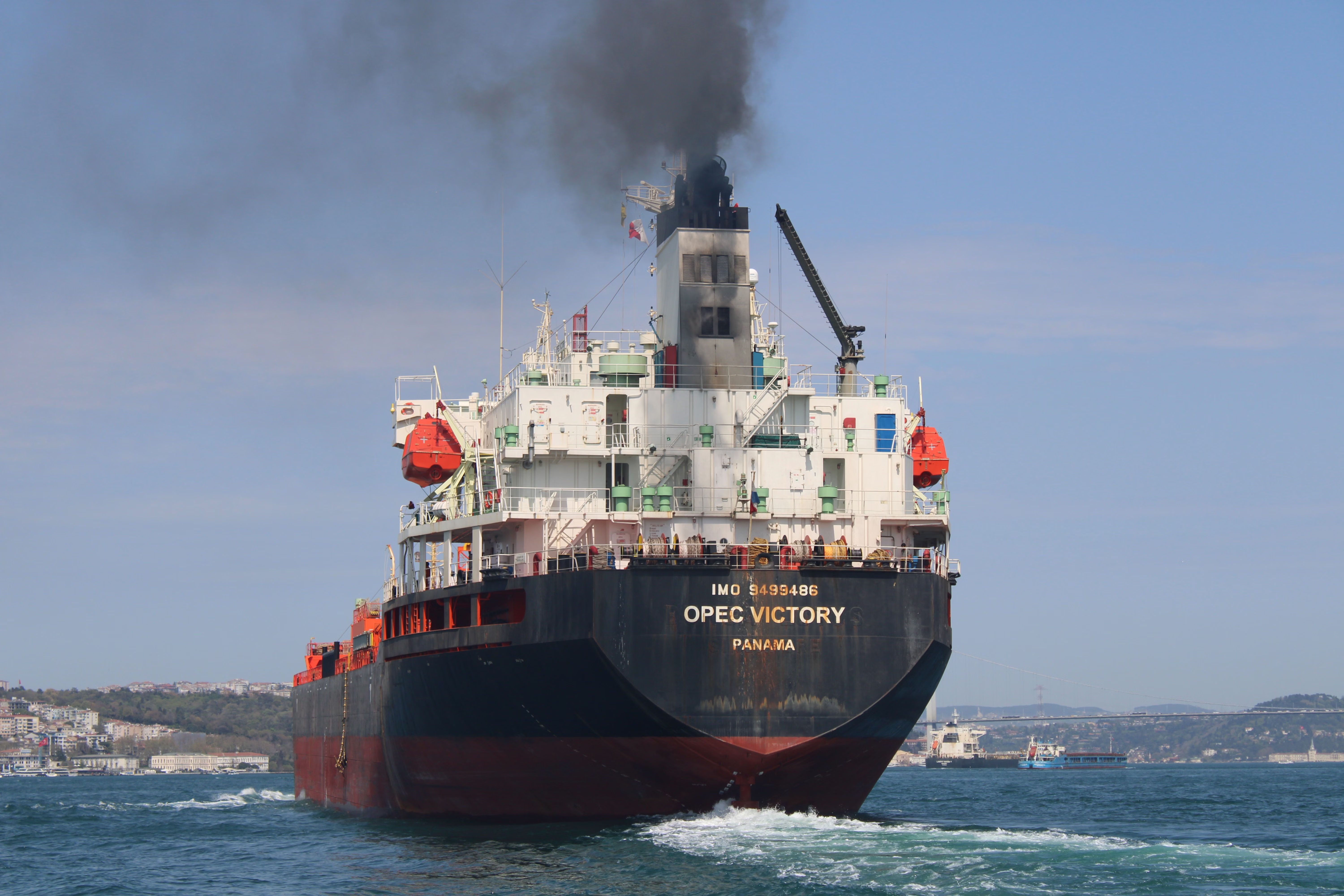
OPEC+ restored 3.5M bpd in production cuts, but export disruptions keep secure oil supply at a premium.
- The Organization of the Petroleum Exporting Countries and its allies (OPEC+) completed the reversal of approximately 3.5 million barrels per day (bpd) in 2023 production cuts with its September 2026 quota decision, yet Gulf physical exports remain roughly 40% below pre-war levels.
- Saudi Aramco cut its Arab Light official selling price (OSP) to Asia to a six-year low for September while asking Asian buyers to submit contingency crude nominations from ports outside the Strait of Hormuz, hedging against disruption to its primary export route.
- Barrels transported through infrastructure that avoids contested maritime corridors are commanding a premium over Gulf crude of comparable grade and quality.
- Global oil demand is on track for its first annual decline since 2020, increasing competition among suppliers and favoring barrels with lower logistics exposure over those with lower production costs alone.
- The same route-to-market assessment used for crude can also identify jurisdictional and logistics risks across mining supply chains.
OPEC+ Completes Quota Unwind, but Deliverable Barrels Remain Constrained
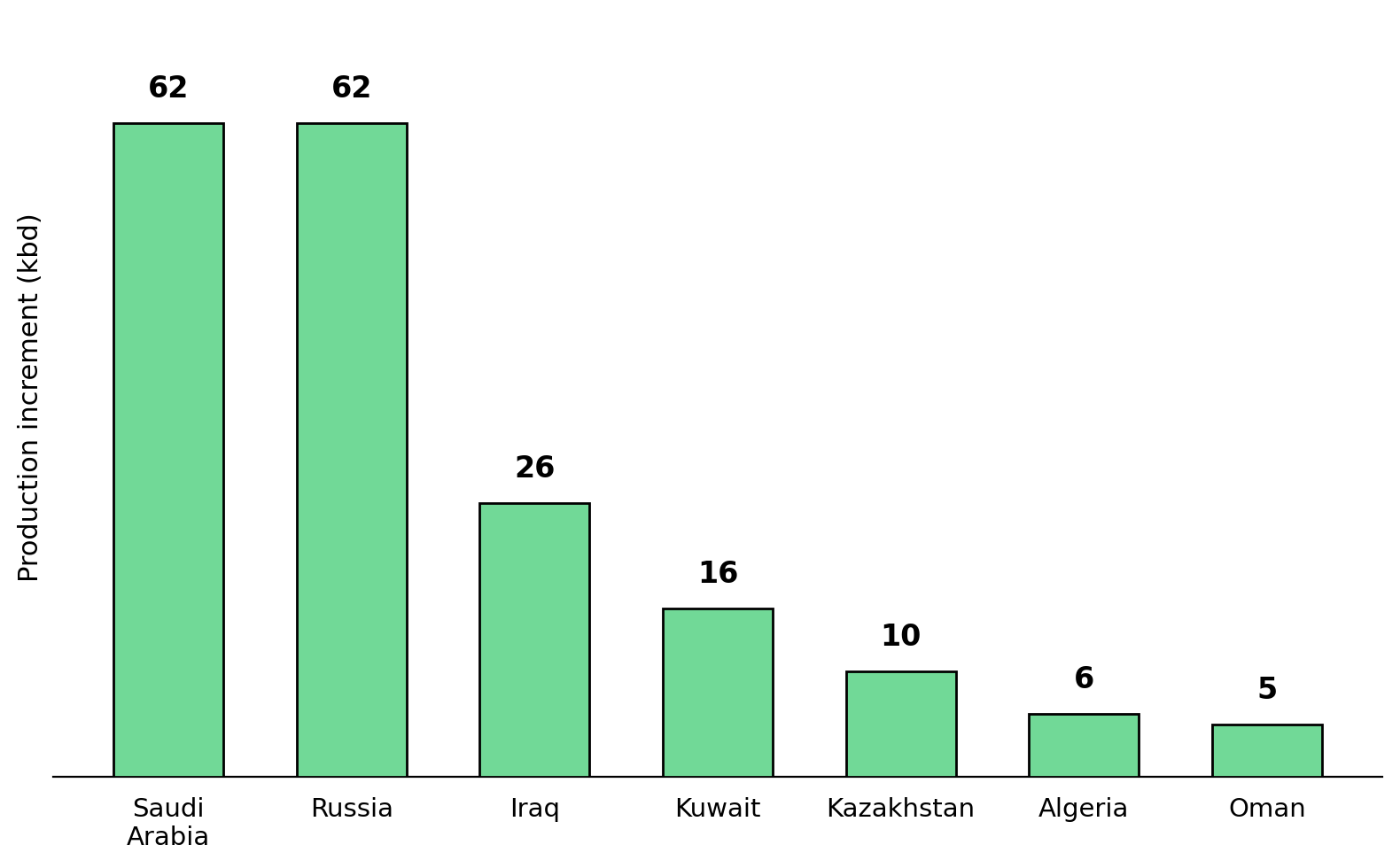
Seven OPEC+ members, Saudi Arabia, Russia, Iraq, Kuwait, Kazakhstan, Algeria, and Oman, agreed on August 2, 2026 to raise their collective production target by almost 190,000 bpd for September, completing the reversal of approximately 3.5 million bpd in voluntary production cuts first announced in 2023. The group has raised quotas every month during the current conflict, even as Gulf physical exports remain constrained. Delegates acknowledged that many OPEC+ members remain unable to produce to their allotted quotas because of technical and operational constraints that higher quotas alone cannot resolve.
The market has been slow to price the gap between announced production quotas and barrels that are actually delivered. Kpler data shows Gulf crude and condensate exports averaged approximately 10.7 million bpd in July 2026, still roughly 40% below the pre-war average of approximately 24 million bpd, when the region handled about one-fifth of global oil flows before the conflict began on February 28, 2026. The International Energy Agency (IEA) reports Gulf production remains 11.4 million bpd below pre-war levels. Global oil supply rebounded by 4.1 million bpd to 98.8 million bpd in June but remained 9.4 million bpd below its pre-war level.
Aramco's Contingency Planning Signals Export-Route Risk
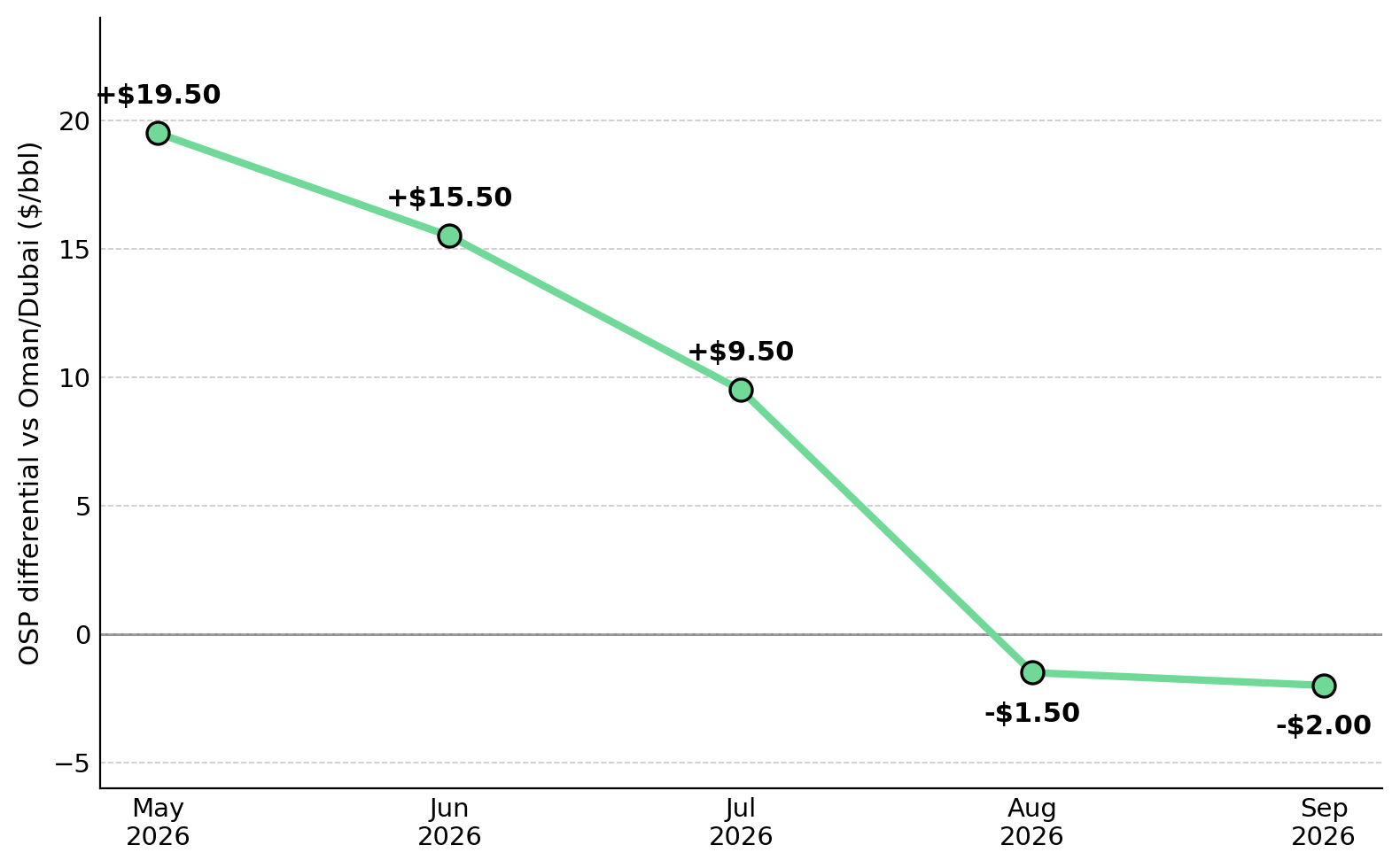
Saudi Aramco set its September Arab Light OSP for Asia at $2 per barrel below the Oman/Dubai average, the lowest level since June 2020 and deeper than the -$1.50 per barrel differential in August. The price cut reflected a weaker spot market, with Dubai cash premiums averaging $1.26 per barrel in July, down from $2.39 in June, even as Aramco raised its Arab Medium and Arab Heavy OSPs by $1.25 per barrel each.
Aramco's contingency shipping instructions provide a stronger signal than its September price cut. Alongside its September OSP announcement, Aramco asked Asian customers to submit crude nominations by August 7, 2026 for loading at Ras Tanura, its main export terminal inside the Strait of Hormuz, while also requesting alternative nominations from Yanbu or Sidi Kerir if the strait remains constrained. Only limited Arab Light volumes are available from those alternate ports. Aramco's contingency planning suggests export-route reliability should be assessed alongside crude prices when evaluating oil and gas assets over the next 12 to 24 months.
Export-Route Disruptions Lift Premiums for Secure Oil Supply
Oil export disruptions now extend beyond the Gulf. The Caspian Pipeline Consortium, which carries more than 80% of Kazakhstan's oil exports, has repeatedly suspended Black Sea loadings since July after Ukrainian drone strikes on its Novorossiysk terminal, reducing Kazakh output to approximately 1 million bpd from a June average of 2.16 million bpd. Houthi attacks on tankers in the Bab el-Mandeb reduced exports from Saudi Arabia's Red Sea port of Yanbu to 3 million bpd after July 20, down from 3.8 million bpd during April through June. With the Strait of Hormuz, the Bab el-Mandeb, and the Black Sea all facing disruptions, crude prices increasingly reflect export-route reliability as well as oil quality and production costs.
Dune Oil's disclosed route to market avoids contested maritime chokepoints, reducing exposure to the export disruptions affecting many international crude producers. The company holds a 29% working interest in Block M47, where a pipeline completed in 2026 supports additional export capacity without relying on contested shipping routes. A Chapman Petroleum Engineering resource report, effective December 31, 2025, estimates a 27.6 million barrel contingent (2C) resource net to the company's interest. The company estimates netbacks ranging from $44 per barrel at $65 Brent to $61 per barrel at $85 Brent, including approximately $50 per barrel at $72 Brent, across its published Brent price assumptions.
Scott Lower, President of Dune Oil, explains conventional light oil's lasting cost advantage:
"In North America now, you've pretty much run out of onshore conventional light oil because it's the best oil and the lowest cost. Production costs are about $50 a barrel. You go to the Zagros Basin, and they've always been able to produce at about $10 a barrel. We're estimating about $10 a barrel in production costs, compared to about $50 in North America."
Chokepoint Exposure Raises Logistics Risk for Mining Projects
Mining operations rely on the same roads, railways, ports, and shipping routes that transport crude oil. Diesel, reagents, and equipment move to mine sites, while mined materials move to processing facilities and end markets through these transport networks. As oil markets place greater value on secure transport routes, logistics risk may become a more important factor in evaluating mining projects.
Higher fuel and logistics costs are already affecting mining regions that rely heavily on imports. IEA data shows Australian retail diesel prices were approximately 47% higher year over year in early May 2026, with some operators reporting fuel costs more than double their original guidance assumptions. South African mining operations have also faced higher diesel costs, haulage rates, and generator fuel expenses at remote sites. These higher costs are not reflected in ore grade or strip ratio. Instead, they widen the gap between a project's modeled all-in sustaining cost (AISC) and its realized operating cost after fuel and logistics expenses are incurred. Development-stage project evaluations increasingly need to consider not only net-present value (NPV) and AISC assumptions, but also how project economics change if key transport corridors are disrupted.
Lower Oil Demand & Slow Inventory Rebuild Keep Secure Supply in Demand
Lower oil demand does not remove export-route constraints affecting global oil supply. The IEA projects global oil demand will decline by approximately 1 million bpd in 2026, the first annual contraction since 2020. The US Energy Information Administration (EIA) forecasts a slightly larger decline of approximately 1.2 million bpd, with 0.8 million bpd of that reduction concentrated in economies outside the Organization for Economic Co-operation and Development (OECD).
Low global oil inventories mean weaker demand is unlikely to eliminate the premium for secure supply routes. Saudi Aramco Chief Executive Officer Amin Nasser said in a Reuters interview that the world has lost more than 2.6 billion barrels of oil since the conflict began and that rebuilding global inventories would take approximately 18 months at 2.1 million bpd, even if the Strait of Hormuz reopened immediately.
Weaker oil demand does not remove the logistics constraints affecting global crude supply. With global inventories likely to take years rather than months to rebuild, supply with limited exposure to contested shipping routes may continue to command a premium.
The Investment Thesis for Oil & Gas
- Explorers and developers whose route to market bypasses maritime chokepoints may be better positioned during export disruptions, particularly where disclosed project economics demonstrate resilient netbacks across different oil prices.
- Producers with export routes concentrated through a single contested corridor may face higher logistics risk, regardless of resource quality or reservoir performance.
- Netbacks tested across a range of oil prices, rather than a single forecast price, provide a more complete view of how project economics may perform under different market conditions.
- Evaluating transport routes alongside project economics can provide a more complete assessment of mining developers and producers exposed to global supply-chain disruptions.
- A multi-year inventory rebuild means supply with limited exposure to contested shipping routes may continue to command a premium beyond the current period of geopolitical disruption.
- Route-to-market resilience can influence project economics alongside all-in sustaining cost, net-present value, and jurisdictional fiscal terms when assessing oil and gas exploration projects.
OPEC+ has restored production quotas, but physical supply continues to be constrained by export-route disruptions. As long as the gap between announced capacity and deliverable barrels persists, secure transport routes are likely to remain an important driver of project economics alongside production costs. The same principle extends beyond oil and gas. Route-to-market resilience can influence project economics across the mining sector, where fuel, equipment, and product shipments depend on many of the same transport networks. Projects that combine resilient economics with limited exposure to contested shipping routes may be better positioned while global supply disruptions continue.
TL;DR
OPEC+ has completed the reversal of its 2023 production cuts, but Gulf oil exports remain about 40% below pre-war levels because export routes, not production quotas, continue to constrain physical supply. Saudi Aramco's contingency shipping plans reinforce that logistics risk has become a key factor alongside crude prices when evaluating oil and gas assets. The article argues that projects with resilient netbacks and secure routes to market may be better positioned during prolonged supply disruptions. It also extends this framework to mining, where higher fuel and logistics costs can widen the gap between modeled and realized project economics, making transport resilience an increasingly important consideration.
FAQs (AI-Generated)
Analyst's Notes





Subscribe to Our Channel






Stay Informed


