




Platinum’s 28.7% Premium Restores Palladium’s Cost Edge, Widening PGM Valuations


Platinum’s 28.7% premium favors palladium substitution, while a 297,000-ounce deficit supports platinum prices and separates PGM valuations.
- Platinum traded at $1,756.90 per ounce on August 13, 2026, a $391.90 or 28.7% premium to palladium that increases automakers’ incentive to use palladium-rich autocatalysts where certification permits.
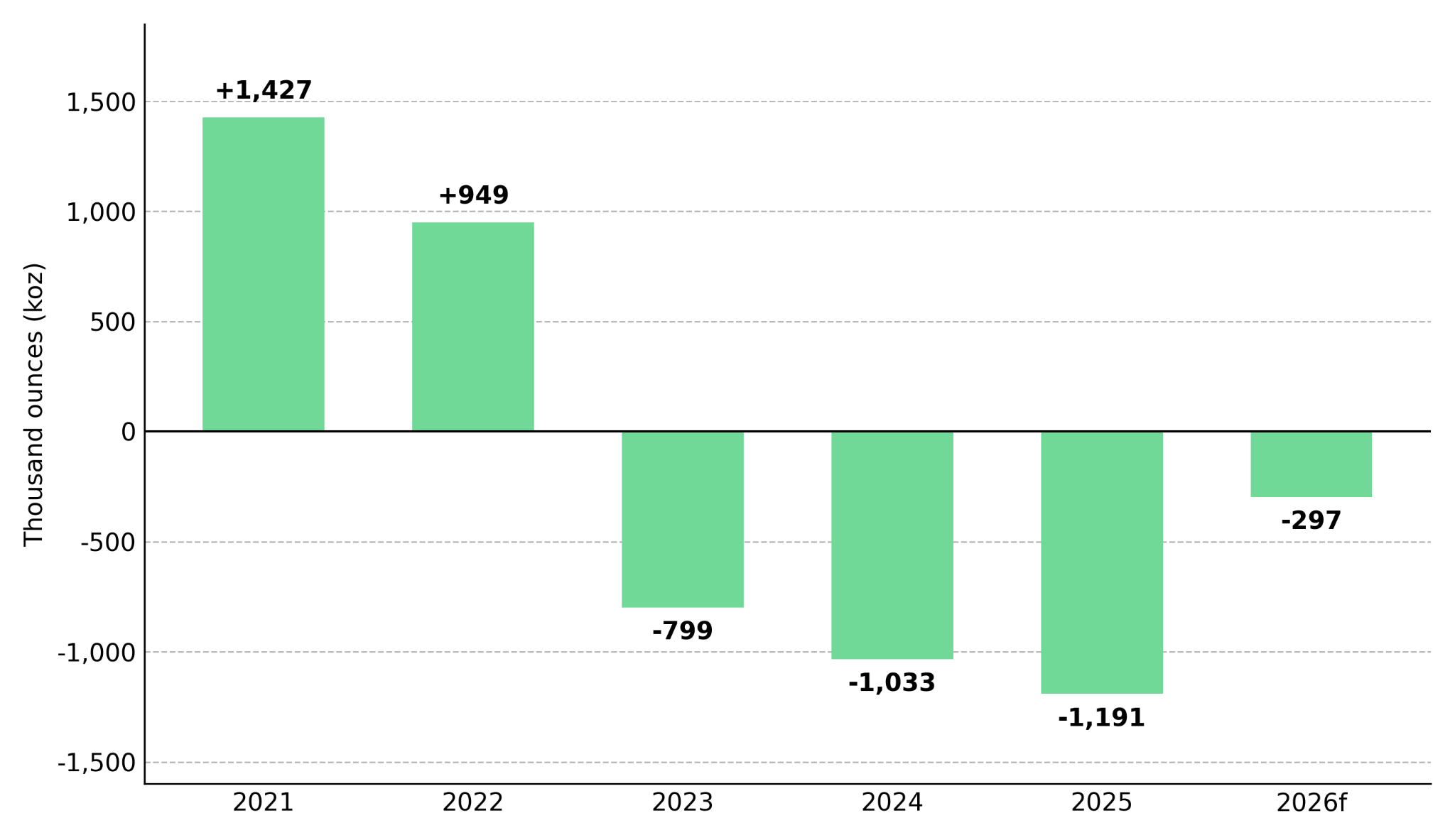
- The World Platinum Investment Council (WPIC) May 18, 2026 Platinum Quarterly forecasts a 297,000-ounce platinum deficit in 2026, marking a fourth consecutive shortfall that supports prices despite palladium substitution.
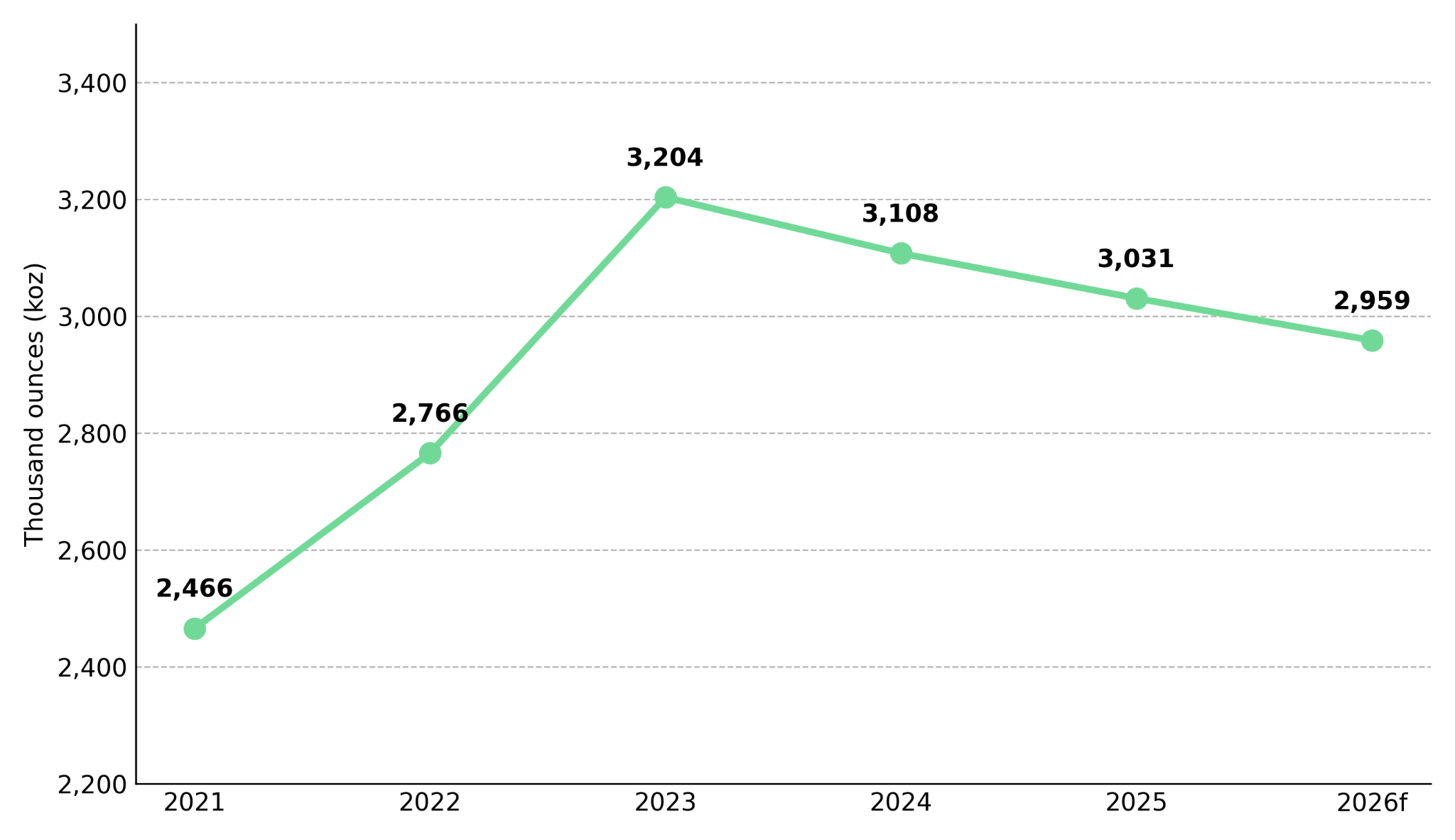
- Because hybrids retain catalytic converters, WPIC forecasts a 12% production increase in 2026 to limit automotive platinum demand’s decline to 2%, or 72,000 ounces, leaving demand at 2.959 million ounces.
- China’s domestic passenger-vehicle sales fell 21.1% year over year to 1.47 million units in July 2026, shrinking the sales base for autocatalyst demand and limiting palladium’s substitution upside.
- Producers require metal-mix analysis, developers require conservative long-term price assumptions, and explorers require quantified recovery rates and funded work programs before higher platinum group metal (PGM) prices justify valuation gains.
Historical Autocatalyst Substitution Confirms Price Sensitivity, Supporting Palladium-Rich Producers
The PGMs market priced platinum at $1,756.90 per ounce on August 13, 2026, a $391.90 or 28.7% premium to palladium at $1,365.00. That premium gives automakers a financial incentive to use palladium-rich autocatalysts where certification permits, which could shift future automotive demand from platinum to palladium.
Platinum displaced approximately 620,000 ounces of palladium in autocatalysts in 2023, up from 385,000 ounces in 2022, while WPIC’s 2024 forecast placed substitution at 700,000 ounces. A price spread below 20% reduced the incentive to research further replacement of palladium with platinum in 2024, but platinum’s current 28.7% premium gives technically viable palladium-rich formulations the cost advantage.
Certification Limits Annual Substitution, Preserving Platinum Demand & Delaying Palladium Gains
WPIC research found that new models account for only about 15% of annual vehicle production. Because existing models have completed emissions and durability certification, automakers typically change autocatalyst formulations through new-model programs. That 15% renewal rate preserves near-term platinum demand by delaying the shift toward palladium-rich autocatalysts.
According to WPIC, catalytic converters account for about 40% of global platinum demand, compared with more than 80% of palladium demand. Palladium-rich equities are therefore more sensitive to gasoline-vehicle production and catalyst loadings, while platinum retains broader demand across automotive and non-automotive uses.
Fourth Annual Platinum Deficit Cuts Inventories, Supporting Prices Despite Palladium Substitution
WPIC forecasts a 297,000-ounce platinum deficit in 2026, marking the fourth consecutive annual shortfall. The forecast places total supply at 7.377 million ounces, demand at 7.674 million ounces, and mine supply at 5.551 million ounces. The shortfall supports platinum prices, but higher platinum procurement costs increase automakers’ incentive to use palladium-rich autocatalysts in future vehicle programs.
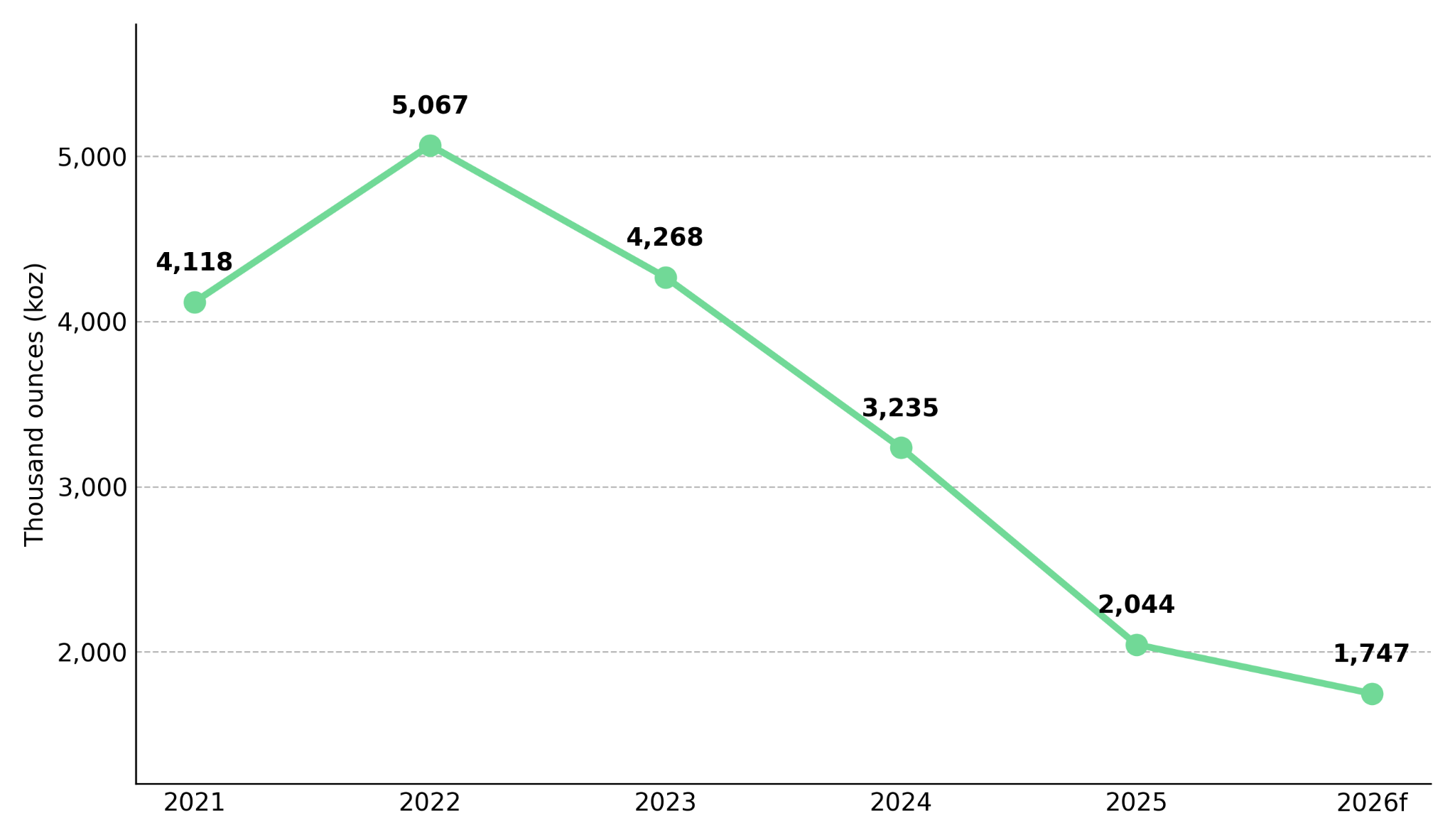
Above-ground platinum stocks are forecast to fall 15% to 1.747 million ounces by the end of 2026, equivalent to less than 3 months of global demand. Industrial platinum demand is forecast to rise 9% to 2.238 million ounces, including 377,000 ounces for glass and 119,000 ounces for electrical uses. Because autocatalyst reformulation does not affect these industrial uses, 2.238 million ounces of demand remain outside platinum-to-palladium substitution.
Recycling Fails to Close Platinum Deficit & China Discounts Limit Price Upside
Recycled platinum supply is forecast to rise 9%, or 147,000 ounces, to 1.826 million ounces in 2026, according to WPIC. Including this recycled volume, forecast total supply remains 297,000 ounces below demand, requiring inventory withdrawals or lower consumption to balance the market.
Shanghai Metals Market reported the most-traded Guangzhou Futures Exchange platinum contract at 432.1 yuan per gram on August 13, 2026, down 0.52% for the session. Shanghai Gold Exchange platinum was offered about 2 yuan per gram below the futures contract, while other physical quotations were about 3 yuan per gram lower. These discounts show that physical platinum remained available below futures prices in China despite WPIC’s 2026 deficit forecast, so the projected global shortfall had not produced uniform spot pricing.
12% Hybrid Growth Sustains Autocatalyst Demand, Supporting Platinum & Palladium Valuations
WPIC forecasts production of light vehicles powered only by internal combustion engines (ICEs) to fall 8% in 2026, while hybrid production rises 12%, offsetting most of the loss. Hybrid electric vehicles (HEVs) and plug-in hybrid electric vehicles (PHEVs) retain catalytic converters, while battery-electric vehicles (BEVs) eliminate PGM demand from this component. Hybrid growth limits the forecast decline in automotive platinum demand to 2%, or 72,000 ounces, leaving demand at 2.959 million ounces and preserving a large market for future autocatalyst reformulation.
The Annual Precious Metals Forecast Survey from the London Bullion Market Association (LBMA) reported an average palladium price of $1,150.29 per ounce in 2025, above the survey’s closest forecast of $1,090. Palladium rose from $921 at the start of 2025 to $1,660 at year-end and reached $1,837 on December 23 as Russian supply concerns and hybrid demand outweighed projected oversupply. This forecast miss shows why palladium equity valuations should test hybrid-production and Russian-supply scenarios alongside BEV adoption.
China’s 21.1% Passenger-Vehicle Sales Decline Limits Palladium’s Substitution Upside
China’s domestic passenger-vehicle sales fell 21.1% year over year to 1.47 million units in July 2026, marking 10 consecutive months of declines. Higher fuel prices weighed most heavily on gasoline vehicles and entry-level sedans, shrinking the vehicle segment that provides palladium’s largest demand exposure. Platinum’s 28.7% premium gives automakers an incentive to raise palladium loadings in eligible new-model autocatalysts, but lower gasoline-vehicle sales reduce the number of vehicles available for that substitution.
Chinese vehicle exports rose 88.2% year over year to 923,000 units in July 2026, while combined BEV and PHEV exports increased 147.8%. Because only PHEVs retain catalytic converters, the combined increase does not quantify platinum or palladium demand without separate BEV and PHEV volumes.
Concentrated PGM Supply Raises Disruption Risk & Strengthens Geographic Diversification
South Africa supplies about 70% of global mined platinum. Together, South Africa and Zimbabwe supply approximately 80% of global mined platinum, while Russia contributes about 11%. South Africa and Russia each provide approximately 40% of global mined palladium. These concentrations make platinum prices more sensitive to South African mine disruptions and palladium prices more sensitive to Russian trade restrictions, allowing supply shocks to change the price spread before other mines can raise output.
PGM mine production fell 4.4% year over year in May 2026, while PGM sales value rose 70.5%. The increase in sales value had not translated into higher production by May, so additional South African mine supply was not available to moderate PGM prices.
Alternative PGM Resources Broaden Geographic Supply Options
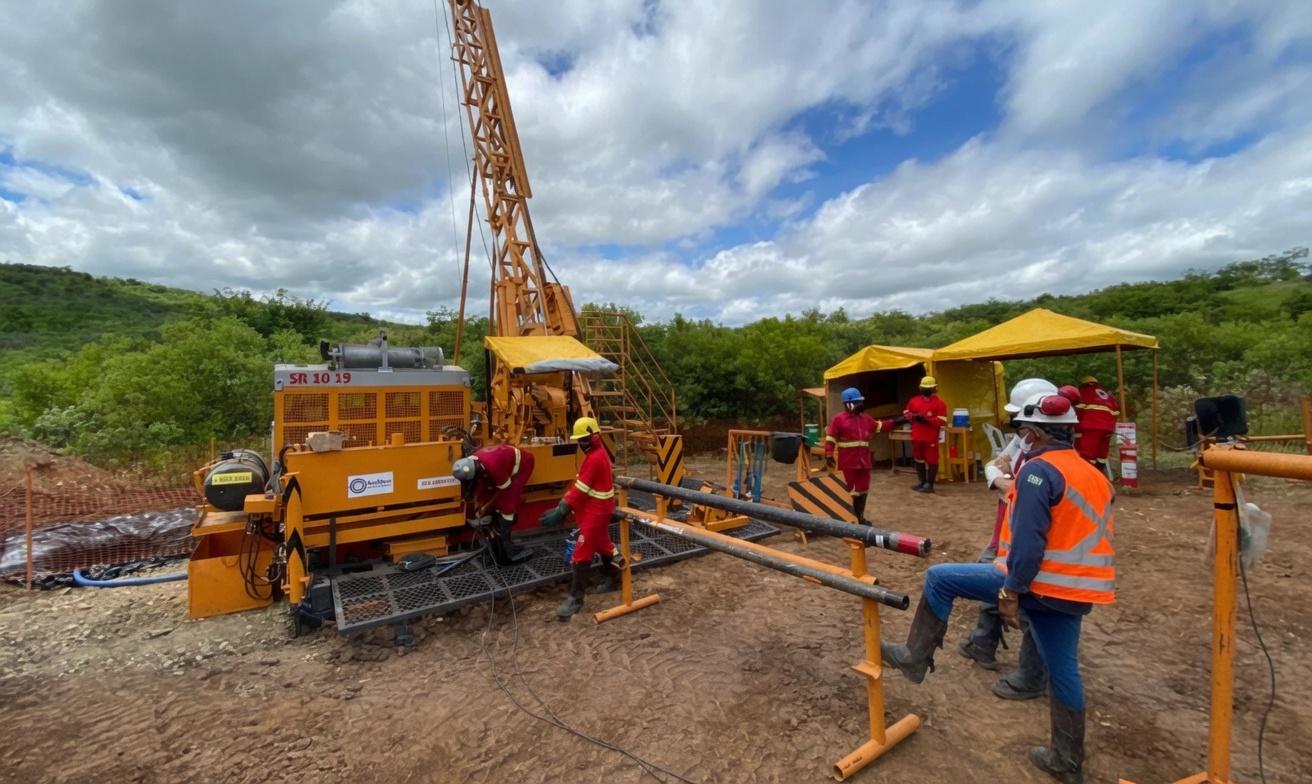
ValOre Metals is targeting a third-quarter 2026 resource update that could incorporate more than 6,000 meters of drilling into the current 2.198 million-ounce inferred resource at its 100%-owned Pedra Branca project in Ceará State, Brazil. With platinum’s 28.7% premium encouraging palladium substitution, the project’s platinum-palladium mix provides exposure to demand shifts between both metals, while a fourth-quarter preliminary economic assessment would provide the first economic basis for valuation.
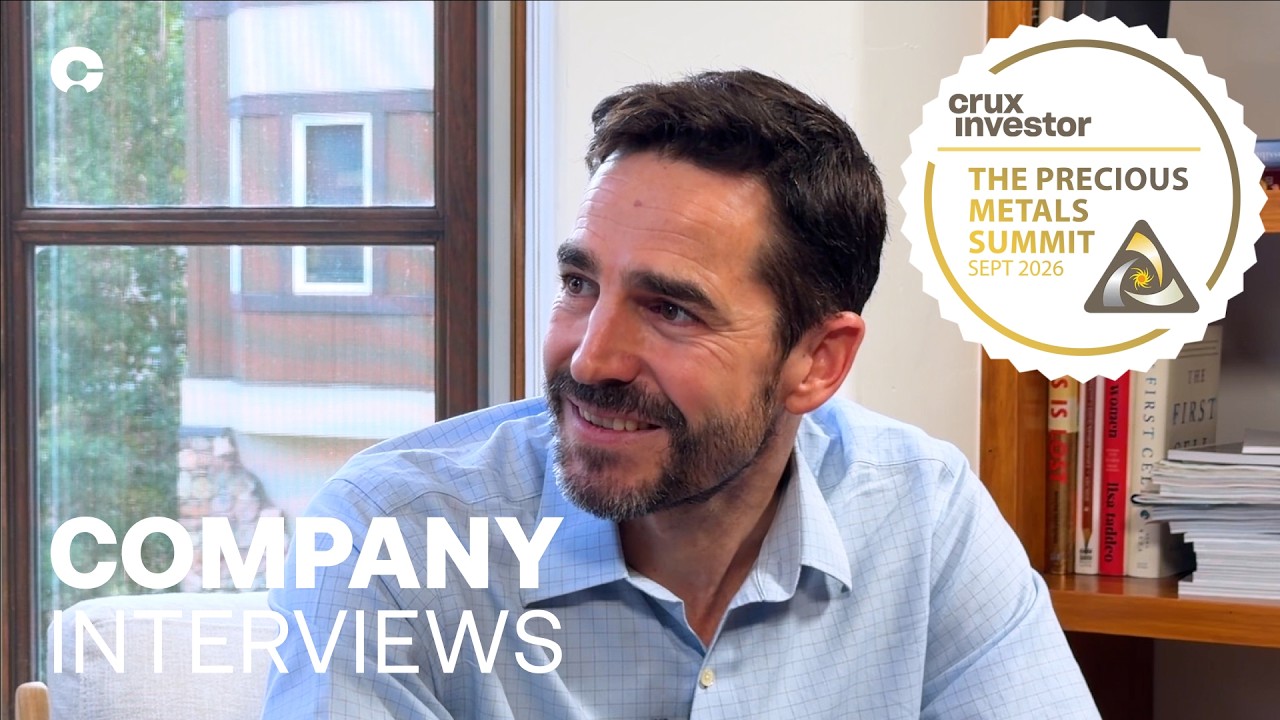
Nick Smart, Chief Executive Officer of ValOre Metals, outlines why geographic diversity matters to PGM security:
"When you've got a market for PGEs that is as concentrated as it is in platinum and palladium, so much production coming out of South Africa, Zimbabwe, and Russia, there's a geopolitical risk here. I think there's going to be a realization of that and a desire to diversify some of where those metals are coming from."
Platinum’s $1,700-$2,870 Forecast Range Widens Project Valuations
LBMA forecast average platinum prices of approximately $1,700 to $2,870 per ounce in 2026 and $1,274.73 per ounce in 2025, above the highest analyst forecast of $1,100. Using $2,870 instead of $1,700 as a project price assumption raises modeled revenue, NPV, and IRR without changing the orebody, so developers should disclose their base-case price and test the lower forecast. Commodity price alone cannot value every PGM equity because all-in sustaining cost (AISC) sets operating margins, payable-metal mix determines revenue exposure, debt increases downside risk, and mine life determines cash-flow duration.
Platinum, Palladium, Rhodium & Gold Proportions Change Resource Value, Limiting EV/oz Comparisons
At platinum’s 28.7% premium, a resource ounce’s value depends on its platinum, palladium, rhodium, and gold mix. Enterprise value per resource ounce (EV/oz) excludes recovery, payability, infrastructure, and resource confidence. A low EV/oz can therefore indicate project risk rather than undervaluation.
The 297,000-ounce platinum deficit supports producer pricing, while forecasts of $1,700 to $2,870 per ounce widen valuation outcomes for developers and explorers. Producers can generate revenue and earnings before interest, taxes, depreciation, and amortization (EBITDA) by selling metal at current prices, while developers must complete permitting, financing, construction, and commissioning before generating sales. Portfolio exposure should therefore reflect each stage’s liquidity, financing, and delay risks.
Platinum Deficit & Palladium Substitution Split PGM Outlook, Requiring Separate Valuation Scenarios
The PGM outlook is neutral with a bullish platinum bias because WPIC forecasts a 297,000-ounce platinum deficit and less than 3 months of global demand cover, while China’s 21.1% July passenger-vehicle sales decline limits palladium demand. Platinum’s 28.7% premium supports platinum-rich producer revenue but also increases automakers’ savings from eligible palladium-rich autocatalysts. Exposure to both metals can benefit from platinum’s supply deficit and palladium substitution, but palladium’s more than 80% automotive dependence raises downside risk if gasoline-vehicle production falls.
Platinum’s 28.7% premium exceeds the 20% spread that previously reduced substitution research, while WPIC’s 12% hybrid-production growth forecast preserves autocatalyst demand. However, new models represent only 15% of annual vehicle production, limiting how quickly automakers can adopt palladium-rich formulations. If the premium narrows after automakers adopt these formulations, palladium demand can rise, while a decline caused by weaker platinum industrial demand provides no equivalent support.
Platinum forecasts of $1,700 to $2,870 per ounce and palladium forecasts of $1,400 to $2,087 require PGM companies to be valued under multiple price scenarios. Producers need low costs and revenue from multiple payable metals, developers need project economics that remain positive at lower forecast prices, and explorers need verified recovery rates and enough cash to complete the next study.
The Investment Thesis for Platinum Group Metals
- A 297,000-ounce platinum deficit and less than 3 months of global demand cover support prices, while low costs, revenue from multiple metals, and low debt improve producer resilience if prices fall.
- Platinum’s 28.7% premium gives automakers a cost incentive to adopt palladium-rich autocatalysts in new-model programs, which could increase palladium demand and producer revenue.
- A forecast 12% increase in hybrid production during 2026 supports catalytic-converter demand, while BEVs use no autocatalyst PGMs, making the sales split between these vehicle types a key demand indicator.
- Platinum price forecasts of $1,700 to $2,870 per ounce in 2026 require developers to calculate NPV and IRR across multiple price cases, including the $1,700 lower forecast.
- Explorers outside South Africa and Russia diversify geographic supply exposure, but resource estimates support higher valuations only after testing confirms recovery rates and funding covers the next work program.
- Recycled platinum supply is forecast to rise 9% to 1.826 million ounces in 2026, but total supply remains 297,000 ounces below demand, requiring inventory withdrawals or lower consumption.
The forecast 297,000-ounce deficit supports platinum prices, while platinum’s 28.7% premium gives automakers a cost incentive to use palladium in eligible autocatalysts. PGM allocation should distinguish producers generating cash at current prices, developers whose projects remain economic under lower price assumptions, and explorers with verified recovery rates and enough funding for the next work program. Because metal mix, costs, recovery rates, and funding differ, higher PGM prices do not create equal cash flow or valuation gains across every project.
TL;DR
Platinum’s 28.7% premium to palladium creates a cost incentive for palladium-rich autocatalysts, but certification limits substitution to new vehicle programs, which represent about 15% of annual production. WPIC forecasts a 297,000-ounce platinum deficit and less than 3 months of demand cover in 2026, supporting platinum prices despite substitution risk. Forecast 12% hybrid-production growth preserves catalytic-converter demand for both metals, while China’s 21.1% July passenger-vehicle sales decline limits palladium’s upside. PGM equities therefore require separate valuations based on payable-metal proportions, operating costs, recovery rates, development stage, and funding.
FAQs (AI-Generated)
Analyst's Notes





Subscribe to Our Channel




Stay Informed


