




Cash-Backed Ridgeline Minerals Hunts Step-Change North American Deal



Ridgeline Minerals (TSXV:RDG) holds ~C$30M after its C$32.7M NGM sale, trades near cash, and is drilling Selena step-outs while seeking a step-change deal.
- Ridgeline Minerals sold four early-stage Nevada gold projects to Nevada Gold Mines for C$32.7 million in non-dilutive cash.
- CEO Chad Peters says the company holds roughly C$30 million against a market capitalisation of about C$33 million which implies undervalue for Selena.
- Ridgeline is seeking an acquisition or merger in copper, gold or silver that would deliver a step change rather than incremental growth.
- South32 has spent US$8.5 million of its US$10 million first-phase earn-in at Selena, and step-out results will be released together.
Few junior explorers get to decide their next move from a position of financial strength. Ridgeline Minerals Corp. (TSXV:RDG) is now one of them. In August 2026, the Nevada-focused precious and base metals explorer closed an all-cash sale of four early-stage gold projects to Nevada Gold Mines (NGM) for US$23.15 million, or roughly C$32.7 million. Speaking with Crux Investor at the Beaver Creek Precious Metals Summit, President and CEO Chad Peters explained how the deal came together and what the company plans to do with the money. He also set out why the South32-partnered Selena project now sits at the centre of the investment case.
Nevada Gold Mines Sale Coming Together
Ridgeline operates a hybrid prospect generator model. It assembles projects, brings in major partners to fund exploration, and retains carried interests through to production. NGM first came in at Swift, a large land package directly adjacent to its Pipeline operation. A second agreement followed at the Black Ridge project.
Both deals were structured as two-phase earn-ins totalling US$40 million across the two projects. If NGM met every trigger, it would have earned a 75% stake, with Ridgeline holding 25% carried to commercial production. The agreements were front-end loaded, and Peters said around US$16 million was spent over roughly four years. Drilling confirmed a large gold system at Swift, but not a critical-mass discovery.
As Swift neared the end of its first earn-in phase, Peters grew concerned about competition for capital inside NGM. The Fourmile deposit, discovered by Barrick, was absorbing much of the attention. When Ridgeline asked what results would justify a more aggressive programme at Swift, the answer was intercepts in the order of 40 metres at 40 grams per tonne (g/t) gold. Peters concluded that Swift risked being shelved once the first phase ended.
Rather than remain a minority partner in a basket of joint ventures, Ridgeline proposed a cash transaction. It added two further projects to create a four-asset package covering Swift, Black Ridge, Bell Creek and Atlas. Peters pointed out that the price was paid for early-stage assets with no resource and, in his view, not yet a true discovery hole. The sale was also non-dilutive for shareholders.
Trading at Cash: The Valuation Question
The transaction left Ridgeline in an unusual position for a junior. Peters said the company holds roughly C$30 million in the bank, against a market capitalisation of about C$33 million at the time of the interview. The market is assigning very little value to Selena, which he describes as the company's most advanced project and a new discovery.
The company is also covering its overheads while partner-funded drilling is under way. Peters said Ridgeline earns around US$125,000 a month in management fees as operator at Selena, plus about US$75,000 a month in interest income. General and administrative (G&A) costs run at roughly US$115,000 a month. He expects Ridgeline to finish the year with more cash than it started with. Peters acknowledged that a self-funding treasury does not, on its own, sell a growth story.
Capital Allocation: Searching for a Step Change
One option is to scale up the existing model by adding staff and another 10 to 20 projects. Peters is hesitant to reinvest in a business model he describes as both time-consuming and expensive. The NGM proceeds took five years to generate, and he has little appetite for restarting that clock. His stated priority is to return value to shareholders sooner.
That points towards an acquisition or merger that gives Ridgeline exposure to a resource or a producing asset. Peters accepts that being a strong explorer does not automatically make a company a credible miner. The focus is therefore on assets where Ridgeline's technical team can add meaningful value, particularly a resource with substantial growth potential.
The screening criteria are specific. Ridgeline wants exposure to copper, gold or silver. The preferred jurisdiction is the western United States, although Canada and Mexico are also under consideration. Grade and scale are essential, and any target must leave room for the team to deploy capital through drilling. A 200,000-ounce resource with modest upside does not meet the bar. Neither does a leap into an unfamiliar jurisdiction such as a copper mine in Peru.
Deal flow has not been a constraint. After eight years as CEO, Peters has built a network across Canada and the US, and the sale has prompted a stream of inbound approaches from long-time claim holders and cash-strapped companies. The team is also still staking new ground.
"There's all these different things that we're doing, but we're being pretty strict with what we're looking for. If we do something, it's going to be meaningful. It's going to be a step change that re-rates the company."
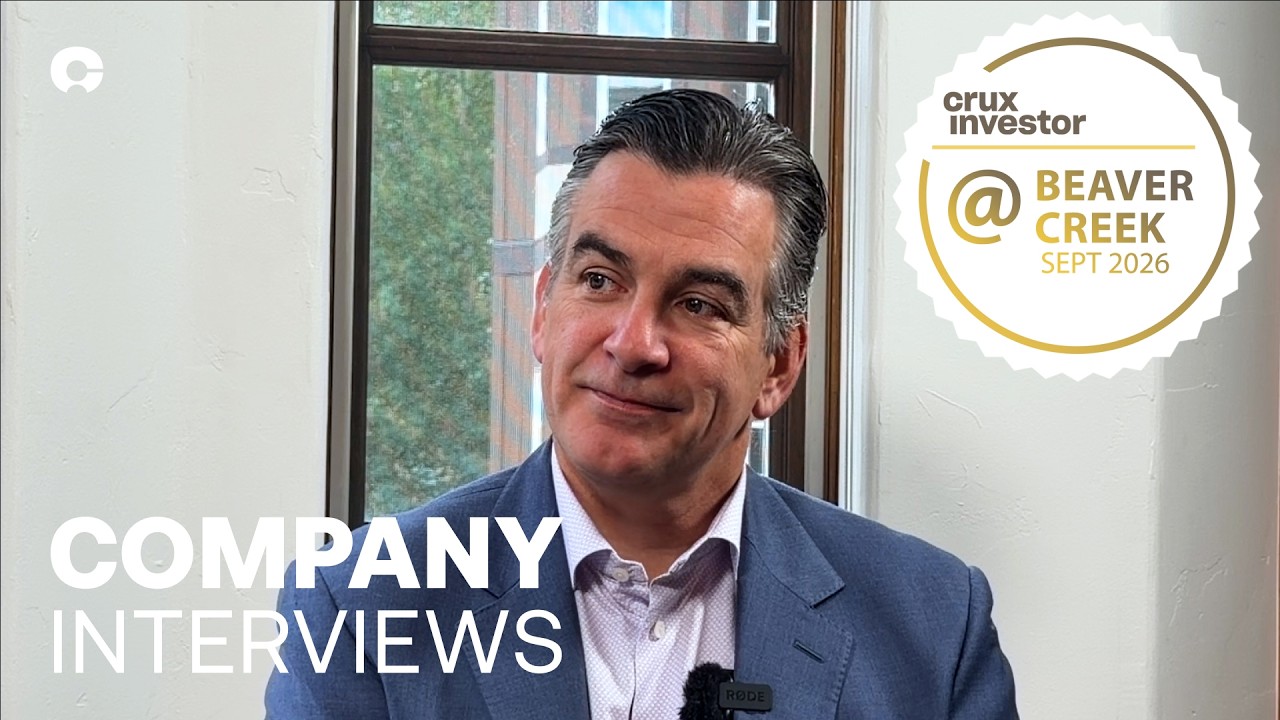
Interview with Chad Peters, President and CEO of Ridgeline Minerals
Selena Under Follow-Up
With the portfolio now smaller, Selena carries more weight. The project hosts a carbonate replacement deposit (CRD) discovery made in 2025. A 3 to 4 hole follow-up programme has been running for about three months, and drilling had reached the third hole. This directional step-out drilled from a re-entry of the original discovery hole. It steps out 100 metres to the south, where the team expects copper and silver grades to increase. Peters said the drill was a couple of hundred feet above the target at the time of the interview. The programme includes two tighter step-outs and two larger step-outs testing new ideas.
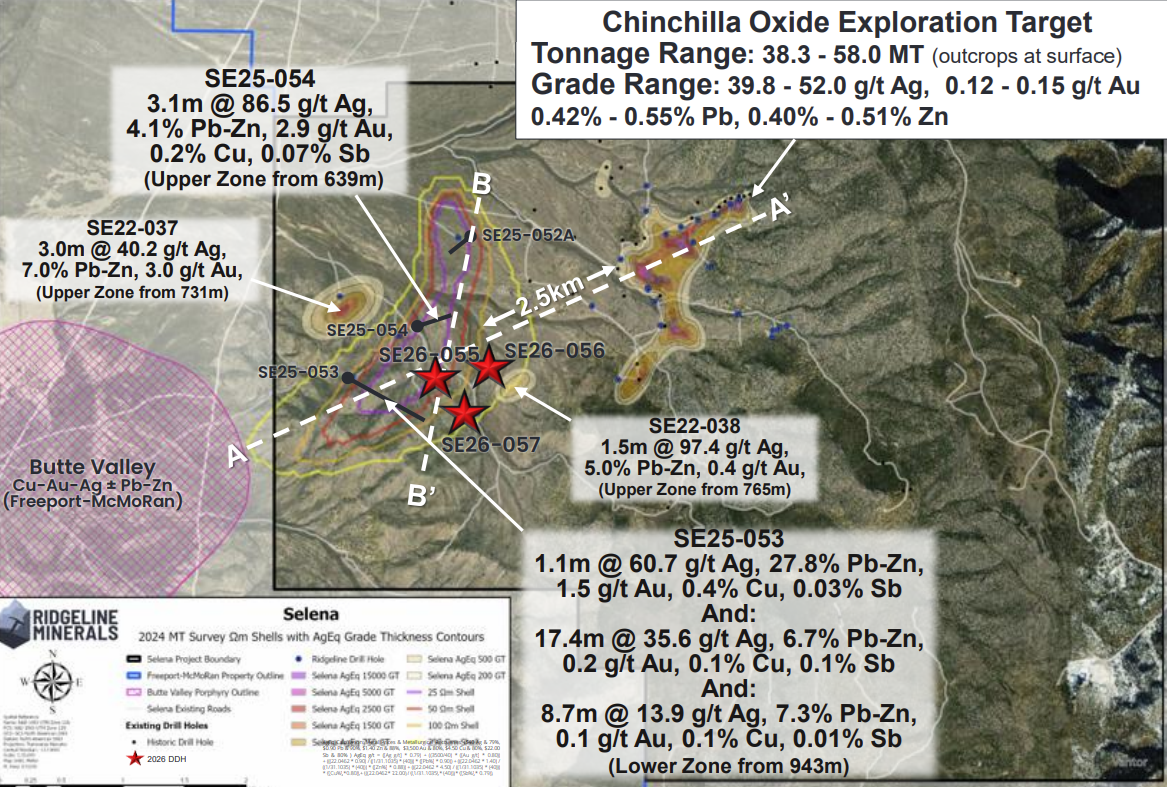
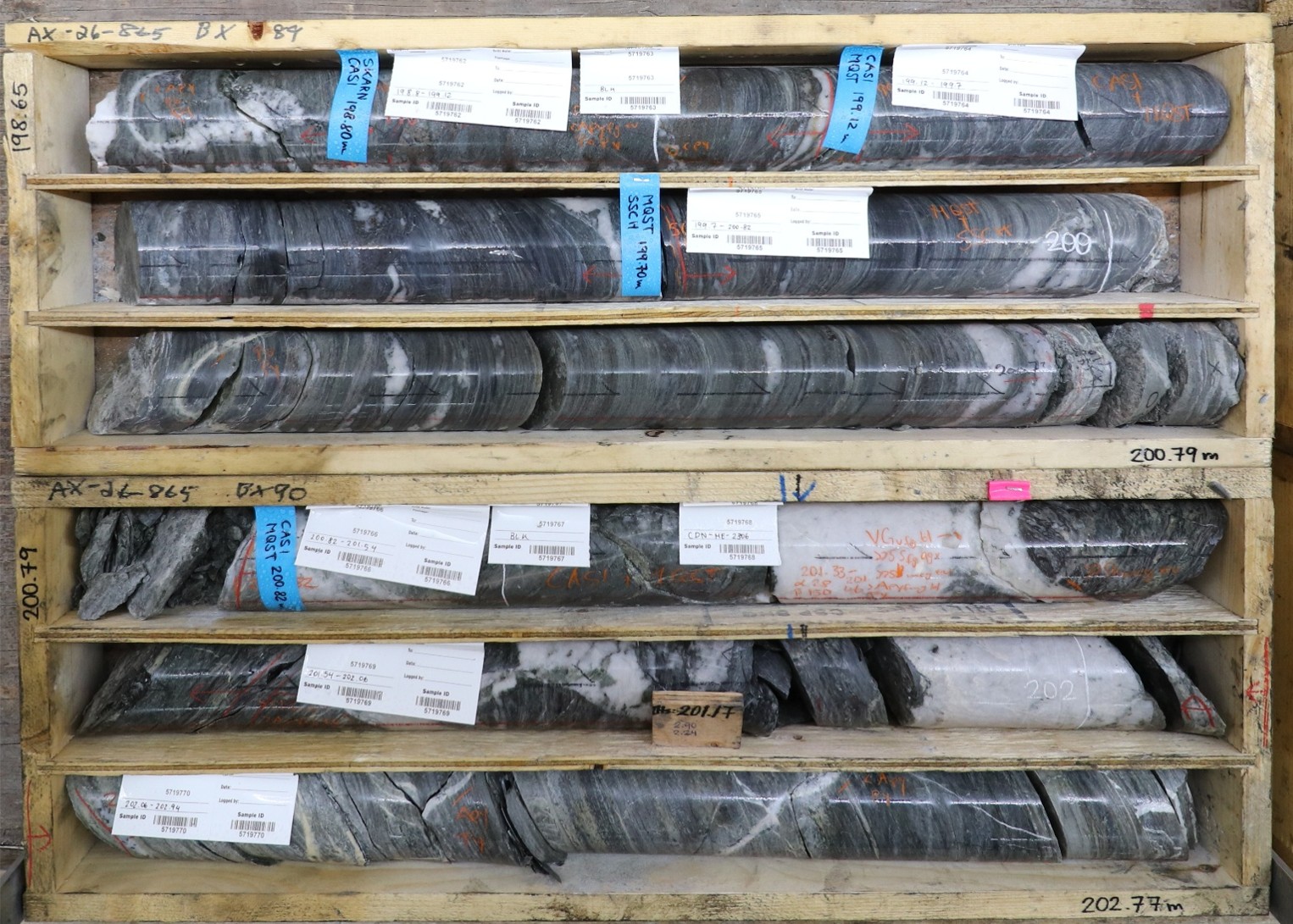
Earlier wide-spaced drilling established a very large CRD footprint. Peters said every hole has returned wide low-grade intercepts, narrow high-grade intercepts, or both. The priority now is continuity. He aims to return to the market this autumn with a clearer picture of strike, thickness and grade. He has floated around 250 metres of strike and 50 metres of consolidated thickness as the kind of geometry he hopes to demonstrate.
The South32 Earn-In & the Value of a Free Carry
Peters describes the Selena agreement as Ridgeline's best-structured deal, informed by lessons from the NGM agreements. South32 can spend US$20 million over eight years in two phases. The first phase requires US$10 million for a 60% interest, and Peters said South32 had already spent US$8.5 million in the first two years. Once phase one is complete, South32 has a 90-day window to elect to fund a further US$10 million for an 80% stake.
If South32 completes the full US$20 million, Ridgeline retains a 20% interest carried to production. Peters sees the closest analogue to Selena as South32's Taylor deposit in Arizona, which is now being developed. He put its build cost at roughly US$3 billion. A company of Ridgeline's size could not fund its share of a build on that scale without heavy dilution. The free carry removes that problem. In effect, it functions much like a 20% net profits interest. The timeline, however, sits with South32.
Big Blue & a Shift Towards 100%-Owned Exploration
Ridgeline also holds the 100%-owned Big Blue project. Its 2025 maiden drill programme, beneath a historic mine, returned 0.6 metres grading more than 3,200 g/t silver, 0.7% copper and 2.6% tungsten. The market paid little attention to the result. Peters sees it as evidence of a robust system. The same host rocks that contain the Selena deposit sit about 200 metres below that intercept, and the fault that fed the high-grade zone cuts down through them.
Ridgeline adopted the hybrid model because it was founded in a weak market. With a stronger treasury, it would like to lean further into 100%-owned exploration. Peters suggested Big Blue could justify a further $1 to $1.5 million of drilling, now that such spending no longer threatens dilution.
The Investment Thesis for Ridgeline Minerals
- Ridgeline trades close to its cash backing, so the market is attributing little value to Selena, Big Blue or the management-fee income.
- The Nevada Gold Mine sale converted early-stage assets without a resource into roughly C$32.7 million of non-dilutive cash.
- Management fees and interest income currently exceed G&A, which limits cash burn while partners fund drilling.
- A completed US$20 million South32 earn-in would leave Ridgeline with a 20% interest carried to production at Selena.
- Investors should monitor the release of the full Selena step-out results, which South32 intends to publish together.
- Investors should watch for any acquisition or merger announcement and test it against management's stated criteria of grade, scale and North American jurisdiction.
- Key risks include value-destructive M&A, the uncertainty of South32's phase-two election, and partner control over timelines.
Macro Thematic Analysis
Ridgeline's situation reflects a wider theme in the junior mining sector. Precious and base metal prices are strong, yet many junior equities continue to trade at depressed valuations. That gap creates both a problem and an opportunity. Companies without cash struggle to fund exploration without heavy dilution. Companies with cash can acquire quality assets from weaker holders at attractive prices. Peters sees the current market in exactly those terms.
"Our goal is to add value for shareholders. That's the the very baseline of it. And if that means acquiring something big and really growing fast, we have the capital to do that."
The prospect generator model was built for scarcity. When capital is expensive, letting majors fund high-risk drilling while retaining carried interests protects shareholders from dilution. As sentiment improves and investors begin rewarding discovery risk again, the calculation changes. A cashed-up junior can hold more of the upside itself.
Major producers also shape this cycle. They must rank projects across large portfolios, and Ridgeline's experience at Swift shows how a partnered project can lose momentum when a bigger internal opportunity competes for rigs and budget.
The metals Ridgeline is targeting all have supportive narratives. Copper benefits from electrification and grid investment. Gold and silver continue to attract investors seeking protection against monetary and geopolitical uncertainty. Silver also carries growing industrial demand. Nevada and the broader western US offer established mining jurisdictions with infrastructure and a skilled workforce. For juniors with a balance sheet, the combination of strong metal prices and discounted asset values may represent a window for consolidation. The challenge is to use that window without overpaying.
TL;DR
Ridgeline Minerals closed the sale of four early-stage Nevada gold projects to Nevada Gold Mines in August 2026 for C$32.7 million in cash. CEO Chad Peters says the company now holds about C$30 million, against a market capitalisation of roughly C$33 million, which leaves little value on the South32-partnered Selena CRD discovery. Management fees and interest income cover G&A. Rather than scale up its prospect generator model, Ridgeline is seeking an acquisition or merger that delivers a step change in grade and scale, focused on copper, gold or silver in North America. South32 has spent US$8.5 million of its US$10 million first-phase earn-in at Selena. Step-out results will be released together.
FAQs (AI Generated)
Analyst's Notes





Subscribe to Our Channel


Stay Informed






















