




Selkirk's Phase 2 Drilling Rate Is Running Ahead of the Market


Selkirk Copper's Phase 2 drilling reaches 120 metres/day per drill, advancing studies, restarting plans, and highlighting a potential valuation gap.
- Phase 2 drilling is averaging 120 metres per day per drill, up from Phase 1's 94 metres per day, with 14,000 metres completed in the first month.
- Both phases have employed four diamond drills, indicating the Phase 2 productivity improvement reflects drilling efficiency rather than a change in equipment count.
- The Trade-Off Study, Preliminary Economic Assessment (PEA), and updated Mineral Resource Estimate (MRE) are all targeted for mid-2026, with a Feasibility Study (FS) and Final Investment Decision (FID) both slated for mid-2027.
- Selkirk has the lowest market capitalisation among a named peer group that includes Foran Mining, Firefly Metals, Trilogy Metals, and Western Copper, at below C$300 million, despite an 881-million-pound total copper resource.
- Successful amendment of the Quartz Mining Licence, Exploration Licence, and Water Licence or Licences, along with underground water management resolution with the Government of Yukon, remain as open conditions on the restart path.
One month into its 50,000-metre Phase 2 drill programme, Selkirk Copper Mines (TSX-V: SCMI) is delivering a concrete measure of operational performance: 120 metres per day per drill, up from a Phase 1 average of 94 metres per day. The programme is feeding a study schedule with defined mid-2027 deadlines for the planned Feasibility Study (FS), and the rate at which Phase 2 is accumulating metres is a direct input into whether those deadlines can be met. Against a market capitalisation below C$300 million and a total copper resource of 881 million pounds, the Phase 2 drilling data is the first operational measure of the gap between what is priced and what is in progress.
Phase 2 Drilling Pace vs. Phase 1
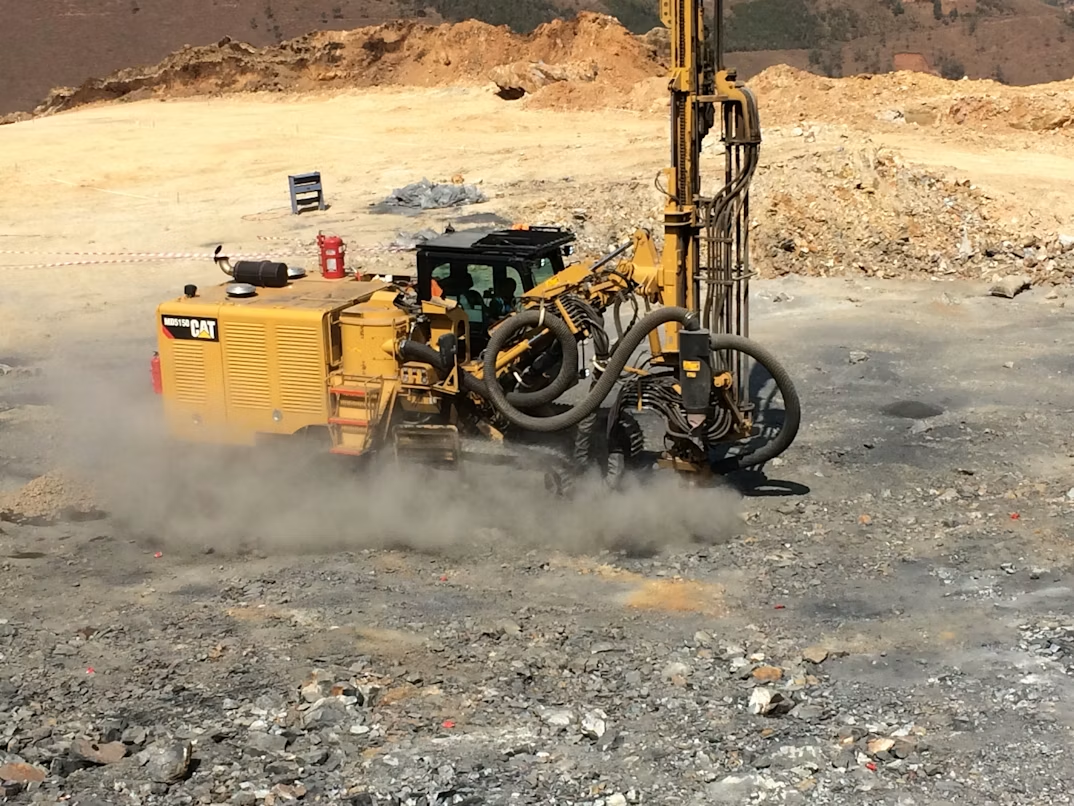
As of June 2026, four drill rigs had completed 14,000 metres across 59 holes in Phase 2's opening month, accounting for 28% of the planned 50,000-metre programme. Drilling is averaging 120 metres per day per drill.
Phase 1 ran from August 2025 through April 2026, completing 52,288 metres across 175 drill holes using the same four-drill configuration. Its average was 94 metres per day per drill.
Both programmes employed four diamond drills, so the difference in daily output between the two phases reflects a change in drilling efficiency rather than a difference in equipment count. The Phase 2 programme reached 28% completion at the 30-day mark.
Study Sequence & the Path to FID
Phase 2 is drilling into a defined milestone sequence. Engineering work on the Trade-Off Study and Preliminary Economic Assessment (PEA) has been awarded to Hatch Ltd. and SRK Consulting (Canada), and both studies are actively underway alongside preparation of an updated Mineral Resource Estimate (MRE), with all three targeted for completion in mid-2026. A restart direction to the Yukon Government and Selkirk First Nation is targeted for October 2026. The FS and Final Investment Decision (FID) are both slated for mid-2027, with potential first production from a restarted operation targeted for mid-2028.
President and Chief Executive Officer of Selkirk Copper Mines, M. Colin Joudrie, explains the PEA's purpose plainly for investors awaiting updated economics:
"The PEA will crystallize quite a bit of that thought because that'll be the first updated economics on this. That's mid-year this year. And then folks will kind of get to see the whites of our eyes if that's the right phrase."
The PEA's declared objectives establish the parameters for the update: a mine life of 12 to 15 years, throughput of 4,100 tonnes per day (1.5 million tonnes per annum), and approximately 30,000 tonnes of copper equivalent production per annum. These are the declared targets the PEA is being designed around.
On the mid-2028 production target, Joudrie frames the implied pace in industry terms:
"The fact that our intentions are to bring it back into production by mid-2028, that's lightning speed in this industry. Regardless of the restart character of this, that's still quick."
The Valuation Gap
Among a named peer group that includes Foran Mining, Firefly Metals, Trilogy Metals, and Western Copper, Selkirk carries the lowest valuation, with an enterprise value of C$228,502,298 against an 881-million-pound total copper resource.
The current MRE, effective April 2025, divides that total into an indicated resource of 12.588 million tonnes grading 1.20% copper, containing 333.8 million pounds of copper, 186,600 ounces of gold, and 1,728,000 ounces of silver, and an inferred resource of 23.658 million tonnes at 1.05% copper, containing 546.8 million pounds of copper, 294,700 ounces of gold, and 2,968,100 ounces of silver.
The company's explanation for the valuation gap is specific to the asset's history. The previous operator's bankruptcy eliminated a precious metals stream that had historically paid out more than US$250 million, as well as a concentrate offtake agreement. Selkirk's position is that removing those encumbrances will significantly improve net cash flow and project economics going forward.
Joudrie is direct about the re-rate logic and why asset history has suppressed the current valuation:
"This becomes a very cost-effective restart opportunity. The re-rate is high because the history is not great."
Capital Position & Risk Factors
The company completed a C$4.5 million initial financing and a C$40 million equity raise in 2025, and a further C$35 million equity raise in April 2026. The reported cash position of C$28,029,238 is dated December 2025, and predates the April 2026 equity raise; both figures are reported separately in the company's materials. The project timeline requires that financing be initiated and secured ahead of the mid-2027 FID and mill commissioning in the first quarter of 2028.
Two conditions remain unresolved before the restart path is clear. The restart plan requires the successful amendment or modification of the existing Quartz Mining Licence, Exploration Licence, and/or Water Licence(s). Underground water removal is currently under discussion with the Government of Yukon, with both the physical and permitting requirements still to be resolved.
FAQs (AI-Generated)
Analyst's Notes





Subscribe to Our Channel




Stay Informed


